Report ID: 1424 |
Published Date: 25 Sep 2026 |
Report Format: |
Delivery Timeline: 48-72 Business Hours
Acellular Dermal Matrices Market Outlook:
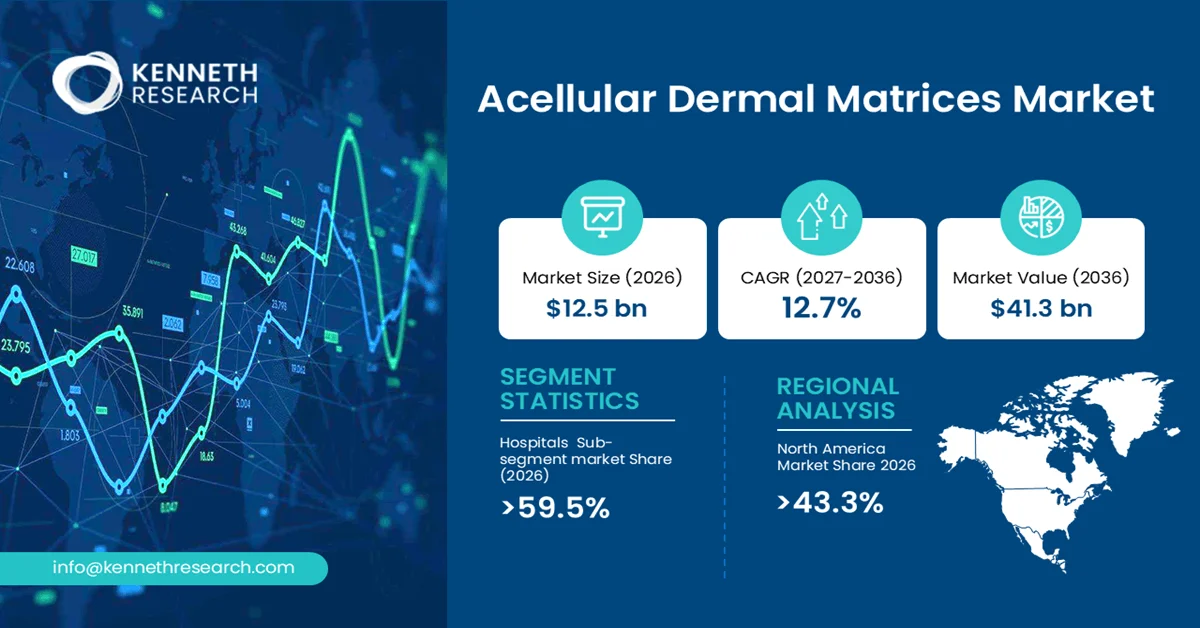
Acellular Dermal Matrices Market size was valued at USD 12.5 billion in 2026 and is projected to reach USD 41.3 billion by the end of 2036, rising at a CAGR of 12.7% during the forecast period, i.e., 2027-2036. In 2027, the industry size of the acellular dermal matrices is estimated at USD 14.1 billion.
The primary growth driver for the acellular dermal matrices market is the expanding use of advanced tissue-reconstruction solutions across reconstructive and wound-care procedures.
The acellular dermal matrices market comprises biologically derived tissue scaffolds that have undergone decellularization and processing to remove cellular components while retaining an extracellular matrix framework. These matrices can be derived from human or animal tissue and are designed to provide structural support for tissue repair, reconstruction, and regeneration. Depending on their source, processing method, physical characteristics, and intended application, products can be supplied in different configurations suitable for surgical use.
A key characteristic of acellular dermal matrices is their ability to function as a biologically compatible scaffold while preserving structural components of the original tissue. Their applications span reconstructive surgery, wound management, soft-tissue reinforcement, and other specialized surgical procedures.
Key Acellular Dermal Matrices Market Insights Summary:
Key Takeaways: Market Trends & Insights
- Acellular dermal matrices market is projected to grow from USD 12.5 billion in 2026 to USD 41.3 billion by 2036, expanding at a 12.7% CAGR.
- North America accounted for the largest regional share at 43.3% in 2026, supported by advanced healthcare infrastructure, established tissue-processing capabilities, and strong demand for reconstructive and wound-care technologies.
- Hospitals are expected to remain the leading end user segment with a 59.5% market share in 2026, driven by the concentration of complex surgical procedures, reconstructive interventions, and specialized wound-management services in hospital settings.
- Human-derived matrices are projected to witness strong growth as demand increases for biologically compatible scaffolds that provide structural support and facilitate tissue integration across reconstructive and wound-care applications.
Market Drivers
- Expansion of advanced wound-care applications
- Growing adoption of biologically compatible tissue-reconstruction solutions
- Increasing product innovation in decellularization and scaffold engineering
- Broader use of regenerative biomaterials across reconstructive procedures
Challenges
- Complex tissue sourcing, processing, and supply-chain requirements
- Regulatory and clinical adoption complexity
Acellular Dermal Matrices Market Overview & Supply Chain
Adoption of acellular dermal matrices is increasing globally as healthcare systems expand access to surgical reconstruction, wound management, and advanced tissue-repair procedures. Demand is supported by the broader need for safe and effective surgical care, particularly as hospitals seek biomaterial solutions that can provide structural reinforcement while supporting tissue integration. Technological progress in tissue processing, decellularization, sterilization, preservation, and quality-control systems is also improving manufacturers' ability to produce standardized matrices for clinical use. At the healthcare-system level, regulatory oversight and requirements for product safety, traceability, and consistent biological performance are encouraging suppliers to invest in controlled manufacturing and validated processing systems.
The value chain begins with the sourcing of suitable human or animal tissue from qualified and regulated sources, followed by screening, collection, transportation, and controlled preservation. Manufacturers then process the tissue through decellularization and related treatment stages designed to remove cellular material while retaining the extracellular matrix architecture. Subsequent operations include washing, shaping, sterilization, preservation, packaging, and quality testing, with traceability maintained across production batches.
Acellular Dermal Matrices Market: Growth Drivers & Challenges
Growth Drivers:
- Expansion of advanced wound-care applications: The increasing use of biologically derived scaffolds in complex wound management is strengthening demand for acellular dermal matrices. These materials provide an extracellular-matrix framework that can support cellular infiltration, tissue integration, and reconstruction, making them relevant for difficult-to-heal wounds and soft-tissue defects. Product innovation is reinforcing this trend. In April 2025, LifeNet Health launched Dermacell® Porous, a next-generation human acellular dermal matrix designed to retain endogenous growth factors, collagen, and elastin within its scaffold. Such developments demonstrate how manufacturers are adapting matrix architecture and biological characteristics to address wound-care requirements. Continued product refinement should expand physician familiarity, application flexibility, and institutional adoption.
- Growing adoption of biologically compatible tissue-reconstruction solutions: The market is also benefiting from the increasing preference for biomaterials that can provide structural reinforcement while interacting with the body's tissue-healing environment. Acellular matrices retain components of the extracellular framework after cellular material is removed, enabling their use as scaffolds in reconstructive and regenerative procedures. Their versatility allows manufacturers to develop products for different anatomical sites, wound characteristics, and surgical techniques. Academic research has highlighted the role of extracellular matrix structures in cellular attachment, tissue organization, signaling, and repair, supporting continued technological development of matrix-based products.
Challenges:
- Complex tissue sourcing and processing requirements: A major restraint is the operational complexity involved in obtaining, screening, processing, sterilizing, preserving, and distributing biological tissue materials. Human-derived matrices require tightly controlled sourcing and donor-screening procedures, while animal-derived products must address additional requirements associated with tissue origin and processing. Manufacturers must maintain traceability throughout the product lifecycle and demonstrate consistent processing quality. These requirements increase manufacturing complexity and can create supply constraints when qualified tissue availability is limited.
- Regulatory and clinical adoption complexity: Regulatory requirements and the need for healthcare professionals to establish confidence in biological scaffolds can constrain adoption. Acellular dermal matrices involve specialized processing and clinical-use considerations, meaning manufacturers must address product classification, safety, manufacturing controls, labeling, and applicable regulatory requirements. Hospitals and surgeons may also evaluate products according to handling characteristics, procedural suitability, clinical familiarity, and institutional purchasing criteria before incorporating them into established workflows. This can lengthen commercialization cycles and increase the resources required for market access.
Acellular Dermal Matrices Market Size and Forecast:
| Report Attribute | Details |
|---|---|
| Base Year |
2026 |
| Forecast Period |
2027-2036 |
| CAGR |
12.7% |
| Base Year Market Size (2026) |
USD 12.5 billion |
| Forecast Year Market Size (2036) |
USD 41.3 billion |
| Regional Scope |
|
Acellular Dermal Matrices Market Segmentation Analysis:
End user Type Segment Analysis
In the end user segment, the hospitals sub-segment is anticipated to capture the largest market share of 59.5% in 2026.
Hospitals represent the leading end-user segment because they concentrate complex surgical procedures, reconstructive interventions, wound management, and specialist care where acellular dermal matrices can provide structural tissue support. Hospital-based adoption is reinforced by the availability of multidisciplinary surgical teams, operating-room infrastructure, pathology services, and established procurement systems capable of handling specialized biological products. The concentration of surgical activity within hospital settings also creates opportunities for manufacturers to establish standardized product protocols and institutional purchasing relationships. On the supply side, manufacturers increasingly emphasize ready-to-use formats, preservation technologies, handling characteristics, and application-specific matrix configurations that can integrate into hospital workflows.
Source Type Segment Analysis
Human-derived matrices are positioned for continued growth because they closely replicate the structural characteristics of native human dermal tissue while providing a biologically compatible scaffold for reconstruction and tissue repair. Their demand is supported by applications requiring integration with surrounding tissue, particularly reconstructive and wound-care procedures where surgeons value matrix characteristics that resemble the patient's native extracellular environment. Supply-side innovation is also expanding potential sourcing and processing options. Research has investigated alternative human tissue sources, including surgical-discard tissue, to address limitations associated with conventional donor availability. These developments could improve material availability while encouraging more efficient tissue-processing models.
Our in-depth analysis of the global acellular dermal matrices market includes the following segments:
|
Segment |
Sub-segment |
|
Product Type |
|
|
By Source |
|
|
By Application |
|
|
End User |
|
Acellular Dermal Matrices Market Regional Insights:
North America Market Trends & Insights:
North America holds the dominant position in the acellular dermal matrices market, accounting for 43.3% in 2026. Regional leadership is supported by an advanced healthcare infrastructure, high concentration of hospitals and specialized surgical centers, established tissue-processing capabilities, and strong demand for sophisticated reconstructive and wound-management technologies. The region also benefits from mature medical-device procurement systems and established regulatory frameworks governing biological and tissue-based products.
In the U.S., demand is supported by its extensive hospital network, specialized reconstructive-surgery capabilities, established tissue banks, and sophisticated medical-device ecosystem. Manufacturers benefit from access to advanced research institutions and experienced clinical users, encouraging continued product development and application expansion.
Canada complements regional growth through its established healthcare system and developing medical-device manufacturing base. Statistics Canada reports that Canada's medical-devices manufacturing sector generated substantial economic activity through production, research and development, employment, and trade, reinforcing the country's role within the broader North American healthcare technology ecosystem.
Asia-Pacific Market Trends & Insights:
Asia-Pacific represents a significant opportunity for the acellular dermal matrices market as healthcare infrastructure, surgical capacity, and access to advanced medical technologies continue to expand across major economies. Demand is supported by increasing hospital activity, development of specialist surgical services, and greater availability of sophisticated wound-management and reconstructive-care technologies. Governments across the region are also strengthening healthcare systems and medical-resource capacity, creating a more favorable environment for specialized biological products.
In Japan, the mature healthcare system and sophisticated medical-device ecosystem provide favorable conditions for premium biological and tissue-based technologies. Japan’s well-established healthcare infrastructure, advanced surgical capabilities, and strong emphasis on medical technology quality support the adoption of sophisticated biologic and tissue-reconstruction solutions.
In China, expanding hospital infrastructure and extensive healthcare utilization provide a broad addressable environment for advanced surgical materials. Together, Japan and China are positioned to support regional demand through healthcare modernization, technological adoption, and expanding access to specialized surgical solutions.
Leading Companies Operating in the Global Acellular Dermal Matrices Market:
Here is a list of upstream, downstream, and key players operating in the global acellular dermal matrices market competitive ecosystem:
- Allergan Aesthetics (AbbVie) (U.S.)
- Company Overview
- Business Strategy
- Key Product Offerings
- Financial Performance
- Key Performance Indicators
- Risk Analysis
- Recent Development
- Regional Presence
- SWOT Analysis
- LifeNet Health (U.S.)
- MTF Biologics (U.S.)
- Zimmer Biomet (U.S.)
- Bimini Health Tech (U.S.)
- Cellution Biologics (U.S.)
Recent Developments
- August 2026 — Cellution Biologics Inc. completed its acquisition of the SimpliDerm hydrated human acellular dermal matrix business from Elutia. The company stated that the transaction adds reconstructive surgery to its existing human tissue-based portfolio and combines the SimpliDerm business with its tissue-processing, manufacturing, and quality capabilities.
- June 2026 — MTF Biologics announced the launch of FlexHD Meshed, expanding its FlexHD reconstructive-surgery portfolio with an additional product configuration. The company's official media center records the announcement on June 4, 2026.
Frequently Asked Question
In 2026, the acellular dermal matrices market exceeded USD 12.5 billion.
The acellular dermal matrices market is projected to reach USD 41.3 billion by the end of 2036, expanding at a CAGR of 12.7% over the forecast period (2027-2036).
The major players in the market are Allergan Aesthetics (AbbVie), LifeNet Health, MTF Biologics, Zimmer Biomet, Bimini Health Tech, and others.
In the end user segment, the hospitals sub-segment is anticipated to capture the largest market share of 59.5% in the future and exhibit lucrative growth opportunities during 2027-2036.
North America is projected to hold the largest market share of 43.3% by the end of 2026 and provide more business opportunities in the future.
Why Choose Kenneth Research ?
-
Insight with Impact : We don’t just gather data — we uncover stories, trends, and opportunities that fuel business growth.
-
Experts Who Get It : Our team speaks your industry’s language and knows what really matters to your customers and market.
-
Custom-Built for You : Forget one-size-fits-all. We craft research and consulting solutions as unique as your business vision.
-
Partners, Not Just Providers : We work with you, not for you — collaborating closely to turn insights into smart, strategic moves.
-
Results That Speak : Our work powers brands, startups, and industry leaders alike — with a track record of ideas that work in the real world.
Report ID: 1424 |
Published Date: 25 Sep 2026 |
Report Format: |
Delivery Timeline: 48-72 Business Hours

Copyright © 2025 Kenneth Research. All rights reserved. Terms of Use | Privacy Policy
