Report ID: 1188 |
Published Date: 26 Aug 2026 |
Report Format: |
Delivery Timeline: 48-72 Business Hours
5G Security Market Outlook:
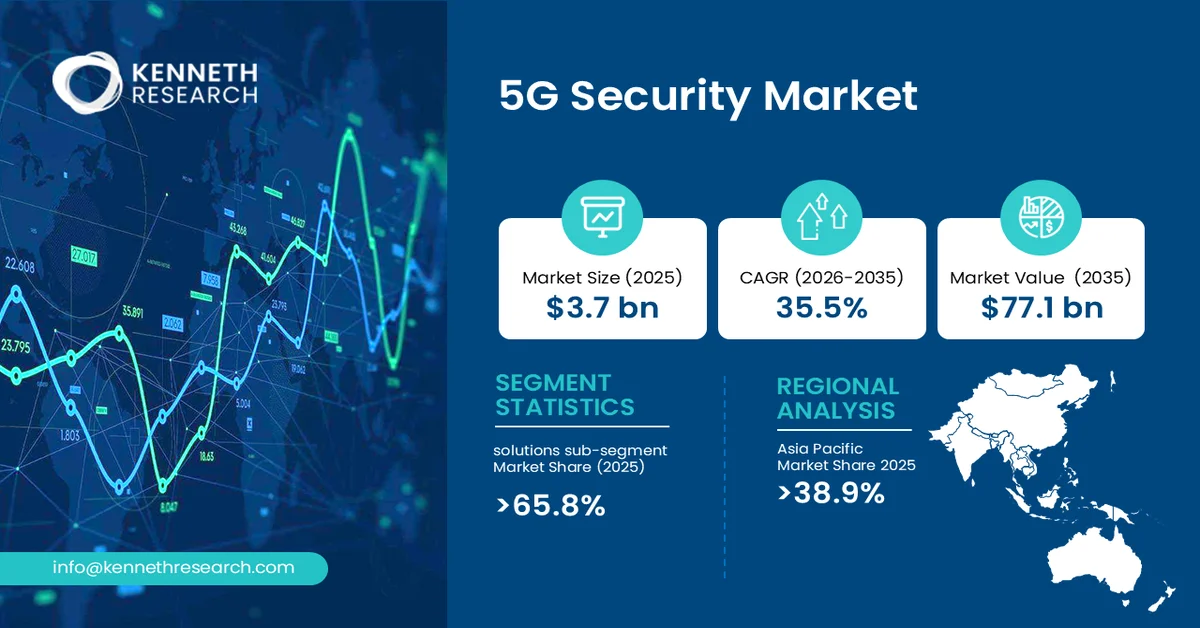
5G Security Market size was valued at USD 3.7 billion in 2025 and is projected to reach USD 77.1 billion by the end of 2035, rising at a CAGR of 35.5% during the forecast period, i.e., 2026-2035. In 2026, the industry size of the 5G security is estimated at USD 5 billion.
The primary growth driver for the 5G security market is the expanding deployment of 5G networks across critical communications and enterprise environments. Greater connectivity, network virtualization, edge computing, and network slicing introduce more complex security requirements, increasing demand for solutions that protect infrastructure, devices, data, and network functions.
The 5G security market encompasses cybersecurity solutions and services designed to protect 5G networks, infrastructure, connected devices, applications, data, and associated communications from cyber threats. The market covers security technologies deployed across the radio access network, 5G core, network interfaces, cloud-native infrastructure, edge environments, and connected endpoints. Solutions include network security, identity and access management, encryption, threat detection, intrusion prevention, security analytics, and other mechanisms designed to safeguard increasingly virtualized telecommunications environments.
Key characteristics include distributed network architectures, software-defined functions, network slicing, edge computing, virtualization, and extensive device connectivity. These characteristics increase the importance of continuous monitoring, authentication, privacy protection, and automated threat response.
Key 5G Security Market Insights Summary:
Key Takeaways: Market Trends & Insights
- 5G security market projected to grow from USD 3.7 billion in 2025 to USD 77.1 billion by 2035 at a 35.5% CAGR.
- Asia Pacific accounted for the largest regional share at 38.9% in 2025, supported by rapid 5G deployment, expanding digital infrastructure, and strengthening telecommunications security initiatives across Japan and China.
- Solutions will remain the leading Offering segment with a 65.8% market share, driven by demand for integrated protection across increasingly complex 5G network architectures.
- Radio Access Network (RAN) Security is expected to witness strong growth as Open RAN, virtualized RAN, private 5G, and distributed network architectures increase the need for dedicated protection of radio infrastructure and interfaces.
Market Drivers
- Expansion of 5G network infrastructure
- Increasing cybersecurity requirements across virtualized networks
- Growing adoption of private 5G networks across enterprises and industries
- Rising integration of edge computing, network slicing, and Open RAN architectures
Challenges
- Increasing network complexity and expanded attack surface
- Evolving cyber threats and security requirements
5G Security Market: Market Overview & Supply Chain
Global adoption of 5G security is increasing as telecom operators expand 5G infrastructure across consumer, enterprise, industrial, and critical-communication applications. The transition toward virtualized network functions, edge computing, software-defined architectures, and increasingly connected devices is expanding the potential attack surface and increasing the need for network monitoring, identity protection, threat detection, and infrastructure security. India's Department of Telecommunications reported that 5G services had reached 779 districts by October 2024, demonstrating the rapid expansion of 5G infrastructure and the corresponding need to secure increasingly extensive telecommunications networks.
The 5G security market value chain begins with cybersecurity software, network-security hardware, encryption technologies, identity-management systems, threat-intelligence platforms, monitoring tools, and telecommunications infrastructure components. Security technology providers develop solutions that integrate with radio access networks, 5G core infrastructure, edge platforms, cloud-native network functions, and connected devices. Network equipment manufacturers and telecom technology companies incorporate security capabilities into their infrastructure, while specialized cybersecurity vendors provide independent protection, detection, analytics, and response solutions. Distribution occurs through direct sales, technology partnerships, systems integrators, managed-security providers, and telecommunications operators.
5G Security Market: Growth Drivers & Challenges
Growth Drivers:
- Expansion of 5G network infrastructure: The continued deployment of 5G networks is increasing the need for dedicated security capabilities across telecommunications infrastructure. Compared with earlier mobile architectures, 5G incorporates cloud-native functions, virtualization, network slicing, edge computing, and more distributed network components, creating additional interfaces and security considerations. NIST's 2026 5G security guidance specifically recommends network-infrastructure design principles for commercial and private 5G operators to strengthen cybersecurity and privacy. As operators expand standalone 5G and enterprise private networks, security vendors are gaining opportunities to provide network monitoring, identity management, threat detection, segmentation, encryption, and security analytics.
- Increasing cybersecurity requirements across virtualized networks: The increasing virtualization and software orientation of 5G networks is creating demand for more sophisticated cybersecurity solutions. Network functions are increasingly implemented through software and cloud-based infrastructure, requiring operators to secure APIs, workloads, interfaces, identities, and communications alongside traditional network components. This architecture is encouraging organizations to adopt continuous monitoring, zero-trust principles, automated threat detection, and coordinated security controls across distributed environments.
Challenges:
- Increasing network complexity and expanded attack surface: The transition from conventional mobile networks toward virtualized, cloud-native, and distributed 5G architectures is increasing the complexity of security management. Network slicing, edge computing, software-defined functions, Open RAN, and large numbers of connected devices create multiple interconnected components that must be secured and continuously monitored. The International Telecommunication Union identifies the complexity of 5G networks as a significant cybersecurity challenge requiring proactive protection of networks and critical infrastructure. This complexity can increase deployment costs, integration requirements, and the technical expertise needed to implement comprehensive protection.
- Evolving cyber threats and security requirements: The rapidly changing 5G threat landscape creates a continuing requirement for security technologies to adapt to new vulnerabilities, attack methods, and network configurations. As 5G becomes more deeply integrated with enterprise and critical-infrastructure applications, security failures can have broader operational consequences. NIST's 5G cybersecurity program emphasizes that the development, deployment, and use of 5G are continuously evolving, requiring organizations to address cybersecurity and privacy throughout the technology lifecycle.
5G Security Market Size and Forecast:
| Report Attribute | Details |
|---|---|
| Base Year |
2025 |
| Forecast Year |
2026-2035 |
| CAGR |
35.5% |
| Base Year Market Size (2025) |
USD 3.7 billion |
| Forecast Year Market Size (2035) |
USD 77.1 billion |
| Regional Scope |
|
5G Security Market Segmentation Analysis:
Offering Segment Analysis
In the offering segment, the solutions sub-segment is anticipated to capture the largest market share of 65.8% by the end of 2025.
Its leadership is supported by increasing requirements for integrated protection across 5G infrastructure, including network functions, interfaces, connected devices, and virtualized environments. Security solutions can provide capabilities such as threat detection, network monitoring, identity protection, encryption, access control, and security analytics, enabling operators to address multiple risk areas through coordinated platforms. NIST's 5G cybersecurity work emphasizes implementing cybersecurity and privacy capabilities across commercial and private 5G environments, including network infrastructure and supporting components. The solutions segment is also benefiting from the increasing complexity of 5G architectures, which requires security controls to operate across distributed and software-driven environments.
Network Component Security Segment Analysis
The Radio Access Network (RAN) Security sub-segment is projected to grow as 5G deployments become more distributed, software-driven, and dependent on open interfaces between network components. RAN security encompasses controls that protect radio infrastructure, signaling, management interfaces, and communications between RAN elements from unauthorized access, manipulation, and disruption. Increasing adoption of Open RAN is creating additional security requirements because disaggregated architectures introduce multi-vendor components and standardized interfaces that must be continuously protected. NIST's work on Open RAN security specifically addresses areas including Open Fronthaul, RAN Intelligent Controller security, system management and orchestration, and AI/ML security, demonstrating the expanding security requirements surrounding modern RAN architectures.
Our in-depth analysis of the global 5G security market includes the following segments:
|
Segment |
Sub-segment |
|
Component |
|
|
Network Component |
|
|
Application |
|
|
End User |
|
5G Security Market Regional Insights:
Asia Pacific Market Trends & Insights:
Asia Pacific is the dominant region in the 5G security market, accounting for 38.9% in 2025.
Regional leadership is supported by extensive 5G deployment, rapid digitalization, large telecommunications ecosystems, and increasing government attention to the security of next-generation communications infrastructure. China and Japan are particularly important because both countries are advancing 5G infrastructure while strengthening cybersecurity requirements around telecommunications systems
Japan is strengthening its 5G security ecosystem through government policies that promote secure development and deployment of advanced telecommunications systems. Japan's Ministry of Economy, Trade and Industry states that its framework for advanced information and communications systems is intended to improve system safety and reliability while ensuring cybersecurity.
China represents a major regional opportunity because of its extensive 5G infrastructure and continued integration of 5G with AI, cloud computing, industrial applications, and edge technologies. Its 2024 national 5G action plan explicitly calls for strengthening security capabilities and developing virtualized, intelligent, and adaptive security products.
North America Market Trends & Insights:
North America represents a significant growth region for the 5G security market, supported by continued 5G deployment, advanced telecommunications infrastructure, strong cybersecurity capabilities, and growing emphasis on protecting critical communications networks. The U.S. is strengthening its focus on 5G security through federal cybersecurity guidance and coordination. CISA identifies 5G as a major transformation of telecommunications infrastructure and provides dedicated security and resilience guidance for organizations deploying and operating 5G networks.
U.S. remains a major regional opportunity due to its advanced telecommunications ecosystem and strong federal focus on securing 5G infrastructure. CISA and NIST continue to develop guidance addressing cybersecurity risks and security-by-design practices for commercial and private 5G deployments.
Canada is strengthening its 5G security framework through government-led telecommunications security measures. The Canadian government has implemented restrictions on high-risk telecommunications suppliers and emphasized protection of 5G networks as part of national critical-infrastructure security.
Leading Companies Operating in the Global 5G Security Market:
Here is a list of upstream, downstream, and key players operating in the global 5G security market competitive ecosystem:
- Nokia(Finland)
- Company Overview
- Business Strategy
- Key Product Offerings
- Financial Performance
- Key Performance Indicators
- Risk Analysis
- Recent Development
- Regional Presence
- SWOT Analysis
- Palo Alto Networks(United States)
- Ericsson(Sweden)
Recent Developments
- February 2026 –Ericsson strengthened its telecom cybersecurity portfolio by introducing an Agentless Endpoint Detection and Response (EDR) capability for communications service providers and mission-critical systems.
- November 2025 – Nokia: Nokia and OneLayer announced a partnership combining Nokia’s private 5G/LTE networks with OneLayer’s OT asset visibility and protection capabilities for utilities.
Frequently Asked Question
In 2025, the 5G security market exceeded USD 3.7 billion.
The 5G security market is projected to reach USD 77.1 billion by the end of 2035, expanding at a CAGR of 35.5% over the forecast period (2026–2035).
The major players in the market are Nokia, Ericsson, Palo Alto Networks, Cisco, Fortinet, and others.
In the Offering segment, the Solutions sub-segment is anticipated to capture the largest market share of 65.8% in the future and exhibit lucrative growth opportunities during 2026–2035.
Asia Pacific is projected to hold the largest market share of 38.9% by the end of 2025 and provide more business opportunities in the future. Rapid 5G deployment, expanding digital infrastructure, and strengthening telecommunications cybersecurity initiatives in Japan and China are fostering the region's dominance.
Why Choose Kenneth Research ?
-
Insight with Impact : We don’t just gather data — we uncover stories, trends, and opportunities that fuel business growth.
-
Experts Who Get It : Our team speaks your industry’s language and knows what really matters to your customers and market.
-
Custom-Built for You : Forget one-size-fits-all. We craft research and consulting solutions as unique as your business vision.
-
Partners, Not Just Providers : We work with you, not for you — collaborating closely to turn insights into smart, strategic moves.
-
Results That Speak : Our work powers brands, startups, and industry leaders alike — with a track record of ideas that work in the real world.
Report ID: 1188 |
Published Date: 26 Aug 2026 |
Report Format: |
Delivery Timeline: 48-72 Business Hours

Copyright © 2025 Kenneth Research. All rights reserved. Terms of Use | Privacy Policy
