Report ID: 1292 |
Published Date: 28 Sep 2026 |
Report Format: |
Delivery Timeline: 48-72 Business Hours
4D Imaging Radar Market Outlook:
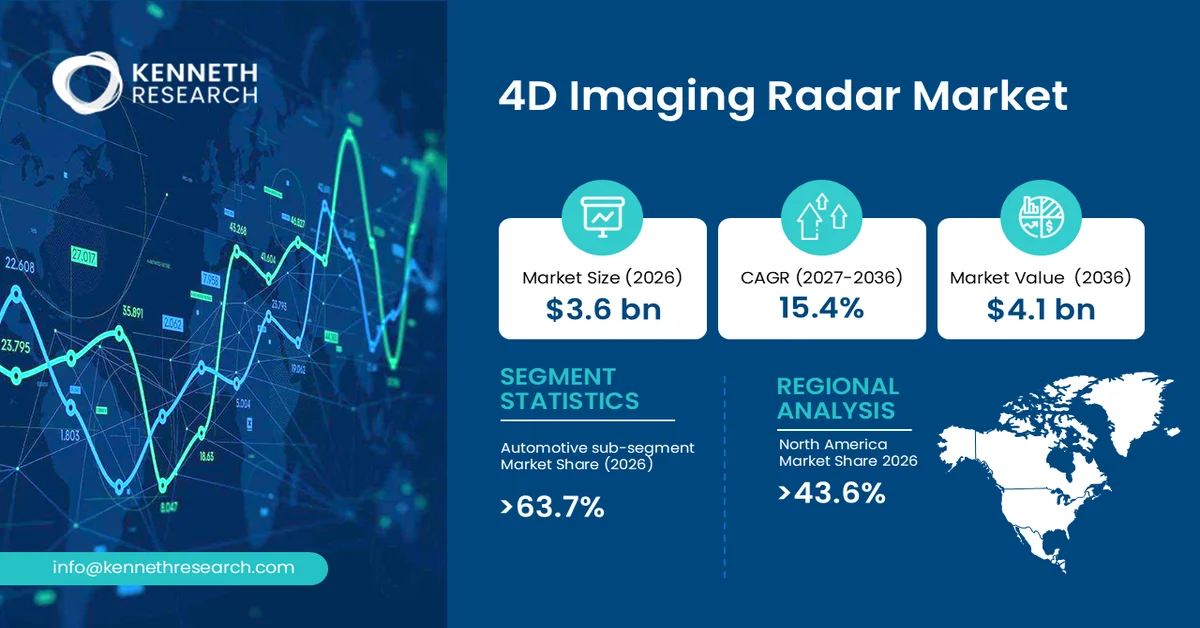
4D Imaging Radar Market size was valued at USD 3.6 billion in 2026 and is projected to reach USD 14.9 billion by the end of 2036, rising at a CAGR of 15.4% during the forecast period, i.e., 2027–2036. In 2027, the industry size of the 4d imaging radar is estimated at USD 4.1 billion.
The increasing deployment of advanced driver-assistance systems and automated driving technologies is accelerating demand for 4D imaging radar.
The 4d imaging radar market encompasses radar sensing technologies that provide vehicles and other systems with multidimensional information about surrounding objects, including range, velocity, azimuth, and elevation. Unlike conventional radar systems that primarily measure distance and relative speed, 4D imaging radar uses advanced antenna architectures, signal processing, and digital beamforming to generate more detailed representations of the surrounding environment.
Key characteristics include high-resolution object detection, improved spatial awareness, operation in adverse weather and low-light conditions, and the ability to support advanced perception functions. The technology is particularly relevant to automotive applications, where it can complement cameras, LiDAR, and other sensing technologies in advanced driver-assistance systems and automated driving platforms.
Key 4D Imaging Radar Market Insights Summary:
Key Takeaways: Market Trends & Insights
- 4D imaging radar market is projected to grow from USD 3.6 billion in 2026 to USD 14.9 billion by 2036, registering a CAGR of 15.4% during the forecast period.
- North America is projected to remain the leading regional market, accounting for 43.6% in 2026, supported by advanced automotive technology ecosystems, strong ADAS development, and growing investment in automated-driving technologies across the U.S. and Canada.
- Automotive is expected to remain the leading Application segment with a 63.7% share in 2026, driven by increasing integration of high-resolution radar into ADAS, automated-driving, collision-avoidance, and vehicle perception systems.
- OEM-Installed is expected to remain a key Deployment Mode as automakers increasingly integrate 4D imaging radar directly into factory-built vehicles for coordinated sensor fusion, vehicle computing, and advanced safety functionality.
Market Drivers
- Increasing adoption of ADAS and automated-driving technologies across passenger and commercial vehicles.
- Growing demand for high-resolution environmental perception in challenging weather and lighting conditions.
- Rising integration of radar with camera, LiDAR, and other sensor-fusion architectures.
- Continuous development of compact, cost-efficient radar chipsets and software-defined sensing platforms.
Challenges
- Radar Interference and Signal Reliability
- High System Complexity and Integration Requirements
4D Imaging Radar Market Overview & Supply Chain
Adoption of 4D imaging radar is increasing as automotive manufacturers and technology suppliers strengthen advanced driver-assistance and automated-driving capabilities. The technology provides richer environmental perception by combining distance, velocity, angular position, and elevation information, helping vehicles detect and track surrounding objects under challenging visibility conditions. Regulatory and safety initiatives are also encouraging greater integration of advanced sensing technologies. In 2024, the U.S. National Highway Traffic Safety Administration finalized updates to its 5-Star Safety Ratings program, incorporating additional advanced driver-assistance technologies and establishing a longer-term roadmap for vehicle safety evaluation.
The 4D imaging radar value chain begins with semiconductor devices, radar chipsets, antennas, RF components, processors, sensors, and specialized materials. These inputs are integrated into radar modules through hardware design, signal-processing development, calibration, software integration, testing, and validation. Tier-1 suppliers and radar technology companies then provide complete sensing modules and perception solutions to automotive OEMs. Distribution primarily occurs through direct OEM relationships, long-term procurement agreements, and automotive technology partnerships.
4D Imaging Radar Market: Growth Drivers & Challenges
Growth Drivers
- Rising Adoption of Advanced Driver-Assistance Systems: The growing integration of advanced driver-assistance systems (ADAS) is accelerating demand for high-resolution sensing technologies such as 4D imaging radar. Unlike conventional radar, 4D imaging radar provides richer spatial information that can improve object detection, tracking, classification, and environmental mapping. This makes the technology increasingly relevant for automatic emergency braking, adaptive cruise control, lane assistance, blind-spot monitoring, and higher levels of automated driving. Regulatory developments are further supporting adoption. In 2024, the U.S. Department of Transportation finalized a Federal Motor Vehicle Safety Standard requiring automatic emergency braking and pedestrian automatic emergency braking on new light vehicles, strengthening the market environment for advanced perception systems.
- Increasing Development of Automated and Software-Defined Vehicles: The transition toward automated and software-defined vehicles is creating demand for sophisticated perception technologies capable of generating detailed real-time environmental data. 4D imaging radar complements cameras and LiDAR by providing robust sensing across different lighting and weather conditions while supplying information on object position, movement, and elevation. Its compatibility with centralized vehicle computing architectures also makes it increasingly relevant for L2+ and higher automated-driving applications. OEMs and technology suppliers are therefore investing in radar systems that offer greater resolution, processing capability, and integration flexibility.
Challenges
- Radar Interference and Signal Reliability: The increasing number of radar-equipped vehicles can create electromagnetic interference, particularly in dense traffic environments where multiple radar systems operate simultaneously. Interference can degrade object detection, tracking continuity, and overall perception reliability, creating a significant challenge for 4D imaging radar systems that are expected to deliver precise environmental information for ADAS and automated-driving functions. The U.S. National Highway Traffic Safety Administration has specifically identified mutual radar interference as a concern as radar-enabled crash-avoidance systems become more widespread, noting that performance can deteriorate in radar-congested environments.
- High System Complexity and Integration Requirements: 4D imaging radar requires sophisticated RF hardware, antenna arrays, signal-processing capabilities, software algorithms, and vehicle-level integration. Achieving high-resolution environmental perception while maintaining reliability, thermal efficiency, compact packaging, and cost competitiveness can make system development technically demanding. Integration with cameras, LiDAR, vehicle control units, and centralized computing platforms further increases validation and software requirements. These challenges can extend development cycles and increase engineering costs for radar suppliers and automotive OEMs, particularly when systems must meet stringent functional-safety and automated-driving requirements.
4D Imaging Radar Market Size and Forecast:
| Report Attribute | Details |
|---|---|
| Base Year |
2026 |
| Forecast Year |
2027-2036 |
| CAGR |
15.4% |
| Base Year Market Size (2026) |
USD 3.6 billion |
| Forecast Year Market Size (2036) |
USD 4.1 billion |
| Regional Scope |
|
4D Imaging Radar Market: Segment Analysis
Application Type Segment Analysis
In the Application segment, the Automotive sub-segment is anticipated to capture the largest market share of 63.7% in 2026.
Its dominance is supported by rising integration of advanced driver-assistance systems, automated parking, collision avoidance, adaptive cruise control, and increasingly sophisticated vehicle perception architectures. 4D imaging radar provides detailed range, velocity, azimuth, and elevation information, making it valuable for detecting and tracking vehicles, pedestrians, cyclists, and other road objects. Automotive OEMs are increasingly combining radar with cameras and LiDAR to improve sensor-fusion performance and all-weather perception. Government safety requirements are also strengthening the adoption environment for advanced vehicle sensing technologies. The U.S. National Highway Traffic Safety Administration has been advancing regulatory and safety frameworks for automated-driving technologies, supporting continued development of advanced vehicle perception systems.
Deployment Mode Segment Analysis
In the Deployment Mode segment, the OEM-Installed sub-segment is projected to grow strongly as automakers increasingly integrate advanced radar systems directly into factory-built vehicles. OEM installation enables 4D imaging radar to be incorporated with vehicle computing platforms, cameras, LiDAR, braking systems, and other ADAS technologies during vehicle development, allowing coordinated calibration and sensor fusion. This approach also supports consistent system performance and enables manufacturers to optimize radar placement according to vehicle architecture. Demand is further supported by increasing development of automated-driving capabilities, where high-resolution radar can provide elevation-aware environmental data.
Our in-depth analysis of the global 4d imaging radar market includes the following segments:
|
Segment |
Sub-segment |
|
Type |
|
|
Radar Architecture |
|
|
Component |
|
|
Deployment Mode |
|
|
Frequency Band |
|
|
Application |
|
4D Imaging Radar Market – Regional Analysis
North America Market Trends & Insights:
North America is projected to remain the dominant region in the 4D Imaging Radar Market, accounting for 43.6% in 2026. Regional leadership is supported by a mature automotive manufacturing ecosystem, strong ADAS development, advanced mobility technology investment, and early commercialization of automated-driving systems. Government data show that Canada registered 26.8 million road motor vehicles in 2024, highlighting the substantial vehicle base supporting demand for advanced sensing technologies.
The U.S. remains the principal regional market, supported by extensive vehicle production, technology development, and deployment of ADAS and automated-driving functions. Its automotive ecosystem encourages collaboration among OEMs, Tier-1 suppliers, semiconductor companies, and radar technology developers.
Canada strengthens North America's automotive supply chain through established assembly operations and supplier capabilities. In 2024, five major OEMs assembled more than 1.31 million light-duty vehicles at Canadian plants, reinforcing the country's role within the integrated North American automotive manufacturing network.
Asia-Pacific Market Trends & Insights:
Asia-Pacific is an important growth region for 4D imaging radar, supported by expanding intelligent-vehicle development, advanced automotive manufacturing, and increasing deployment of ADAS and automated-driving technologies. China is strengthening its regulatory and technology ecosystem through intelligent connected-vehicle road-testing programs and automotive radar standardization, while Japan continues to promote automated-driving development through government-industry-academia collaboration.
Japan benefits from established automotive and electronics capabilities, with government initiatives supporting automated-driving commercialization, safety evaluation, and industry collaboration.
China offers significant opportunities through its large automotive ecosystem and accelerating intelligent-vehicle development. Its government has also established automotive radar requirements covering the 76–79 GHz band and related technical specifications, supporting a more structured environment for radar deployment.
4D Imaging Radar Market – Competitive Landscape
Here is a list of upstream, downstream, and key players operating in the global 4d imaging radar competitive ecosystem:
- Aptiv PLC(Ireland)
- Company Overview
- Business Strategy
- Key Product Offerings
- Financial Performance
- Key Performance Indicators
- Risk Analysis
- Recent Development
- Regional Presence
- SWOT Analysis
- ZF Friedrichshafen AG (Germany)
- Robert Bosch GmbH (Germany)
Recent Developments
- May 2026: Aptiv announced that Volvo Cars selected its Gen 8 radar platform for deployment in future vehicles beginning in 2028. The platform is intended to support safety and driver-assistance functions within software-defined vehicle architectures.
- November 2025: ZF showcased its ProWave high-resolution radar at Agritechnica 2025. The 77-GHz radar provides 4D target detection and generates point-cloud data for autonomous agricultural vehicles and field robots.
Frequently Asked Question
In 2026, the 4d imaging radar market exceeded USD 3.6 billion.
The 4d imaging radar market is projected to reach USD 14.9 billion by the end of 2036, expanding at a CAGR of 15.4% over the forecast period (2027–2036).
The major players in the market are Robert Bosch GmbH, Continental AG, ZF Friedrichshafen AG, Aptiv PLC, Arbe Robotics Ltd., and others.
Which segment will capture the significant share for the 4d imaging radar market by the end of 2036?
North America is projected to hold the largest market share of 43.6% by the end of 2026 and provide more business opportunities in the future.
Why Choose Kenneth Research ?
-
Insight with Impact : We don’t just gather data — we uncover stories, trends, and opportunities that fuel business growth.
-
Experts Who Get It : Our team speaks your industry’s language and knows what really matters to your customers and market.
-
Custom-Built for You : Forget one-size-fits-all. We craft research and consulting solutions as unique as your business vision.
-
Partners, Not Just Providers : We work with you, not for you — collaborating closely to turn insights into smart, strategic moves.
-
Results That Speak : Our work powers brands, startups, and industry leaders alike — with a track record of ideas that work in the real world.
Report ID: 1292 |
Published Date: 28 Sep 2026 |
Report Format: |
Delivery Timeline: 48-72 Business Hours

Copyright © 2025 Kenneth Research. All rights reserved. Terms of Use | Privacy Policy
