Report ID: 1191 |
Published Date: 27 Aug 2026 |
Report Format: |
Delivery Timeline: 48-72 Business Hours
3D Printing Market Outlook:
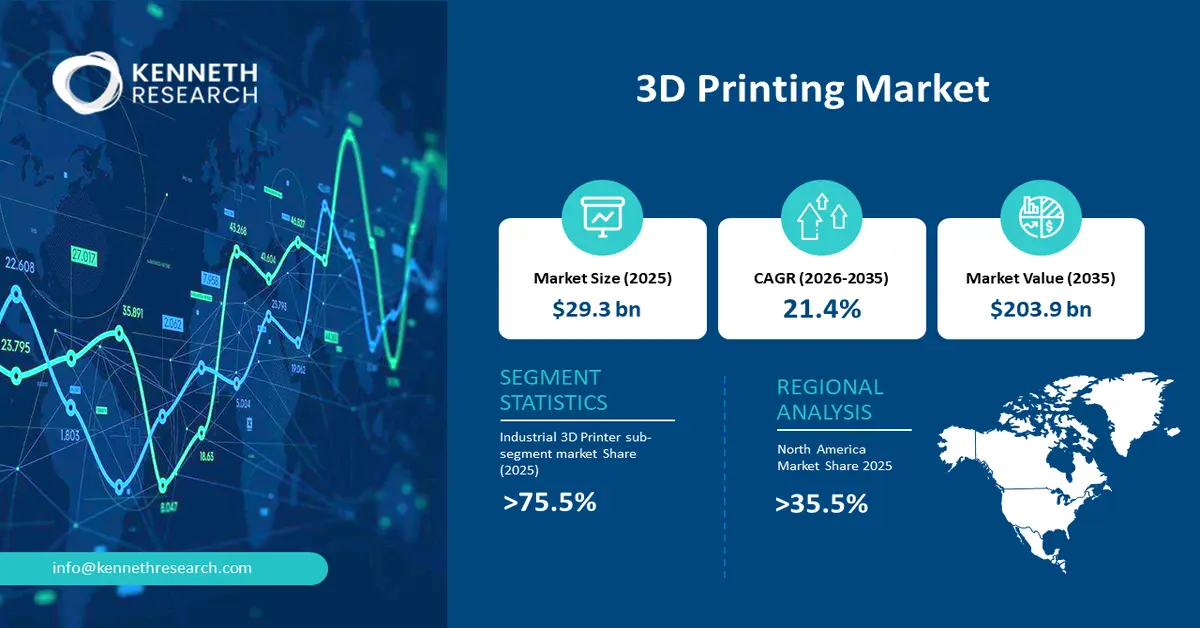
3D Printing Market size was valued at USD 29.3 billion in 2025 and is projected to reach USD 203.9 billion by the end of 2035, rising at a CAGR of 21.4% during the forecast period, i.e., 2026-2035. In 2026, the industry size of the 3D printing is estimated at USD 35.6 billion.
The primary growth driver of the 3D printing market is increasing adoption of additive manufacturing across industrial production, prototyping, customization, and low-volume manufacturing.
The 3D printing market encompasses technologies, equipment, materials, software, and related solutions used to manufacture three-dimensional objects directly from digital designs through additive processes. Unlike conventional subtractive manufacturing, 3D printing builds components layer by layer, using materials such as polymers, metals, ceramics, and composites. Printing technologies include material extrusion, powder-bed processes, vat photopolymerization, directed energy deposition, and other digitally controlled manufacturing approaches.
Key characteristics include design flexibility, rapid prototyping, customization, tooling reduction, part consolidation, and the ability to manufacture geometries that may be difficult or uneconomical to produce through conventional techniques. Systems range from desktop and professional printers to industrial platforms designed for continuous production and demanding applications.
Key 3D Printing Market Insights Summary:
Key Takeaways: Market Trends & Insights
- 3D Printing Market is projected to grow from USD 29.3 billion in 2025 to USD 203.9 billion by 2035, registering a 21.4% CAGR during the forecast period.
- North America accounted for the largest regional share at 35.5% in 2025, supported by advanced manufacturing infrastructure, strong additive manufacturing research, and increasing industrial adoption across the U.S. and Canada.
- Industrial 3D Printer will remain the leading Printer Type segment with a 75.5% share in 2025, supported by growing use of additive manufacturing for industrial production, rapid prototyping, customization, and low-volume manufacturing.
- Hardware is expected to remain a key Component segment as manufacturers invest in advanced printing systems, process-monitoring equipment, and production-scale additive manufacturing technologies.
Market Drivers
- Expansion of industrial additive manufacturing
- Increasing demand for customized and complex products
- Growing adoption of digital manufacturing and automated production workflows
- Increasing use of 3D printing for tooling, repair, and low-volume production
Challenges
- Qualification, standardization, and process certification
- Production consistency and limited process scalability
3D Printing Market Overview & Supply Chain
The adoption of 3D printing is increasing globally as manufacturers seek greater production flexibility, faster prototyping, customization, and more efficient material utilization. The technology is becoming increasingly relevant across aerospace, automotive, healthcare, electronics, consumer products, and industrial manufacturing. The U.S. Census Bureau added additive manufacturing (3D printing) to its 2022 Economic Census to better capture its growing role across industries, noting applications in consumer goods, medical products, transportation, architecture, and manufacturing. NIST estimates that U.S. shipments of goods produced using additive manufacturing were USD 2.8 billion, while U.S. value added from additive manufacturing was estimated at USD 1.4 billion, highlighting its measurable contribution to manufacturing activity.
The 3D printing market value chain begins with raw materials including polymers, metal powders, photopolymers, ceramics, composites, and other specialized feedstocks. Material producers formulate and process these inputs into printer-compatible powders, filaments, resins, pellets, or other formats with controlled physical and chemical properties. Printer manufacturers then integrate hardware, print heads, lasers, build platforms, sensors, and control systems, while software providers supply design, slicing, simulation, monitoring, and workflow-management capabilities.
3D Printing Market: Growth Drivers & Challenges
Growth Drivers:
- Expansion of industrial additive manufacturing: The expansion of additive manufacturing across industrial production is a major growth driver for the 3D printing market. Manufacturers are increasingly using 3D printing for prototyping, tooling, customized components, repair parts, and selected low-volume production because the technology can shorten design cycles and reduce dependence on conventional tooling. NIST highlights additive manufacturing's ability to support rapid prototyping, customized production, complex components, and lower-volume manufacturing while reducing material waste. The U.S. government has also identified additive manufacturing as an important advanced-manufacturing technology requiring continued development of standards, measurement capabilities, and industrialization pathways.
- Increasing demand for customized and complex products: Growing demand for customized products and complex component geometries is strengthening the commercial case for 3D printing across multiple industries. Additive manufacturing allows manufacturers to produce intricate designs, consolidated components, customized products, and low-volume parts without requiring the extensive tooling associated with conventional manufacturing. This capability is particularly valuable in aerospace, automotive, healthcare, electronics, and industrial manufacturing, where product specifications can vary significantly across applications. NIST identifies complex-part production, customized products, rapid design iterations, and specialized tooling among the key applications enabled by additive manufacturing.
Challenges:
- Qualification, standardization, and process certification: Qualification and standardization remain important restraints for broader industrial adoption of 3D printing, particularly for applications requiring consistent and certifiable performance. Additive manufacturing involves numerous combinations of materials, machines, process parameters, build orientations, and post-processing conditions, making conventional qualification approaches difficult to apply uniformly. NIST identifies process variability, inconsistent material properties, part accuracy, and insufficient qualification and certification methods as continuing technical challenges for additive manufacturing.
- Production consistency and limited process scalability: Maintaining consistent quality while scaling 3D printing from prototyping to continuous production remains a significant commercial challenge. Variations in feedstock characteristics, machine conditions, thermal behavior, build parameters, and environmental factors can affect dimensional accuracy, surface quality, mechanical properties, and production repeatability. NIST highlights high process variability, inconsistent material properties, limited part accuracy, and challenges in achieving predictable and repeatable operations as barriers to wider industrial implementation.
3D Printing Market Size and Forecast:
| Report Attribute | Details |
|---|---|
| Base Year |
2025 |
| Forecast Period |
2026-2035 |
| CAGR |
21.4% |
| Base Year Market Size (2025) |
USD 29.3 billion |
| Forecast Year Market Size (2035) |
USD 203.9 billion |
| Regional Scope |
|
3D Printing Market Segmentation Analysis:
Printer Type Segment Analysis
In the Printer Type segment, the Industrial 3D Printer sub-segment is anticipated to capture the largest market share of 75.5% in 2025.
Its dominance is supported by increasing adoption of additive manufacturing for industrial prototyping, tooling, customized components, and low-volume production. Industrial systems provide greater build capacity, process control, material compatibility, and repeatability than consumer-oriented equipment, making them suitable for demanding manufacturing environments. The U.S. National Institute of Standards and Technology (NIST) supports industrial adoption through research focused on metals, polymers, ceramics, composites, measurement science, and standards for additive manufacturing. On the demand side, manufacturers are increasingly integrating industrial printers into production workflows where complex geometries, customization, and reduced tooling requirements provide commercial advantages.
Component Type Segment Analysis
In the Component segment, the Hardware sub-segment is projected to grow as manufacturers increasingly invest in complete additive manufacturing systems, including printers, build platforms, material-delivery systems, sensors, and process-control equipment. Hardware forms the physical foundation of 3D printing and directly determines build volume, production speed, material compatibility, accuracy, and process repeatability. NIST identifies hardware and process technologies as core areas of additive manufacturing research and highlights the need for improved measurement, monitoring, and industrialization capabilities. Demand is being driven by the transition of 3D printing from prototyping toward industrial production, customized manufacturing, tooling, repair, and complex component fabrication. On the supply side, manufacturers are developing systems with larger build capacities, improved automation, advanced monitoring, and compatibility with diverse material formats. NIST also notes that additive manufacturing supports rapid prototyping, customized products, low-volume production, tooling, and complex components.
Our in-depth analysis of the global 3D printing market includes the following segments:
|
Segment |
Sub-segment |
|
Printer Type |
|
|
Component |
|
|
Technology |
|
|
Application |
|
|
Material |
|
|
Vertical |
|
3D Printing Market Regional Insights:
North America Market Trends & Insights:
North America accounted for 35.5% of the 3D printing market in 2025, supported by advanced manufacturing infrastructure, strong research capabilities, established industrial adoption, and government-backed additive manufacturing programs. The U.S. benefits from extensive investment in aerospace, automotive, healthcare, defense, and industrial applications, while Canada contributes through advanced manufacturing research and technology development.
The U.S. remains the principal contributor to regional demand, supported by a broad industrial base and extensive adoption of additive manufacturing for prototyping, customized production, tooling, and complex components. NIST identifies these applications as important areas of additive manufacturing deployment.
Canada provides complementary opportunities through its advanced manufacturing ecosystem, research institutions, and industrial technology capabilities. The country's aerospace, automotive, healthcare, and industrial sectors create demand for sophisticated 3D printing systems and materials.
Europe Market Trends & Insights:
Asia-Pacific represents a significant growth opportunity for the 3D Printing Market, supported by expanding advanced manufacturing, electronics, automotive production, aerospace activity, and government-backed digital manufacturing initiatives. Japan and China are strengthening additive manufacturing capabilities through technology development, industrial research, and efforts to improve commercialization. Japan’s METI states that additive manufacturing is already being commercially used in aerospace, medical devices, prototyping, and energy, while its policy efforts focus on technology development, cost reduction, workforce development, and quality assurance.
Japan offers strong opportunities because of its sophisticated manufacturing base, precision-engineering capabilities, and growing interest in using 3D printing to address production flexibility and workforce challenges.
China provides substantial opportunities through its extensive industrial ecosystem and expanding advanced-manufacturing capabilities. The government is supporting additive manufacturing equipment, intelligent production systems, and industrial digitalization, creating a favorable environment for printer manufacturers, material suppliers, and technology providers.
Leading Companies Operating in the Global 3D Printing Market:
Here is a list of upstream, downstream, and key players operating in the global 3D printing market competitive ecosystem:
- Stratasys Ltd. (United States)
- Company Overview
- Business Strategy
- Key Product Offerings
- Financial Performance
- Key Performance Indicators
- Risk Analysis
- Recent Development
- Regional Presence
- SWOT Analysis
- 3D Systems Corporation (United States)
- EOS GmbH (Germany)
- HP Inc. (United States)
Recent Developments
- April 2026 –3D Systems introduced the SLA 825 Dual production system and AddiTrak factory-floor software at RAPID + TCT 2026.
- April 2026 –EOS acquired Metalpine GmbH, a specialist in high-quality metal powders, to strengthen its industrial metal additive manufacturing capabilities. The acquisition expands EOS’s access to titanium powders and integrates material expertise with its additive manufacturing systems and process knowledge.
Frequently Asked Question
In 2025, the 3D printing market exceeded USD 29.3 billion.
The 3D printing market is projected to reach USD 203.9 billion by the end of 2035, expanding at a CAGR of 21.4% over the forecast period (2026-2035).
The major players in the market are Stratasys Ltd., 3D Systems Corporation, EOS GmbH, HP Inc., Formlabs Inc., and others.
In the printer type segment, the industrial 3d printer sub-segment is anticipated to capture the largest market share of 75.5% in the future and exhibit lucrative growth opportunities during 2026-2035.
North America is projected to hold the largest market share of 35.5% by the end of 2025 and provide more business opportunities in the future.
Why Choose Kenneth Research ?
-
Insight with Impact : We don’t just gather data — we uncover stories, trends, and opportunities that fuel business growth.
-
Experts Who Get It : Our team speaks your industry’s language and knows what really matters to your customers and market.
-
Custom-Built for You : Forget one-size-fits-all. We craft research and consulting solutions as unique as your business vision.
-
Partners, Not Just Providers : We work with you, not for you — collaborating closely to turn insights into smart, strategic moves.
-
Results That Speak : Our work powers brands, startups, and industry leaders alike — with a track record of ideas that work in the real world.
Report ID: 1191 |
Published Date: 27 Aug 2026 |
Report Format: |
Delivery Timeline: 48-72 Business Hours

Copyright © 2025 Kenneth Research. All rights reserved. Terms of Use | Privacy Policy
