Report ID: 1186 |
Published Date: 28 Sep 2026 |
Report Format: |
Delivery Timeline: 48-72 Business Hours
3D Printed Satellite Market Outlook:
3D Printed Satellite Market size was valued at USD 147 billion in 2025 and is projected to reach USD 1,566.6 billion by the end of 2035, expanding at a CAGR of 26.7% during the forecast period, i.e., 2026-2035. In 2026, the industry size of the 3D printed satellite is estimated at USD 186.2 billion.
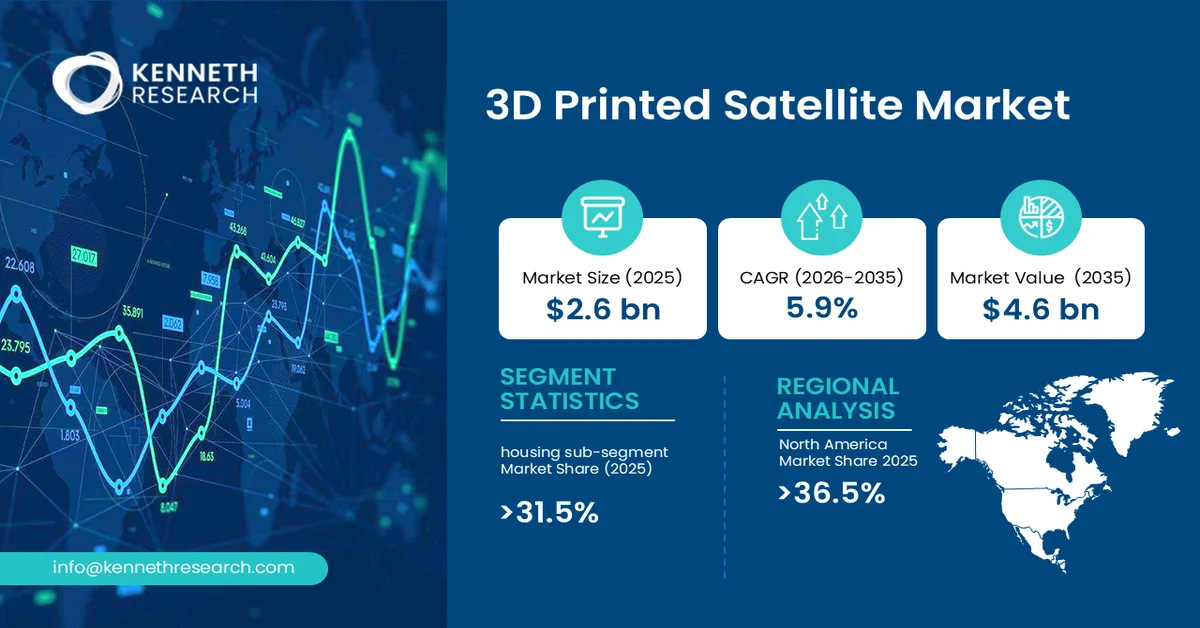
The primary growth driver of the 3D printed satellite market is the increasing adoption of additive manufacturing for lightweight, complex, and mission-specific spacecraft components.
The 3D printed satellite market comprises satellite structures, components, and related spacecraft hardware manufactured using additive manufacturing technologies. These technologies build components layer by layer from digital designs using materials such as polymers, metals, and specialized composites, enabling geometries and integrated structures that can be difficult or costly to produce through conventional manufacturing.
Key characteristics of 3D printed satellite manufacturing include design flexibility, component consolidation, material optimization, rapid prototyping, and the potential to reduce structural mass. The technology is particularly relevant to SmallSats and CubeSats, where manufacturers seek compact, lightweight, mission-specific structures.
Key 3D Printed Satellite Market Insights Summary:
Key Takeaways: Market Trends & Insights
- 3D Printed Satellite Market is projected to grow from USD 147 billion in 2025 to USD 1,566.6 billion by 2035, registering a 26.7% CAGR during the forecast period.
- North America accounted for the largest regional share at 36.5% in 2025, supported by advanced aerospace capabilities, strong space-sector investment, and established additive-manufacturing infrastructure.
- Housing is the leading Component segment, accounting for 31.5% in 2025, driven by demand for lightweight, customized, and structurally optimized satellite housings.
- Communication is expected to remain a key application area, supported by growing requirements for satellite connectivity, advanced communications payloads, and high-performance spacecraft architectures.
Market Drivers
- Increasing adoption of additive manufacturing for mission-specific satellite components.
- Growing demand for lightweight and customized satellite architectures.
- Advancement of printable aerospace-grade materials and manufacturing processes.
- Increasing integration of 3D printing into SmallSat and spacecraft development workflows.
Challenges
- Complex qualification and certification requirements.
- Material and process consistency across additive manufacturing systems.
3D Printed Satellite Market Overview & Supply Chain
The adoption of 3D printing in satellite manufacturing is increasing as space organizations and commercial developers seek lightweight structures, faster prototyping, mission-specific geometries, and more flexible production methods. Additive manufacturing is particularly relevant to SmallSat development because it can enable topology optimization, component integration, and reduced material use. NASA's 2026 State-of-the-Art of Small Spacecraft Technology identifies additive manufacturing as an increasingly adopted approach for spacecraft structures and notes its ability to support mission-specific customization and mass optimization.
The 3D printed satellite market value chain begins with suppliers of polymers, metals, composites, conductive materials, specialty powders, filaments, and other additive-manufacturing feedstocks. These inputs are processed through 3D printing technologies such as fused filament fabrication, selective laser sintering, stereolithography, and metal additive manufacturing to produce structural and functional satellite components. Manufacturers subsequently perform post-processing, inspection, qualification, assembly, and environmental testing to meet aerospace performance requirements. Finished components and integrated satellite systems reach customers through direct procurement, aerospace contractors, satellite manufacturers, and specialized space-technology suppliers.
3D Printed Satellite Market: Growth Drivers & Challenges
Growth Drivers:
- Increasing adoption of additive manufacturing for mission-specific satellite components: The growing use of additive manufacturing for satellite structures and functional components is accelerating market adoption by enabling designs that conventional machining cannot efficiently produce. 3D printing allows satellite manufacturers to integrate complex geometries, optimize material distribution, and tailor components to specific mission requirements while potentially reducing development time and structural mass. NASA's 2026 State-of-the-Art of Small Spacecraft Technology identifies additively manufactured components as an established option for SmallSat structures and highlights their ability to support mission-specific customization and mass optimization.
- Growing Demand for Lightweight and Customized Satellite Architectures: The increasing requirement for lightweight, compact, and highly customized satellite architectures is creating favorable conditions for 3D printed components. Satellite developers are under continuous pressure to optimize payload capacity, structural efficiency, and spacecraft configuration while accommodating increasingly specialized mission requirements. Additive manufacturing enables topology-optimized structures, integrated components, and geometries that can be difficult or uneconomical to manufacture through conventional processes. This flexibility is particularly valuable for SmallSats, where structural mass and available internal volume directly influence spacecraft design decisions.
Challenges:
- Complex qualification and certification requirements: The qualification and certification of 3D printed satellite components remains a major restraint because aerospace hardware must demonstrate consistent material properties, structural integrity, process reliability, and performance under demanding space conditions. Additive manufacturing can introduce process-dependent variations, defects, and differences between production builds, requiring extensive inspection and validation before components can be incorporated into flight systems. NASA has established specific additive manufacturing requirements for spaceflight systems, covering design, fabrication, testing, process control, and qualification.
- Material and process consistency across additive manufacturing systems: Variability in materials and printing processes creates another important challenge for 3D printed satellite manufacturing. Differences in feedstock characteristics, printer parameters, build orientation, thermal conditions, post-processing, and equipment configuration can influence the final properties of printed components. Such variability makes it difficult to establish repeatable production outcomes across different facilities and manufacturing platforms. NASA's additive manufacturing guidance highlights the importance of qualified material processes, equipment controls, personnel training, and documented production controls for reliable spaceflight hardware.
3D Printed Satellite Market Size and Forecast:
| Report Attribute | Details |
|---|---|
| Base Year |
2025 |
| Forecast Year |
2026-2035 |
| CAGR |
5.9% |
| Base Year Market Size (2025) |
USD 2.6 billion |
| Forecast Year Market Size (2035) |
USD 4.6 billion |
| Regional Scope |
|
3D Printed Satellite Market Segmentation Analysis:
Component Segment Analysis
In the component segment, the housing sub-segment is anticipated to capture the largest market share of 31.5% by the end of 2025.
Its dominance is supported by the growing use of additive manufacturing for customized satellite structures that require lightweight construction, optimized geometry, and efficient material utilization. NASA's 2026 State-of-the-Art of Small Spacecraft Technology identifies additive manufacturing as increasingly applicable to primary spacecraft structures, particularly for CubeSat and PocketQube-class spacecraft, while highlighting its ability to enable mission-specific designs and topology optimization. Demand is also supported by the expanding need for compact satellite architectures and faster development cycles. On the supply side, advances in polymeric additive manufacturing, CAD/CAM integration, printing technologies, and space-qualified materials are improving manufacturers' ability to produce complex housing structures.
Application Type Segment Analysis
The communication application segment is projected to grow as satellite operators increasingly require compact, high-performance communication systems capable of supporting higher data volumes, inter-satellite links, and distributed spacecraft architectures. NASA’s 2026 Small Spacecraft Technology report identifies both RF and free-space optical communications as important technologies for current and future SmallSat missions, supporting continued investment in advanced communication hardware. Additive manufacturing strengthens this application by enabling complex geometries, lightweight components, integrated structures, and rapid customization of communication hardware. Demand is further supported by growing interest in satellite constellations and spacecraft swarms that require efficient crosslinks for exchanging information.
Our in-depth analysis of the global 3D printed satellite market includes the following segments:
|
Segment |
Sub-segment |
|
Component |
|
|
Application |
|
|
Satellite Mass |
|
|
Manufacturing Technique |
|
3D Printed Satellite Market Regional Insights:
North America Market Trends & Insights:
North America accounted for 36.5% of the 3D printed satellite market in 2025, establishing its position as the dominant region. Regional leadership is supported by a mature aerospace ecosystem, strong commercial space activity, advanced additive-manufacturing capabilities, and substantial government involvement in spacecraft technology development.
The U.S. remains the principal contributor to regional demand, supported by its extensive commercial satellite industry and established space-technology research infrastructure. Companies such as Sidus Space have developed hybrid 3D-printed satellite platforms, demonstrating the transition of additive manufacturing from component production toward integrated spacecraft architectures.
Canada complements regional growth through its aerospace engineering capabilities, satellite communications expertise, and participation in advanced space technology development. Together, the U.S. and Canada provide a strong ecosystem for additive manufacturing, spacecraft engineering, satellite communications, and commercial space innovation, creating favorable conditions for continued regional adoption of 3D printed satellite technologies.
Europe Market Trends & Insights:
Asia-Pacific is emerging as an important market for 3D printed satellite technologies, supported by expanding space programs, growing satellite communications requirements, domestic aerospace manufacturing capabilities, and increasing government support for commercial space innovation. Japan and China are strengthening their satellite development ecosystems while encouraging advanced manufacturing and greater private-sector participation. Japan's Space Strategy Fund, established to support private-sector space technology development, specifically includes initiatives to accelerate commercial satellite constellations and develop satellite parts and components for domestic supply chains.
Japan is strengthening its space-industrial base through government-backed technology development and commercialization programs. Its Space Technology Strategy prioritizes satellite technologies and support for private-sector commercialization, creating favorable conditions for advanced manufacturing adoption.
China is expanding satellite constellation development and broader space capabilities, including commercial communications infrastructure. Japan's Ministry of Defense notes that China's satellite constellation activity is accelerating, including the deployment of the Qianfan low-Earth-orbit internet constellation.
Leading Companies Operating in the Global 3D Printed Satellite Market:
Here is a list of upstream, downstream, and key players operating in the global 3D printed satellite market competitive ecosystem:
- Sidus Space(United States)
- Company Overview
- Business Strategy
- Key Product Offerings
- Financial Performance
- Key Performance Indicators
- Risk Analysis
- Recent Development
- Regional Presence
- SWOT Analysis
- SWISSto12(Switzerland)
- Fleet Space Technologies(Australia)
Recent Developments
- December 2025 —Sidus Space announced the successful bus-level commissioning of LizzieSat-3, its hybrid 3D-printed satellite, including validation of its autonomous guidance, navigation, and control capabilities.
- January 2026 —SWISSto12 announced €73 million in financial support from ESA member states for its HummingSat program, alongside additional private investment.
Frequently Asked Question
In 2025, the 3D printed satellite market exceeded USD 147 billion.
The 3D printed satellite market is projected to reach USD 1,566.6 billion by the end of 2035, expanding at a CAGR of 26.7% over the forecast period (2026–2035).
The major players in the market are Sidus Space, SWISSto12, Fleet Space Technologies, Thales Alenia Space, 3Ding, and others.
In the Component segment, the Housing sub-segment is anticipated to capture the largest market share of 31.5% in the future and exhibit lucrative growth opportunities during 2026–2035.
North America is projected to hold the largest market share of 36.5% by the end of 2035 and provide more business opportunities in the future.
Why Choose Kenneth Research ?
-
Insight with Impact : We don’t just gather data — we uncover stories, trends, and opportunities that fuel business growth.
-
Experts Who Get It : Our team speaks your industry’s language and knows what really matters to your customers and market.
-
Custom-Built for You : Forget one-size-fits-all. We craft research and consulting solutions as unique as your business vision.
-
Partners, Not Just Providers : We work with you, not for you — collaborating closely to turn insights into smart, strategic moves.
-
Results That Speak : Our work powers brands, startups, and industry leaders alike — with a track record of ideas that work in the real world.
Report ID: 1186 |
Published Date: 28 Sep 2026 |
Report Format: |
Delivery Timeline: 48-72 Business Hours

Copyright © 2025 Kenneth Research. All rights reserved. Terms of Use | Privacy Policy
