Report ID: 1293 |
Published Date: 01 Sep 2026 |
Report Format: |
Delivery Timeline: 48-72 Business Hours
3D Printed Electronics Market Outlook:
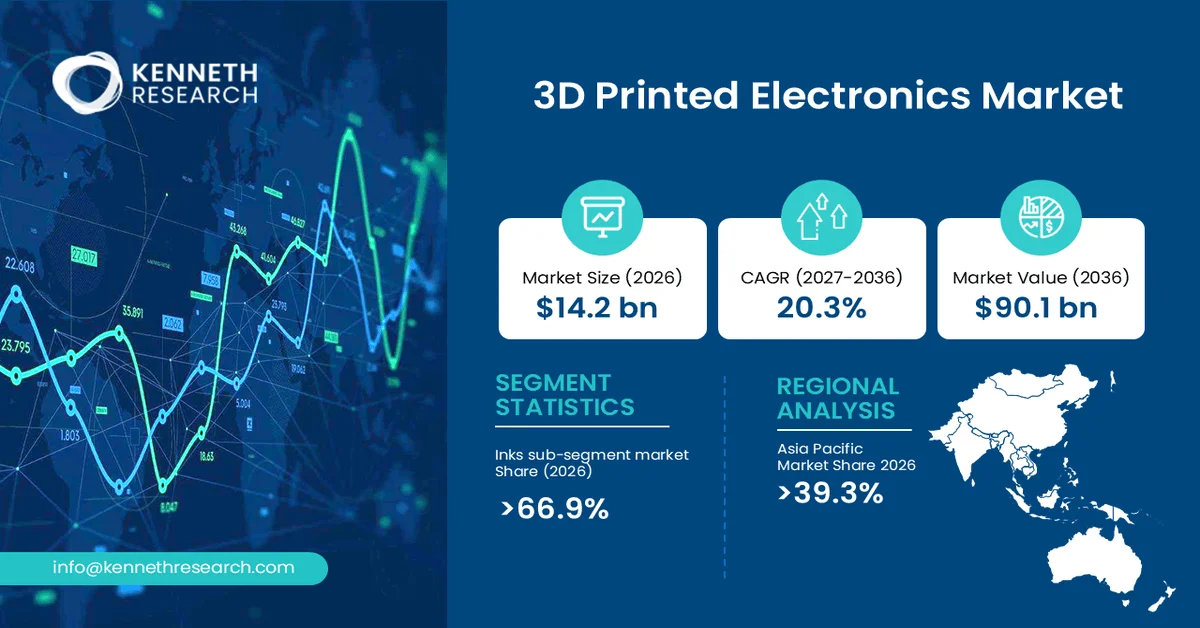
3D Printed Electronics Market size was valued at USD 14.2 billion in 2026 and is projected to reach USD 90.1 billion by the end of 2036, rising at a CAGR of 20.3% during the forecast period, i.e., 2027-2036. In 2027, the industry size of the 3D printed electronics is estimated at USD 17.1 billion.
The primary growth driver is the increasing industrial adoption of additive manufacturing to produce customized, complex, and directly integrated electronic structures. Digital fabrication enables manufacturers to shorten development cycles, reduce tooling dependence, support rapid design iteration, and create lightweight, conformal circuitry for applications where conventional electronics manufacturing is less flexible.
The 3D printed electronics market comprises technologies, materials, equipment, and associated solutions used to additively manufacture electronic structures, circuits, and functional components directly from digital designs. Unlike conventional electronics production, which generally relies on subtractive processing, assembly, and separate component integration, 3D printed electronics deposits functional materials in controlled patterns and layers to create conductive, insulating, resistive, capacitive, sensing, or antenna structures.
Key characteristics include the use of specialized functional inks, polymers, powders, and other printable materials; digitally controlled deposition; compatibility with complex or curved geometries; and the ability to integrate electronic functionality with physical structures. NASA describes additive manufacturing as building objects through successive material layers and has demonstrated its use for printed antennas and customized circuitry.
Key 3D Printed Electronics Market Insights Summary:
Key Takeaways: Market Trends & Insights
- 3D Printed Electronics Market reached USD 14.2 billion in 2026, reflecting strong commercial momentum
- The market is projected to reach USD 90.1 billion by 2036, supported by a 20.3% CAGR during 2027–2036
- Inks led the Material segment with a 66.9% market share in 2026, driven by demand for conductive and functional printed materials
- Roll-to-Roll is identified as the fastest-growing Transport Technique, supported by its suitability for continuous and scalable printed-electronics manufacturing
- Asia Pacific dominated the market with a 39.3% share in 2026, with China and Japan providing strong electronics manufacturing, materials, and advanced technology capabilities
Market Drivers
- Increasing adoption of flexible and conformal electronic architectures
- Expansion of digitally controlled and automated manufacturing workflows
- Demand for Rapid and Customized Electronics Manufacturing
- Integration of Electronics with Complex Three-Dimensional Structures
Challenges
- Reliability, process variability, and qualification complexity
- Material and process integration constraints
3D Printed Electronics Market Overview & Supply Chain
Adoption of 3D printed electronics is increasing globally as manufacturers seek greater design flexibility, rapid prototyping, localized production, and integration of electronic functionality into complex geometries and unconventional surfaces. The technology is increasingly relevant to aerospace, automotive, healthcare, energy, consumer electronics, and advanced manufacturing because it can combine material deposition with digitally controlled fabrication. Government-backed manufacturing initiatives are also recognizing additive and direct-printed electronics as strategic advanced-manufacturing capabilities. In its 2022 National Strategy for Advanced Manufacturing, the U.S. government specifically identified investment in additive and direct-printed electronics as a priority within semiconductor and electronics nanomanufacturing.
The 3D printed electronics value chain begins with raw-material suppliers producing conductive metals, semiconductor materials, polymers, dielectric compounds, substrates, binders, solvents, and other functional materials formulated for printing. Material developers and specialty-ink manufacturers then engineer these inputs for specific deposition methods, electrical properties, adhesion requirements, curing conditions, and substrate compatibility. Equipment manufacturers supply printers, deposition systems, curing and sintering technologies, software, process-control systems, and associated production infrastructure. Electronics manufacturers and contract manufacturers integrate these capabilities into prototyping or production workflows, combining printed circuitry with conventional electronic components where required. Distribution occurs through direct sales, specialized distributors, technology partners, and manufacturing-service providers. End users include aerospace and defense organizations, automotive manufacturers, medical-device companies, consumer-electronics producers, energy companies, and industrial equipment manufacturers.
3D Printed Electronics Market: Growth Drivers & Challenges
Growth Drivers
- Demand for rapid and customized electronics manufacturing: 3D printed electronics can accelerate product development by allowing electronic structures to be designed, modified, and fabricated directly from digital models without extensive tooling or conventional masking and etching steps. This capability is particularly valuable for aerospace, automotive, medical devices, industrial sensing, and other applications requiring customized geometries or rapid design iterations. NASA demonstrated this development advantage by designing, printing, and testing a 3D-printed antenna for a weather-balloon mission in just three months, illustrating how additive electronics can compress development workflows for specialized hardware. As manufacturers increasingly prioritize shorter development cycles and flexible production, direct printing can reduce process complexity while enabling electronics on curved, lightweight, or otherwise difficult surfaces.
- Integration of electronics with complex three-dimensional structures: The growing need to embed electronic functionality directly into physical structures is creating opportunities for 3D printed electronics across advanced manufacturing industries. Conventional electronics production is generally optimized for planar substrates, whereas additive deposition can place conductive and functional materials onto curved, irregular, flexible, or three-dimensional surfaces. This enables manufacturers to consolidate functions, develop more compact assemblies, and create components in which structural and electronic characteristics are designed together. The approach is relevant to sensors, antennas, wearables, aerospace systems, automotive components, and connected industrial equipment.
Challenges
- Reliability, process variability, and qualification complexity: A major restraint is the difficulty of achieving predictable electrical and mechanical performance across printed electronic structures. 3D printed electronics combine conductive, dielectric, and substrate materials whose interactions can vary with deposition conditions, curing, sintering, layer adhesion, geometry, and environmental exposure. These dependencies make repeatability and long-term reliability more difficult to establish than in mature conventional electronics processes. NIST identifies process variability, inconsistent material properties, part accuracy, and inadequate qualification and certification methods as significant barriers to broader additive-manufacturing implementation. For electronic products, these limitations can increase validation requirements, lengthen customer qualification cycles, and discourage adoption in safety-critical or high-reliability applications.
- Material and process integration constraints: The market also faces constraints from the limited compatibility between functional materials and printing processes. 3D printed electronics may require conductive, insulating, semiconducting, and structural materials to operate together while maintaining appropriate adhesion, thermal behavior, electrical performance, and dimensional stability. Optimizing these properties simultaneously is difficult because changes to ink formulation, deposition conditions, curing, or substrate characteristics can affect multiple performance parameters. This creates a substantial development burden for material suppliers and equipment manufacturers and can limit the transfer of laboratory demonstrations into repeatable industrial production. NIST highlights the need for material characterization, process monitoring, performance qualification, and integrated process control to address these barriers.
3D Printed Electronics Market Size and Forecast:
| Report Attribute | Details |
|---|---|
| Base Year |
2026 |
| Forecast Period |
2027-2036 |
| CAGR |
20.3% |
| Base Year Market Size (2026) |
USD 14.2 billion |
| Forecast Year Market Size (2036) |
USD 90.1 billion |
| Regional Scope |
|
3D Printed Electronics Market Segmentation Analysis:
Material Segment Analysis
In the material segment, the Inks sub-segment is anticipated to capture the largest market share of 66.9% by the end of 2026.
Inks dominate the material segment because they are the functional medium through which conductive, dielectric, semiconducting, and other electronic properties are directly deposited onto substrates. Demand is supported by expanding requirements for flexible circuits, sensors, antennas, energy-storage structures, and electronics integrated onto complex surfaces. Supply-side development is also strengthening the segment as material suppliers and research organizations develop metal, carbon, polymer, ceramic, and biodegradable ink formulations compatible with different deposition technologies. Future adoption should increasingly favor inks offering lower-temperature processing, improved stability, multifunctionality, and compatibility with automated production.
Transport Technique Segment Analysis
The Roll-to-Roll is projected to grow as the second-largest segment in the 3D printed electronics market due to four converging demand drivers.
Roll-to-roll (R2R) is projected to grow rapidly because it converts printed-electronics fabrication from discrete batch processing into a continuous manufacturing workflow. Demand is being driven by flexible sensors, antennas, energy devices, displays, and other electronics that can be fabricated on continuous web substrates. The approach improves production continuity while supporting high-throughput deposition, making it attractive for applications requiring scalable manufacturing. Government activity is reinforcing this industrial transition: in 2023, NIST awarded $399,979 to Interlink Electronics for development of manufacturing techniques using R2R printing to enable mass production of electrochemical gas sensors. Supply-side capabilities are also advancing through improved web handling, deposition, curing, registration, and inline measurement technologies. DOE-supported programs similarly emphasize R2R as a pathway toward high-throughput manufacturing of flexible and thin-film products.
Our in-depth analysis of the global 3D printed electronics market includes the following segments:
|
Segment |
Sub-segment |
|
Printing Technology |
|
|
Material |
|
|
Resolution |
|
|
Application |
|
|
End-Use Industry |
|
|
Transport Technique |
|
3D Printed Electronics Market Regional Insights:
Asia Pacific Market Trends & Insights:
Asia Pacific 3D printed electronics market is projected to hold the largest revenue share of 39.3% by the end of 2026.
Its leadership reflects the region’s deep electronics manufacturing ecosystem, extensive semiconductor and component supply chains, large-scale consumer-electronics production, and increasing investment in advanced manufacturing. China, Japan, South Korea, Taiwan, and other regional economies provide complementary capabilities spanning materials, electronic components, equipment, research, and high-volume manufacturing. Government industrial policies supporting semiconductor self-sufficiency, intelligent manufacturing, and advanced production technologies further reinforce the regional ecosystem.
Within the region, China is the principal manufacturing hub, supported by extensive electronics supply chains, high-volume component production, and continued investment in advanced industrial capabilities. Its scale creates favorable conditions for adoption of printed and additive electronic processes.
Japan contributes advanced materials expertise, precision manufacturing, electronics R&D, and established industrial technology capabilities.
North America Market Trends & Insights:
North America represents a strong secondary market for 3D printed electronics, supported by demand for advanced electronics, aerospace and defense systems, automotive technologies, medical devices, sensors, and connected industrial products. The region benefits from an established research ecosystem linking manufacturers, technology developers, universities, and government laboratories. In the United States, federal advanced-manufacturing policy explicitly supports additive and direct-printed electronics, while initiatives focused on resilient domestic electronics supply chains are encouraging investment in next-generation manufacturing capabilities.
Within the region, the United States provides the broader industrial base, combining semiconductor and electronics research with aerospace, defense, automotive, healthcare, and advanced-manufacturing capabilities. Public-private manufacturing programs are also designed to accelerate technology transfer and strengthen domestic production ecosystems.
Canada has complementary strengths in printed and embedded electronics, advanced materials, additive manufacturing, and smart manufacturing research. The National Research Council Canada is actively developing conductive inks, printable electronics, embedded functionality, and advanced materials for industrial applications, creating opportunities for commercialization through collaboration between research organizations and manufacturers.
Leading Companies Operating in the Global 3D Printed Electronics Market:
Here is a list of upstream, downstream, and key players operating in the global 3D printed electronics market competitive ecosystem:
- Optomec, Inc. (United States)
- Company Overview
- Business Strategy
- Key Product Offerings
- Financial Performance
- Key Performance Indicators
- Risk Analysis
- Recent Development
- Regional Presence
- SWOT Analysis
- Nano Dimension Ltd. (Israel)
- EOS GmbH (Germany)
- DuraTech Industries (United States)
- Stratasys Ltd. (United States/Israel)
Recent Developments
- In April 2026, Nano Dimension sold its Additive Manufacturing Electronics (AME) business—including the DragonFly 3D printer and related ink formulations—to Inspira Technologies (Nasdaq: IINN). The sale marks a strategic shift for Nano Dimension toward SMT and inkjet businesses, while Inspira plans to leverage AME technology for medical device and sensor applications.
- In April 2026, Optomec launched its Aerosol Jet Education Platform, a ready-to-use learning solution combining specialized hardware, intuitive HMI software, and structured curriculum to train the next generation of engineers in printed electronics. The platform includes pre-programmed toolpaths and instructor-led labs covering conductive trace printing, passive component fabrication, strain gauge calibration, antenna design, and multilayer circuit fabrication.
Frequently Asked Question
In 2026, the 3D printed electronics market exceeded USD 14.2 billion.
The 3D printed electronics market is projected to reach USD 90.1 billion by the end of 2036, expanding at a CAGR of 20.3% over the forecast period (2027-2036).
The major players in the market are Optomec, Inc., Nano Dimension Ltd., EOS GmbH, DuraTech Industries, Stratasys Ltd., and others.
In the Material segment, the Inks sub-segment is anticipated to capture the largest market share of 66.9% in the future and exhibit lucrative growth opportunities during 2027-2036. This growth trajectory is largely attributed to increasing demand for conductive and functional materials used in flexible, conformal, and integrated electronic structures.
Asia Pacific is projected to hold the largest market share of 39.3% by the end of 2026 and provide more business opportunities in the future. Continuous investments in electronics manufacturing, advanced materials, semiconductor capabilities, and additive manufacturing technologies in China and Japan are fostering the region's dominance.
Why Choose Kenneth Research ?
-
Insight with Impact : We don’t just gather data — we uncover stories, trends, and opportunities that fuel business growth.
-
Experts Who Get It : Our team speaks your industry’s language and knows what really matters to your customers and market.
-
Custom-Built for You : Forget one-size-fits-all. We craft research and consulting solutions as unique as your business vision.
-
Partners, Not Just Providers : We work with you, not for you — collaborating closely to turn insights into smart, strategic moves.
-
Results That Speak : Our work powers brands, startups, and industry leaders alike — with a track record of ideas that work in the real world.
Report ID: 1293 |
Published Date: 01 Sep 2026 |
Report Format: |
Delivery Timeline: 48-72 Business Hours

Copyright © 2025 Kenneth Research. All rights reserved. Terms of Use | Privacy Policy
