Report ID: 1352 |
Published Date: 28 Sep 2026 |
Report Format: |
Delivery Timeline: 48-72 Business Hours
Wearable Technology Market Outlook:
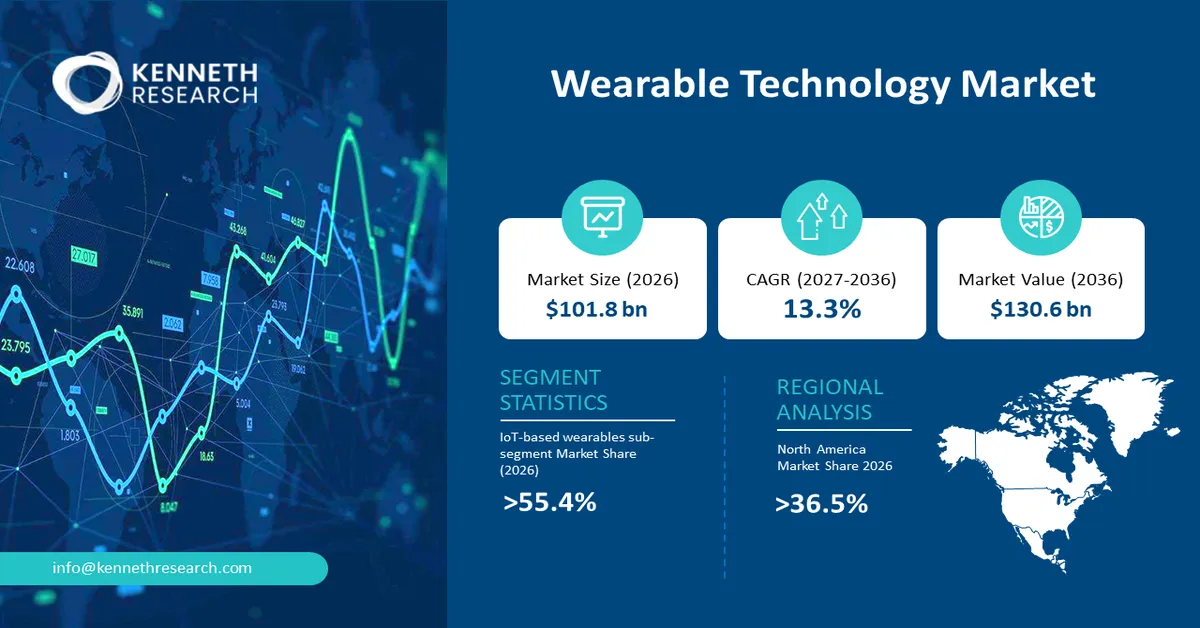
Wearable Technology Market size was valued at USD 101.8 billion in 2026 and is projected to reach USD 130.6 billion by the end of 2036, rising at a CAGR of 13.3% during the forecast period, i.e., 2027-2036. In 2027, the industry size of the wearable technology is estimated at USD 115.3 billion.
The increasing adoption of wearable devices for health and fitness monitoring is a key growth driver for the wearable technology market.
The wearable technology market comprises electronic devices designed to be worn on the body or incorporated into clothing and accessories to perform computing, sensing, communication, monitoring, and data-processing functions. These devices include smartwatches, fitness trackers, smart glasses, wearable medical devices, smart clothing, and other connected body-worn technologies.
The market encompasses hardware components, embedded sensors, connectivity technologies, software, and associated platforms that enable users or organizations to collect, process, transmit, and utilize real-time information.
Key Wearable Technology Market Insights Summary:
Key Takeaways: Market Trends & Insights
- The wearable technology market is projected to expand from USD 101.8 billion in 2026 to USD 130.6 billion by 2036, registering a CAGR of 13.3% during 2027-2036.
- IoT-based wearables represented the leading Technology segment, accounting for 55.4% in 2026, supported by increasing connectivity, real-time data collection, and integration with digital platforms.
- North America held the dominant regional position with a 36.5% share in 2026, with the U.S. and Canada serving as major markets.
- The Active segment within the Type category is expected to provide significant growth opportunities as demand increases for fitness, sports, activity tracking, and connected health applications.
- Asia-Pacific remains an important secondary market, particularly across Japan and China, supported by advanced electronics manufacturing, digital infrastructure, and increasing adoption of connected devices.
Market Drivers
- Expansion of IoT-Enabled Wearable Devices
- Increasing Adoption of Wearables for Healthcare Monitoring
- Advancements in Miniaturized and Energy-Efficient Electronics
- Development of Advanced Sensors and Flexible Wearable Technologies
Challenges
- Battery Life and Power Management
- Data Security, Interoperability, and Reliability
Wearable Technology Market Overview & Supply Chain
The wearable technology market is evolving from standalone consumer electronics toward connected devices that continuously collect, process, and transmit user-generated information. Wearables include smartwatches, fitness trackers, smart glasses, smart clothing, hearables, and healthcare-oriented devices incorporating sensors and wireless connectivity. Their applications increasingly span healthcare, fitness, workplace safety, sports, communication, and industrial environments. The U.S. Government Accountability Office reported that warehousing, manufacturing, and construction workers experienced over 700,000 nonfatal injuries in 2022, highlighting the potential role of wearable technologies in improving workplace safety and productivity.
The supply chain of the wearable technology market begins with raw-material and component suppliers, which provide semiconductors, sensors, microcontrollers, displays, batteries, memory components, communication modules, and specialized materials. These inputs are supplied to wearable-device manufacturers and electronics companies responsible for product design, hardware integration, embedded software, and device assembly.
The next stage involves sensor and hardware integration, where components such as motion sensors, optical sensors, biometric sensors, GPS modules, wireless connectivity chips, and processors are incorporated into compact device architectures. Manufacturers then undertake calibration, firmware integration, software testing, reliability assessment, and regulatory compliance before commercial release.
Wearable Technology Market: Growth Drivers & Challenges
Growth Drivers:
- Expansion of IoT-enabled wearable devices: The integration of wearables with the Internet of Things is a major growth driver. IoT-enabled devices can collect physiological or activity-related information, transmit it wirelessly, and connect users with smartphones, cloud platforms, healthcare systems, or enterprise applications. NIST research identifies smart wearables and remote physiological monitoring as important IoT-health applications, supporting the development of connected healthcare ecosystems.
- Increasing adoption of wearables for healthcare monitoring:
Wearable technologies are increasingly being developed for continuous health monitoring outside conventional clinical environments. NIST research describes wearable medical sensors capable of supporting continuous monitoring and transmitting physiological information to healthcare providers. This creates opportunities for remote patient monitoring, preventive healthcare, personalized medicine, and home-based care.
Challenges:
- Battery life and power management: Limited battery capacity remains a significant challenge as manufacturers attempt to add more sensors, connectivity functions, processing capabilities, and monitoring features without increasing device size. Continuous operation can increase energy consumption, particularly for healthcare and IoT applications where uninterrupted data collection is important. Energy harvesting and ultra-low-power electronics can help address this constraint, but achieving reliable operation remains technically demanding.
- Data security, interoperability, and reliability: Connected wearable devices transmit potentially sensitive information across multiple hardware and software environments, creating requirements for secure communications, reliable data transmission, interoperability, and effective data management. NIST identifies reliability, energy efficiency, interference, and security as important technical considerations for body-area networks and wearable medical sensing applications.
Wearable Technology Market Size and Forecast:
| Report Attribute | Details |
|---|---|
| Base Year |
2026 |
| Forecast Period |
2027-2036 |
| CAGR |
13.3% |
| Base Year Market Size (2026) |
USD 101.8 billion |
| Forecast Year Market Size (2036) |
USD 130.6 billion |
| Regional Scope |
|
Wearable Technology Market Segmentation Analysis:
Technology Segment Analysis
In the Technology segment, the IoT-based wearables sub-segment is anticipated to capture the largest market share of 55.4% in 2026.
IoT-based wearables are gaining traction because they combine sensing, wireless connectivity, data transmission, and software-enabled analytics within compact body-worn devices. Their ability to continuously collect and communicate information supports applications across healthcare, fitness, sports, workplace monitoring, and connected consumer electronics.
The growing emphasis on continuous monitoring is strengthening demand for connected wearable platforms. Research published through the U.S. National Library of Medicine highlights that wearable devices can support continuous collection of biosignals and facilitate longer-term health monitoring, while advances in embedded artificial intelligence are expanding their potential for autonomous diagnostic and assistive applications.
Type Segment Analysis
In the Type segment, the Active sub-segment is anticipated to witness significant growth opportunities during the forecast period. Active wearables are designed to support users during physical activity, exercise, sports, and fitness-related applications by continuously capturing information through embedded sensors and connected technologies. These devices include fitness trackers, sports-oriented smartwatches, activity monitors, and other wearable solutions designed to provide real-time feedback.
The growing emphasis on measuring physical activity is supporting demand for these devices. From a B2B perspective, the active segment creates opportunities for manufacturers of sensors, processors, connectivity modules, batteries, displays, and wearable platforms. Integration with mobile applications and cloud-based analytics further enables manufacturers and service providers to deliver personalized activity insights and performance monitoring.
Our in-depth analysis of the global wearable technology market includes the following segments:
|
Segment |
Sub-segment |
|
By Type |
|
|
Technology |
|
|
End User |
|
Wearable Technology Market Regional Insights:
North America Market Trends & Insights:
North America wearable technology market is projected to hold the largest revenue share of 36.5% by the end of 2026. The region's market is led by the U.S. and Canada, where manufacturers and technology providers benefit from mature ecosystems spanning semiconductors, software, telecommunications, healthcare, and consumer electronics.
The U.S. represents a particularly important market because of its extensive digital-health and connected-device ecosystem. The U.S. Government Accountability Office has highlighted the growing potential of health-related wearable devices for clinical decision-making, including their ability to collect health information and support healthcare applications.
Canada is also contributing to regional development through its digital-health and connected-technology capabilities. The combination of established telecommunications infrastructure, technology-oriented consumers, healthcare digitization, and demand for remote monitoring is supporting opportunities for wearable-device manufacturers and solution providers.
Asia-Pacific Market Trends & Insights:
Asia-Pacific is expected to remain a significant regional market for wearable technology, supported by expanding digital infrastructure, advanced electronics manufacturing capabilities, and increasing integration of connected devices into consumer and healthcare ecosystems.
Japan provides a favorable environment for wearable technology through its advanced electronics and healthcare technology ecosystem. The country’s emphasis on connected healthcare, robotics, sensors, and digital technologies creates opportunities for manufacturers to develop sophisticated wearable products incorporating health monitoring, activity tracking, communication, and IoT capabilities.
China represents another important growth market because of its extensive electronics manufacturing base and rapidly developing digital ecosystem.
Leading Companies Operating in the Wearable Technology Market:
Here is a list of upstream, downstream, and key players operating in the global wearable technology market competitive ecosystem:
- Apple (U.S)
- Company Overview
- Business Strategy
- Key Product Offerings
- Financial Performance
- Key Performance Indicators
- Risk Analysis
- Recent Development
- Regional Presence
- SWOT Analysis
- Samsung (South Korea)
- Garmin (U.S)
Recent Developments
- September 2025: Apple introduced the Apple Watch Ultra 3 alongside its latest Apple Watch generation. The company highlighted expanded health, fitness, safety, connectivity, and sports-oriented capabilities for the new wearable.
- July 2025: Samsung launched the Galaxy Watch8 series, introducing new smartwatch capabilities focused on health, sleep, exercise, and connected user experiences. Samsung officially announced the series on July 9, 2025.
Frequently Asked Question
In 2026, the wearable technology market was valued at USD 101.8 billion.
The wearable technology market is projected to reach USD 130.6 billion by the end of 2036, expanding at a CAGR of 13.3% during the forecast period, i.e., 2027–2036.
The major players in the market include Apple, Samsung, Garmin, Google, Xiaomi, and Huawei.
In the Technology segment, the IoT-based wearables sub-segment is anticipated to capture the largest market share of 55.4% in 2026, supported by increasing integration of connected devices, sensors, wireless communication, and data-driven applications.
North America is projected to hold the largest market share of 36.5% in 2026, supported by strong technology adoption and established digital ecosystems across the U.S. and Canada.
Why Choose Kenneth Research ?
-
Insight with Impact : We don’t just gather data — we uncover stories, trends, and opportunities that fuel business growth.
-
Experts Who Get It : Our team speaks your industry’s language and knows what really matters to your customers and market.
-
Custom-Built for You : Forget one-size-fits-all. We craft research and consulting solutions as unique as your business vision.
-
Partners, Not Just Providers : We work with you, not for you — collaborating closely to turn insights into smart, strategic moves.
-
Results That Speak : Our work powers brands, startups, and industry leaders alike — with a track record of ideas that work in the real world.
Report ID: 1352 |
Published Date: 28 Sep 2026 |
Report Format: |
Delivery Timeline: 48-72 Business Hours

Copyright © 2025 Kenneth Research. All rights reserved. Terms of Use | Privacy Policy
