Report ID: 1430 |
Published Date: 25 Sep 2026 |
Report Format: |
Delivery Timeline: 48-72 Business Hours
Train Battery Market Outlook:
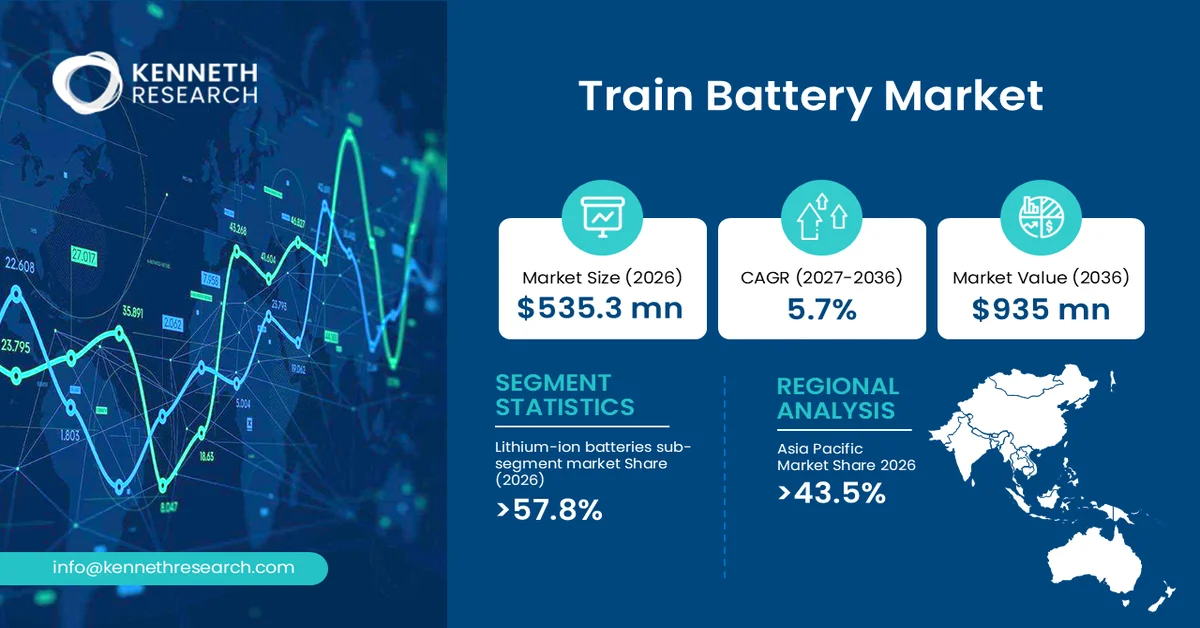
Train Battery Market size was valued at USD 535.3 million in 2026 and is projected to reach USD 935 million by the end of 2036, expanding at a CAGR of 5.7% during the forecast period, i.e., 2027–2036. In 2027, the industry size of the global train battery market is estimated at USD 567.7 million.
The primary growth driver for the train battery market is railway decarbonization, as governments and rail operators pursue alternatives to diesel traction on non-electrified routes.
The train battery market comprises batteries and associated battery systems designed to provide, store, and manage electrical energy for railway rolling stock. These systems support traction as well as auxiliary functions, depending on train configuration and operational requirements. Battery-powered and battery-electric trains can operate across electrified and non-electrified sections, with batteries charged through electrified track sections, dedicated charging facilities, or while trains are stabled.
Key characteristics include high energy-storage capability, reliable power delivery, thermal and battery-management systems, charging compatibility, safety controls, and suitability for integration with existing train electrical architectures. Battery configurations can support battery-only operation or hybrid arrangements in which trains draw electricity from railway infrastructure when available and rely on stored energy elsewhere.
Key Train Battery Market Insights Summary:
Key Takeaways: Market Trends & Insights
- Lithium-ion batteries held 57.8% market share in 2026, making them the leading battery type segment due to increasing adoption of battery-electric and hybrid trains
- Asia Pacific held 43.5% market share in 2026, supported by extensive railway networks, rolling-stock investment, electrification, and strong government attention to lower-emission rail technologies
- The train battery market is projected to reach USD 935.0 million by 2036, expanding at a 5.7% CAGR during 2027–2036
- Auxiliary batteries are projected to grow as rail operators modernize rolling stock and require reliable onboard power for lighting, communications, passenger information, ventilation, control systems, and emergency equipment
- Railway decarbonization is a key growth driver as battery-powered trains provide an alternative to diesel traction on routes where continuous electrification is difficult or commercially unattractive
Market Drivers
- Railway decarbonization and replacement of diesel traction
- Battery technology and fast-charging advancements
- Expansion of partially electrified and non-electrified rail networks
- Government support for low-emission rolling-stock modernization
Challenges
- High Upfront System and Infrastructure Requirements
- Battery Performance Constraints and Lifecycle Management
Train Battery Market Overview & Supply Chain
Adoption of train battery market technologies is increasing globally as railway operators and governments seek practical pathways to reduce dependence on diesel traction, particularly on routes where continuous electrification is operationally or economically challenging. Battery systems enable trains to draw electrical power from existing electrified infrastructure and use stored energy across non-electrified sections, supporting flexible low-emission operations. Technological progress in battery energy storage, power electronics, thermal management, regenerative braking, and fast charging is improving the feasibility of battery-powered rolling stock.
The train battery market value chain begins with upstream sourcing of battery materials, cells, electronic components, cooling systems, enclosures, and safety-related materials. Cell and module manufacturers convert these inputs into battery packs engineered for railway duty cycles, while system integrators incorporate battery management systems, thermal controls, power electronics, charging interfaces, and monitoring technologies. Train manufacturers and specialist rolling-stock suppliers then integrate complete battery systems into locomotives, multiple units, and hybrid platforms. Distribution typically involves direct procurement, engineering partnerships, framework agreements, and specialized rail-equipment channels. End users include passenger and freight rail operators, infrastructure managers, industrial rail users, and fleet owners.
Train Battery Market: Growth Drivers & Challenges
Growth Drivers
- Decarbonization of non-electrified rail networks: Government-led railway decarbonization programs are accelerating demand for battery traction because batteries provide an alternative to diesel operation on routes where continuous electrification is impractical. Battery-electric trains can combine onboard energy storage with existing electrified sections, reducing the need for extensive infrastructure expansion while maintaining operational flexibility. This creates opportunities for battery suppliers, rolling-stock manufacturers, charging-system providers, and rail operators to participate in fleet modernization programs.
- Advances in battery and fast-charging technology: Improvements in battery chemistry, energy management, thermal control, power electronics, and charging technology are improving the operational practicality of battery-powered trains. Faster charging enables operators to replenish onboard energy during scheduled station stops or at terminal facilities, reducing dependence on lengthy charging windows and supporting timetable continuity.
Challenges
- High upfront system and infrastructure requirements: Battery-powered rail deployment requires more than replacing a diesel powertrain with batteries. Operators may need dedicated charging equipment, grid connections, depot modifications, high-voltage safety systems, and specialized maintenance capabilities. The root cause is the integration of energy storage with railway infrastructure, where charging capacity and train operating patterns must be coordinated.
- Battery performance constraints and lifecycle management: Battery trains face operational constraints linked to energy density, charging availability, thermal management, degradation, and replacement planning. Unlike conventional traction systems, onboard energy storage must be sized around route length, gradients, passenger or freight loads, ambient conditions, and charging opportunities. Battery degradation can gradually reduce usable energy capacity, creating additional requirements for monitoring, maintenance, refurbishment, and eventual replacement.
Train Battery Market Size and Forecast:
| Report Attribute | Details |
|---|---|
| Base Year |
2026 |
| Forecast Period |
2027-2036 |
| CAGR |
5.7% |
| Base Year Market Size (2026) |
USD 535.3 Million |
| Forecast Year Market Size (2036) |
USD 935 Million |
| Regional Scope |
|
Train Battery Market Segmentation Analysis:
Battery Type Segment Analysis
In the battery type segment, lithium-ion batteries sub-segment is anticipated to capture the largest market share of 57.8% by the end of 2026.
Lithium-ion batteries dominate the battery type segment because their combination of energy density, rechargeability, power delivery, compact form factor, and established manufacturing ecosystem aligns closely with railway traction requirements. Demand is being reinforced by the transition toward battery-electric and hybrid trains, particularly where operators seek lower-emission alternatives without full route electrification. The U.S. Federal Railroad Administration notes that recent battery-electric locomotives in production or use employ variations of lithium-ion technology, with LFP and NMC among the principal chemistries. Supply-side maturity further strengthens the segment: lithium-ion benefits from extensive cell manufacturing capacity, established battery-management technologies, and increasingly diversified chemistry options. The International Energy Agency reports that lithium-ion battery capacity additions have expanded substantially as electrification accelerates across transport and energy applications.
Application Segment Analysis
The Auxiliary batteries are projected to grow as the second-largest segment in the train battery market due to four converging demand drivers.
Auxiliary batteries are projected to grow as rail operators increasingly prioritize reliable onboard power for essential non-traction functions, including lighting, communications, passenger information, ventilation, control systems, and emergency equipment. Their demand is strengthened by the modernization of rolling stock and the deployment of battery-electric, bi-mode, and hybrid trains, where dependable auxiliary power is important for maintaining services when traction power is unavailable or trains are stationary. Government policy is also encouraging technologies that reduce diesel operation. The UK Department for Transport states that its fast-charge trial with Great Western Railway is supporting battery-powered trains alongside improvements in air quality, decarbonization, and operational efficiency.
Our in-depth analysis of the train battery market includes the following segments:
|
Segment |
Sub-segment |
|
Battery Type |
|
|
Application |
|
|
Train Type |
|
|
Advanced Train Type |
|
Train Battery Market Regional Insights:
Asia Pacific Market Trends & Insights:
Asia Pacific train battery market is projected to hold the largest revenue share of 43.5% by the end of 2026.
Its leadership is supported by extensive railway networks, sustained rolling-stock investment, expanding electrification, and strong government attention to lower-emission rail technologies.
China represents the principal country market within Asia Pacific, supported by its extensive railway network, continuing infrastructure development, and strong domestic rail-equipment ecosystem.
Japan complements this scale advantage with established rail engineering capabilities and policy support for lower-carbon railway technologies. Together, these markets provide a strong foundation for battery-system deployment across new trains, fleet modernization, and specialized rail applications. The region’s combination of infrastructure scale, industrial capability, policy support, and technological development should sustain its leadership as railway operators progressively evaluate battery-based solutions for routes where conventional electrification is less practical.
Europe Market Trends & Insights:
Europe represents an important market for battery railway technologies because operators are seeking practical alternatives to diesel traction on routes where complete electrification may be difficult or commercially unattractive. Demand is supported by fleet modernization, decarbonization targets, increasing deployment of battery-electric multiple units, and investment in charging infrastructure.
Germany is a leading European country for battery-train deployment, with Deutsche Bahn developing charging infrastructure and expanding battery-train operations as part of its strategy to phase out diesel traction. Its Schleswig-Holstein program demonstrates how charging islands can enable battery trains to operate across routes without continuous overhead electrification.
The United Kingdom is similarly pursuing battery technology as part of railway decarbonization. The Department for Transport has supported battery-train trials and identified battery-electric trains as an important component of its longer-term approach to reducing diesel dependence. Together, Germany and the United Kingdom provide strong opportunities for suppliers through fleet renewal, infrastructure upgrades, technology trials, and future battery-electric rolling-stock procurement.
Leading Companies Operating in the Global Train Battery Market:
Here is a list of upstream, downstream, and key players operating in train battery market competitive ecosystem:
- Saft (France)
- Company Overview
- Business Strategy
- Key Product Offerings
- Financial Performance
- Key Performance Indicators
- Risk Analysis
- Recent Development
- Regional Presence
- SWOT Analysis
- EnerSys (United States)
- Exide Industries (India)
- Hitachi Rail (Japan)
- Forsee Power (France)
- HBL Engineering Limited (India)
Recent Developments
- In August 2026, Saft signed a Joint Development Agreement with Mana Battery to advance anode-free sodium-ion battery technology for rail and other demanding applications. The collaboration combines Mana's proprietary electrolyte and anode-free cell technology with Saft's cell design, manufacturing, and qualification expertise. The agreement targets rail applications where safety, reliability, and energy density are at a premium, alongside defense, aerospace, and datacenter markets.
- In June 2026, Forsee Power announced a partnership with KONČAR to electrify regional passenger trains in Europe. KONČAR selected FORSEE ZEN 55 LFP RAIL battery systems to equip its new generation of Battery Multiple Units (BMU) and Battery Electric Multiple Units (BEMU) trains, with an initial order to equip eight trains for operation in Croatia. The ZEN 55 LFP RAIL is compliant with EN 50126 SIL2 and key international standards including IEC 62928 and EN 45545, delivering up to 7,000 cycles.
Frequently Asked Question
In 2026, the train battery market exceeded USD 535.3 million.
The train battery market is projected to reach USD 935 million by the end of 2036, expanding at a CAGR of 5.7% over the forecast period (2027-2036).
The major players in the market are Saft (France), EnerSys (United States), Exide Industries (India), Hitachi Rail (Japan), Forsee Power (France), HBL Engineering Limited (India), and others.
In the Battery Type segment, the Lithium-ion batteries sub-segment is anticipated to capture the largest market share of 57.8% in the future and exhibit lucrative growth opportunities during 2027-2036. This growth trajectory is largely attributed to increasing adoption of battery-electric and hybrid trains.
Asia Pacific is projected to hold the largest market share of 43.5% by the end of 2036 and provide more business opportunities in the future. Continuous railway investment and technological development in China and Japan are fostering the region's dominance.
Why Choose Kenneth Research ?
-
Insight with Impact : We don’t just gather data — we uncover stories, trends, and opportunities that fuel business growth.
-
Experts Who Get It : Our team speaks your industry’s language and knows what really matters to your customers and market.
-
Custom-Built for You : Forget one-size-fits-all. We craft research and consulting solutions as unique as your business vision.
-
Partners, Not Just Providers : We work with you, not for you — collaborating closely to turn insights into smart, strategic moves.
-
Results That Speak : Our work powers brands, startups, and industry leaders alike — with a track record of ideas that work in the real world.
Report ID: 1430 |
Published Date: 25 Sep 2026 |
Report Format: |
Delivery Timeline: 48-72 Business Hours

Copyright © 2025 Kenneth Research. All rights reserved. Terms of Use | Privacy Policy
