Report ID: 1452 |
Published Date: 28 Sep 2026 |
Report Format: |
Delivery Timeline: 48-72 Business Hours
Telecom Shelter Cooling Market Outlook:
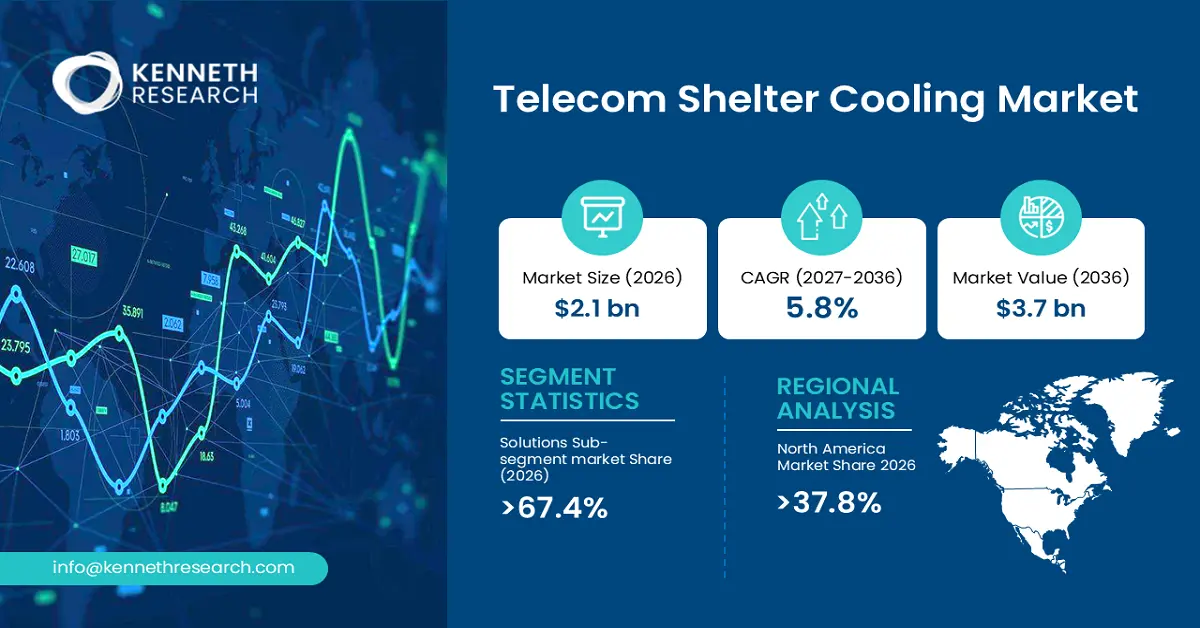
Telecom Shelter Cooling Market size was valued at USD 2.1 billion in 2026 and is projected to reach USD 3.7 billion by the end of 2036, rising at a CAGR of 5.8% during the forecast period, i.e., 2027–2036. In 2027, the industry size of the global telecom shelter cooling market is estimated at USD 2.2 billion.
The primary growth driver for the telecom shelter cooling market is the increasing deployment and densification of telecommunications infrastructure, which raises the need to maintain stable operating conditions for sensitive network equipment.
The telecom shelter cooling market comprises equipment, systems, and associated solutions used to regulate temperature and manage heat inside enclosed telecommunications shelters, cabinets, and equipment housing environments. These cooling systems protect network hardware from excessive heat and help maintain operating conditions required for reliable telecommunications services.
Key characteristics include continuous operation, thermal-load management, equipment protection, environmental control, and suitability for remote or unattended telecommunications sites. Solutions can incorporate active cooling technologies, including air conditioning units, as well as other thermal-management approaches selected according to shelter configuration, equipment density, ambient conditions, and energy requirements.
Key Telecom Shelter Cooling Market Insights Summary:
Key Takeaways: Market Trends & Insights
- Active cooling accounted for 67.4% market share in 2026, making it the leading sub-segment within Cooling Type
- North America held 37.8% market share in 2026, supported by telecommunications infrastructure investment and network modernization
- The telecom shelter cooling market is projected to grow at a 5.8% CAGR from 2027 to 2036
- The market is projected to increase from USD 2.2 billion in 2027 to USD 3.7 billion by 2036
- Air conditioning units are identified as the second and fastest-growing analysis segment within the component category
Market Drivers
- Expansion and modernization of telecommunications infrastructure
- Rising emphasis on energy-efficient thermal-management technologies
- Increasing network equipment density and associated heat loads
- Growing requirements for reliable cooling at remote and continuously operating sites
Challenges
- High energy consumption and total cost of ownership
- Installation complexity and maintenance constraints at remote sites
Telecom Shelter Cooling Market Overview & Supply Chain
Adoption of telecom shelter cooling systems is increasing globally as telecommunications networks expand, data-intensive services become more widespread, and operators upgrade infrastructure to support higher equipment densities and increasingly demanding operating environments. Cooling is essential for maintaining appropriate thermal conditions around network equipment, particularly at remote, continuously operating sites where equipment reliability and service continuity are critical.
The telecom shelter cooling market value chain begins with raw-material and component suppliers providing metals, plastics, insulation materials, compressors, heat exchangers, fans, controls, electrical components, refrigerants, and other thermal-management inputs. Equipment manufacturers integrate these inputs into air-conditioning units, active cooling systems, control assemblies, and shelter-specific cooling solutions, with production increasingly focused on reliability, energy efficiency, remote monitoring, and compatibility with telecommunications equipment. Distributors, system integrators, and specialized channel partners then move products to telecommunications operators, infrastructure providers, engineering contractors, and site-management companies. Installation and commissioning typically involve specialized technical service providers, while maintenance organizations support ongoing operation through inspection, replacement parts, repairs, and system optimization.
Telecom Shelter Cooling Market: Growth Drivers & Challenges
Growth Drivers
- Rising Demand for Energy-Efficient Cooling Infrastructure: The expansion and modernization of digital infrastructure are increasing attention on the energy performance of cooling systems used around telecommunications and computing equipment. As equipment becomes denser and thermal loads rise, operators have stronger incentives to deploy cooling technologies that maintain dependable operating conditions while controlling energy consumption.
- Increasing Network Equipment Density and Thermal Management Requirements: The continuing evolution of telecommunications infrastructure is increasing the importance of effective thermal management at network sites. Modern shelters may accommodate power systems, radio equipment, transmission hardware, batteries, and other electronic components within constrained spaces, making heat removal an integral part of site engineering. Higher equipment density can concentrate thermal loads and increase the consequences of inadequate temperature control, particularly at remote or continuously operating locations.
Challenges
- High Energy Consumption and Total Cost of Ownership: Cooling systems can represent a significant operating consideration for telecommunications shelters because equipment may need continuous temperature control regardless of traffic fluctuations or site utilization. The root cause is the combination of persistent cooling requirements, variable outdoor temperatures, heat generated by electronic equipment, and the need to maintain controlled conditions within compact enclosures.
- Installation Complexity and Maintenance Constraints at Remote Sites: Telecommunications shelters are frequently deployed across geographically dispersed locations, creating operational challenges for cooling-system installation, servicing, and component replacement. The root cause is the physical separation between network sites and centralized technical teams, combined with difficult access, environmental exposure, limited local infrastructure, and the need to coordinate cooling equipment with electrical and telecommunications systems.
| Report Attribute | Details |
|---|---|
| Base Year |
2026 |
| Forecast Year |
2027-2036 |
| CAGR |
5.8% |
| Base Year Market Size (2026) |
USD 2.1 Billion |
| Forecast Year Market Size (2037) |
USD 3.7 Billion |
| Regional Scope |
|
Telecom Shelter Cooling Market Segmentation Analysis:
Cooling Type Segment Analysis
Active cooling sub-segment is anticipated to capture the largest market share of 67.4% by the end of 2026.
Active cooling dominates the cooling-type segment because telecommunications shelters increasingly house network equipment that generates substantial heat during continuous operation. Unlike passive thermal-management approaches, active systems can actively remove heat and maintain controlled internal conditions despite changing outdoor temperatures and equipment loads. Demand is supported by network densification, 5G deployment, higher equipment processing requirements, and the growing need for reliable operation at remote sites. The International Telecommunication Union reported that 36% of mobile-broadband subscriptions were 5G/IMT-2020 subscriptions in 2025, reflecting the continued transition toward more advanced mobile networks. This transition supports demand for dependable thermal-management infrastructure because higher-performance network equipment requires appropriate environmental control.
Component Segment Analysis
The air conditioning units is projected to grow as the second-largest segment in the telecom shelter cooling market due to four converging demand drivers.
Air conditioning units are projected to grow within the component segment as telecommunications operators require dependable, controllable temperature management for increasingly distributed network infrastructure. These units provide active heat removal and can maintain stable shelter conditions across varying outdoor temperatures and equipment loads, making them suitable for sites where passive cooling is insufficient. Demand is supported by network expansion, rural connectivity initiatives, equipment modernization, and the increasing deployment of wireless infrastructure. The U.S. National Telecommunications and Information Administration reported 400,403 active Citizens Broadband Radio Service Devices nationwide as of July 1, 2024, demonstrating the expanding installed base of wireless infrastructure requiring supporting environmental systems. Supply-side development is increasingly focused on compact designs, energy efficiency, remote monitoring, and simplified maintenance.
Our in-depth analysis of the telecom shelter cooling market includes the following segments:
|
Segment |
Sub-segment |
|
Component |
|
|
Cooling Type |
|
|
Application |
|
|
End-User |
|
Telecom Shelter Cooling Market Regional Insights:
North America Market Trends & Insights:
Asia Pacific telecom shelter cooling is projected to hold the largest revenue share of 37.8% by the end of 2026.
North America remains the dominant regional market for telecom shelter cooling, supported by extensive telecommunications infrastructure, continued network modernization, investment in advanced wireless systems, and established technology supply chains.
The United States represents the region's principal consumption and investment base, supported by extensive network infrastructure, federal broadband programs, and ongoing deployment of advanced wireless technologies.
Canada complements this ecosystem through spectrum modernization, rural connectivity initiatives, and regulatory support for 5G deployment. Together, the two markets create sustained requirements for reliable shelter cooling, particularly as operators modernize equipment and expand network capacity across diverse climatic conditions.
Europe Market Trends & Insights:
Europe presents a sustained demand environment for telecom shelter cooling as governments and telecommunications operators continue expanding high-capacity digital infrastructure, upgrading mobile networks, and improving connectivity in underserved areas.
Germany is a significant opportunity within Europe because its Gigabit Strategy targets nationwide access to fibre and advanced mobile communications while encouraging more energy- and resource-efficient connectivity infrastructure. Continued network expansion creates requirements for dependable environmental control at telecommunications sites.
France is similarly positioned for continued infrastructure investment through France Très Haut Débit and the France 2030 agenda, which supports fibre deployment, industrial 5G adoption, sovereign networks, energy-efficient network technologies, and longer-term 6G development. These initiatives can broaden opportunities for telecom shelter cooling suppliers as network modernization extends across both countries.
Leading Companies Operating in the Telecom Shelter Cooling Market:
Here is a list of upstream, downstream, and key players operating in Telecom Shelter Cooling market competitive ecosystem:
- Schneider Electric (France)
- Company Overview
- Business Strategy
- Key Product Offerings
- Financial Performance
- Key Performance Indicators
- Risk Analysis
- Recent Development
- Regional Presence
- SWOT Analysis
- Delta Electronics, Inc. (Taiwan)
- Huawei Technologies Co., Ltd. (China)
- Eaton Corporation plc (Ireland)
- STULZ (Germany)
Recent Developments
- In September 2026, STULZ unveiled the fourth generation of its TelAir and WallAir cooling series. This particular series has been engineered to cater to the growing demand for critical and edge infrastructure applications, as well as 5G, by combining low worldwide warming potential R454C refrigerant, a certified EN 378 safety architecture, and integrated free cooling.
Frequently Asked Question
In 2026, the telecom shelter cooling market exceeded USD 2.1 billion.
The telecom shelter cooling market is projected to reach USD 3.7 billion by the end of 2036, expanding at a CAGR of 5.8% over the forecast period (2027-2036).
The major players in the market are Schneider Electric, Delta Electronics, Inc., Huawei Technologies Co., Ltd., Eaton Corporation plc, and others.
In the cooling type segment, the active cooling sub-segment is anticipated to capture the largest market share of 67.4% in the future and exhibit lucrative growth opportunities during 2027-2036. This growth trajectory is largely attributed to increasing network equipment density and associated heat loads.
North America is projected to hold the largest market share of 37.8% by the end of 2026 and provide more business opportunities in the future. Continuous investments in advanced wireless networks, infrastructure modernization, and telecommunications capacity across the United States and Canada are fostering the region's dominance.
Why Choose Kenneth Research ?
-
Insight with Impact : We don’t just gather data — we uncover stories, trends, and opportunities that fuel business growth.
-
Experts Who Get It : Our team speaks your industry’s language and knows what really matters to your customers and market.
-
Custom-Built for You : Forget one-size-fits-all. We craft research and consulting solutions as unique as your business vision.
-
Partners, Not Just Providers : We work with you, not for you — collaborating closely to turn insights into smart, strategic moves.
-
Results That Speak : Our work powers brands, startups, and industry leaders alike — with a track record of ideas that work in the real world.
Report ID: 1452 |
Published Date: 28 Sep 2026 |
Report Format: |
Delivery Timeline: 48-72 Business Hours

Copyright © 2025 Kenneth Research. All rights reserved. Terms of Use | Privacy Policy
