Report ID: 1231 |
Published Date: 28 Sep 2026 |
Report Format: |
Delivery Timeline: 48-72 Business Hours
Space Robotics Market Outlook:
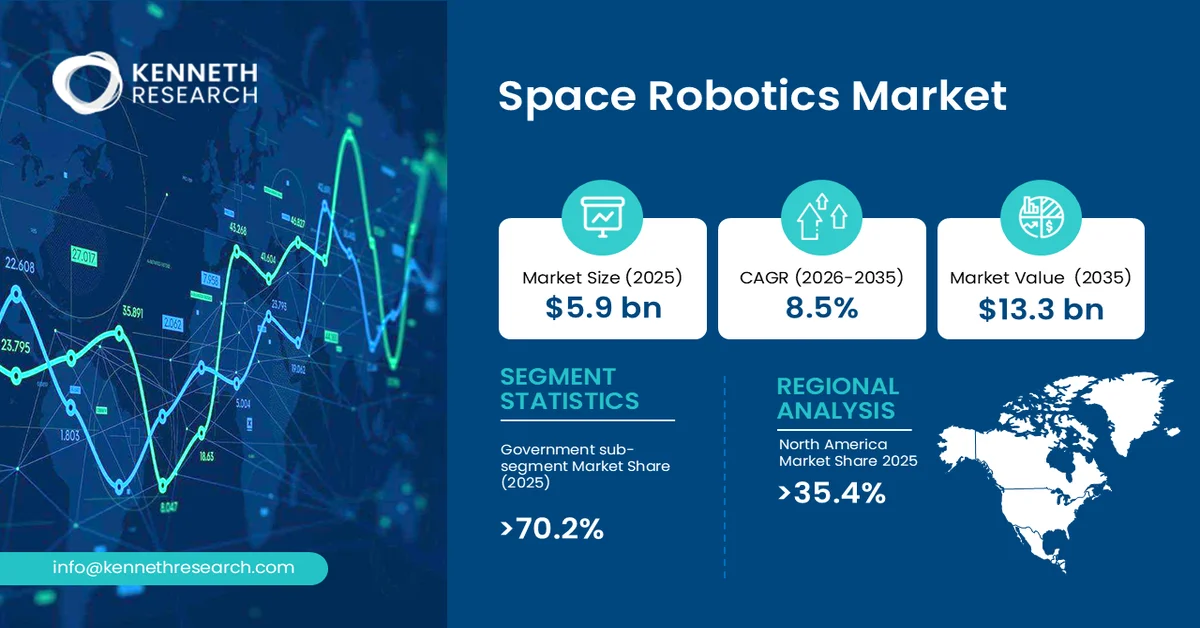
Space Robotics Market size was valued at USD 5.9 billion in 2025 and is projected to reach USD 13.1 billion by the end of 2035, expanding at a CAGR of 8.5% during the forecast period, i.e., 2026-2035. In 2026, the industry size of the space robotics is estimated at USD 6.4 billion.
The primary growth driver of the space robotics market is the increasing deployment of robotic systems to perform inspection, maintenance, cargo handling, exploration, and other tasks in environments where human intervention is difficult, costly, or risky. NASA identifies robotic systems as important technologies for human spaceflight and exploration, covering remotely controlled robots, autonomous systems, dexterous manipulation, telepresence, sensing, mobility, and fault-tolerant operations.
The space robotics market comprises robotic hardware, software, control systems, sensors, manipulators, rovers, remotely operated vehicles, and autonomous robotic platforms designed for operations in space. These systems can support spacecraft servicing, station maintenance, cargo handling, inspection, planetary exploration, scientific research, and infrastructure development.
Space robotics includes robotic arms, free-flying robots, planetary rovers, remotely operated systems, and autonomous robotic platforms. NASA's Astrobee program demonstrates the use of free-flying robots aboard the International Space Station for inventory management, experiment documentation, cargo movement, and technology research, with robots capable of autonomous operation or remote control.
Key Space Robotics Market Insights Summary:
Key Takeaways: Space Robotics Market
- The space robotics market is projected to grow from USD 5.9 billion in 2025 to USD 13.1 billion by 2035, registering a CAGR of 8.5% during 2026–2035.
- North America was the leading regional market, accounting for 35.4% in 2025, supported by strong government space programs, advanced robotics capabilities, and commercial participation.
- The Government segment dominated by end user, accounting for 70.2% in 2025, reflecting the continued importance of government-funded exploration, servicing, infrastructure, and technology-demonstration programs.
- Remotely Operated Vehicles (ROVs) represent an important solution category as space missions increasingly require remote inspection, servicing, exploration, and infrastructure-support capabilities.
Market Drivers
- Increasing demand for autonomous space operations.
- Growing use of robots for in-space infrastructure and exploration.
- Rising adoption of robotic systems for inspection, servicing, and maintenance.
- Advances in autonomous navigation, artificial intelligence, and multi-robot coordination.
Challenges
- Extreme space environment and component reliability.
- Communication delays and limited remote control.
Space Robotics Market: Market Overview & Supply Chain
The space robotics market is expanding as space agencies and commercial operators increasingly deploy robotic systems for inspection, maintenance, cargo handling, scientific research, and exploration. Robotic technologies can reduce astronaut exposure to hazardous or repetitive activities while improving mission productivity and enabling operations in environments where continuous human presence is impractical. NASA identifies autonomy, dexterous manipulation, sensing, mobility, telepresence, and fault tolerance as key areas of space robotics development.
The supply chain begins with suppliers of actuators, sensors, cameras, processors, control electronics, communication systems, batteries, structural materials, robotic joints, propulsion components, and specialized software. Robotics manufacturers and system integrators combine these components into robotic arms, rovers, free-flying robots, remotely operated vehicles, and autonomous platforms. Testing and qualification represent critical stages because space robots must operate reliably under microgravity, radiation, vacuum, thermal extremes, communication delays, and other demanding conditions.
Space Robotics Market: Growth Drivers & Challenges
Growth Drivers:
- Increasing demand for autonomous space operations: The growing need to perform inspection, maintenance, exploration, and infrastructure-related activities with limited human intervention is driving demand for autonomous space robotics. NASA identifies autonomy, automated planning, computer vision, distributed systems, and intelligent robotic software as important technologies for increasingly complex space missions. Autonomous systems can perform repetitive or long-duration tasks, support astronauts, and operate in environments where continuous ground control is impractical.
- Growing use of robots for in-space infrastructure and exploration: The expansion of lunar exploration and in-space infrastructure development is creating new requirements for robotic systems capable of assembling, servicing, inspecting, and constructing space assets. NASA states that future long-duration missions will require robots capable of helping construct and maintain infrastructure such as solar power systems, communications towers, and habitats. NASA's Fly Foundational Robots mission is also intended to demonstrate commercial robotic capabilities in low Earth orbit, supporting future applications including satellite servicing, infrastructure assembly, and construction.
Challenges:
- Extreme space environment and component reliability: Space robots must operate reliably under radiation, vacuum, temperature extremes, abrasive dust, and other conditions that can degrade sensors, actuators, electronics, and mechanical components. NASA identifies robotic actuation, subsystem components, and system architectures for long-duration and extreme-environment operation as a technology shortfall, noting that terrestrial robotic technologies cannot always be transferred directly to space applications without targeted development and qualification.
- Communication delays and limited remote control: Communication latency becomes a major constraint as robotic missions move beyond low Earth orbit. NASA research indicates that lunar missions can experience several seconds of one-way communication latency, while Mars missions can involve much longer delays, making conventional real-time ground control increasingly impractical. This increases the requirement for onboard autonomy, intelligent decision-making, and fault management.
Space Robotics Market Size and Forecast:
| Report Attribute | Details |
|---|---|
| Base Year |
2025 |
| Forecast Year |
2026-2035 |
| CAGR |
8.5% |
| Base Year Market Size (2025) |
USD 5.9 billion |
| Forecast Year Market Size (2035) |
USD 13.3 billion |
| Regional Scope |
|
Space Robotics Market Segmentation Analysis:
End User Type Segment Analysis
In the End User segment, the Government sub-segment is anticipated to capture the largest market share of 70.2% in 2025.
Government space agencies and defense organizations remain central to the development and deployment of space robotics because robotic systems support exploration, spacecraft servicing, inspection, infrastructure development, and other missions requiring high reliability and advanced technical capabilities. NASA states that robotics are critical to human spaceflight because they enable dexterous manipulation, autonomous vehicle operation, and efficient system management while reducing risks to humans.
Government-led programs are also increasingly creating pathways for commercial participation. NASA's Fly Foundational Robots mission is scheduled to demonstrate a commercial robotic arm in low Earth orbit, with capabilities including dexterous manipulation, autonomous tool use, and movement across spacecraft structures. The program is intended to establish capabilities for future in-space robotic servicing and infrastructure operations.
Solution Type Segment Analysis
In the Solution segment, Remotely Operated Vehicles (ROVs) are expected to gain traction as space missions increasingly require robotic systems that can be controlled from a distance while operating in hazardous, inaccessible, or complex environments. ESA identifies teleoperation and remote control as core capabilities within its space-robotics activities, covering applications ranging from manipulators to autonomous vehicles.
The importance of remotely operated systems is also demonstrated through ESA's Surface Avatar experiments. In 2024, astronauts aboard the International Space Station remotely operated multiple robots on Earth, including a rover and robotic systems, to simulate future operations on the Moon and Mars. The experiments demonstrated the potential for astronauts to control multiple robotic systems from space while performing complex tasks. In 2025, the final Surface Avatar session introduced greater autonomy, allowing an astronaut to delegate tasks to robots while maintaining higher-level control.
Our in-depth analysis of the global space robotics market includes the following segments:
|
Segment |
Sub-segment |
|
By Solution |
|
|
Application |
|
|
End User |
|
Space Robotics Market Regional Insights:
North America Market Trends & Insights:
North America accounted for 35.4% of the space robotics market in 2025, making it the dominant regional market.
The region benefits from strong government-led space programs, established aerospace capabilities, advanced robotics research, and growing collaboration between government agencies and commercial space companies. NASA is advancing robotic technologies for in-space servicing, assembly, manufacturing, exploration, and infrastructure development. Its Fly Foundational Robots mission is planned to deploy and operate a commercial robotic arm in low Earth orbit, demonstrating technologies intended to support future orbital infrastructure and operations at the Moon and beyond.
The U.S. remains the primary regional market, supported by NASA's extensive investment in robotic exploration, autonomous systems, spacecraft servicing, and lunar infrastructure. Government programs are increasingly using commercial partnerships to transition robotic capabilities from demonstrations toward operational space applications.
Canada also contributes significantly to the region's space robotics ecosystem through its established robotic capabilities. The Canadian Space Agency continues developing Canadarm3 for the Lunar Gateway, with the system designed to inspect and maintain the station, relocate modules, assist astronauts, and capture visiting spacecraft.
Europe Market Trends & Insights:
Asia-Pacific is expected to remain an important regional market for space robotics, supported by expanding lunar exploration programs, government-backed robotics research, and increasing development of autonomous and remotely operated systems. Japan and China are particularly significant markets because of their established space programs and growing focus on robotic exploration and lunar infrastructure.
Japan has demonstrated strong capabilities in autonomous lunar robotics. In January 2024, JAXA's LEV-1 and LEV-2 (SORA-Q) successfully operated on the lunar surface following deployment from the SLIM lander. LEV-2 captured and transmitted images of SLIM and demonstrated fully autonomous lunar-surface exploration, while LEV-1 performed hopping mobility and direct communication with Earth.
China is likewise strengthening its lunar and deep-space exploration capabilities through government-led space programs, creating opportunities for robotic platforms, autonomous navigation, remote operations, and planetary exploration technologies.
Leading Companies Operating in the Global Space Robotics Market:
Here is a list of upstream, downstream, and key players operating in the global space robotics market competitive ecosystem:
- MDA Space(Canada)
- Company Overview
- Business Strategy
- Key Product Offerings
- Financial Performance
- Key Performance Indicators
- Risk Analysis
- Recent Development
- Regional Presence
- SWOT Analysis
- Northrop Grumman(United States)
- Maxar Technologies(United States)
- Lockheed Martin(United States)
Recent Developments
- July 2026 — Northrop Grumman / NASA-supported RSGS: The Mission Robotic Vehicle carrying the Robotic Servicing of Geosynchronous Satellites (RSGS) payload launched on July 21, 2026.
- June 2026 —MDA Space highlighted the recognition of the Shuttle Remote Manipulator System (Canadarm) as an IEEE Milestone. The company continues advancing next-generation robotics through its Canadarm3 program and MDA SKYMAKER™ product line.
Frequently Asked Question
In 2025, the space robotics market exceeded USD 5.9 billion.
The space robotics market is projected to reach USD 13.1 billion by the end of 2035, expanding at a CAGR of 8.5% over the forecast period (2026–2035).
The major players in the market are MDA Space, Northrop Grumman, Maxar Technologies, Lockheed Martin, Astroscale, Redwire, and others.
In the End User segment, the Government sub-segment is anticipated to capture the largest market share of 70.2% in the future and exhibit lucrative growth opportunities during 2026–2035.
North America is projected to hold the largest market share of 35.4% by the end of 2025 and provide more business opportunities in the future.
Why Choose Kenneth Research ?
-
Insight with Impact : We don’t just gather data — we uncover stories, trends, and opportunities that fuel business growth.
-
Experts Who Get It : Our team speaks your industry’s language and knows what really matters to your customers and market.
-
Custom-Built for You : Forget one-size-fits-all. We craft research and consulting solutions as unique as your business vision.
-
Partners, Not Just Providers : We work with you, not for you — collaborating closely to turn insights into smart, strategic moves.
-
Results That Speak : Our work powers brands, startups, and industry leaders alike — with a track record of ideas that work in the real world.
Report ID: 1231 |
Published Date: 28 Sep 2026 |
Report Format: |
Delivery Timeline: 48-72 Business Hours

Copyright © 2025 Kenneth Research. All rights reserved. Terms of Use | Privacy Policy
