Report ID: 1441 |
Published Date: 25 Sep 2026 |
Report Format: |
Delivery Timeline: 48-72 Business Hours
Solar Sunlight Control System Market Outlook:
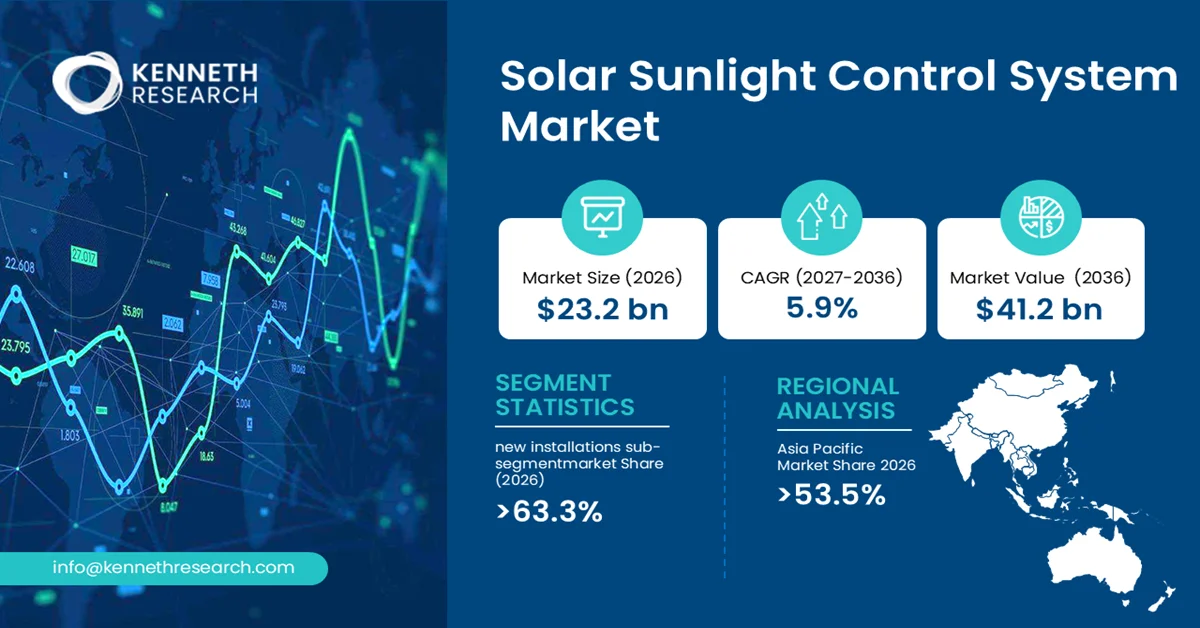
Solar Sunlight Control System Market size was valued at USD 23.2 billion in 2026 and is projected to reach USD 41.2 billion by the end of 2036, rising at a CAGR of 5.9% during the forecast period, i.e., 2027–2036. In 2027, the industry size of the solar sunlight control system market is estimated at USD 24.6 billion.
The primary growth driver for the solar sunlight control system market is the increasing deployment of solar photovoltaic (PV) systems and the growing need to optimize sunlight exposure, energy generation, and system performance.
The solar sunlight control system market comprises technologies and equipment designed to control, regulate, or optimize the amount and direction of sunlight received by solar-energy systems. These systems include automated tracking mechanisms, control units, sensors, actuators, and associated software that adjust solar equipment according to the sun's position and operating conditions. They are used across residential, commercial, and utility-scale solar installations to improve energy capture, operational efficiency, and system performance.
The market covers both new installations and replacement or retrofit applications, with systems supplied through manufacturers, system integrators, engineering companies, and solar installation providers. Growing adoption of automated and intelligent control technologies is further supporting the transition from manually adjusted systems toward digitally managed solar installations.
Key Solar Sunlight Control System Market Insights Summary:
Key Takeaways: Market Trends & Insights
- The solar sunlight control system market is projected to grow from USD 24.6 billion in 2027 to USD 41.2 billion by 2036, driven by expanding solar deployment and demand for optimized energy generation.
- New Installations dominated the Installation Type segment with a 63.3% share in 2026, supported by the integration of sunlight-control technologies into newly developed solar projects.
- Systems represent the key Product segment, benefiting from growing demand for integrated tracking, sensing, control, and monitoring capabilities.
- Asia-Pacific led the market with a 53.5% share in 2026, supported by extensive solar deployment and renewable-energy investment in China and Japan.
Market Drivers
- Rapid expansion of solar PV installations
- Growing adoption of automated and intelligent tracking technologies
- Increasing deployment of utility-scale solar power projects
- Rising demand for higher solar energy yield and optimized land utilization
Challenges
- High Installation, Maintenance, and Component Costs
- Site-Specific Performance and Environmental Constraints
Solar Sunlight Control System Market – Market Overview & Supply Chain
The solar sunlight control system market is expanding alongside the global deployment of solar photovoltaic (PV) capacity, as developers and system operators increasingly seek technologies that improve energy capture and operational performance. Solar sunlight control systems encompass tracking mechanisms, sensors, controllers, actuators, positioning equipment, and software that regulate the orientation or exposure of solar-energy equipment according to sunlight conditions.
The supply chain begins with manufacturers of structural components, sensors, motors, actuators, electronic controllers, communication components, and software. System manufacturers integrate these components into complete sunlight-control solutions and configure them for specific solar installations. Engineering, procurement, and construction companies and system integrators then incorporate the systems into solar projects, while distributors and specialized solar-equipment suppliers support regional sales and installation.
Solar Sunlight Control System Market: Growth Drivers & Challenges
Growth Drivers
- Rapid expansion of solar pv installations: The rapid expansion of solar photovoltaic (PV) installations is increasing demand for sunlight control technologies that maximize energy capture from each installed system. As solar projects become larger and increasingly optimized for energy yield, developers are placing greater emphasis on technologies that can continuously adjust module orientation according to solar position and operating conditions. This trend is expected to strengthen demand for automated sunlight control systems, particularly in utility-scale projects, while also encouraging technology suppliers to develop more reliable, digitally controlled solutions.
- Growing adoption of automated and intelligent tracking technologies: The increasing integration of automated tracking, sensors, electronic controllers, and software-based optimization is creating another important growth avenue for the solar sunlight control system market. Modern control architectures can continuously adjust the position of solar modules according to the sun's movement, weather conditions, irradiance levels, and other operating parameters. This enables solar installations to extract more useful energy from available land and installed generating capacity than conventional fixed-position configurations in suitable locations.
Challenges
- High installation, maintenance, and component costs: The adoption of solar sunlight control systems can be constrained by the additional hardware and maintenance requirements associated with moving solar equipment. Compared with fixed-tilt installations, tracking systems require motors, actuators, controllers, sensors, structural mechanisms, and communication components, creating additional points of potential failure. The commercial impact is particularly relevant for projects operating under tight power-purchase-agreement economics, where additional maintenance expenses can reduce expected returns.
- Site-specific performance and environmental constraints: Solar sunlight control systems must operate reliably under varying site conditions, including wind, dust, temperature fluctuations, uneven terrain, shading, and soil conditions. These factors can affect mechanical alignment, actuator performance, sensor accuracy, and the ability of tracking equipment to maintain the desired position. In the future, manufacturers will need to improve adaptive control algorithms, environmental sensing, structural robustness, and predictive maintenance capabilities to ensure consistent performance across diverse geographic and climatic environments.
Solar Sunlight Control System Market Size and Forecast:
| Report Attribute | Details |
|---|---|
| Base Year |
2026 |
| Forecast Period |
2027-2036 |
| CAGR |
5.9% |
| Base Year Market Size (2026) |
USD 23.2 billion |
| Forecast Year Market Size (2036) |
USD 41.2 billion |
| Regional Scope |
|
Solar Sunlight Control System Market Segmentation Analysis:
Installation Type Segment Analysis
In the Installation Type segment, the new installations sub-segment dominates with a share of 63.3% in 2026, supported by the continued expansion of solar generation capacity and the integration of sunlight-control technologies into newly developed projects. New solar installations provide stronger opportunities to deploy tracking mechanisms, sensors, controllers, and actuators as part of the original system design, avoiding the engineering limitations associated with retrofitting existing assets. Developers are increasingly incorporating automated control technologies during project planning to improve energy capture and optimize land utilization. Going forward, continued solar capacity additions, modernization of project designs, and increasing automation are expected to sustain the dominance of new installations.
Product Type Segment Analysis
In the Product segment, the systems sub-segment is projected to witness strong growth as solar projects increasingly require integrated solutions capable of coordinating sensors, tracking mechanisms, controllers, actuators, and monitoring functions. Rather than relying on individual components, project developers are increasingly seeking integrated systems that can simplify installation, commissioning, control, and long-term operation. This trend is reinforced by the rapid expansion of solar installations across major markets. Supply-side manufacturers are responding by integrating digital controls, sensing capabilities, communications, and automated tracking into increasingly standardized platforms. Over the forecast period, greater system integration and digitalization should strengthen demand for complete sunlight-control systems across utility-scale and distributed solar applications.
Our in-depth analysis of the global solar sunlight control system market includes the following segments:
|
Segment |
Sub-segment |
|
Product Type |
|
|
Installation Type |
|
|
Application |
|
Solar Sunlight Control System Market Regional Insights:
Asia-pacific Market Trends & Insights:
Asia-Pacific dominated the solar sunlight control system market, accounting for 53.5% in 2026. The region's leadership is supported by its extensive solar manufacturing ecosystem, accelerating photovoltaic deployment, large-scale project development, and strong investment in renewable-energy infrastructure.
China is the region's largest demand center because of its extensive utility-scale and distributed solar deployment, creating substantial opportunities for integrated sunlight-control systems.
Japan represents another important market, supported by its mature solar industry, limited land availability, and emphasis on improving generation efficiency from existing sites. The combination of large-scale installations in China and technology-focused deployment in Japan is expected to sustain Asia-Pacific's leadership.
North America Market Trends & Insights:
North America represents an important market for solar sunlight control systems because of expanding utility-scale solar development, commercial installations, grid modernization, and increasing emphasis on maximizing renewable-energy output. The region benefits from established solar supply chains, sophisticated project-development capabilities, and government policies supporting renewable-energy investment.
The U.S. remains the principal North American market because of its large utility-scale solar pipeline, growing electricity demand, and continued investment in renewable generation. Tracking and automated control technologies are particularly relevant to large projects seeking higher energy yields and improved asset utilization.
Canada offers additional opportunities through increasing renewable-energy deployment, provincial clean-energy initiatives, and growing interest in utility-scale and distributed solar generation. Over the forecast period, regional opportunities are expected to expand as developers prioritize higher project efficiency, digital monitoring, and automated solar-system operation.
Leading Companies Operating in the Global Solar Sunlight Control System Market:
Here is a list of upstream, downstream, and key players operating in the global solar sunlight control system market competitive ecosystem:
- Nextracker (Nextpower) (U.S)
- Company Overview
- Business Strategy
- Key Product Offerings
- Financial Performance
- Key Performance Indicators
- Risk Analysis
- Recent Development
- Regional Presence
- SWOT Analysis
- ARRAY Technologies (U.S)
- OMCO Solar (U.S)
Recent Developments
- June2026—Nextpower launched the NX Gemini 2P solar tracker system for international markets and introduced the NX Anchor integrated foundation solution for its NX Horizon platform. The expansion broadens its tracker portfolio for different site and land-use requirements
- June 2026 — ARRAY launched the DuraTrack D2S, a dual-row tracker designed with terrain-following flexibility, passive wind-stow technology, and SmarTrack software compatibility.
Frequently Asked Question
In 2026, the solar sunlight control system market exceeded USD 23.2 billion.
The solar sunlight control system market is projected to reach USD 41.2 billion by the end of 2036, expanding at a CAGR of 5.9% over the forecast period (2027–2036).
The major players in the market are Nextracker (Nextpower), ARRAY Technologies, Kinematics, OMCO Solar, and others.
In the Installation Type segment, the New Installations sub-segment is anticipated to capture the largest market share of 63.3% in the future and exhibit lucrative growth opportunities during 2027–2036.
Asia-Pacific is projected to hold the largest market share of 53.5% by the end of 2036 and provide more business opportunities in the future.
Why Choose Kenneth Research ?
-
Insight with Impact : We don’t just gather data — we uncover stories, trends, and opportunities that fuel business growth.
-
Experts Who Get It : Our team speaks your industry’s language and knows what really matters to your customers and market.
-
Custom-Built for You : Forget one-size-fits-all. We craft research and consulting solutions as unique as your business vision.
-
Partners, Not Just Providers : We work with you, not for you — collaborating closely to turn insights into smart, strategic moves.
-
Results That Speak : Our work powers brands, startups, and industry leaders alike — with a track record of ideas that work in the real world.
Report ID: 1441 |
Published Date: 25 Sep 2026 |
Report Format: |
Delivery Timeline: 48-72 Business Hours

Copyright © 2025 Kenneth Research. All rights reserved. Terms of Use | Privacy Policy
