Report ID: 1431 |
Published Date: 25 Sep 2026 |
Report Format: |
Delivery Timeline: 48-72 Business Hours
Solar Farm Market Outlook:
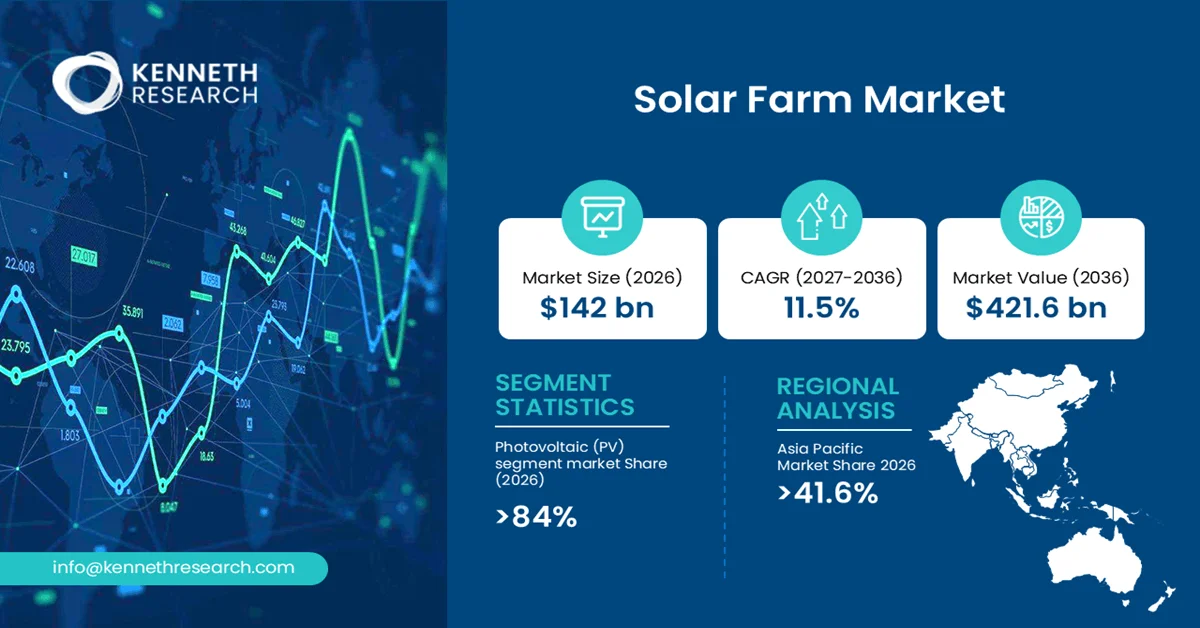
Solar Farm Market size was valued at USD 142 billion in 2026 and is projected to reach USD 421.6 billion by the end of 2036, rising at a CAGR of 11.5% during the forecast period, i.e., 2027-2036. In 2027, the industry size of the solar farm is estimated at USD 158.3 billion.
The primary growth driver for the solar farm market is the accelerating global deployment of renewable electricity capacity as governments pursue decarbonization, energy security, and reduced dependence on fossil fuels.
The solar farm market refers to the industry involved in the development, financing, construction, operation, and maintenance of large-scale facilities that generate electricity from solar energy. These projects primarily use photovoltaic (PV) modules to convert sunlight directly into electricity, while some facilities may use other solar-generation technologies.
Key characteristics include extensive land or suitable-site requirements, interconnected solar generation assets, electrical collection and conversion infrastructure, monitoring and control systems, and increasingly integrated battery-storage capabilities.
Key Solar Farm Market Insights Summary:
Key Takeaways: Market Trends & Insights
- Solar Farm Market projected to grow from USD 142 billion in 2026 to USD 421.6 billion by 2036 at an 11.5% CAGR
- Asia-Pacific accounted for the largest regional share at 41.6% in 2026
- Photovoltaic (PV) is expected to remain the leading Technology segment with an 84% market share in 2026, supported by the scalability and widespread adoption of PV systems in large-scale solar projects
- Utility-Scale Solar Farms will continue to represent a significant market opportunity as utilities and independent power producers expand large-scale renewable generation capacity and integrate solar with storage and grid infrastructure
Market Drivers
- Expansion of utility-scale renewable-energy procurement and competitive auctions
- Rising electricity demand from industrialization, electrification, and data-center development
- Increasing corporate adoption of renewable power-purchase agreements
- Integration of solar farms with battery storage and modern grid-management systems
Challenges
- Grid-connection and transmission constraints
- Land, permitting, and project-development complexity
Solar Farm Market Overview & Supply Chain
Global adoption of solar farms is increasing as governments and utilities expand renewable electricity generation, improve energy security, and reduce dependence on fossil-fuel-based power. Technological improvements in photovoltaic modules, trackers, inverters, grid infrastructure, and battery integration are improving project economics and operational flexibility. Supportive renewable-energy policies, competitive generation costs, and increasing electricity demand are further encouraging developers and institutional investors to expand solar-farm portfolios. The growing integration of battery storage with utility-scale PV projects is also improving grid flexibility and creating additional opportunities for solar-farm developers.
The solar farm value chain begins with raw materials and component inputs, including silicon, glass, aluminum, copper, polymers, semiconductor materials, steel, and electronic components used in modules, mounting structures, trackers, cables, inverters, transformers, and switchgear. Manufacturers process these inputs into photovoltaic modules and balance-of-system equipment, while specialized engineering companies provide tracking, monitoring, power-conversion, and grid-management technologies.
Solar Farm Market: Growth Drivers & Challenges
Growth Drivers:
- Accelerating global renewable-energy deployment: The rapid expansion of renewable electricity capacity is a fundamental growth driver for the solar farm market. Governments are increasing renewable-energy targets, implementing competitive auctions, and supporting grid-connected solar projects to reduce emissions and strengthen energy security. Solar PV is particularly attractive because projects can be deployed at different scales and increasingly benefit from lower equipment costs, improved module efficiency, tracking systems, and streamlined project development.
- Rising electricity demand and grid decarbonization: Growing electricity consumption is encouraging utilities and power developers to add new generation capacity, while decarbonization objectives are increasing the preference for renewable power sources. Solar farms provide a scalable generation option that can be developed alongside transmission infrastructure, storage systems, and other flexible resources. Their ability to generate electricity without direct fuel consumption also reduces exposure to fossil-fuel price volatility and supports long-term power-supply planning.
Challenges:
- Grid-connection and transmission constraints: A major restraint is the limited availability of transmission infrastructure in areas with strong solar resources. Solar farms are often developed faster than the grid infrastructure required to evacuate their electricity, creating connection delays, curtailment risks, and uncertainty over project commissioning schedules. The challenge becomes more pronounced as solar penetration rises and generation increasingly occurs far from major electricity-demand centers.
- Land, permitting, and project-development complexity: Large solar farms require suitable land, environmental assessments, construction approvals, grid-interconnection permissions, and coordination with local authorities and communities. Lengthy permitting procedures can extend development timelines and increase pre-construction expenditure, while land-use conflicts can restrict project locations or require developers to redesign projects. These issues are particularly significant for utility-scale installations because projects involve large physical footprints and long operating lifetimes.
Solar Farm Market Size and Forecast:
| Report Attribute | Details |
|---|---|
| Base Year |
2026 |
| Forecast Period |
2027-2036 |
| CAGR |
11.5% |
| Base Year Market Size (2026) |
USD 142 billion |
| Forecast Year Market Size (2036) |
USD 421.6 billion |
| Regional Scope |
|
Solar Farm Market Segmentation Analysis:
Technology Type Segment Analysis
Photovoltaic (PV) is the leading technology segment in the solar farm market, accounting for 84% in 2026. Its dominance reflects the scalability, technological maturity, and broad commercial deployment of PV systems for utility-scale electricity generation. Developers increasingly favor PV farms because improvements in module efficiency, solar tracking, inverters, and project engineering enable larger installations and better utilization of available land. Falling equipment costs and increasingly competitive procurement mechanisms are also supporting adoption.
On the supply side, an established manufacturing ecosystem for modules, inverters, trackers, and balance-of-system components supports large-scale project deployment. Increasing integration of PV with battery storage and advanced grid-management systems is further improving its operational flexibility.
Type Segment Analysis
Utility-Scale Solar Farms are projected to remain a major growth segment within the type category because large-scale projects provide utilities and independent power producers with a scalable method of adding renewable generation to electricity grids. Demand is being supported by rising electricity consumption, government renewable-energy procurement, corporate power-purchase agreements, and the increasing need to replace or diversify fossil-fuel generation. Supply-side conditions are also becoming more favorable as improvements in photovoltaic modules, trackers, inverters, grid infrastructure, and project-development practices enable increasingly large installations.
Our in-depth analysis of the global solar farm market includes the following segments:
|
Segment |
Sub-segment |
|
By Type |
|
|
By Technology |
|
|
By Capacity |
|
|
End User |
|
Solar Farm Market Regional Insights:
Asia-pacific Market Trends & Insights:
Asia-Pacific is the dominant region in the solar farm market, accounting for 41.6% of the market in 2026.
The region benefits from extensive solar-resource availability, large-scale renewable-energy deployment, established photovoltaic manufacturing capabilities, and substantial government investment in clean-power infrastructure.
China remains the principal regional market because of its extensive solar manufacturing ecosystem, large utility-scale project pipeline, and continued expansion of renewable electricity generation. Its vertically integrated supply chain supports module production, project development, engineering, and deployment at scale.
Japan represents another important market, with demand supported by energy-security priorities, distributed and utility-scale solar deployment, and efforts to increase renewable electricity in its power mix. The combination of manufacturing strength, government-backed renewable targets, grid investment, and rising electricity demand is expected to maintain Asia-Pacific's leadership through the forecast period.
North America Market Trends & Insights:
North America represents a significant secondary market for the solar farm market, supported by rising electricity demand, renewable-energy procurement, utility investment, and continued development of large-scale photovoltaic projects.
The U.S. remains the principal North American market, supported by substantial utility-scale project development and an established ecosystem of developers, manufacturers, financiers, and grid operators.
Canada offers additional opportunities through provincial renewable-energy procurement and government-backed projects. In Alberta, for example, the Canadian government reported that the 465 MW travers solar project is one of North America's largest solar projects, while federal funding has supported Indigenous-led solar projects.
Leading Companies Operating in the Global Solar Farm Market:
Here is a list of upstream, downstream, and key players operating in the global solar farm market competitive ecosystem:
- LONGi (China)
- Company Overview
- Business Strategy
- Key Product Offerings
- Financial Performance
- Key Performance Indicators
- Risk Analysis
- Recent Development
- Regional Presence
- SWOT Analysis
- JinkoSolar (China)
- First Solar (U.S)
Recent Developments
- August 2026 — LONGi launched its integrated LONGi ONE solar-and-energy-storage solution in Egypt on August 11, 2026. The company stated that the launch was intended to support integrated solar and storage development in Egypt and the wider MENA region.
- June 2026 — In June 2026, JinkoSolar launched its next-generation Tiger Neo 5.0 module. The company's second-quarter 2026 results state that the module offers more than 700 W of power output and up to 25.91% module efficiency.
Frequently Asked Question
In 2026, the solar farm market exceeded USD 142 billion.
The solar farm market is projected to reach USD 421.6 billion by the end of 2036, expanding at a CAGR of 11.5% over the forecast period (2027-2036).
The major players in the market are First Solar, LONGi, JinkoSolar, Trinasolar, and others.
In the technology segment, the photovoltaic (PV) sub-segment is anticipated to capture the largest market share of 84% in the future and exhibit lucrative growth opportunities during 2027-2036.
Asia-Pacific is projected to hold the largest market share of 41.6% by the end of 2026 and provide more business opportunities in the future.
Why Choose Kenneth Research ?
-
Insight with Impact : We don’t just gather data — we uncover stories, trends, and opportunities that fuel business growth.
-
Experts Who Get It : Our team speaks your industry’s language and knows what really matters to your customers and market.
-
Custom-Built for You : Forget one-size-fits-all. We craft research and consulting solutions as unique as your business vision.
-
Partners, Not Just Providers : We work with you, not for you — collaborating closely to turn insights into smart, strategic moves.
-
Results That Speak : Our work powers brands, startups, and industry leaders alike — with a track record of ideas that work in the real world.
Report ID: 1431 |
Published Date: 25 Sep 2026 |
Report Format: |
Delivery Timeline: 48-72 Business Hours

Copyright © 2025 Kenneth Research. All rights reserved. Terms of Use | Privacy Policy
