Report ID: 1256 |
Published Date: 01 Sep 2026 |
Report Format: |
Delivery Timeline: 48-72 Business Hours
Solar Energy Systems Market Outlook:
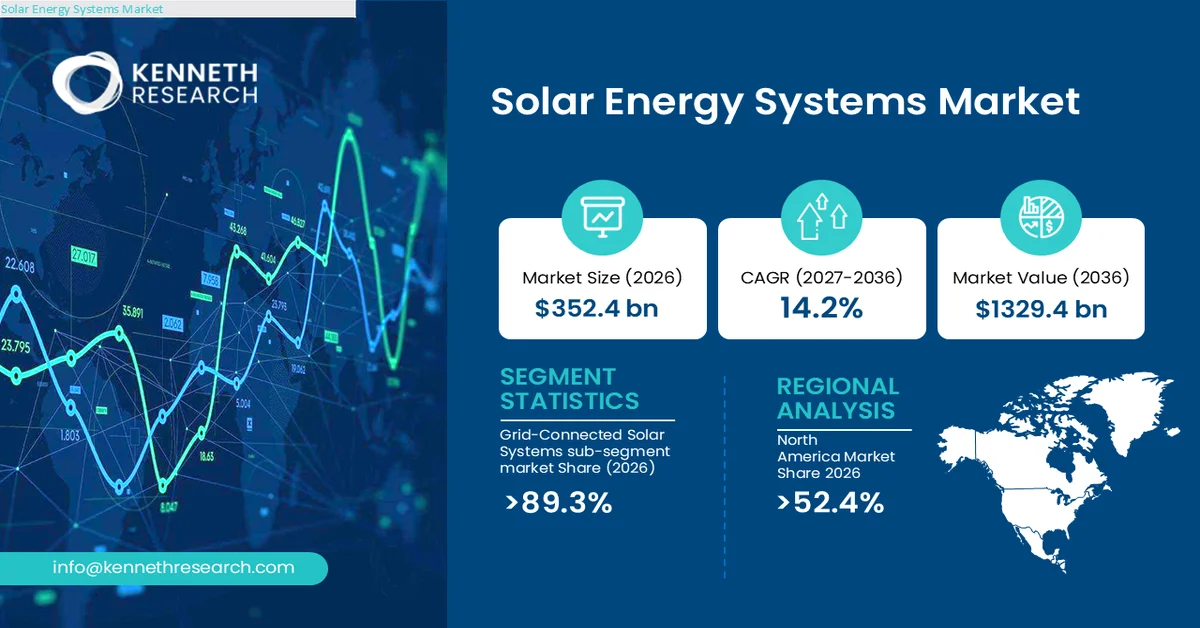
Solar Energy Systems Market size was valued at USD 352.4 billion in 2026 and is projected to reach USD 1329.4 billion by the end of 2036, rising at a CAGR of 14.2% during the forecast period, i.e., 2027–2036. In 2027, the industry size of the solar energy systems is estimated at USD 402.4 billion.
The primary growth driver for the solar energy systems market is accelerating global adoption of solar power as utilities, businesses, and households seek low-carbon electricity generation and greater energy security.
The solar energy systems market encompasses equipment, technologies, and integrated solutions that capture solar radiation and convert it into usable electricity or heat. The market primarily includes photovoltaic systems, concentrating solar-thermal systems, modules, mounting structures, inverters, transformers, electrical protection equipment, monitoring systems, and associated storage technologies.
Key characteristics include modular system architecture, scalable deployment, integration with electricity networks, and compatibility with residential, commercial, industrial, utility-scale, and off-grid applications. PV systems convert sunlight directly into electricity, while inverters convert the resulting direct current into alternating current suitable for electrical loads and grid connection.
Key Solar Energy Systems Market Insights Summary:
Key Takeaways: Market Trends & Insights
- Solar Energy Systems Market projected to grow from USD 352.4 billion in 2026 to USD 1329.4 billion by 2036 at a 14.2% CAGR.
- North America accounted for the largest regional share at 52.4% in 2026, supported by expanding solar deployment, established renewable-energy infrastructure, and continued investment across the U.S. and Canada.
- Grid-Connected Solar Systems is expected to remain the leading System Type segment with an 89.3% market share in 2026, driven by increasing utility-scale and distributed PV deployment and growing integration of solar generation into electricity networks.
- Solar Photovoltaic (PV) is expected to maintain strong growth within the Technology segment, supported by advances in module efficiency, inverter technology, system monitoring, and grid-integration capabilities.
Market Drivers
- Increasing utility-scale deployment of solar photovoltaic generation.
- Growing integration of solar systems with electricity grids and energy-storage technologies.
- Expansion of distributed solar generation across commercial and residential applications.
- Increasing government support for renewable-energy deployment and electricity-system decarbonization.
Challenges
- Grid integration and interconnection complexity.
- Supply chain and manufacturing constraints.
Solar Energy Systems Market: Market Overview & Supply Chain
Global adoption of solar energy systems is increasing as governments, utilities, businesses, and households pursue lower-carbon electricity generation, energy diversification, and greater energy security. Technological improvements in photovoltaic modules, inverters, power electronics, monitoring systems, and grid integration are improving system performance and expanding deployment across utility-scale, commercial, and distributed applications. The International Energy Agency reports that solar PV accounted for more than three-quarters of renewable capacity additions globally in 2024, highlighting its growing importance within electricity-system expansion.
The solar energy systems market value chain begins with raw-material suppliers providing silicon, glass, aluminum, semiconductor materials, electrical conductors, encapsulants, and other inputs required for solar equipment. Manufacturers process these materials into photovoltaic cells, modules, inverters, mounting systems, electrical equipment, monitoring technologies, and related system components. System integrators and engineering, procurement, and construction firms then design and assemble complete installations according to project requirements.
Solar Energy Systems Market: Growth Drivers & Challenges
Growth Drivers
- Accelerating solar power deployment: The accelerating deployment of solar power is strengthening demand for complete solar energy systems across utility-scale, commercial, and distributed applications. Solar PV is increasingly being integrated into electricity systems as governments and utilities expand renewable generation and pursue lower-carbon power portfolios. In the U.S., the Energy Information Administration reported that utility-scale solar photovoltaic capacity reached 122,061.8 MW in 2024, demonstrating the expanding physical infrastructure supporting solar electricity generation. This expansion creates demand across the system value chain, including modules, inverters, mounting structures, electrical equipment, monitoring systems, and grid-interconnection technologies.
- Expanding grid integration and energy-system flexibility: Increasing integration of solar generation into conventional electricity networks is driving demand for systems capable of operating reliably under changing power-generation conditions. Solar output varies with weather and daylight, creating requirements for advanced inverters, monitoring systems, grid-management technologies, and complementary storage. Solar systems are consequently evolving from standalone generation assets into integrated energy solutions capable of communicating with grid infrastructure and responding to operational requirements. Utilities are also adopting technologies that improve forecasting, power-quality management, voltage regulation, and system visibility as solar penetration increases.
Challenges
- Grid integration and interconnection complexity: The increasing deployment of solar systems creates technical challenges for electricity networks because solar generation is variable and can introduce bidirectional power flows, voltage-management requirements, and changing system operating conditions. Utilities must upgrade planning models, protection systems, inverters, communications infrastructure, and network controls to accommodate growing volumes of inverter-based generation. The U.S. Department of Energy identifies system planning, system operation, resilience, cybersecurity, and enabling technologies as key areas requiring attention for reliable integration of solar and other inverter-based resources.
- Supply chain and manufacturing constraints: Solar-system deployment remains exposed to supply-chain complexity because production depends on interconnected manufacturing stages spanning raw materials, wafers, cells, modules, power electronics, and balance-of-system components. Disruptions at any stage can affect procurement schedules, project execution, and equipment availability. The U.S. Department of Energy has identified upstream PV manufacturing as an area where production capacity and supply-chain development need strengthening, particularly across silicon wafer and cell manufacturing. This creates commercial challenges for manufacturers and developers seeking predictable equipment availability and competitive procurement conditions.
Solar Energy Systems Market Size and Forecast:
| Report Attribute | Details |
|---|---|
| Base Year |
2026 |
| Forecast Period |
2027-2036 |
| CAGR |
14.2% |
| Base Year Market Size (2026) |
USD 352.4 billion |
| Forecast Year Market Size (2036) |
USD 1329.4 billion |
| Regional Scope |
|
Solar Energy Systems Market Segmentation Analysis:
System Type Segment Analysis
In the System Type segment, the Grid-Connected Solar Systems sub-segment is anticipated to capture the largest market share of 89.3% by the end of 2026. Its dominance is supported by increasing deployment of utility-scale and distributed photovoltaic generation that feeds electricity directly into established power networks. Grid-connected configurations enable solar projects to serve electricity demand while allowing utilities and system operators to incorporate renewable generation into broader power-system planning. The U.S. Energy Information Administration reported that solar photovoltaic generation across utility-scale and small-scale facilities reached 303,752 thousand megawatthours in 2024, reflecting the expanding contribution of grid-connected and distributed solar resources.
Technology Type Segment Analysis
In the Technology segment, the Solar Photovoltaic (PV) sub-segment is projected to maintain strong growth as photovoltaic technology remains the principal pathway for converting sunlight directly into electricity. Demand is supported by utility-scale solar development, distributed generation, commercial installations, and increasing integration of solar resources into electricity networks. The U.S. Energy Information Administration reported that total U.S. solar photovoltaic capacity from utility-scale and small-scale facilities reached 175,289.9 MW in 2024, illustrating the expanding installed base of PV technology.
Industry adoption is reinforced by continued improvements in module efficiency, inverter technology, system monitoring, installation methods, and power-management capabilities. The supply side is also expanding through broader PV manufacturing capacity and increasingly integrated system offerings.
Our in-depth analysis of the global solar energy systems market includes the following segments:
|
Segment |
Sub-segment |
|
By Technology |
|
|
By Product |
|
|
System Type |
|
|
System Size |
|
|
Installation Type |
|
|
End-Use |
|
Solar Energy Systems Market Regional Insights:
North America Trends & Insights:
North America is the dominant region, accounting for 52.4% in 2026, supported by extensive solar deployment, strong utility participation, established renewable-energy infrastructure, and continued investment in grid-connected generation. The region benefits from supportive clean-energy policies, established project-development ecosystems, and advanced manufacturing and engineering capabilities. Solar is also becoming an increasingly important component of new electricity-generation capacity. The U.S. Energy Information Administration reported that developers planned 36.4 GW of utility-scale solar additions in the United States for 2024, reflecting strong project activity and continued expansion of solar-generation infrastructure.
The U.S. remains the principal growth engine in North America, supported by large-scale utility solar projects, distributed PV deployment, grid expansion, and increasing integration of solar with battery storage. The country's mature financing, EPC, manufacturing, and utility ecosystem supports deployment across multiple project categories.
Canada is also expanding its solar-power base, with opportunities driven by renewable-energy development, provincial clean-electricity initiatives, distributed generation, and utility-scale projects.
Asia-Pacific Trends & Insights:
Asia-Pacific represents a major opportunity for the Solar Energy Systems Market, supported by rapid renewable-energy deployment, expanding electricity demand, industrial decarbonization, and increasing integration of distributed and utility-scale solar generation. Governments across the region are strengthening policies and infrastructure to accommodate higher solar penetration and improve renewable-energy utilization. The region's established manufacturing ecosystem further supports project deployment and technology development.
Japan is focusing on improving grid flexibility and renewable-energy integration as solar deployment expands. Government-backed initiatives are creating opportunities for advanced photovoltaic systems, distributed generation, energy-management technologies, and grid-integration solutions.
China represents a particularly important growth engine because of its extensive solar manufacturing capabilities, large electricity system, and continued renewable-energy deployment. China's energy authorities are also promoting improved grid infrastructure and new mechanisms for local renewable-energy consumption, including direct renewable-electricity connections between generation and industrial users.
Leading Companies Operating in the Global Solar Energy Systems Market:
Here is a list of upstream, downstream, and key players operating in the global solar energy systems market competitive ecosystem:
- First Solar (United States)
- Company Overview
- Business Strategy
- Key Product Offerings
- Financial Performance
- Key Performance Indicators
- Risk Analysis
- Recent Development
- Regional Presence
- SWOT Analysis
- LONGi (China)
- JinkoSolar (China)
Recent Developments
- July 2026 — LONGi introduced a new portfolio of photovoltaic technologies spanning solar cells, modules, hardware, and energy-management solutions at its 2026 PV and Energy Storage Innovation Technology Launch.
- April 2026 — JinkoSolar launched its next-generation Tiger Neo 5.0 photovoltaic module platform, based on advanced TOPCon technology, alongside a new energy-storage system.
Frequently Asked Question
In 2026, the solar energy systems market exceeded USD 352.4 billion.
The solar energy systems market is projected to reach USD 1329.4 billion by the end of 2036, expanding at a CAGR of 14.2% over the forecast period (2027–2036).
The major players in the market are First Solar, LONGi, JinkoSolar, Trinasolar, Canadian Solar, and others.
In the System Type segment, the Grid-Connected Solar Systems sub-segment is anticipated to capture the largest market share of 89.3% in the future and exhibit lucrative growth opportunities during 2027–2036.
North America is projected to hold the largest market share of 52.4% by the end of 2036 and provide more business opportunities in the future.
Why Choose Kenneth Research ?
-
Insight with Impact : We don’t just gather data — we uncover stories, trends, and opportunities that fuel business growth.
-
Experts Who Get It : Our team speaks your industry’s language and knows what really matters to your customers and market.
-
Custom-Built for You : Forget one-size-fits-all. We craft research and consulting solutions as unique as your business vision.
-
Partners, Not Just Providers : We work with you, not for you — collaborating closely to turn insights into smart, strategic moves.
-
Results That Speak : Our work powers brands, startups, and industry leaders alike — with a track record of ideas that work in the real world.
Report ID: 1256 |
Published Date: 01 Sep 2026 |
Report Format: |
Delivery Timeline: 48-72 Business Hours

Copyright © 2025 Kenneth Research. All rights reserved. Terms of Use | Privacy Policy
