Report ID: 1270 |
Published Date: 01 Sep 2026 |
Report Format: |
Delivery Timeline: 48-72 Business Hours
Silicones Market Outlook:
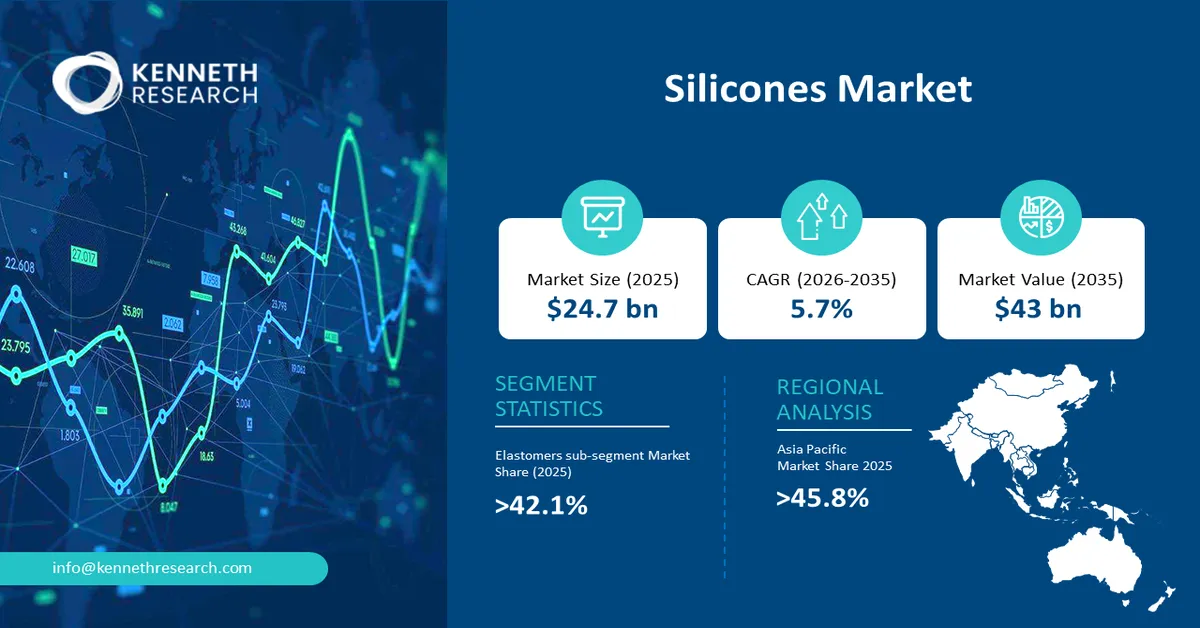
Silicones Market size was valued at USD 24.7 billion in 2025 and is projected to reach USD 43 billion by the end of 2035, rising at a CAGR of 5.7% during the forecast period, i.e., 2026-2035. In 2026, the industry size of the silicones is estimated at USD 26.1 billion.
Increasing demand for high-performance, durable materials across construction, automotive, electronics, healthcare, and industrial applications is driving silicone consumption. Silicones provide a combination of thermal stability, flexibility, chemical resistance, weatherability, electrical insulation, and long service life, making them suitable for applications where conventional materials may have performance limitations. Growing demand for advanced manufacturing, infrastructure, electronics, and electric vehicles is further supporting adoption of silicone-based products.
The silicones market comprises silicone-based polymers, fluids, elastomers, resins, gels, and related formulations manufactured from silicon-based raw materials for use across diverse industries. Silicone materials are valued for their resistance to temperature extremes, moisture, chemicals, weathering, and aging, alongside their flexibility and electrical-insulation properties. The market includes products used in elastomers, fluids, resins, adhesives, sealants, and other silicone-based formulations. These materials serve applications ranging from automotive components and electronics to construction sealants, medical devices, personal care products, industrial processes, and energy-related equipment.
Key Silicones Market Insights Summary:
Key Takeaways: Market Trends & Insights
- Silicones market projected to grow from USD 24.7 billion in 2025 to USD 43 billion by 2035, registering a 5.7% CAGR.
- Asia Pacific held the largest regional share at 45.8% in 2025, supported by strong manufacturing, automotive, electronics, construction, and chemical industries.
- Elastomers represented the leading Product segment with a 42.1% share in 2025, driven by demand for flexible, durable, and temperature-resistant silicone materials.
- Industrial Processes is an important end-use area, with silicones used as processing aids, release agents, defoamers, lubricants, and specialty materials.
- Market opportunities are supported by industrial modernization, automotive electrification, electronics manufacturing, infrastructure development, and increasing demand for high-performance materials.
- Key challenges include environmental and regulatory scrutiny and recycling and end-of-life management, encouraging manufacturers to improve product sustainability and circularity.
Market Drivers
- Expanding automotive and electronics manufacturing.
- Rising demand for durable industrial materials.
- Increasing use of silicone-based insulation and sealing solutions.
- Growth in infrastructure and industrial applications.
Challenges
- Environmental and regulatory scrutiny
- Recycling and end-of-life management
Silicones Market Overview & Supply Chain
The silicones market is supported by broad demand from automotive, construction, electronics, healthcare, consumer products, and industrial manufacturing. Silicone materials are increasingly used where flexibility, durability, thermal stability, electrical insulation, and resistance to moisture or chemicals are required. Japan's automotive industry illustrates the strength of a key downstream application: the Japan Automobile Manufacturers Association reported 8.23 million four-wheel vehicles produced in 2024, supporting continued demand for silicone-based components, sealants, insulation, and protective materials
The supply chain begins with silicon-based raw materials and intermediates, followed by silicone polymer production, compounding, formulation, and conversion into elastomers, fluids, resins, adhesives, sealants, and other products. These materials are supplied through direct industrial sales, specialty distributors, formulators, and component manufacturers before reaching end users. Key participants include silicone producers, chemical suppliers, compounders, converters, distributors, OEMs, construction companies, electronics manufacturers, automotive companies, and industrial users.
Silicones Market: Growth Drivers & Challenges
Growth Drivers:
- Expanding industrial and manufacturing activity: Rising manufacturing activity across automotive, electronics, machinery, construction, and chemical industries is supporting silicone demand. Silicones provide thermal stability, flexibility, insulation, sealing, and resistance to moisture and chemicals, making them suitable for demanding industrial applications. Japan's Ministry of Economy, Trade and Industry tracks production across chemicals, electrical machinery, transport machinery, plastics, and other manufacturing categories, highlighting the breadth of industries linked to silicone consumption.
- Increasing demand for advanced electronics and automotive components: Growing production of electronic equipment, electric vehicles, and advanced automotive systems is creating opportunities for silicone-based insulation, encapsulation, adhesives, sealants, and protective components. Silicones can withstand temperature variation and provide electrical insulation, making them valuable in increasingly compact and performance-sensitive applications. Continued investment in electronics and automotive manufacturing should support demand for specialized silicone materials.
Challenges:
- Environmental and regulatory scrutiny: Certain silicone intermediates, particularly cyclic siloxanes such as D4, are receiving increased regulatory attention because of potential environmental and exposure concerns. The U.S. EPA's ongoing D4 risk evaluation illustrates the growing need for manufacturers to monitor chemical-use requirements, exposure controls, and regulatory developments. Such scrutiny can increase compliance costs and encourage manufacturers to develop alternative formulations and tighter process controls.
- Recycling and end-of-life management: Silicone products can be difficult to recycle economically because many applications involve crosslinked or highly durable materials. The EPA's recent assessment notes that recycling silicone products remains a specialty process, while many end-of-life silicone products may ultimately enter disposal streams. This creates pressure on manufacturers to improve collection, recycling technologies, material recovery, and circular-product design. Developing cost-effective recycling pathways while maintaining silicone performance remains an important industry challenge.
Silicones Market Size and Forecast:
| Report Attribute | Details |
|---|---|
| Base Year |
2025 |
| Forecast Period |
2026-2035 |
| CAGR |
5.7% |
| Base Year Market Size (2025) |
USD 24.7 billion |
| Forecast Year Market Size (2035) |
USD 43 billion |
| Regional Scope |
|
Silicones Market Segmentation Analysis:
Product Type Segment Analysis
In the Product segment, the Elastomers sub-segment is anticipated to capture the largest market share of 42.1% in 2025.
Silicone elastomers are widely used because of their flexibility, thermal stability, weather resistance, electrical insulation, and durability. Demand is supported by applications across automotive components, electronics, construction, healthcare, and industrial equipment. Their ability to maintain performance across demanding temperature and environmental conditions makes them suitable for seals, gaskets, insulation, tubing, keypads, and molded components. Continued expansion of automotive electrification, electronics manufacturing, and industrial automation is expected to create additional opportunities for silicone elastomer suppliers.
End Use Type Segment Analysis
The Industrial Processes segment is expected to grow as manufacturers increasingly use silicones for processing aids, release agents, defoamers, lubricants, coatings, and other specialized functions. Silicone materials offer thermal stability, low surface energy, chemical resistance, and controlled processing characteristics, making them useful across plastics, textiles, chemicals, manufacturing, and other industrial operations. Growing automation and demand for efficient production processes are creating additional opportunities for silicone-based process materials. Manufacturers are also developing application-specific formulations designed to improve productivity, reduce material waste, and maintain consistent processing performance. Continued industrial modernization across Asia Pacific, North America, and other manufacturing regions is expected to support demand for silicone products used in industrial processes.
Our in-depth analysis of the global silicones market includes the following segments:
|
Segment |
Sub-segment |
|
Product |
|
|
End Use |
|
Silicones Market Regional Insights:
Asia Pacific Market Trends & Insights:
Asia Pacific accounted for 45.8% of the silicones market in 2025, supported by strong manufacturing, automotive production, electronics, construction, and chemical-processing industries.
The region benefits from extensive downstream manufacturing capacity and established silicone supply chains, while increasing investment in advanced electronics, electric mobility, infrastructure, and industrial production is creating additional demand. Japan and China remain key markets because of their sophisticated manufacturing ecosystems and broad consumption of silicone-based materials.
Japan has strong demand from automotive, electronics, healthcare, and industrial applications, supported by advanced manufacturing capabilities and established specialty-chemical industries.
China provides significant opportunities through its large automotive, electronics, construction, and industrial manufacturing base. China's National Bureau of Statistics reported that the country's value added of industrial enterprises above designated size increased 5.8% in 2024, demonstrating continued industrial activity that supports downstream demand for silicone materials.
North America Market Trends & Insights:
North America represents an important market for silicones, supported by established automotive, electronics, construction, healthcare, and industrial manufacturing industries. Demand is reinforced by the region's need for durable sealing, insulation, encapsulation, protective coatings, and high-performance elastomer solutions. The U.S. benefits from a large and diversified manufacturing base, while Canada adds opportunities through automotive, industrial, construction, and chemical applications.
The U.S. remains the principal regional market because of its extensive industrial infrastructure and demand for advanced materials across automotive, electronics, aerospace, healthcare, and construction. The Federal Reserve's industrial-production data tracks substantial manufacturing activity across transportation equipment, electrical equipment, chemicals, and other industries that use silicone-based materials.
Canada provides additional opportunities through its manufacturing and automotive ecosystem. Statistics Canada reported CAD 931.2 billion in total manufacturing revenue in 2024, demonstrating the scale of Canada's downstream industrial base. Continued industrial modernization, automotive production, infrastructure investment, and demand for durable materials should support silicone consumption across both countries.
Leading Companies Operating in the Global Silicones Market:
Here is a list of upstream, downstream, and key players operating in the silicones market competitive ecosystem:
- Dow(United States)
- Company Overview
- Business Strategy
- Key Product Offerings
- Financial Performance
- Key Performance Indicators
- Risk Analysis
- Recent Development
- Regional Presence
- SWOT Analysis
- Wacker Chemie AG(Germany)
- Shin-Etsu Chemical(Japan)
- Momentive(United States)
Recent Developments
- September 2025: Dow Launched DOWSIL™ EG-4175 Silicone Gel for high-voltage power electronics used in electric vehicles and renewable-energy applications.
- May 2025: Dow Introduced its first low-carbon silicone elastomer blends under the Decarbia™ platform for personal-care applications.
Frequently Asked Question
The silicones market was valued at USD 24.7 billion in 2025.
The market is projected to reach USD 43 billion by 2035, expanding at a 5.7% CAGR during 2026-2035.
Major players include Dow, Wacker Chemie AG, Shin-Etsu Chemical, Momentive, and Elkem, among others.
Within the Product segment, Elastomers held the largest share at 42.1% in 2025, supported by demand from automotive, electronics, construction, healthcare, and industrial applications.
Asia Pacific is projected to remain the leading region, accounting for 45.8% in 2025, supported by strong manufacturing, automotive, electronics, construction, and chemical industries in Japan and China.
Why Choose Kenneth Research ?
-
Insight with Impact : We don’t just gather data — we uncover stories, trends, and opportunities that fuel business growth.
-
Experts Who Get It : Our team speaks your industry’s language and knows what really matters to your customers and market.
-
Custom-Built for You : Forget one-size-fits-all. We craft research and consulting solutions as unique as your business vision.
-
Partners, Not Just Providers : We work with you, not for you — collaborating closely to turn insights into smart, strategic moves.
-
Results That Speak : Our work powers brands, startups, and industry leaders alike — with a track record of ideas that work in the real world.
Report ID: 1270 |
Published Date: 01 Sep 2026 |
Report Format: |
Delivery Timeline: 48-72 Business Hours

Copyright © 2025 Kenneth Research. All rights reserved. Terms of Use | Privacy Policy
