Report ID: 1324 |
Published Date: 11 Sep 2026 |
Report Format: |
Delivery Timeline: 48-72 Business Hours
Selective Emitter Solar Cell Market Outlook:
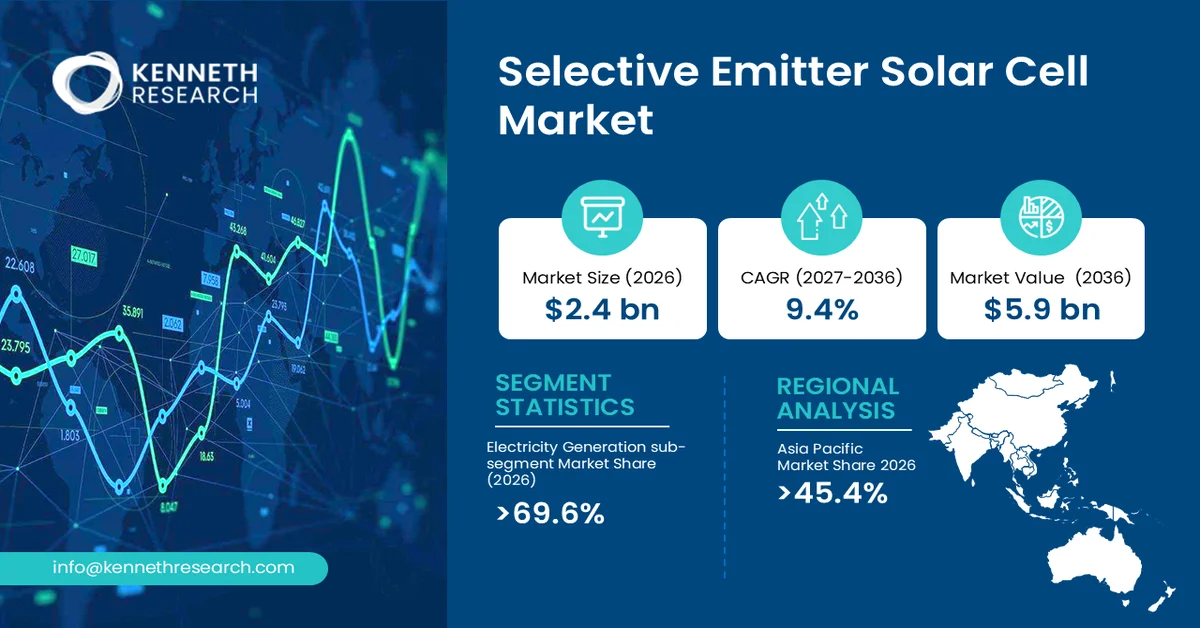
Selective Emitter Solar Cell Market size was valued at USD 2.4 billion in 2026 and is projected to reach USD 5.9 billion by the end of 2036, rising at a CAGR of 9.4% during the forecast period, i.e., 2027–2036. In 2027, the industry size of the global selective emitter solar cell market is estimated at USD 2.6 billion.
The primary growth driver is accelerating solar photovoltaic deployment supported by policy momentum, energy-security priorities, and improving competitiveness. The International Energy Agency reported that global renewable capacity additions were set to increase by 107 GW in 2023, with solar PV accounting for the principal expansion, strengthening demand for higher-efficiency cell technologies.
The selective emitter solar cell market comprises technologies, materials, manufacturing processes, and associated equipment used to produce photovoltaic cells incorporating a selective-emitter architecture. A selective emitter is designed to create different doping characteristics across the cell surface, typically providing a highly doped region beneath metal contacts while maintaining a comparatively less heavily doped region elsewhere. This architecture is intended to reduce electrical losses associated with carrier collection while maintaining effective contact formation.
Key characteristics include localized emitter engineering, controlled dopant distribution, optimized contact interfaces, and compatibility with established crystalline-silicon photovoltaic manufacturing processes. The approach can support higher cell conversion performance by improving the electrical properties of the emitter and reducing recombination or contact-related losses.
Key Selective Emitter Solar Cell Market Insights Summary:
Key Takeaways: Market Trends & Insights
- Selective emitter solar cell market is valued at USD 2.4 billion in 2026 and is projected to reach USD 5.9 billion by 2036, reflecting a 9.4% CAGR during 2027–2036
- Electricity Generation leads the End Use segment with a 69.6% market share in 2026, supported by expanding photovoltaic deployment and demand for higher-efficiency electricity generation
- Monocrystalline Silicon Solar Cells represent the fastest-growing analysis segment as manufacturers prioritize higher-efficiency crystalline-silicon technologies and advanced cell architectures
- Asia Pacific dominates the regional landscape with a 45.4% market share in 2026, supported by extensive photovoltaic manufacturing, deployment, and investment across China and Japan
Market Drivers
- Increasing demand for higher photovoltaic cell efficiency
- Integration with established crystalline-silicon manufacturing infrastructure
- Advancement of precision doping, laser processing, and metallization technologies
- Growing emphasis on manufacturing productivity, process optimization, and cell performance
Challenges
- Manufacturing complexity and stringent process-control requirements
- Competitive pressure from alternative photovoltaic cell architectures
Selective Emitter Solar Cell Market Overview & Supply Chain
Global adoption of selective-emitter technology is increasing as photovoltaic manufacturers pursue higher cell performance while leveraging established crystalline-silicon production platforms. The technology is relevant to the broader expansion of solar power because emitter engineering can improve charge collection and reduce electrical losses, supporting efforts to increase photovoltaic conversion efficiency.
The selective emitter solar cell value chain begins with upstream materials and process inputs, principally high-purity silicon feedstock, dopant materials, conductive metals, chemicals, gases, and semiconductor-processing consumables. These inputs move through silicon refining and wafer production before reaching cell manufacturers, where wafers undergo surface preparation, emitter formation, doping, passivation, metallization, firing, testing, and quality control. Specialized production-equipment suppliers provide diffusion, deposition, laser-processing, metallization, inspection, and measurement systems required to implement selective-emitter architectures. Finished cells are supplied to module manufacturers, which integrate them with glass, encapsulants, backsheets, frames, junction boxes, and electrical components. Distribution therefore spans material suppliers, equipment manufacturers, cell producers, module assemblers, distributors, project developers, and system integrators. End users include utility-scale solar operators, commercial and industrial installations, distributed-generation customers, and other electricity producers.
Selective Emitter Solar Cell Market - Growth Drivers & Challenges
Growth Drivers
- Demand for Higher-Performance Crystalline-Silicon Cells: The drive to improve photovoltaic conversion performance is a primary growth driver for selective-emitter technology. Selective emitter structures allow manufacturers to engineer heavily doped regions beneath electrical contacts while maintaining more lightly doped areas across the remainder of the cell. This architecture can help reduce recombination and improve contact performance, supporting higher-performing crystalline-silicon devices.
- Compatibility With Established Silicon Manufacturing: Compatibility with established crystalline-silicon manufacturing processes is another important growth driver. Selective-emitter approaches can be integrated with established wafer processing, doping, surface treatment, passivation, and metallization workflows, allowing manufacturers to pursue cell improvements through targeted process changes. This reduces the technological disruption associated with adopting an advanced cell architecture and creates opportunities for equipment suppliers specializing in diffusion, laser patterning, deposition, metallization, inspection, and process control.
Challenges
- Manufacturing Complexity and Process-Control Requirements: Selective-emitter fabrication requires precise control over localized doping profiles, surface preparation, contact formation, and metallization. The root challenge is that the performance benefit depends on accurately positioning and controlling highly doped regions while preserving low-recombination characteristics elsewhere on the cell. This introduces additional process-control requirements compared with simpler emitter structures and can complicate integration with high-throughput production lines. Commercially, manufacturers must balance the performance gains against equipment requirements, process development, yield management, and qualification costs.
- Competitive Pressure From Alternative Cell Architectures: Selective-emitter technology faces commercial pressure from competing crystalline-silicon architectures that can deliver efficiency improvements through different combinations of passivation, contacts, doping, and structural design. Manufacturers must therefore evaluate selective-emitter investments against alternative technology pathways rather than assessing the architecture in isolation. This creates a commercial challenge when equipment upgrades, process changes, and qualification efforts compete for limited capital and engineering resources.
Selective Emitter Solar Cell Market Size and Forecast:
| Report Attribute | Details |
|---|---|
| Base Year |
2026 |
| Forecast Year |
2027-2036 |
| CAGR |
9.4% |
| Base Year Market Size (2026) |
USD 2.4 billion |
| Forecast Year Market Size (2036) |
USD 5.9 billion |
| Regional Scope |
|
Selective Emitter Solar Cell Market - Segment Analysis
End Use Segment Analysis
In the end use segment, Electricity Generation sub-segment is anticipated to capture the largest market share of 69.6% the end of 2026.
Electricity generation is the leading end-use segment because selective-emitter cells directly support photovoltaic systems designed to convert sunlight into electricity with improved cell-level performance. Demand is being reinforced by utility-scale solar deployment, grid decarbonization initiatives, energy-security priorities, and continued investment in renewable generation infrastructure. The International Energy Agency reported that global solar PV generation reached 1,002.9 TWh in 2021, demonstrating the technology’s growing role in electricity supply. From the supply side, selective-emitter architectures are attractive because they can be incorporated into crystalline-silicon manufacturing processes while targeting improvements in emitter and contact performance.
Cell Type Segment Insights
The Monocrystalline Silicon Solar Cells is projected to grow as the second-largest segment in the selective emitter solar cell market due to four converging demand drivers.
Monocrystalline silicon solar cells are projected to expand as manufacturers prioritize higher-efficiency photovoltaic technologies and seek scalable solutions compatible with established silicon manufacturing infrastructure. Their adoption is supported by the strong performance characteristics of monocrystalline wafers, including efficient use of semiconductor material and compatibility with advanced cell architectures such as selective-emitter designs. Going forward, continued emphasis on efficiency, manufacturing compatibility, and incremental cell-performance improvements should support adoption of monocrystalline silicon as a key platform for advanced photovoltaic cell technologies.
Our in-depth analysis of the selective emitter solar cell market includes the following segments:
|
Segment |
Sub-segment |
|
Product Type |
|
|
Cell Type |
|
|
Application |
|
|
End Use |
|
Selective Emitter Solar Cell Market - Regional Analysis
Asia Pacific Market Trends & Insights:
Asia Pacific selective emitter solar cell market is projected to hold the largest revenue share of 45.4% the end of 2026.
Its leadership reflects the concentration of photovoltaic manufacturing, extensive solar deployment, expanding industrial investment, and supportive clean-energy policies across major economies. China provides substantial manufacturing depth across the photovoltaic value chain, while Japan contributes established solar technology capabilities and continued deployment.
China remains the principal regional manufacturing and deployment hub, supported by integrated photovoltaic supply chains, large-scale project development, and sustained investment in renewable electricity.
Japan represents another important market, supported by established photovoltaic manufacturing expertise, distributed solar deployment, and policies encouraging renewable-energy integration. Together, these markets strengthen demand for advanced cell-processing technologies, including selective-emitter architectures, as manufacturers pursue efficiency improvements and production optimization. Looking ahead, Asia Pacific should retain its leadership as photovoltaic manufacturing capacity, domestic solar deployment, technology development, and energy-transition investment continue to reinforce the regional ecosystem.
Europe Market Market Trends & Insights:
Europe represents an important secondary region for the selective emitter solar cell market, supported by rising demand for renewable electricity, industrial decarbonization, energy-security priorities, and efforts to strengthen domestic clean-technology manufacturing. The European Union’s Solar Energy Strategy, introduced under REPowerEU, is designed to accelerate photovoltaic deployment while addressing permitting, skills, grid integration, and manufacturing challenges.
Germany remains a major European market, supported by strong renewable-energy investment, streamlined permitting, and extensive deployment across residential, commercial, and utility applications. Its established engineering and industrial base also provides opportunities for photovoltaic equipment and advanced cell-technology suppliers.
Spain is another important growth market, benefiting from favorable solar resources, renewable-energy policy, and investment in new generation infrastructure. Its updated national energy and climate plan places strong emphasis on expanding photovoltaic generation, while government-authorized renewable projects are strengthening the project pipeline.
Selective Emitter Solar Cell Market Competitive Landscape
Here is a list of upstream, downstream, and key players operating in the selective emitter solar cell market competitive ecosystem:
- Trina Solar (China)
- Company Overview
- Business Strategy
- Key Product Offerings
- Financial Performance
- Key Performance Indicators
- Risk Analysis
- Recent Development
- Regional Presence
- SWOT Analysis
- Tata Power Solar Systems (India)
- LONGi Green Energy (China)
- Canadian Solar Inc. (Canada)
Recent Developments
- In January 2025, Trina Solar achieved a world record for n-type heterojunction (HJT) PV modules with 25.44 percent efficiency, verified by Fraunhofer ISE. This breakthrough builds on the company's series of records for TOPCon and HJT solar cells, reflecting sustained innovation in advanced passivation and selective emitter (SE) technologies.
- In May 2025, Tata Power's subsidiary TP Solar surpassed 4 GW of solar module production capacity at its integrated manufacturing facility in Tamil Nadu. The plant is equipped to produce both mono PERC and TOPCon modules, capable of supporting selective emitter architectures, and operates with in-house cells for domestic content compliance
Frequently Asked Question
In 2026, the selective emitter solar cell market exceeded USD 2.4 billion.
The selective emitter solar cell market is projected to reach USD 5.9 billion by the end of 2036, expanding at a CAGR of 9.4% over the forecast period (2027-2036).
The major players in the market are Trina Solar, Tata Power Solar Systems, LONGi Green Energy, Canadian Solar Inc., and others.
In the end use segment, the Electricity Generation sub-segment is anticipated to capture the largest market share of 69.6% in the future and exhibit lucrative growth opportunities during 2027-2036. This growth trajectory is largely attributed to increasing demand for higher photovoltaic cell efficiency.
Asia Pacific is projected to hold the largest market share of 45.4% by the end of 2026 and provide more business opportunities in the future. Continuous investments in photovoltaic manufacturing, solar deployment, and renewable-energy infrastructure across China and Japan are fostering the region's dominance.
Why Choose Kenneth Research ?
-
Insight with Impact : We don’t just gather data — we uncover stories, trends, and opportunities that fuel business growth.
-
Experts Who Get It : Our team speaks your industry’s language and knows what really matters to your customers and market.
-
Custom-Built for You : Forget one-size-fits-all. We craft research and consulting solutions as unique as your business vision.
-
Partners, Not Just Providers : We work with you, not for you — collaborating closely to turn insights into smart, strategic moves.
-
Results That Speak : Our work powers brands, startups, and industry leaders alike — with a track record of ideas that work in the real world.
Report ID: 1324 |
Published Date: 11 Sep 2026 |
Report Format: |
Delivery Timeline: 48-72 Business Hours

Copyright © 2025 Kenneth Research. All rights reserved. Terms of Use | Privacy Policy
