Report ID: 1208 |
Published Date: 14 Sep 2026 |
Report Format: |
Delivery Timeline: 48-72 Business Hours
Robotic Welding Market Outlook:
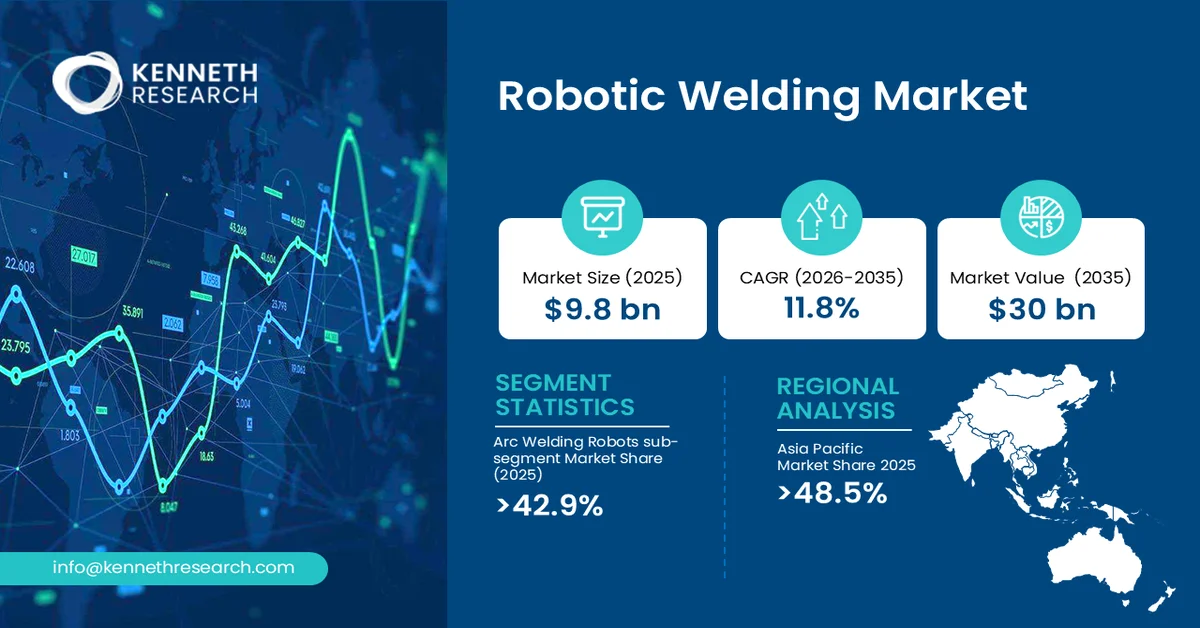
Robotic Welding Market size was valued at USD 9.8 billion in 2025 and is projected to reach USD 30.0 billion by the end of 2035, rising at a CAGR of 11.8% during the forecast period, i.e., 2026-2035. In 2026, the industry size of robotic welding is estimated at USD 10.9 billion.
The primary growth driver is manufacturers’ need to automate welding operations amid persistent workforce replacement requirements, while improving process consistency, throughput, workplace safety, and production flexibility. Robotic welding systems address repetitive, physically demanding joining tasks and enable manufacturers to maintain output with less dependence on continuously available skilled welding labor.
The robotic welding market comprises robotic systems, welding equipment, controls, software, sensors, and integrated work cells used to automate metal-joining operations. These solutions combine programmable industrial robots with welding power sources, torches, positioners, fixtures, vision or sensing technologies, and process-control software to execute repeatable welding sequences. Depending on production requirements, systems can support processes such as arc welding and can be configured for different component sizes, geometries, materials, and production volumes.
Key characteristics include programmable motion, repeatability, integration with manufacturing lines, automated parameter control, and the ability to perform repetitive welding tasks with limited direct manual intervention. Robotic cells can also incorporate collaborative or conventional industrial robot architectures, depending on safety, speed, payload, and workflow requirements.
Key Robotic Welding Market Insights Summary:
Key Takeaways: Market Trends & Insights
- Global robotic welding market valued at USD 9.8 billion in 2025 and projected to reach USD 30.0 billion by 2035
- Market expansion is forecast at a CAGR of 11.8% during 2026–2035
- Arc Welding Robots represented the largest Robot Type sub-segment with a 42.9% share in 2025
- Asia Pacific led the market with a 48.5% share in 2025, supported by manufacturing and automation activity across China and Japan
- China produced 773,074 industrial robots in 2025, with output increasing 28.0% year over year, reinforcing the region’s expanding industrial-robotics ecosystem
Market Drivers
- Smart manufacturing and factory automation
- Need for consistent, flexible production
- Workforce availability and skilled-labor replacement needs
- Expansion of automated production across heavy manufacturing and energy-related equipment
Challenges
- Complex integration and programming requirements
- Limited flexibility for high-mix production
Robotic Welding Market Overview & Supply Chain
Adoption of robotic welding is increasing globally as manufacturers pursue higher process consistency, production flexibility, workplace safety, and integration with digitally enabled factory environments. Robotic systems are particularly relevant where welding involves repetitive operations, demanding production schedules, complex component geometries, or difficult working conditions. Technological advances in sensing, programming, motion control, machine vision, and production-line connectivity are improving the ability of robotic cells to handle varied welding applications while supporting more automated quality control. The industrial relevance is reinforced by the broader importance of manufacturing efficiency and energy management. According to the International Energy Agency (IEA), industry accounted for nearly 40% of global final energy demand in 2024, highlighting the scale and strategic importance of industrial operations where automation can support more efficient production practices.
The robotic welding market value chain begins with raw-material and component suppliers providing structural metals, motors, drives, controllers, sensors, welding power sources, torches, cables, electronic components, and specialized materials required for robotic welding systems. Robot manufacturers and welding-equipment producers then assemble mechanical, electrical, control, and software components into individual robots or complete welding cells. System integrators play a critical role by engineering fixtures, programming motion sequences, configuring welding parameters, and integrating robots with production lines and quality-control systems. Distribution occurs through direct sales, industrial-equipment distributors, specialist automation partners, and integrators. End users include automotive manufacturers, machinery producers, fabricated-metal companies, transportation-equipment manufacturers, and other industrial producers.
Robotic Welding Market: Growth Drivers & Challenges
Growth Drivers:
- Smart manufacturing and factory automation: The integration of robotics with smart manufacturing is accelerating adoption by enabling welding operations to connect with broader production, sensing, analytics, and control environments. Robotic welding systems can capture process information, execute programmed movements consistently, and integrate with automated material handling and inspection workflows. This allows manufacturers to move beyond isolated welding automation toward connected production cells that support operational visibility and repeatable quality. Government support for smart manufacturing is reinforcing this transition. In 2023, the U.S. Department of Energy, together with the Collaborative Ecosystems Smart Manufacturing Innovation Institute, selected seven projects to advance smart manufacturing technologies and processes, explicitly highlighting robotics, artificial intelligence, and machine learning as technologies that can increase integration and automation.
- Need for consistent, flexible production: Manufacturers increasingly require welding processes that deliver consistent results while accommodating changing product configurations and production requirements. Robotic systems address this need through programmable motion, repeatable weld paths, controlled operating parameters, and the ability to switch between programmed tasks without redesigning an entire production process. This is particularly valuable for industries producing complex assemblies or operating multiple product variants, where manual welding can introduce variability and create bottlenecks. Advances in easier programming, sensing, calibration, and robot reconfiguration are also lowering integration barriers, making automation more practical across a wider range of manufacturing environments.
Challenges:
- Complex integration and programming requirements: Robotic welding deployment can be constrained by the engineering complexity of integrating robots with welding power sources, fixtures, sensors, safety systems, controllers, and existing production equipment. The root cause is that welding automation is a system-level application: variations in part geometry, fixture positioning, joint preparation, and equipment interfaces can require application-specific programming and commissioning. This creates commercial implications beyond the robot purchase itself, including longer implementation cycles, greater dependence on specialized integrators, and higher execution risk for manufacturers with limited automation expertise. Industry experience also indicates that programming difficulty can influence workforce acceptance and usability, particularly where welding teams must transition from manual processes to robot operation.
- Limited flexibility for high-mix production: Robotic welding can face adoption barriers when manufacturers handle frequent product changes, variable component geometries, small production runs, or inconsistent joint conditions. Conventional automation performs most effectively when parts, fixtures, weld paths, and process parameters remain sufficiently stable; substantial variation can require reprogramming, fixture adjustments, recalibration, or additional sensing. The root issue is the difficulty of translating human welding judgment into automated responses when real-world components deviate from predefined production conditions. Commercially, this can weaken the business case for manufacturers whose production environment changes frequently because engineering effort and commissioning requirements can offset automation benefits.
Robotic Welding Market Size and Forecast:
| Report Attribute | Details |
|---|---|
| Base Year |
2025 |
| Forecast Year |
2026-2035 |
| CAGR |
11.8% |
| Base Year Market Size (2025) |
USD 9.8 billion |
| Forecast Year Market Size (2035) |
USD 30.0 billion |
| Regional Scope |
|
Robotic Welding Market Segmentation Analysis:
Robot Type Segment Analysis
In the robot type segment, the Arc Welding Robots sub-segment is anticipated to capture the largest market share of 42.9% by the end of 2025.
Arc welding robots dominate because they align closely with high-volume metal fabrication environments where repeatable joining, continuous operation, and controlled weld quality are commercially important. Automotive, machinery, transportation equipment, and fabricated-metal manufacturers commonly require repetitive joining of assemblies, making arc-based robotic cells particularly suitable for standardized production workflows. Demand is further supported by the expansion of automated manufacturing capacity and the increasing integration of robots with material handling, sensing, inspection, and digital production systems.
Payload Capacity Segment Analysis
The Medium Payload Robots (51–150 kg) is projected to grow as the second-largest segment in the robotic welding market due to four converging demand drivers.
Medium payload robots in the 51–150 kg range are positioned for strong growth because they provide a practical balance between handling capability, reach, flexibility, and installation requirements. Their payload envelope is suitable for welding applications involving automotive bodies, structural assemblies, machinery components, and fabricated metal parts where robots must manipulate welding equipment or relatively substantial workpieces without requiring the infrastructure associated with heavier-duty systems. On the supply side, robot manufacturers and integrators increasingly offer configurable arms, welding packages, positioners, sensors, and software suited to varied production environments.
Our in-depth analysis of the global robotic welding market includes the following segments:
|
Segment |
Sub-segment |
|
Robot Type |
|
|
Payload Capacity |
|
|
End-Use Industry |
|
Robotic Welding Market Regional Insights:
Asia Pacific Market Trends & Insights:
Asia Pacific robotic welding market is projected to hold the largest revenue share of 48.5% by the end of 2025.
It is supported by its concentration of automotive, machinery, electronics, fabricated-metal, and heavy-equipment manufacturing. The region combines large industrial production bases with sustained investment in factory automation, creating a strong ecosystem for robotic welding deployment. China is particularly influential through expanding industrial automation capabilities and domestic manufacturing capacity.
China represents the principal regional demand center, benefiting from extensive automotive, machinery, metal fabrication, and advanced manufacturing activity. Government emphasis on industrial modernization and intelligent manufacturing further supports investment in automated welding infrastructure.
Japan remains a critical regional market because of its established robotics expertise, sophisticated automotive and machinery industries, and mature factory-automation ecosystem. Its manufacturing base provides both a substantial customer pool and an important technology-development environment for robotic systems.
North America Market Trends & Insights:
North America represents a significant secondary region for robotic welding, supported by established automotive, aerospace, machinery, metal fabrication, energy, and transportation-equipment industries. Demand is increasingly shaped by manufacturers seeking greater production flexibility, process consistency, and resilience while addressing workforce and skills constraints. In the United States, federal advanced-manufacturing programs emphasize robotics, automation, resilient domestic supply chains, and workforce development, creating a supportive environment for further industrial automation. The National Institute of Standards and Technology’s Manufacturing USA strategy specifically identifies robotics as part of the advanced-manufacturing technologies being developed through public-private collaboration.
The United States remains the region’s principal industrial automation market, with automotive manufacturing, aerospace, heavy equipment, fabricated metals, and machinery providing diverse applications for robotic welding. Federal initiatives increasingly emphasize domestic manufacturing capability and technology integration, supporting investment in automation and robotics.
Canada is developing a complementary advanced-manufacturing ecosystem through government-backed research and commercialization programs. The National Research Council Canada’s active Advanced Manufacturing Initiative specifically supports robotics, AI, sensing, and digital technologies for more agile and efficient manufacturing.
Robotic Welding Market Competitive Landscape
Here is a list of upstream, downstream, and key players operating in the global robotic welding market competitive ecosystem:
- KUKA AG (Germany)
- Company Overview
- Business Strategy
- Key Product Offerings
- Financial Performance
- Key Performance Indicators
- Risk Analysis
- Recent Development
- Regional Presence
- SWOT Analysis
- Fanuc Corporation (Japan)
- Yaskawa Electric Corporation (Japan)
- ABB Ltd (Switzerland)
- Comau S.p.A. (Italy)
- Carl Cloos Schweißtechnik GmbH (Germany)
Recent Developments
- In June 2026, KUKA showcased its new arc_cellerate Index standardized welding cell at FABTECH Canada, offering a flexible, compact automation system designed as an economical option for high-mix, low-volume applications. The pre-engineered cell includes options for Index, Side-By-Side, and Ferris configurations, enabling manufacturers to simplify entry into robotic welding, boost productivity, and make fast data-driven decisions through real-time monitoring using advanced weld cameras.
- In June 2026, Yaskawa opened a new robotics distribution center and assembly hall in Kočevje, Slovenia, with an investment of approximately €32 million. The facility will consolidate processing and delivery of robot orders for the EMEA region, with at least 80 percent of orders expected to be processed through Kočevje by fiscal 2027, particularly benefiting customers requiring large robotic welding systems through shorter supply chains.
Frequently Asked Question
In 2025, the robotic welding market exceeded USD 9.8 billion.
The robotic welding market is projected to reach USD 30.0 billion by the end of 2035, expanding at a CAGR of 11.8% over the forecast period (2026–2035).
The major players in the market are KUKA AG, Fanuc Corporation, Yaskawa Electric Corporation, ABB Ltd, Comau S.p.A., Carl Cloos Schweißtechnik GmbH, and others.
In the Robot Type segment, the Arc Welding Robots sub-segment is anticipated to capture the largest market share of 42.9% in the future and exhibit lucrative growth opportunities during 2026–2035. This growth trajectory is largely attributed to demand for repeatable joining, continuous operation, and controlled weld quality across high-volume manufacturing environments.
Asia Pacific is projected to hold the largest market share of 48.5% by the end of 2025 and provide more business opportunities in the future. Continuous investments in industrial automation and manufacturing capabilities across China and Japan are fostering the region's dominance.
Why Choose Kenneth Research ?
-
Insight with Impact : We don’t just gather data — we uncover stories, trends, and opportunities that fuel business growth.
-
Experts Who Get It : Our team speaks your industry’s language and knows what really matters to your customers and market.
-
Custom-Built for You : Forget one-size-fits-all. We craft research and consulting solutions as unique as your business vision.
-
Partners, Not Just Providers : We work with you, not for you — collaborating closely to turn insights into smart, strategic moves.
-
Results That Speak : Our work powers brands, startups, and industry leaders alike — with a track record of ideas that work in the real world.
Report ID: 1208 |
Published Date: 14 Sep 2026 |
Report Format: |
Delivery Timeline: 48-72 Business Hours

Copyright © 2025 Kenneth Research. All rights reserved. Terms of Use | Privacy Policy
