Report ID: 1239 |
Published Date: 14 Sep 2026 |
Report Format: |
Delivery Timeline: 48-72 Business Hours
Robotic Tray Denester Market Outlook:
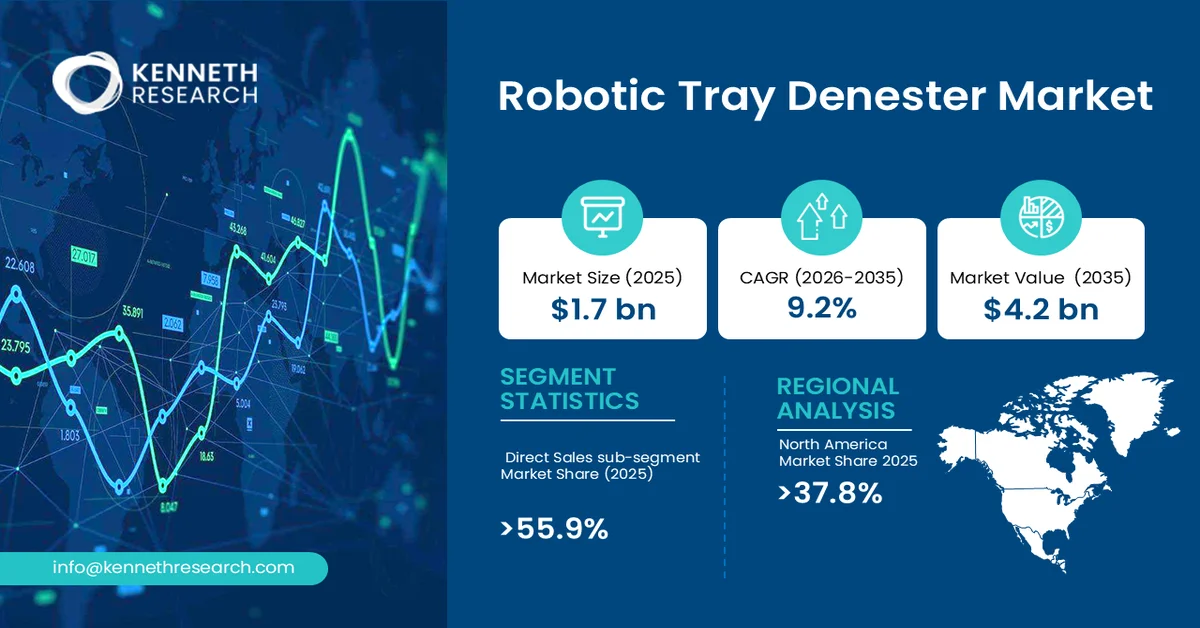
Robotic Tray Denester Market size was valued at USD 1.7 billion in 2025 and is projected to reach USD 4.2 billion by the end of 2035, rising at a CAGR of 9.2% during the forecast period, i.e., 2026-2035. In 2026, the industry size of the robotic tray denester is estimated at USD 1.9 billion.
The primary growth driver is the increasing adoption of robotics in food manufacturing to address labor constraints, improve handling consistency, and automate repetitive packaging operations. Government evidence shows that food manufacturing is among the leading manufacturing industries for robotics adoption, reinforcing demand for automated tray handling and denesting solutions.
The robotic tray denester market comprises robotic systems, equipment, and integrated automation solutions designed to separate and present individual trays from stacked tray supplies for downstream filling, processing, sealing, labeling, inspection, or packaging operations. These systems typically combine robotic manipulation with tray magazines, feeding mechanisms, sensors, machine vision, controls, and line-integration capabilities to deliver consistent tray positioning and automated material handling.
Robotic tray denesters are primarily deployed where packaging lines require repeatable handling of trays at production speed while reducing dependence on manual loading. Their configuration can be adapted to different tray materials, dimensions, stacking arrangements, product formats, and line layouts. Integration with conveyors, pick-and-place robots, vision systems, packaging machinery, and plant control platforms enables denesting to operate as part of an automated production workflow.
Key Robotic Tray Denester Market Insights Summary:
Key Takeaways: Market Trends & Insights
- Labor optimization and automated food processing remain a core growth driver for robotic tray denesting
- Integration of robotics, machine vision and smart packaging lines is strengthening demand for flexible denesting solutions
- Direct Sales is the leading distribution channel segment with a 55.9% market share in 2025
- Food & Beverage is the fastest-growing end-user segment as manufacturers increasingly automate tray handling operations
- North America leads the market with a 37.8% share in 2025, supported by the United States and Canada
Market Drivers
- Labor optimization and automated food processing
- Integration of vision, robotics, and smart packaging lines
- Rising demand for automated food and beverage packaging
- Expansion of flexible and integrated packaging-line automation
Challenges
- High integration complexity and application-specific configuration
- Tray variability and reliability risks in high-speed operations
Robotic Tray Denester Market Overview & Supply Chain
Global adoption of robotic tray denesters is increasing as food processors and other high-throughput manufacturers seek greater automation, repeatable handling, improved line continuity, and reduced dependence on manual tray loading. Advances in robotics, machine vision, sensors, and integrated controls are making denesting systems easier to connect with automated packaging lines. The technology is particularly relevant to food and beverage production, where hygienic handling, consistent tray presentation, and reliable synchronization with downstream filling and sealing equipment are operational priorities. The industrial importance of this application is reinforced by Statistics Canada’s 2024 manufacturing data: food manufacturing accounted for 18.4% of revenue from goods produced across all manufacturing subsectors.
The robotic tray denester market value chain begins with input suppliers providing robotic components, servo motors, drives, sensors, machine-vision equipment, controllers, grippers, stainless-steel structures, conveyors, tray magazines, and electrical components. System manufacturers and automation integrators then engineer these inputs into denesting equipment configured for specific tray dimensions, materials, stacking patterns, production speeds, and packaging-line architectures. Production typically includes mechanical fabrication, robotic assembly, electrical integration, software configuration, testing, and line validation. Distribution occurs through direct sales, automation integrators, specialized machinery distributors, and equipment partners, depending on customer requirements and geographic coverage. End users include food and beverage processors, prepared-food manufacturers, meat and poultry processors, bakeries, and other packaging-intensive manufacturers.
Robotic Tray Denester Market: Growth Drivers & Challenges
Growth Drivers:
- Labor optimization and automated food processing: Persistent labor constraints and the need for consistent repetitive handling are encouraging food manufacturers to automate tray-loading and related packaging activities. Robotic tray denesters can continuously separate stacked trays, synchronize them with conveyors, and feed downstream equipment without requiring operators to perform repetitive manual movements. This creates value through more consistent cycle execution, reduced handling variability, and better allocation of personnel toward higher-value production, quality, and maintenance activities. The technology is particularly relevant in food processing, where production environments combine demanding throughput requirements with stringent handling expectations. A USDA-supported poultry automation program illustrates the direction of industrial development.
- Integration of vision, robotics, and smart packaging lines: The convergence of robotics, machine vision, sensors, and digital controls is expanding the functional capabilities of tray denesting systems. Rather than operating as isolated mechanical feeders, modern denesters can be integrated with vision systems and programmable controls to identify tray positions, manage variations in presentation, coordinate robotic movements, and communicate with upstream and downstream packaging equipment. This improves line synchronization and enables manufacturers to accommodate multiple product formats without extensive manual intervention. The resulting flexibility is particularly valuable for food processors managing frequent product changes, shorter production runs, and increasingly automated packaging architectures. Over time, software-enabled configuration and intelligent sensing should make robotic denesting more adaptable to different tray geometries, materials, and stacking conditions.
Challenges:
- High integration complexity and application-specific configuration: A major restraint is the engineering complexity involved in integrating robotic tray denesters with existing packaging lines. Tray dimensions, material characteristics, nesting geometry, conveyor layouts, robotic reach, sensors, controls, fillers, and sealing equipment must operate in coordination. Variations in tray design can therefore require application-specific tooling, programming, testing, and commissioning rather than straightforward equipment installation. This increases project complexity and can extend implementation timelines, particularly where manufacturers are upgrading established lines instead of building new automated cells. Commercially, the additional engineering requirement can raise the total cost of ownership and make investment decisions more difficult for manufacturers with diverse packaging formats.
- Tray variability and reliability risks in high-speed operations: Tray variability creates another important restraint because automated denesting depends on predictable physical characteristics and consistent separation between nested containers. Differences in material stiffness, geometry, flange dimensions, surface characteristics, or nesting behavior can affect gripping and separation performance. Poorly matched trays can consequently cause misfeeds, double picks, jams, or interruptions that propagate into downstream filling and sealing operations. The commercial consequence is particularly significant because a denester functions at the beginning of an interconnected packaging line; instability at this stage can undermine the utilization of equipment throughout the broader production cell. Manufacturers may therefore need tray redesign, additional validation, specialized tooling, or more sophisticated sensing before deployment.
Robotic Tray Denester Market Size and Forecast:
| Report Attribute | Details |
|---|---|
| Base Year |
2025 |
| Forecast Year |
2026-2035 |
| CAGR |
9.2% |
| Base Year Market Size (2025) |
USD 1.7 billion |
| Forecast Year Market Size (2035) |
USD 4.2 billion |
| Regional Scope |
|
Robotic Tray Denester Market Segmentation Analysis:
Distribution Channel Segment Analysis
In the distribution channel segment, the Direct Sales sub-segment is anticipated to capture the largest market share of 55.9% by the end of 2025.
Direct sales leads the robotic tray denester market because the equipment is highly application-specific and typically requires technical consultation, line assessment, configuration, commissioning, and after-sales support. Purchasing directly from equipment manufacturers enables food processors and other packaging-intensive producers to work with suppliers on tray specifications, robotic configurations, machine interfaces, changeover requirements, and integration with downstream equipment. This model also allows suppliers to retain closer control over installation, validation, spare parts, software support, and lifecycle service. Demand is reinforced by the increasing digitalization of food manufacturing procurement and production ecosystems.
End-User Segment Analysis
The food & beverage is projected to grow as the second-largest segment in robotic tray denester market due to four converging demand drivers.
The Food & Beverage segment is positioned for continued growth because tray-based packaging is integral to prepared foods, ready-to-eat products, meat and poultry, bakery items, dairy products, and other packaged food categories. Manufacturers increasingly prioritize automated material handling to maintain consistent tray presentation, coordinate packaging-line operations, and reduce repetitive manual intervention. Adoption is further supported by advances in robotics, machine vision, high-speed automation, and integrated packaging technologies. On the supply side, equipment manufacturers can configure robotic denesting systems around tray formats, line speeds, and downstream machinery, enabling more application-specific solutions. As food producers pursue greater automation and operational flexibility, demand should increasingly shift toward integrated denesting platforms capable of reliable operation within automated packaging cells.
Our in-depth analysis of the global robotic tray denester market includes the following segments:
|
Segment |
Sub-segment |
|
Product Type |
|
|
Application |
|
|
End-User |
|
|
Distribution Channel |
|
Robotic Tray Denester Market Regional Insights:
North America Market Trends & Insights:
North America robotic tray denester market is projected to hold the largest revenue share of 37.8% by the end of 2025.
The region benefits from a large installed base of automated manufacturing equipment and sophisticated supply networks linking robotic-equipment manufacturers, packaging machinery suppliers, integrators, and food processors. Regulatory emphasis on food safety and manufacturing efficiency also encourages investment in automated handling technologies. In the United States, the USDA Economic Research Service reports that food and beverage manufacturing establishments represented 16.8 percent of sales across all U.S. manufacturing establishments in 2021, highlighting the substantial industrial base relevant to tray-handling and packaging automation.
The United States remains the principal country-level contributor through its extensive food-processing footprint, advanced automation capabilities, and concentration of packaging-equipment suppliers and technology integrators. Government data identifies a broad national network of food and beverage manufacturing establishments, supporting demand for automated tray handling across diverse production environments.
Canada complements regional demand through growing industrial interest in robotics. Statistics Canada reports that food manufacturing was among the manufacturing industries with the highest robotics adoption in its 2022 Survey of Advanced Technology, demonstrating a direct technological pathway for robotic tray-denesting applications.
Asia Pacific Market Trends & Insights:
Asia Pacific is an important growth region for robotic tray denesting, supported by expanding food-processing activity, manufacturing modernization, labor-efficiency requirements, and accelerating adoption of smart-factory technologies. Governments across the region are promoting industrial automation, digital transformation, equipment modernization, and robotics adoption, creating a favorable environment for automated packaging equipment. China is strengthening intelligent manufacturing and industrial-equipment renewal, while Japan is addressing food-manufacturing labor constraints through robotics and automation. These initiatives create opportunities for denesting suppliers offering flexible, hygienic, vision-enabled systems that can integrate with broader packaging and production lines.
China offers substantial opportunities through its large manufacturing ecosystem and government-backed intelligent-manufacturing initiatives. Food producers are increasingly pursuing connected production, automated inspection, digital traceability, and flexible manufacturing, creating complementary demand for robotic tray handling.
Japan presents a strong technology-led opportunity, particularly because food manufacturers face labor shortages and challenging product-handling conditions. Government programs are supporting robotic solutions for prepared-food production, including automated tray supply and product-transfer processes, strengthening the ecosystem for specialized packaging automation.
Leading Companies Operating in the Global Robotic Tray Denester Market:
Here is a list of upstream, downstream, and key players operating in the global robotic tray denester market competitive ecosystem:
- QUPAQ (Netherlands)
- Company Overview
- Business Strategy
- Key Product Offerings
- Financial Performance
- Key Performance Indicators
- Risk Analysis
- Recent Development
- Regional Presence
- SWOT Analysis
- KUKA AG (Germany)
- Yaskawa Electric Corporation (Japan)
- Veserkal (Italy)
Recent Developments
- In January 2025, QUPAQ launched the Smart Buffer Servo Twin, a 100% electrical servo-driven tray denester capable of denesting up to 400 trays per minute on single or dual lanes. The system features independent lane drives, a custom Smart Tool Twin, and INPRO software for automatic error correction to minimize line stops. It can be configured at 90° or 180° angles to suit production floor layouts.
- In 2025, Yaskawa supported a strawberry grower’s automation solution that integrated Yaskawa GP series robots with a tray denester, achieving a throughput of 10,000 trays and 1,000 crates per hour. The solution replaced labor-intensive 24-hour manual operations, significantly improving flexibility and capacity for fruit farming applications.
Frequently Asked Question
In 2025, the robotic tray denester market was USD 1.7 billion.
The robotic tray denester market is projected to reach USD 4.2 billion by the end of 2035, expanding at a CAGR of 9.2% over the forecast period (2026-2035).
The major players in the market are QUPAQ, KUKA AG, Yaskawa Electric Corporation, Veserkal, and others.
In the Distribution Channel segment, the Direct Sales sub-segment captured the largest market share of 55.9% in 2025 and is expected to provide lucrative growth opportunities during 2026–2035. This growth trajectory is largely attributed to manufacturers' need for application-specific configuration, integration, commissioning, and after-sales technical support.
North America is the dominant region, with a 37.8% market share in 2025, and is positioned to provide significant business opportunities in the future. Continuous investment in food-processing automation, packaging technology, and robotic integration across the United States and Canada supports the region's leadership.
Why Choose Kenneth Research ?
-
Insight with Impact : We don’t just gather data — we uncover stories, trends, and opportunities that fuel business growth.
-
Experts Who Get It : Our team speaks your industry’s language and knows what really matters to your customers and market.
-
Custom-Built for You : Forget one-size-fits-all. We craft research and consulting solutions as unique as your business vision.
-
Partners, Not Just Providers : We work with you, not for you — collaborating closely to turn insights into smart, strategic moves.
-
Results That Speak : Our work powers brands, startups, and industry leaders alike — with a track record of ideas that work in the real world.
Report ID: 1239 |
Published Date: 14 Sep 2026 |
Report Format: |
Delivery Timeline: 48-72 Business Hours

Copyright © 2025 Kenneth Research. All rights reserved. Terms of Use | Privacy Policy
