Report ID: 1241 |
Published Date: 28 Sep 2026 |
Report Format: |
Delivery Timeline: 48-72 Business Hours
Robotic Total Stations Market Outlook:
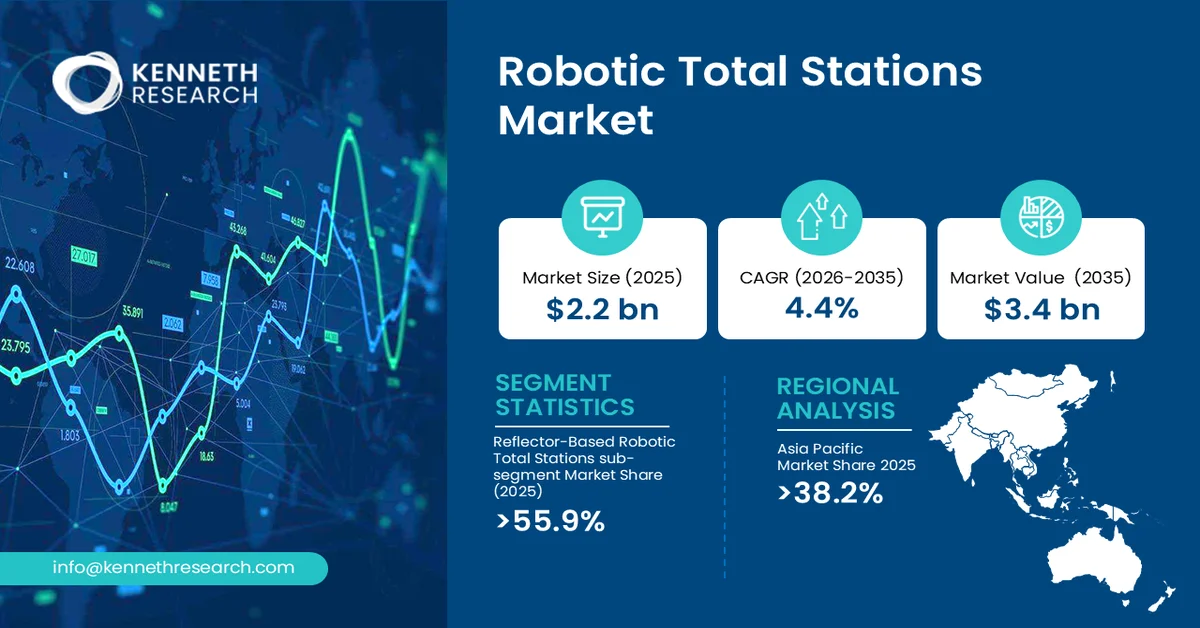
Robotic Total Stations Market size was valued at USD 2.2 billion in 2025 and is projected to reach USD 3.4 billion by the end of 2035, rising at a CAGR of 4.4% during the forecast period, i.e., 2026-2035. In 2026, the industry size of robotic total stations is estimated at USD 2.3 billion.
The primary growth driver is the accelerating digitization of surveying and geospatial workflows, supported by expanding demand for precise, integrated measurement. China’s natural-resources authorities reported 18,637 surveying and mapping qualification entities at the end of 2022, reinforcing the expanding institutional base for advanced surveying technologies and equipment adoption.
The robotic total stations market comprises the development, manufacture, supply, and deployment of automated surveying instruments that integrate electronic angle measurement, electronic distance measurement, onboard computing, and robotic or remote-control functionality. These systems are designed to capture precise spatial measurements while reducing the amount of manual instrument handling required during field operations.
Robotic total stations typically combine motorized instrument movement with automatic target recognition, tracking, positioning, data collection, and digital field-to-office workflows. Depending on configuration, they can operate with prisms or other reflective targets and can interface with controllers, GNSS equipment, surveying software, and broader geospatial information systems.
Key Robotic Total Stations Market Insights Summary:
Key Takeaways: Market Trends & Insights
- Reflector-based robotic total stations held the leading position in the Technology segment with a 55.9% market share in 2025
- Asia Pacific remained the dominant regional market with a 38.2% market share in 2025, supported by infrastructure development and geospatial modernization across China and India
- The global robotic total stations market was valued at USD 2.2 billion in 2025 and is projected to reach USD 3.4 billion by 2035
- Construction is the fastest-growing end-user segment, driven by increasing demand for automated measurement, digital site coordination, and precision layout workflows
- The robotic total stations market is expected to expand at a CAGR of 4.4% from 2026 to 2035, supported by increasing adoption of automated and digitally connected surveying workflows
Market Drivers
- Expansion of digital geospatial infrastructure
- Increasing demand for automated surveying workflows
- Growing adoption of digital construction and BIM-enabled workflows
- Rising requirements for high-precision infrastructure surveying and monitoring
Challenges
- High technical complexity and calibration requirements
- Integration barriers across fragmented digital workflows
Robotic Total Stations Market Overview & Supply Chain
Adoption of robotic total stations is increasing as surveying and construction workflows shift toward digitally integrated, high-precision measurement. The technology supports automated angle and distance measurement, robotic instrument positioning, target tracking, field data capture, and connectivity with digital engineering workflows. Its relevance extends across construction, infrastructure, land administration, utilities, transportation, and geospatial mapping, where accurate spatial information is essential for planning, execution, monitoring, and asset management. Government-led digital infrastructure programs are also strengthening the ecosystem in which advanced surveying technologies operate.
The robotic total stations value chain begins with specialized inputs including optical components, electronic sensors, precision mechanical assemblies, motors, encoders, batteries, processors, communication modules, and ruggedized housings. Component suppliers provide these inputs to instrument manufacturers, which integrate precision optics, electronic distance measurement, automated positioning, target-recognition capabilities, onboard computing, and software into finished surveying systems. Manufacturing is supported by calibration, testing, firmware integration, quality assurance, and application-specific configuration. Distribution typically combines direct enterprise sales, authorized surveying-equipment dealers, geospatial technology distributors, and project-based procurement channels. End users include construction contractors, civil engineering firms, land surveyors, infrastructure developers, government surveying agencies, utilities, and industrial operators.
Robotic Total Stations Market: Growth Drivers & Challenges
Growth Drivers:
- Expansion of digital geospatial infrastructure: Government-led integration of geospatial data into infrastructure planning is strengthening the environment for robotic surveying technologies. Robotic total stations can contribute by automating measurements and transferring field observations into digital engineering and mapping environments. The resulting workflow reduces dependence on manually recorded measurements and supports more consistent project execution. As public infrastructure programs become increasingly data-driven, contractors and engineering organizations are likely to prioritize surveying equipment capable of connecting field measurement with broader digital platforms. Over time, this should encourage greater adoption of robotic instruments across infrastructure, transportation, utilities, and land-development projects.
- Increasing demand for automated surveying workflows: The transition from manually operated surveying toward automated field workflows is creating a structural growth opportunity for robotic total stations. These instruments combine precision measurement with motorized movement, target tracking, automated observation, and digital data handling, allowing survey teams to accomplish repetitive measurement tasks with less direct instrument manipulation. The resulting workflow can improve operational consistency while enabling personnel to focus on interpretation, verification, layout, and other higher-value activities. This is particularly relevant for construction and infrastructure projects where measurements must be repeated across large or complex sites. Integration with GNSS receivers, controllers, engineering software, and digital mapping systems further increases the practical value of robotic instruments.
Challenges:
- High technical complexity and calibration requirements: Robotic total stations combine precision optics, electronic distance measurement, motorized positioning, target recognition, communications, and software, making system performance dependent on accurate calibration and correct field configuration. The root challenge is that surveying applications demand reliable coordinate measurements, while instrument performance can be affected by setup conditions, environmental factors, component wear, and integration errors. ISO 17123-5 specifies field procedures for evaluating the precision and repeatability of total stations, illustrating the importance of structured verification. For commercial users, this creates additional requirements for trained personnel, maintenance, calibration, and technical support. Equipment downtime or inaccurate measurements can disrupt construction layouts and generate downstream rework.
- Integration barriers across fragmented digital workflows: Robotic total stations increasingly operate as components of broader digital surveying and construction ecosystems, but interoperability remains a practical constraint. Projects may combine instruments, GNSS equipment, field controllers, BIM platforms, CAD environments, scanning technologies, and proprietary software, creating compatibility requirements across hardware and data workflows. The challenge becomes particularly significant for contractors working across multiple projects or technology vendors, because inconsistent interfaces and data processes can complicate deployment and increase training requirements. Commercially, organizations may delay equipment purchases when integration uncertainty creates concerns about workflow disruption or vendor lock-in. Suppliers consequently face pressure to provide open interfaces, software compatibility, and dependable field-to-office data transfer.
Robotic Total Stations Market Size and Forecast:
| Report Attribute | Details |
|---|---|
| Base Year |
2025 |
| Forecast Year |
2026-2035 |
| CAGR |
4.4% |
| Base Year Market Size (2025) |
USD 2.2 billion |
| Forecast Year Market Size (2035) |
USD 3.4 billion |
| Regional Scope |
|
Robotic Total Stations Market Segmentation Analysis:
Technology Segment Analysis
In the technology segment, the Reflector-Based Robotic Total Stations sub-segment is anticipated to capture the largest market share of 55.9% by the end of 2025.
Reflector-Based Robotic Total Stations lead the technology segment because construction, infrastructure, and engineering surveying continue to require dependable target-based positioning and precise site measurement. Reflector-based configurations are particularly suited to workflows where surveyors need controlled observations over established points, structural elements, and construction layouts. Their compatibility with automated target recognition and tracking further supports productivity gains compared with conventional manually operated instruments. Demand is reinforced by continued construction activity and the increasing digitization of site measurement. Statistics Canada reported that investment in building construction rose 5.8% to $253.8 billion in 2024, demonstrating sustained activity across the built environment and an ongoing requirement for professional surveying and measurement services.
End-User Segment Analysis
The construction is projected to grow as the second-largest segment in the robotic total stations market due to four converging demand drivers.
The Construction end-user segment is projected to grow as infrastructure development, commercial building activity, and increasingly digitized project execution raise demand for precise, efficient site surveying. Robotic total stations support construction teams with automated measurement, positioning, layout, target tracking, and digital data transfer, making them valuable for complex projects where repeatable accuracy and productivity are important. India’s government reported that the construction sector recorded 10.7% growth in FY 2023-24, highlighting strong underlying activity within a key consuming industry. Adoption is also being supported by the movement toward BIM-enabled workflows, digital site coordination, automated layout, and integrated surveying. Equipment manufacturers are responding with improved robotic tracking, controller connectivity, software integration, and interoperability with GNSS and engineering platforms.
Our in-depth analysis of the global robotic total stations market includes the following segments:
|
Segment |
Sub-segment |
|
Technology |
|
|
Application |
|
|
End User |
|
Robotic Total Stations Market Regional Insights:
Asia Pacific Market Trends & Insights:
Asia Pacific robotic total stations market is projected to hold the largest revenue share of 38.2% by the end of 2025.
Asia Pacific is the dominant regional market, supported by sustained infrastructure development, expanding urban construction, industrial investment, and increasing digitization of surveying and geospatial workflows. The region’s leadership is reinforced by China’s extensive public investment in spatial-data infrastructure and surveying capabilities, while India is accelerating geospatial integration across infrastructure and development programs.
China represents the region’s principal technology and production hub, supported by extensive construction activity, advanced manufacturing capabilities, and government-led geospatial modernization. Its established surveying ecosystem supports both equipment deployment and technological development.
India represents a high-potential demand center, driven by infrastructure expansion, urban development, transportation projects, and increasing use of GIS-enabled planning. Government programs linking geospatial information with infrastructure execution are strengthening the commercial environment for automated surveying solutions. Together, China and India provide complementary demand characteristics: China combines mature industrial and geospatial capabilities, while India offers expanding infrastructure-led applications and increasing digitalization. The regional outlook therefore remains favorable for suppliers offering connected, automated, and interoperable surveying platforms.
North America Market Trends & Insights:
North America represents a strong secondary market for robotic total stations, supported by sophisticated construction, transportation, utilities, energy, surveying, and geospatial industries. Demand is reinforced by the region’s emphasis on infrastructure modernization, digital project execution, precision positioning, and increasingly integrated field-to-office workflows. In the United States, federal infrastructure programs continue to support projects spanning design, pre-construction, and construction activities, creating an environment conducive to advanced surveying and measurement technologies.
The United States benefits from a mature surveying and engineering ecosystem and extensive infrastructure activity. Adoption opportunities are particularly relevant across transportation construction, commercial development, utilities, industrial facilities, and infrastructure inspection. Increasing integration of digital engineering and geospatial workflows should favor robotic instruments capable of connecting measurement activities with project-management and design environments.
Canada offers opportunities through infrastructure development, natural-resource projects, construction, land surveying, and government geospatial modernization. Natural Resources Canada is strengthening national positioning and geodetic capabilities, supporting accurate location information for construction and other applications. This creates a favorable ecosystem for complementary high-precision surveying technologies and connected field workflows.
Leading Companies Operating in the Global Robotic Total Stations Market:
Here is a list of upstream, downstream, and key players operating in the global robotic total stations market competitive ecosystem:
- Hexagon AB (Sweden)
- Company Overview
- Business Strategy
- Key Product Offerings
- Financial Performance
- Key Performance Indicators
- Risk Analysis
- Recent Development
- Regional Presence
- SWOT Analysis
- South Group (China)
- CHCNAV (China)
- Spectra Geospatial (Trimble) (United States)
Recent Developments
- In 2025, South Group partnered with independent testing laboratories to validate millimeter-level accuracy in robotic total stations for railway infrastructure stakeout, demonstrating that modern robotic total stations achieve angular accuracy up to 0.5° and distance accuracy of 0.8mm + 1 ppm.
- In October 2025, Hexagon's Leica Geosystems launched the Leica TS20, the first robotic total station featuring an on-device Neural Processing Unit (NPU) that enables edge AI. Powered by this chip, the instrument offers capabilities like AI-powered target detection (AI-Detect) to verify target types and AI-Follow to maintain tracking of the Leica AP20 AutoPole even when the line of sight is interrupted.
Frequently Asked Question
In 2025, the robotic total stations market was valued at USD 2.2 billion.
The robotic total stations market is projected to reach USD 3.4 billion by the end of 2035, expanding at a CAGR of 4.4% over the forecast period (2026–2035).
The major players in the market are Hexagon AB, South Group, CHCNAV, Spectra Geospatial (Trimble), and others.
In the Technology segment, the Reflector-Based Robotic Total Stations sub-segment is anticipated to capture the largest market share of 55.9% in the future and exhibit lucrative growth opportunities during 2026-2035. This growth trajectory is largely attributed to increasing demand for precise, automated surveying workflows across construction and infrastructure projects.
Asia Pacific is projected to hold the largest market share of 38.2% by the end of 2025 and provide more business opportunities in the future. Continuous infrastructure development, geospatial modernization, and increasing digitalization across China and India are fostering the region's dominance.
Why Choose Kenneth Research ?
-
Insight with Impact : We don’t just gather data — we uncover stories, trends, and opportunities that fuel business growth.
-
Experts Who Get It : Our team speaks your industry’s language and knows what really matters to your customers and market.
-
Custom-Built for You : Forget one-size-fits-all. We craft research and consulting solutions as unique as your business vision.
-
Partners, Not Just Providers : We work with you, not for you — collaborating closely to turn insights into smart, strategic moves.
-
Results That Speak : Our work powers brands, startups, and industry leaders alike — with a track record of ideas that work in the real world.
Report ID: 1241 |
Published Date: 28 Sep 2026 |
Report Format: |
Delivery Timeline: 48-72 Business Hours

Copyright © 2025 Kenneth Research. All rights reserved. Terms of Use | Privacy Policy
