Report ID: 1193 |
Published Date: 27 Aug 2026 |
Report Format: |
Delivery Timeline: 48-72 Business Hours
Robotic Shotcrete Arm Market Outlook:
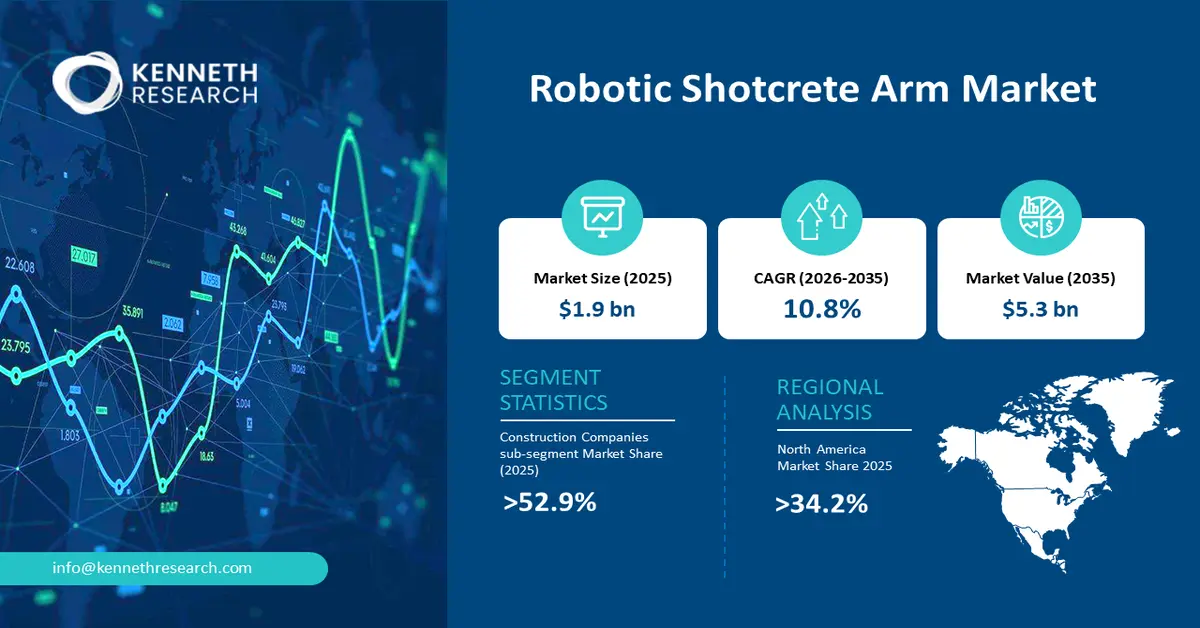
Robotic Shotcrete Arm Market size was valued at USD 1.9 billion in 2025 and is projected to reach USD 5.3 billion by the end of 2035, rising at a CAGR of 10.8% during the forecast period, i.e., 2026-2035. In 2026, the industry size of the robotic shotcrete arm is estimated at USD 2.1 billion.
The primary growth driver is the increasing adoption of construction automation to improve productivity and worker safety during repetitive, labor-intensive shotcrete operations. Robotic arms enable controlled, remotely operated material placement while reducing direct worker exposure to demanding application environments, supporting greater process consistency and automation across construction and infrastructure projects.
The robotic shotcrete arm market comprises robotic arm systems and associated equipment designed to automate the placement of shotcrete, or pneumatically projected concrete, onto construction surfaces. These systems integrate a mechanically controlled arm with a shotcrete delivery and spraying arrangement, enabling operators to direct the nozzle across required surfaces while the robotic mechanism performs controlled positioning and movement.
Shotcrete itself is a mortar or concrete placement method in which material is projected at high velocity onto a receiving surface, allowing placement and compaction to occur during application. It can be applied to vertical and overhead surfaces and is available through both wet-mix and dry-mix processes.
Key Robotic Shotcrete Arm Market Insights Summary:
Key Takeaways: Market Trends & Insights
- Construction Companies held the leading end-user position with a 52.9% market share in 2025
- Single Arm is the second/fastest-growth product type, driven by flexibility and suitability for tunneling, underground construction, repair, and stabilization
- North America led the market with a 34.2% share in 2025, supported by infrastructure activity, tunneling capabilities, and construction automation
- The United States and Canada are the key North American markets, supported by infrastructure projects and demand for specialized construction equipment
- China and India are the key Asia Pacific markets, supported by infrastructure development, manufacturing capabilities, and growing construction automation
Market Drivers
- Rising emphasis on construction worker safety
- Increasing demand for automated and consistent shotcrete application
- Expansion of underground transportation and infrastructure construction
- Advancement of robotic sensing, remote-control, and automation technologies
Challenges
- Complexity of achieving consistent automated application
- Material-flow and equipment integration constraints
Robotic Shotcrete Arm Market Overview & Supply Chain
Global adoption of robotic shotcrete arms is increasing as construction and infrastructure contractors seek greater application control, improved operator positioning, and more consistent sprayed-concrete placement in demanding environments. The technology is particularly relevant to tunneling, underground construction, structural rehabilitation, slope stabilization, and other applications where conventional manual spraying can involve difficult access and intensive hose handling. Government infrastructure data illustrates the scale of the underlying application environment: the U.S. Federal Highway Administration’s National Tunnel Inventory recorded 552 tunnels in its 2022 inventory.
The robotic shotcrete arm value chain begins with raw-material and component suppliers providing structural steel, hydraulic and electrical components, motors, sensors, control systems, pumps, hoses, nozzles, and shotcrete-compatible delivery equipment. Equipment manufacturers integrate these inputs into robotic arm assemblies, mobility platforms, spraying systems, operator controls, and safety mechanisms, followed by factory testing and application-specific configuration. Distribution typically involves specialized construction-equipment dealers, regional distributors, direct manufacturer sales, and project-based equipment suppliers. End users include construction companies, tunneling contractors, mining and underground engineering firms, infrastructure operators, and specialist shotcrete service providers. Major stakeholders extend across equipment manufacturers, concrete and admixture suppliers, engineering consultants, contractors, infrastructure owners, regulators, and maintenance providers.
Robotic Shotcrete Arm Market: Growth Drivers & Challenges
Growth Drivers:
- Rising emphasis on construction worker safety: Construction safety requirements are strengthening demand for robotic shotcrete arms because spraying operations can expose workers to difficult working positions, airborne material, equipment movement, and hazardous construction environments. Robotic arms shift much of the repetitive nozzle-positioning activity from direct manual handling toward remotely controlled mechanical operation, allowing contractors to separate personnel from demanding application zones while maintaining operational oversight. The safety imperative is significant: the U.S. Bureau of Labor Statistics reported 1,075 fatal occupational injuries in the construction industry in 2023, the highest number among private industry sectors that year.
- Increasing demand for automated and consistent shotcrete application: Construction contractors are increasingly evaluating automation to address the operational variability associated with manually controlled shotcrete placement. Robotic arms can provide controlled nozzle movement, repeatable positioning, and programmable operating patterns, helping contractors standardize application practices across complex surfaces and difficult-access areas. This is particularly valuable in tunneling, underground works, structural rehabilitation, slope stabilization, and other projects where consistent material placement affects execution quality and productivity. Automation can also support more efficient coordination between material delivery, spraying, and operator control, reducing dependence on continuous manual manipulation of heavy hoses and spraying equipment.
Challenges:
- Complexity of achieving consistent automated application: The principal technical restraint is the difficulty of maintaining consistent shotcrete placement across changing surface geometries, reinforcement configurations, material behavior, and operating conditions. Robotic movement alone does not guarantee application quality because nozzle distance, orientation, trajectory, material flow, and velocity must remain appropriately coordinated. Research published through the International Association for Automation and Robotics in Construction highlights that automatic and manual shotcreting can produce different nozzle trajectories, while achieving reliable autonomous application remains unresolved. This creates a commercial barrier because contractors must retain skilled oversight even when deploying robotic equipment, limiting the extent to which automation can replace manual expertise.
- Material-flow and equipment integration constraints: Robotic shotcrete arms operate within a wider material-delivery system, making performance dependent on pumps, hoses, compressed air, nozzle assemblies, mix characteristics, and site configuration. Variations in hose length, elevation, material composition, and application method can alter conveying conditions and affect material flow at the nozzle. The American Shotcrete Association notes that wet-mix applications can be particularly susceptible to hose blockages and nozzle pulsation under certain conveying arrangements. These interactions complicate equipment selection and project setup because a robotic arm cannot be evaluated independently from the pumping and delivery infrastructure. Commercially, contractors may face additional engineering, commissioning, maintenance, and operator-training requirements when integrating robotic arms into existing fleets.
Robotic Shotcrete Arm Market Size and Forecast:
| Report Attribute | Details |
|---|---|
| Base Year |
2025 |
| Forecast Period |
2026-2035 |
| CAGR |
10.8% |
| Base Year Market Size (2025) |
USD 1.9 billion |
| Forecast Year Market Size (2035) |
USD 5.3 billion |
| Regional Scope |
|
Robotic Shotcrete Arm Market Segmentation Analysis:
End-User Segment Analysis
In the end-user segment, the construction companies sub-segment is anticipated to capture the largest market share of 52.9% by the end of 2025.
Construction companies dominate the end-user segment because they are directly responsible for deploying shotcrete equipment across tunneling, underground construction, structural rehabilitation, and infrastructure projects. Their purchasing decisions increasingly emphasize productivity, operator safety, application consistency, and the ability to execute complex spraying activities under constrained site conditions. Public infrastructure investment is reinforcing this demand environment. In 2024, the U.S. Department of Transportation announced $11 billion in grants and financing for the Hudson River Tunnel project, demonstrating the scale of government-backed investment supporting major tunnel construction and modernization. Such projects create opportunities for specialized equipment capable of supporting demanding concrete-placement activities. On the supply side, manufacturers are responding with more maneuverable robotic systems, remote-control capabilities, improved nozzle positioning, and integration with pumping equipment.
Product Type Segment Analysis
The Single Arm is projected to grow as the second-largest segment in the robotic shotcrete arm market due to four converging demand drivers.
The single-arm segment is positioned for strong growth because it offers a practical balance between robotic reach, maneuverability, equipment complexity, and deployment flexibility. Contractors can use single-arm configurations across tunneling, underground construction, repair, stabilization, and other shotcrete applications where workspace constraints make compact equipment advantageous. Demand is supported by continued development and maintenance of tunnel infrastructure, which provides a recurring application environment for mechanized shotcrete equipment. Single-arm equipment also offers manufacturers a comparatively straightforward platform for integrating remote controls, hydraulic actuation, improved nozzle positioning, and automation features.
Our in-depth analysis of the global robotic shotcrete arm market includes the following segments:
|
Segment |
Sub-segment |
|
Product Type |
|
|
Application |
|
|
End-User |
|
|
Mobility |
|
Robotic Shotcrete Arm Market Regional Insights:
North America Market Trends & Insights:
North America robotic shotcrete arm market is projected to hold the largest revenue share of 34.2% by the end of 2025.
North America maintains its leading regional position in the robotic shotcrete arm market, supported by a mature construction-equipment ecosystem, extensive infrastructure activity, established tunneling capabilities, and comparatively strong contractor adoption of automation. The region’s demand environment is reinforced by sustained public infrastructure investment and the presence of specialized equipment manufacturers, engineering firms, and large construction contractors capable of deploying mechanized shotcrete technologies.
The United States represents the principal national market within North America, supported by extensive highway, transit, tunnel, water, and civil-infrastructure programs. Contractors increasingly have incentives to adopt robotic spraying systems where improved operator positioning, application consistency, and productivity can strengthen project execution.
Canada provides a complementary growth market, supported by infrastructure modernization and capital-intensive construction. Together, the two countries provide manufacturers with a broad customer base spanning infrastructure owners, construction companies, tunneling specialists, and engineering contractors.
Asia Pacific Market Trends & Insights:
Asia Pacific represents a significant secondary opportunity for the robotic shotcrete arm market because rapid infrastructure development, expanding urban construction, underground transportation projects, mining activity, and industrial modernization are creating broader requirements for mechanized concrete-placement solutions. Governments across the region continue to prioritize transportation connectivity, urban infrastructure, water management, and major civil-engineering projects, creating favorable conditions for specialized construction equipment. The region also benefits from a large manufacturing ecosystem capable of supporting equipment production, component sourcing, system integration, and after-sales servicing. Increasing contractor familiarity with automation is further encouraging the use of robotic equipment where difficult working environments, labor availability, application consistency, and worker positioning are important considerations.
China is the leading opportunity within Asia Pacific, supported by extensive transportation infrastructure development, urban construction, underground works, and a strong domestic industrial base. Its established machinery-manufacturing ecosystem can facilitate localized production, component sourcing, and equipment servicing while supporting technology integration.
India represents another important growth market as transportation infrastructure, metro systems, highways, water infrastructure, and urban development continue to expand. Local contractors are increasingly positioned to evaluate mechanized equipment where productivity, safety, and consistent application are operational priorities.
Leading Companies Operating in the Global Robotic Shotcrete Arm Market:
Here is a list of upstream, downstream, and key players operating in the global robotic shotcrete arm market competitive ecosystem:
- Putzmeister Holding GmbH (Germany)
- Company Overview
- Business Strategy
- Key Product Offerings
- Financial Performance
- Key Performance Indicators
- Risk Analysis
- Recent Development
- Regional Presence
- SWOT Analysis
- MacLean Engineering (Canada)
- Jacon Equipment (Australia)
- Changsha Keda Intelligent Equipments Incorporated Company (China)
Recent Developments
- In September 2025, Putzmeister launched the Wetkret 2 Narrow Vein, the first shotcrete robot specifically designed for dual-operation (electric/diesel) in narrow vein mining. The compact unit operates in sections as small as 2.5 x 2.5 meters, features a 7.5-meter vertical reach, and delivers up to 13 m³/h at 40 bar with reduced pulsation for improved safety and productivity.
- In July 2026, MacLean Engineering emphasized its integrated shotcrete solutions approach, highlighting that operational success depends on how effectively material transport, delivery, and application work together. MacLean's system includes tethered powerpack technology to reduce emissions, adjustable-height hoppers, and the 5-Series platform for autonomous development applications.
Frequently Asked Question
In 2025, the robotic shotcrete arm market exceeded USD 1.9 billion.
The robotic shotcrete arm market is projected to reach USD 5.3 billion by the end of 2035, expanding at a CAGR of 10.8% over the forecast period (2026-2035).
The major players in the market are Putzmeister Holding GmbH, MacLean Engineering, Jacon Equipment, Changsha Keda Intelligent Equipments Incorporated Company, and others.
In the end-user segment, the construction companies sub-segment is anticipated to capture the largest market share of 52.9% in the future and exhibit lucrative growth opportunities during 2026-2035. This growth trajectory is largely attributed to increasing demand for automated and consistent shotcrete application.
North America is projected to hold the largest market share of 34.2% by the end of 2025 and provide more business opportunities in the future. Continuous infrastructure development and investment in the United States and Canada are fostering the region's dominance.
Why Choose Kenneth Research ?
-
Insight with Impact : We don’t just gather data — we uncover stories, trends, and opportunities that fuel business growth.
-
Experts Who Get It : Our team speaks your industry’s language and knows what really matters to your customers and market.
-
Custom-Built for You : Forget one-size-fits-all. We craft research and consulting solutions as unique as your business vision.
-
Partners, Not Just Providers : We work with you, not for you — collaborating closely to turn insights into smart, strategic moves.
-
Results That Speak : Our work powers brands, startups, and industry leaders alike — with a track record of ideas that work in the real world.
Report ID: 1193 |
Published Date: 27 Aug 2026 |
Report Format: |
Delivery Timeline: 48-72 Business Hours

Copyright © 2025 Kenneth Research. All rights reserved. Terms of Use | Privacy Policy
