Report ID: 1194 |
Published Date: 28 Sep 2026 |
Report Format: |
Delivery Timeline: 48-72 Business Hours
Robotic Refueling System Market Outlook:
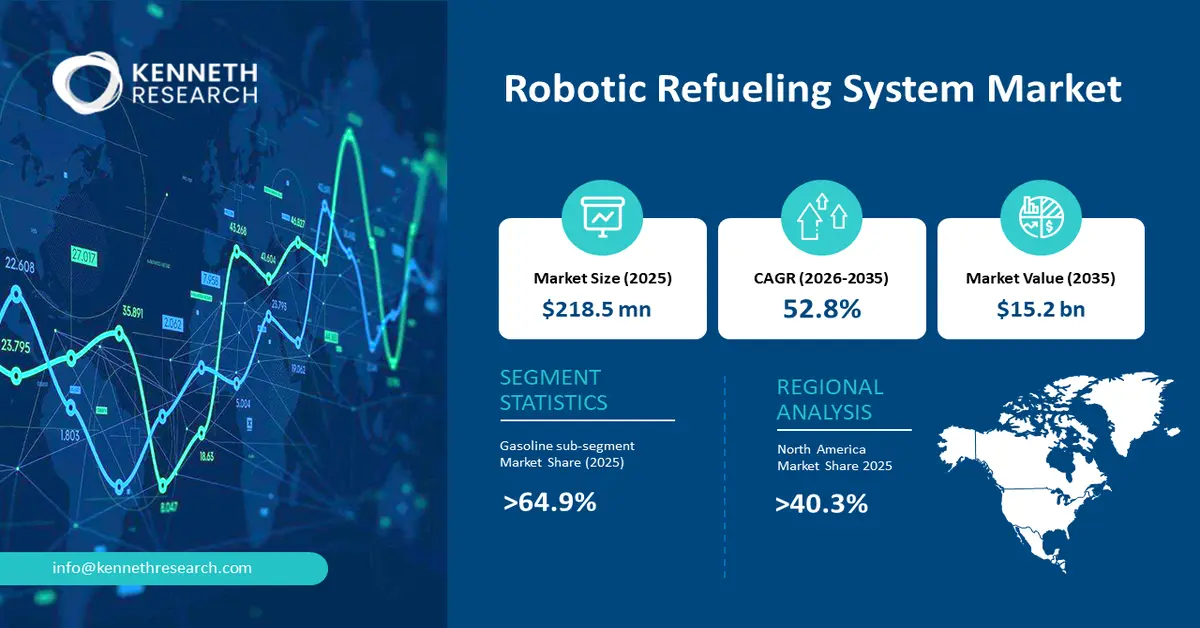
Robotic Refueling System Market size was valued at USD 218.5 million in 2025 and is projected to reach USD 15.2 billion by the end of 2035, rising at a CAGR of 52.8% during the forecast period, i.e., 2026-2035. In 2026, the industry size of the robotic refueling system is estimated at USD 335.3 million.
The primary growth driver for the robotic refueling system market is automation of repetitive fueling operations to improve labor efficiency, service consistency, and operational continuity. U.S. Bureau of Labor Statistics data show gasoline stations employed 746,760 sales and related workers in May 2024, underscoring the scale of personnel-intensive station operations.
Robotic Refueling systems are automated electromechanical solutions that identify a vehicle’s fuel inlet, position a robotic dispensing mechanism, establish a connection, deliver fuel, and complete the refueling cycle with limited or no manual intervention. The market encompasses robotic arms, sensors, cameras, controllers, dispensing interfaces, software, safety systems, and integration services deployed at fueling locations.
Key characteristics include machine vision or sensing for vehicle and nozzle alignment, automated actuation, communication with dispensing equipment, fail-safe controls, and compatibility with station operating procedures. Systems can be designed for conventional liquid fuels and, depending on architecture, other vehicle-fueling applications. Their value proposition centers on repeatable fueling, reduced operator dependence, and integration with automated mobility and infrastructure environments.
Key Robotic Refueling System Market Insights Summary:
Key Takeaways: Market Trends & Insights
- Global robotic refueling system market reached USD 218.5 million in 2025 and is projected to reach USD 15.2 billion by 2035
- The robotic refueling system market is expected to expand at a CAGR of 52.8% during 2026–2035
- Gasoline accounted for the largest Fuel Pumped segment with a 64.9% market share in 2025
- Hardware represents the second and fastest analysis segment under the Component category
- North America dominated the robotic refueling system market with a 40.3% market share in 2025, supported by the United States and Canada
Market Drivers
- Expansion of high-utilization commercial and fleet vehicle operations
- Integration of robotics, sensors, and intelligent automation
- Increasing emphasis on workplace safety and reduced manual fueling intervention
- Growing deployment of connected and automated fueling infrastructure
Challenges
- High integration complexity and infrastructure compatibility
- Stringent safety requirements and regulatory compliance
Robotic Refueling Market Overview & Supply Chain
Adoption of robotic refueling systems is increasing as transportation and fueling operations place greater emphasis on automation, operational consistency, worker safety, and reduced refueling intervention. The technology enables vehicles to be identified, positioned, refueled, and released with limited human involvement, supporting unattended or semi-automated fueling environments across fleet depots, commercial facilities, logistics operations, and mobility infrastructure. Its relevance is particularly strong where vehicles operate on repetitive schedules and downtime directly affects utilization. The continued importance of liquid-fuel infrastructure also creates a substantial operational base for automation.
The robotic refueling system value chain begins with raw-material and component suppliers providing structural metals, engineered plastics, sensors, actuators, pumps, valves, hoses, connectors, control electronics, cameras, and communication components. Component manufacturers then produce robotic arms, dispensing assemblies, positioning mechanisms, safety systems, vehicle-detection equipment, and control units, while system integrators combine these elements with software, fueling interfaces, and site-management platforms. Manufacturing and assembly require precision engineering, mechanical integration, electrical controls, and validation against fueling, vehicle-positioning, and safety requirements. Distribution typically involves direct sales, specialized automation integrators, fuel-equipment distributors, and infrastructure contractors that manage deployment and commissioning.
Robotic Refueling Market: Growth Drivers & Challenges
Growth Drivers:
- Expansion of high-utilization commercial and fleet vehicle operations: The increasing scale and utilization of commercial vehicle fleets is strengthening the business case for robotic refueling systems. Fleet operators can benefit from automated fueling because repetitive refueling tasks can be standardized, scheduled, and integrated with vehicle identification and fleet-management workflows. This is particularly relevant for logistics, transportation, municipal, industrial, and other operations where vehicle availability directly influences productivity. As fleet operators increasingly prioritize uptime, labor efficiency, safety, and predictable turnaround, automated refueling can reduce dependence on manual intervention and improve consistency across fueling sites.
- Integration of robotics, sensors, and intelligent automation: Advances in robotics, machine vision, sensors, positioning systems, and industrial control software are improving the feasibility of automated vehicle refueling. Modern robotic systems can combine vehicle detection with mechanical positioning and dispensing controls, enabling more consistent execution of repetitive fueling procedures while incorporating safety interlocks and operational monitoring. This technological convergence allows refueling equipment to move beyond standalone mechanical automation toward connected infrastructure capable of communicating with vehicles, site-management platforms, and broader fleet systems. For operators, the resulting value extends beyond labor reduction to include process standardization, operational visibility, and improved control over fueling workflows.
Challenges:
- High integration complexity and infrastructure compatibility: Robotic refueling systems must operate reliably across diverse vehicle designs, fuel interfaces, station layouts, dispensing equipment, and existing fuel-management infrastructure. This creates a significant integration challenge because robotic arms, sensors, positioning systems, nozzles, control software, and safety mechanisms must work together with high precision in environments where fueling errors can have serious operational consequences. Legacy stations may also require modifications to accommodate robotic equipment, electrical controls, communication interfaces, and physical operating space. These requirements can lengthen deployment cycles and increase engineering complexity, particularly for operators seeking to retrofit existing facilities rather than construct purpose-built sites.
- Stringent safety requirements and regulatory compliance: Automated fuel handling introduces safety-critical requirements that can constrain commercialization when systems operate around combustible fuels, vehicles, workers, and customers. Robotic refueling equipment must coordinate mechanical movement, fuel dispensing, vehicle positioning, emergency shutdown functions, environmental sensing, and human-machine interaction without creating unsafe conditions. The emergence of dedicated technical standards illustrates the increasing emphasis on formalized requirements: IEEE 3539-2025 establishes general requirements, technical requirements, testing methods, and related provisions for refueling robot systems. Compliance can increase engineering, validation, certification, documentation, and deployment requirements for manufacturers and operators, while differences across jurisdictions can complicate international commercialization.
Robotic Refueling Market Size and Forecast:
| Report Attribute | Details |
|---|---|
| Base Year |
2025 |
| Forecast Period |
2026-2035 |
| CAGR |
52.8% |
| Base Year Market Size (2025) |
USD 218.5 million |
| Forecast Year Market Size (2035) |
USD 15.2 billion |
| Regional Scope |
|
Robotic Refueling Market Segmentation Analysis:
Fuel Pumped Segment Analysis
In the fuel pumped segment, the Gasoline sub-segment is anticipated to capture the largest market share of 64.9% by the end of 2025.
Gasoline dominates the Fuel Pumped segment because it remains a major fuel type across passenger vehicles, commercial fleets, service stations, and high-frequency transportation operations, creating a broad installed base for automated dispensing technologies. Demand for gasoline-based refueling automation is supported by the continued utilization of conventional internal-combustion vehicles and the operational need to improve fueling speed, consistency, and convenience. The scale of this fueling ecosystem supports opportunities for robotic systems that can automate nozzle positioning, vehicle recognition, dispensing, and transaction workflows. On the supply side, established gasoline infrastructure and mature dispensing equipment provide an accessible deployment environment for system integrators. Going forward, gasoline-focused robotic refueling is expected to benefit from fleet automation, unattended fueling concepts, and increasing integration of robotics with connected station infrastructure.
Component Segment Analysis
The hardware is projected to grow as the second-largest segment in the robotic refueling system market due to four converging demand drivers.
Hardware is projected to grow strongly within the Component segment as robotic refueling deployments require increasingly sophisticated physical systems capable of performing positioning, dispensing, sensing, vehicle identification, and safety functions with high reliability. Demand is being supported by the expansion of automated fleet operations, where robotic arms, actuators, sensors, dispensing interfaces, controllers, and safety equipment form the essential infrastructure for autonomous fueling. The U.S. Department of Energy's 2024 Hydrogen Program review documented continued development and testing of an autonomous refueling robot, including dry and hydrogen connection activities, while noting advances in human-safe robotics and robotic vision. These developments indicate increasing technical maturity of the hardware ecosystem supporting automated refueling. Supply-side progress in robotics, machine vision, control electronics, and sensing technologies is enabling more capable and adaptable systems.
Our in-depth analysis of the global robotic refueling market includes the following segments:
|
Segment |
Sub-segment |
|
Component |
|
|
Fuel Pumped |
|
|
Payload Carrying Capacity |
|
|
Industry Vertical |
|
Robotic Refueling Market Regional Insights:
North America Market Trends & Insights:
North America robotic refueling system market is projected to hold the largest revenue share of 40.3% by the end of 2025.
Regional leadership is supported by a mature transportation and fueling ecosystem, high adoption of industrial automation, strong fleet-management capabilities, and substantial investment in robotics and intelligent infrastructure. The United States provides a particularly favorable environment because fleet operators and fueling businesses increasingly prioritize operational efficiency, safety, vehicle uptime, and automated service delivery. Canada further strengthens regional demand through its extensive road-transportation and petroleum distribution infrastructure.
The United States represents the primary country market within North America, supported by its large commercial transportation base, established fueling infrastructure, and strong investment in automation technologies. Federal programs also provide structured guidance for fleet fueling infrastructure development, supporting technology integration across transportation operations.
Canada offers a complementary growth environment, with substantial gasoline consumption and established fuel distribution networks supporting opportunities for automated dispensing technologies. Together, the two countries provide a strong combination of infrastructure readiness, technological capability, fleet activity, and investment capacity, positioning North America to remain a key deployment region as robotic refueling moves toward increasingly connected and automated fueling operations.
Asia Pacific Market Trends & Insights:
Asia Pacific presents strong opportunities for robotic refueling systems as vehicle automation, intelligent transportation infrastructure, industrial robotics, and digitally enabled energy services continue to develop across the region. Demand is being supported by the modernization of fueling infrastructure, expanding commercial transportation activity, labor-efficiency requirements, and growing interest in contactless and automated vehicle services. Government initiatives are also encouraging connected-vehicle infrastructure and broader automation.
China represents a particularly important country market because of its advanced automotive manufacturing base, expanding intelligent-vehicle ecosystem, and growing deployment of automated fueling technologies. Shanghai has already introduced a robotic fueling system capable of autonomously opening fuel tanks, selecting nozzles, dispensing gasoline, and completing the refueling process, demonstrating practical commercial deployment potential.
India offers a complementary opportunity through its expanding automotive and logistics sectors, increasing digitalization of transportation infrastructure, and growing emphasis on automation and smart mobility. Together, China and India can support regional demand as fueling operators, fleet owners, infrastructure developers, and technology providers increasingly pursue automated and connected fueling solutions.
Leading Companies Operating in the Global Robotic Refueling Market:
Here is a list of upstream, downstream, and key players operating in the global Robotic Refueling Market competitive ecosystem:
- Fuelmatics AB (Sweden)
- Company Overview
- Business Strategy
- Key Product Offerings
- Financial Performance
- Key Performance Indicators
- Risk Analysis
- Recent Development
- Regional Presence
- SWOT Analysis
- KUKA AG (Germany)
- ABB Ltd. (Switzerland)
- Stäubli International AG (Switzerland)
Recent Developments
- In June 2025, Stäubli and ArianeGroup signed a Memorandum of Understanding to jointly develop and commercialize a new quick-coupling system for liquid hydrogen refueling, combining ArianeGroup's expertise in handling liquid hydrogen for launch vehicles with Stäubli's leadership in coupling systems. The collaboration aims to create a reliable and efficient solution for rapid motorsport vehicle refueling and other applications utilizing liquid hydrogen as fuel.
- In September 2025, a KUKA industrial robot was featured in the opening of the Hardware-In-The-Loop Space Robotics Facility at City St George's, University of London. The facility enables startups to simulate rendezvous and docking operations for autonomous satellites, including refueling applications. Orbit Fab's UK arm will be the first company to use the facility, demonstrating the RAFTI docking interface with KUKA robots to de-risk satellite refueling technology.
Frequently Asked Question
In 2025, the robotic refueling system market exceeded USD 218.5 million.
The robotic refueling system market is projected to reach USD 15.2 billion by the end of 2035, expanding at a CAGR of 52.8% over the forecast period (2026-2035).
The major players in the market are Fuelmatics AB, KUKA AG, ABB Ltd., Stäubli International AG, and others.
In the Fuel Pumped segment, the Gasoline sub-segment is anticipated to capture the largest market share of 64.9% in the future and exhibit lucrative growth opportunities during 2026-2035. This growth trajectory is largely attributed to the continued utilization of gasoline-based transportation and the growing adoption of automated fueling technologies.
North America is projected to hold the largest market share of 40.3% by the end of 2025 and provide more business opportunities in the future. Strong transportation infrastructure, established fueling networks, and continued investments in automation across the United States and Canada are fostering the region's dominance.
Why Choose Kenneth Research ?
-
Insight with Impact : We don’t just gather data — we uncover stories, trends, and opportunities that fuel business growth.
-
Experts Who Get It : Our team speaks your industry’s language and knows what really matters to your customers and market.
-
Custom-Built for You : Forget one-size-fits-all. We craft research and consulting solutions as unique as your business vision.
-
Partners, Not Just Providers : We work with you, not for you — collaborating closely to turn insights into smart, strategic moves.
-
Results That Speak : Our work powers brands, startups, and industry leaders alike — with a track record of ideas that work in the real world.
Report ID: 1194 |
Published Date: 28 Sep 2026 |
Report Format: |
Delivery Timeline: 48-72 Business Hours

Copyright © 2025 Kenneth Research. All rights reserved. Terms of Use | Privacy Policy
