Report ID: 1196 |
Published Date: 27 Aug 2026 |
Report Format: |
Delivery Timeline: 48-72 Business Hours
Robotic Case Erectors Market Outlook:
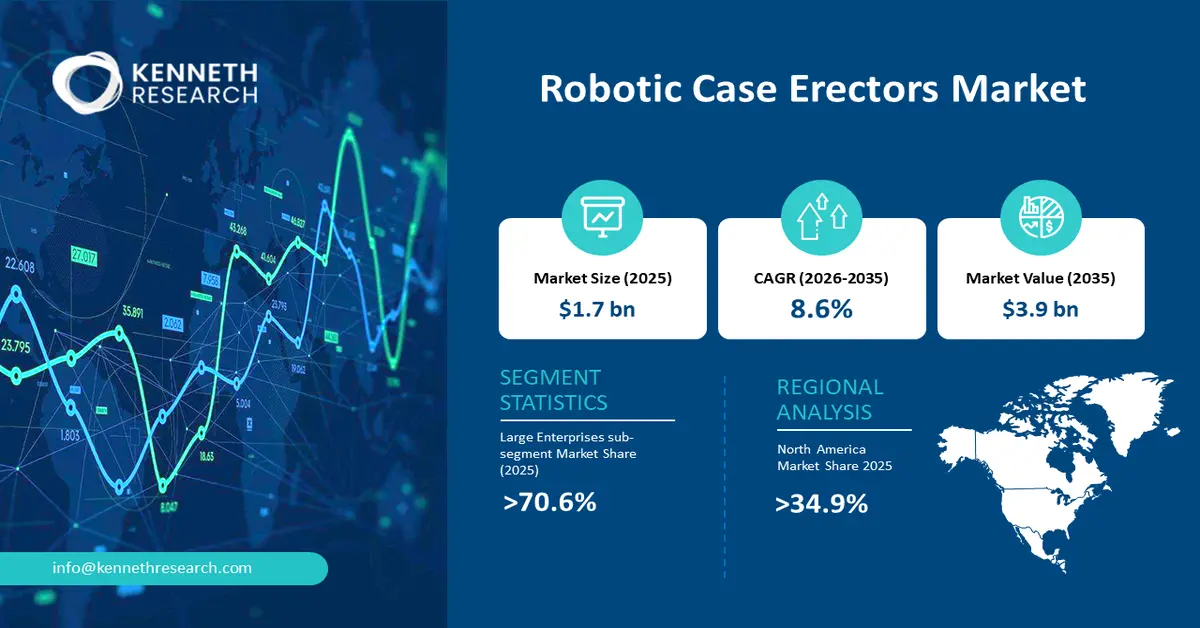
Robotic Case Erectors Market size was valued at USD 1.7 billion in 2025 and is projected to reach USD 3.9 billion by the end of 2035, rising at a CAGR of 8.6% during the forecast period, i.e., 2026-2035. In 2026, the industry size of robotic case erectors is estimated at USD 1.8 billion.
The expansion of e-commerce and high-throughput distribution is a primary growth driver for robotic case erectors, as manufacturers and fulfillment operations require faster, consistent packaging processes. U.S. retail e-commerce sales increased 9.8% year over year in the first quarter of 2026, strengthening demand for automated case preparation and packaging workflows.
The robotic case erectors market comprises automated equipment and integrated robotic systems designed to form, open, square, and prepare flat corrugated cases for subsequent filling and sealing operations. These systems combine robotic handling, mechanical forming mechanisms, sensors, programmable controls, conveyors, and case-feeding technologies to execute packaging preparation with limited manual intervention.
Key characteristics include automated case picking, precise opening and positioning, repeatable forming, programmable operating sequences, integration with upstream and downstream packaging equipment, and compatibility with different case formats and production requirements. Fully automatic configurations can coordinate case handling and forming activities within continuous production environments, while controls and sensing technologies support operational consistency.
Key Robotic Case Erectors Market Insights Summary:
Key Takeaways: Market Trends & Insights
- Large Enterprises account for 70.6% of the robotic case erectors market in 2025, supported by high-volume packaging requirements and greater capacity to invest in automation
- The Fully Automatic segment is positioned for strong growth as manufacturers prioritize continuous, low-intervention packaging operations and integrated end-of-line automation
- North America leads the market with a 34.9% share in 2025, supported by established manufacturing infrastructure and advanced industrial automation adoption
- Asia Pacific represents a significant expansion opportunity as China and India accelerate manufacturing modernization, robotics adoption, and Industry 4.0 initiatives
- The robotic case erectors market is projected to increase from USD 1.8 billion in 2026 to USD 3.9 billion by 2035, reflecting a CAGR of 8.6% over the forecast period
Market Drivers
- Accelerating adoption of industrial robotics and factory automation
- Rising demand for flexible and labor-efficient packaging operations
- Integration of robotic case erectors with connected end-of-line packaging systems
- Increasing need for consistent, scalable, and automated packaging workflows
Challenges
- Integration complexity across existing packaging lines
- Dependence on case quality and format consistency
Robotic Case Erectors Market Overview & Supply Chain
Adoption of robotic case erectors is increasing globally as manufacturers, distribution centers, and packaging-intensive businesses prioritize automated material handling, consistent packaging quality, and higher production-line efficiency. The technology is particularly relevant to industries where repetitive case-forming activities must be coordinated with filling, sealing, labeling, palletizing, and warehouse operations. Robotics also supports manufacturers facing pressure to improve throughput while reducing dependence on repetitive manual processes and maintaining operational consistency across production environments.
The robotic case erectors market value chain begins with suppliers of structural metals, electrical components, motors, sensors, pneumatic systems, controllers, robotic assemblies, conveyor components, and case-handling mechanisms. Equipment manufacturers integrate these inputs into case-erecting machines, combining mechanical assemblies with automation controls, sensing technologies, software, and safety systems. System integrators and engineering firms subsequently configure equipment according to production-line layouts and connect case erectors with upstream and downstream packaging machinery. Distributors, automation specialists, and equipment service providers support delivery, installation, commissioning, spare-parts availability, and maintenance. End users include manufacturers, fulfillment centers, logistics operators, food and beverage companies, pharmaceutical producers, consumer-goods businesses, and other packaging-intensive organizations.
Robotic Case Erectors Market: Growth Drivers & Challenges
Growth Drivers:
- Accelerating adoption of industrial robotics and factory automation: The broader expansion of industrial robotics is strengthening the operating environment for robotic case erectors by encouraging manufacturers to automate repetitive packaging activities alongside production and material-handling processes. This sustained automation activity demonstrates continued investment in robotic production infrastructure and supports integration opportunities for automated case erection within connected packaging lines. As manufacturers increasingly link robotic handling, conveyors, inspection, palletizing, and packaging equipment, case erection can become an integral step in end-of-line automation rather than an isolated operation. The trend is expected to encourage demand for flexible, sensor-enabled, and software-integrated case erectors capable of communicating with broader factory automation systems.
- Rising demand for flexible and labor-efficient packaging operations: Manufacturers are increasingly seeking packaging systems that can maintain consistent output while reducing dependence on repetitive manual case preparation. Robotic case erectors address this requirement by automating case handling, opening, squaring, and positioning, allowing packaging lines to operate with greater process consistency and reduced manual intervention. The demand is particularly relevant for operations managing multiple product formats, frequent production changes, or high-volume distribution requirements, where manual case preparation can create workflow bottlenecks. Fully automatic systems can also be integrated with conveyors, case sealers, filling equipment, labeling systems, and palletizing technologies, creating more coordinated end-of-line workflows.
Challenges:
- Integration complexity across existing packaging lines: A major restraint is the technical complexity involved in integrating robotic case erectors with legacy packaging equipment, conveyors, programmable logic controllers, safety systems, and downstream case packers or sealers. Many facilities operate equipment from multiple suppliers with different communication architectures, making synchronization and fault management more demanding. Integration can require engineering modifications, interface development, layout adjustments, and commissioning expertise, increasing project complexity and extending implementation timelines. Operationally, poor synchronization can cause case-flow interruptions, upstream accumulation, or downstream starvation, reducing the expected efficiency benefits of automation.
- Dependence on case quality and format consistency: Robotic case erectors depend heavily on consistent corrugated blanks because variations in board stiffness, dimensions, die-cut accuracy, moisture exposure, or blank condition can disrupt automated feeding and forming. Unlike manual operators, automated systems have limited ability to compensate for poorly presented or inconsistent cases without additional sensing, adjustment, or control capabilities. Such variability can produce misfeeds, incomplete squaring, unstable cases, sealing problems, and interruptions that propagate into downstream packaging operations. The resulting downtime can undermine productivity improvements and increase maintenance intervention, spare-parts consumption, and operator involvement. Commercially, manufacturers may need to invest in higher-quality packaging materials, improved storage conditions, or equipment configured specifically for their case portfolio, raising the overall automation burden.
Robotic Case Erectors Market Size and Forecast:
| Report Attribute | Details |
|---|---|
| Base Year |
2025 |
| Forecast Period |
2026-2035 |
| CAGR |
8.6% |
| Base Year Market Size (2025) |
USD 1.7 billion |
| Forecast Year Market Size (2035) |
USD 3.9 billion |
| Regional Scope |
|
Robotic Case Erectors Market Segmentation Analysis:
End-User Segment Analysis
In the end-user segment, the Large Enterprises sub-segment is anticipated to capture the largest market share of 70.6% by the end of 2025.
Large enterprises dominate the robotic case erectors market because their high-volume production and distribution environments generate strong requirements for continuous, standardized, and automated case preparation. These organizations typically operate complex packaging lines where case erection must synchronize with filling, sealing, labeling, conveying, and palletizing equipment. Automation therefore provides greater value when deployed across high-throughput facilities with established material-handling infrastructure and dedicated engineering capabilities. Demand is further supported by the ability of large organizations to absorb integration costs and justify automation through operational efficiency, consistency, and scalability objectives.
Product Type Segment Analysis
The Fully Automatic is projected to grow as the second-largest segment in the robotic case erectors market due to four converging demand drivers.
The Fully Automatic segment is projected to grow as manufacturers increasingly prioritize uninterrupted packaging workflows, reduced manual intervention, and consistent case preparation across high-throughput operations. Fully automatic case erectors can perform case feeding, opening, forming, squaring, and transfer with limited operator involvement, making them well suited to integrated packaging lines. This environment encourages equipment suppliers to develop faster, programmable, sensor-enabled systems capable of handling varied case formats and communicating with downstream machinery. Future adoption is expected to strengthen as manufacturers pursue connected end-of-line automation, greater operational consistency, and scalable packaging capacity.
Our in-depth analysis of the global robotic case erectors market includes the following segments:
|
Segment |
Sub-segment |
|
Product Type |
|
|
Distribution Channel |
|
|
Application |
|
|
End-User |
|
Robotic Case Erectors Market Regional Insights:
North America Market Trends & Insights:
North America robotic case erectors market is projected to hold the largest revenue share of 34.9% by the end of 2025.
It is supported by a mature manufacturing base, strong investment in industrial automation, and widespread adoption of integrated packaging and material-handling technologies. The United States provides the region’s principal industrial foundation, while Canada contributes a diversified manufacturing ecosystem and established cross-border supply networks.
The United States remains the key regional market because of its extensive food, beverage, consumer goods, pharmaceutical, automotive, and logistics manufacturing infrastructure, alongside continued factory-automation investment.
Canada complements this ecosystem through its established manufacturing sector, particularly food, transportation equipment, machinery, and fabricated products. ogether, the two countries provide equipment suppliers with substantial opportunities for automated case erection, system integration, aftermarket services, and modernization of existing packaging lines.
Asia Pacific Market Trends & Insights:
Asia Pacific is emerging as a significant opportunity center for robotic case erectors, supported by expanding manufacturing capacity, increasingly automated production environments, and the modernization of logistics and packaging infrastructure. China is accelerating the application of robotics, industrial internet, AI, and other digital technologies across manufacturing, including material-handling operations, creating a favorable environment for automated case preparation. India is also strengthening its advanced-manufacturing ecosystem through government programs emphasizing robotics, automation, digital technologies, and technology-enabled production.
China represents the region's major industrial opportunity, with extensive manufacturing ecosystems and continued government support for wider robotics deployment across factories, material handling, and logistics.
India offers a complementary growth avenue as manufacturers expand production capabilities and pursue greater automation. The country's advanced-manufacturing roadmap specifically identifies robotics and other frontier technologies as important enablers of manufacturing competitiveness, while policy initiatives seek to strengthen technology availability and industrial modernization.
Leading Companies Operating in the Global Robotic Case Erectors Market:
Here is a list of upstream, downstream, and key players operating in the global robotic case erectors market competitive ecosystem:
- Krones AG (Germany)
- Company Overview
- Business Strategy
- Key Product Offerings
- Financial Performance
- Key Performance Indicators
- Risk Analysis
- Recent Development
- Regional Presence
- SWOT Analysis
- A-B-C Packaging Machine Corporation (United States)
- ABB Robotics (Switzerland)
Recent Developments
- In May 2025, ABB Robotics deployed IRB 6710 robots integrated with AI-driven Building Information Modeling (BIM) and digital twin software at Cosmic Buildings' mobile micro-factory in Pacific Palisades, California. The system produces customized structural wall panels with millimeter precision for post-wildfire housing reconstruction, reducing construction time by up to 70% and costs by 30% compared to conventional methods.
- In September 2025, A-B-C Packaging Machine Corporation showcased its Model 400 case erector/sealer at Pack Expo Las Vegas, featuring smart technology with HMI and full connectivity capabilities. The machine handles less-than-perfect corrugated and high-content recycled board while delivering square, sealed cases with real-time status monitoring and OEE data for complete productivity tracking.
Frequently Asked Question
In 2025, the robotic case erectors market exceeded USD 1.7 billion.
The robotic case erectors market is projected to reach USD 3.9 billion by the end of 2035, expanding at a CAGR of 8.6% over the forecast period (2026-2035).
The major players in the market are Krones AG, A-B-C Packaging Machine Corporation, Cama Group, ABB Robotics, and others.
In the end-user segment, the large enterprises sub-segment is anticipated to capture the largest market share of 70.6% in the future and exhibit lucrative growth opportunities during 2026-2035. This growth trajectory is largely attributed to the increasing adoption of automated packaging workflows by high-volume manufacturing and distribution operations.
North America is projected to hold the largest market share of 34.9% by the end of 2025 and provide more business opportunities in the future. Continuous investments in industrial automation and advanced manufacturing across the United States and Canada are fostering the region's dominance.
Why Choose Kenneth Research ?
-
Insight with Impact : We don’t just gather data — we uncover stories, trends, and opportunities that fuel business growth.
-
Experts Who Get It : Our team speaks your industry’s language and knows what really matters to your customers and market.
-
Custom-Built for You : Forget one-size-fits-all. We craft research and consulting solutions as unique as your business vision.
-
Partners, Not Just Providers : We work with you, not for you — collaborating closely to turn insights into smart, strategic moves.
-
Results That Speak : Our work powers brands, startups, and industry leaders alike — with a track record of ideas that work in the real world.
Report ID: 1196 |
Published Date: 27 Aug 2026 |
Report Format: |
Delivery Timeline: 48-72 Business Hours

Copyright © 2025 Kenneth Research. All rights reserved. Terms of Use | Privacy Policy
