Report ID: 1245 |
Published Date: 28 Sep 2026 |
Report Format: |
Delivery Timeline: 48-72 Business Hours
Renewable Aviation Fuel Market Outlook:
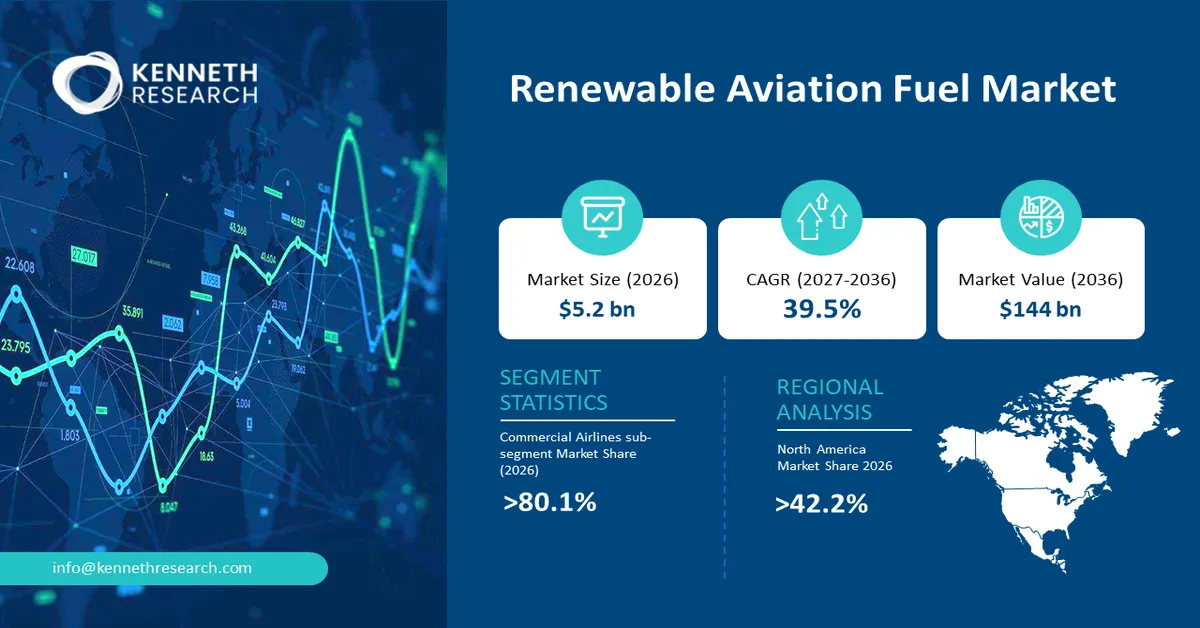
Renewable Aviation Fuel Market size was valued at USD 5.2 billion in 2026 and is projected to reach USD 144 billion by the end of 2036, rising at a CAGR of 39.5% during the forecast period, i.e., 2027-2036. In 2027, the industry size of the renewable aviation fuel is estimated at USD 7.2 billion.
The primary growth driver of the renewable aviation fuel market is the aviation industry's accelerating transition toward lower-carbon fuels.
The renewable aviation fuel market comprises fuels produced from renewable biological resources, waste-derived feedstocks, and other non-fossil sources for use in aircraft. Renewable aviation fuels are designed to provide a lower-carbon alternative to conventional petroleum-derived jet fuel while meeting aviation fuel performance and safety requirements. The market includes fuel production, feedstock processing, upgrading technologies, blending, certification, distribution, and supply to airlines and other aviation users.
Key characteristics include potentially lower lifecycle greenhouse-gas emissions, compatibility with existing aviation infrastructure when produced under approved fuel pathways, and the ability to utilize diverse renewable feedstocks. Depending on the production route, feedstocks can include used cooking oils, agricultural residues, municipal waste, forestry-derived materials, and other renewable resources.
Key Renewable Aviation Fuel Market Insights Summary:
Key Takeaways: Market Trends & Insights
- Renewable aviation fuel market is projected to grow from USD 5.2 billion in 2026 to USD 144 billion by 2036, expanding at a 39.5% CAGR.
- North America accounted for the largest regional share at 42.2% in 2026, supported by strong aviation activity, domestic SAF production initiatives, government incentives, and investments in fuel infrastructure across the U.S. and Canada.
- Commercial Airlines represented the leading End-use segment with an 80.1% share in 2026, driven by increasing airline demand for lower-carbon liquid fuels compatible with existing aircraft and fueling infrastructure.
- 10–50% Blend is positioned for continued growth as approved blending pathways allow airlines to incorporate renewable aviation fuel into existing operations while supporting a gradual transition toward lower-carbon aviation.
Market Drivers
- Strengthening government support and aviation decarbonization policies
- Rising airline demand for lower-carbon drop-in fuels
- Expansion of renewable feedstock availability and advanced fuel-production pathways
- Increasing investment in SAF production capacity, airport infrastructure, and long-term airline offtake agreements
Challenges
- High Production Costs and Feedstock Competition
- Limited Feedstock Availability and Supply-Chain Scalability
Renewable Aviation Fuel Market Overview & Supply Chain
Global adoption of renewable aviation fuel is increasing as airlines, fuel producers, airports, and governments pursue lower-carbon aviation while retaining liquid-fuel compatibility with existing aircraft systems. Renewable aviation fuels are particularly relevant because aviation remains difficult to electrify at scale, making sustainable liquid fuels an important decarbonization pathway. The International Energy Agency projects that sustainable aviation fuel consumption will increase from 1 billion litres in 2024 to 9 billion litres in 2030, supported by mandates in Europe and the United Kingdom, incentives in the United States, and blending targets in Japan.
The renewable aviation fuel value chain begins with feedstock sourcing, including waste oils, agricultural residues, forestry materials, municipal waste, and other renewable inputs. Feedstocks are collected, processed, and converted into intermediate products before being upgraded through approved fuel-production pathways. Producers then refine, condition, and blend the resulting fuel to meet aviation specifications and sustainability requirements.
Renewable Aviation Fuel Market: Growth Drivers & Challenges
Growth Drivers:
- Strengthening government support and aviation decarbonization policies: Government policies are increasingly creating demand certainty for renewable aviation fuel by establishing blending requirements, incentives, funding programs, and long-term decarbonization frameworks. These measures reduce market uncertainty for fuel producers and encourage airlines to enter offtake agreements and invest in supply-chain development. The U.S. Department of Energy's SAF initiative brings together federal agencies to accelerate research, demonstration, and commercial deployment of sustainable aviation fuel, while its commercial-liftoff strategy focuses on building a competitive domestic SAF industry.
- Rising airline demand for lower-carbon drop-in fuels: Airlines are increasingly seeking lower-carbon fuel options that can be incorporated into existing aviation operations without requiring fundamental changes to aircraft propulsion systems. Renewable aviation fuels provide an important pathway because approved fuels can be blended with conventional jet fuel and distributed through established aviation-fuel infrastructure. This compatibility enables airlines to pursue emissions-reduction objectives while maintaining existing fleet operations and route networks. Growing customer, investor, airport, and regulatory pressure to reduce aviation emissions is further strengthening procurement interest.
Challenges:
- High production costs and feedstock competition: The cost structure of renewable aviation fuel remains a major commercial restraint because production depends heavily on feedstock availability, conversion efficiency, financing conditions, and the maturity of individual production pathways. Waste oils, fats, agricultural residues, and other eligible feedstocks are also subject to competition from renewable diesel, biodiesel, and other biofuel applications. This can increase procurement costs and make long-term supply contracts more difficult to secure. The IEA identifies higher costs and the need for stronger supply chains and sustainability measures as important barriers to faster renewable-fuel deployment.
- Limited feedstock availability and supply-chain scalability: The renewable aviation fuel industry faces structural constraints in expanding feedstock supply at the same pace as potential aviation demand. Established pathways often rely on waste oils, fats, and other residues whose availability is finite and subject to competition from other renewable-fuel markets. Expanding into agricultural residues, forestry resources, municipal waste, and other feedstocks requires additional collection infrastructure, processing capacity, certification systems, and technology development.
Renewable Aviation Fuel Market Size and Forecast:
| Report Attribute | Details |
|---|---|
| Base Year |
2026 |
| Forecast Period |
2027-2036 |
| CAGR |
39.5% |
| Base Year Market Size (2026) |
USD 5.2 billion |
| Forecast Year Market Size (2036) |
USD 144 billion |
| Regional Scope |
|
Renewable Aviation Fuel Market Segmentation Analysis:
End-use Segment Analysis
In the End-use segment, the Commercial Airlines sub-segment is anticipated to capture the largest market share of 80.1% in 2026.
Its dominance is supported by the aviation industry's growing need for lower-carbon liquid fuels that can be incorporated into existing aircraft operations and fuel infrastructure. Airlines are increasingly engaging with renewable aviation fuel producers through procurement agreements and decarbonization programs, creating demand visibility across the supply chain. The International Energy Agency identifies aviation as an increasingly important source of biofuel demand and notes that new aviation policies are accelerating deployment. Commercial carriers also provide the largest addressable customer base for renewable aviation fuel because of their extensive flight networks and recurring jet-fuel requirements.
Blending Level Segment Analysis
In the Blending Level segment, the 10–50% Blend sub-segment is projected to grow as aviation stakeholders increasingly adopt renewable aviation fuels within technically approved blending limits. Blending allows airlines to introduce lower-carbon fuel into existing aircraft operations while minimizing the need for changes to aircraft engines, airport storage systems, and fueling infrastructure. The IEA notes that several certified biojet fuel pathways are approved for blends of up to 50%, depending on the specific technology and compatibility requirements.
The blending approach also supports gradual adoption as airlines, fuel suppliers, and airports expand SAF procurement and infrastructure. It provides producers with a practical route to scale supply while certification, feedstock availability, and production technologies continue to mature. Government policies are reinforcing this transition through progressively higher SAF requirements, creating stronger demand for blended aviation fuels.
Our in-depth analysis of the global renewable aviation fuel market includes the following segments:
|
Segment |
Sub-segment |
|
Technology |
|
|
Blending Level |
|
|
End Use |
|
Renewable Aviation Fuel Market Regional Insights:
North America Market Trends & Insights:
North America represents a major opportunity for the renewable aviation fuel market, supported by strong airline activity, domestic fuel-production initiatives, government incentives, and expanding investment in SAF infrastructure. The region benefits from an established refining and aviation ecosystem that can support the production, blending, storage, and distribution of renewable aviation fuels. Future regional growth is expected to be supported by stronger decarbonization requirements, expanding production capacity, and increasing airline demand for lower-carbon aviation fuels.
U.S. remains the leading country market in North America, supported by federal SAF programs, production incentives, and a growing domestic production ecosystem. The U.S. Department of Energy reported that announced projects represented substantial future domestic SAF production potential, demonstrating strong investment momentum across the value chain.
Canada is developing an emerging SAF production base through federal funding and clean-fuel initiatives. Natural Resources Canada has supported SAF project development in Ontario and Manitoba, while federal programs are designed to expand domestic clean-fuel production and infrastructure.
Asia-Pacific Market Trends & Insights:
Asia-Pacific represents a significant opportunity for the renewable aviation fuel market, supported by expanding air traffic, growing aviation fuel demand, government decarbonization initiatives, and increasing interest in sustainable aviation fuels. The region's established refining, petrochemical, and airport infrastructure provides a foundation for SAF production, blending, storage, and distribution. Japan and China are emerging as important markets as governments and airlines pursue lower-carbon aviation pathways.
Japan is advancing SAF adoption through government-led initiatives, airline commitments, domestic production projects, and international supply partnerships. Its focus on reducing aviation emissions is creating opportunities for fuel producers and technology developers.
China offers substantial long-term potential because of its large aviation sector, extensive refining infrastructure, and expanding renewable-energy ecosystem. Increasing attention to sustainable aviation and domestic low-carbon fuel development is expected to support future SAF investment and production.
Leading Companies Operating in the Global Renewable Aviation Fuel Market:
Here is a list of upstream, downstream, and key players operating in the global renewable aviation fuel market competitive ecosystem:
- Neste Oyj (Finland)
- Company Overview
- Business Strategy
- Key Product Offerings
- Financial Performance
- Key Performance Indicators
- Risk Analysis
- Recent Development
- Regional Presence
- SWOT Analysis
- LanzaJet, Inc. (United States)
- Gevo, Inc. (United States)
Recent Developments
- February 2026: Neste extended its relationship with World Fuel Services through a five-year agreement to expand the availability of Neste-supplied sustainable aviation fuel across more than 100 airports in World Fuel’s UK and European network.
- January 2025: LanzaJet selected Wilton International in Teesside, United Kingdom, as the location for its next sustainable aviation fuel production facility, known as Project Speedbird.
Frequently Asked Question
In 2026, the renewable aviation fuel market exceeded USD 5.2 billion.
The renewable aviation fuel market is projected to reach USD 144 billion by the end of 2036, expanding at a CAGR of 39.5% over the forecast period (2027-2036).
The major players in the market are Neste Oyj, LanzaJet, Inc., Gevo, Inc., and others.
In the End-use segment, the Commercial Airlines sub-segment is anticipated to capture the largest market share of 80.1% in the future and exhibit lucrative growth opportunities during 2027-2036.
North America is projected to hold the largest market share of 42.2% by the end of 2026 and provide more business opportunities in the future.
Why Choose Kenneth Research ?
-
Insight with Impact : We don’t just gather data — we uncover stories, trends, and opportunities that fuel business growth.
-
Experts Who Get It : Our team speaks your industry’s language and knows what really matters to your customers and market.
-
Custom-Built for You : Forget one-size-fits-all. We craft research and consulting solutions as unique as your business vision.
-
Partners, Not Just Providers : We work with you, not for you — collaborating closely to turn insights into smart, strategic moves.
-
Results That Speak : Our work powers brands, startups, and industry leaders alike — with a track record of ideas that work in the real world.
Report ID: 1245 |
Published Date: 28 Sep 2026 |
Report Format: |
Delivery Timeline: 48-72 Business Hours

Copyright © 2025 Kenneth Research. All rights reserved. Terms of Use | Privacy Policy
