Report ID: 1267 |
Published Date: 01 Sep 2026 |
Report Format: |
Delivery Timeline: 48-72 Business Hours
Printed Electronics Market Outlook:
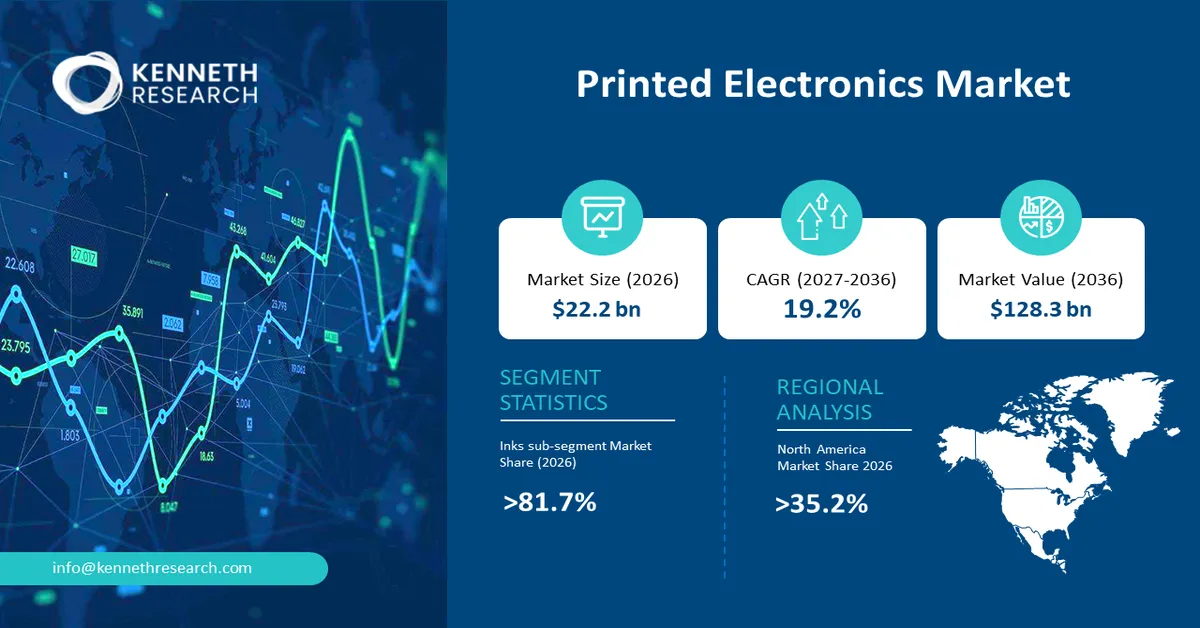
Printed Electronics Market size was valued at USD 22.2 billion in 2026 and is projected to reach USD 128.3 billion by the end of 2036, rising at a CAGR of 19.2% during the forecast period, i.e., 2027-2036. In 2027, the industry size of the printed electronics is estimated at USD 26.4 billion.
Growing adoption of flexible, lightweight, and cost-efficient electronic components across consumer electronics, healthcare devices, automotive systems, packaging, and smart surfaces is driving demand for printed electronics.
The printed electronics market encompasses electronic components and functional devices manufactured by depositing conductive, semiconductive, dielectric, or other functional materials onto substrates using printing-based processes. These technologies enable the production of electronic circuits and components on flexible, rigid, or unconventional surfaces while supporting lightweight designs, material efficiency, and scalable manufacturing.
Key characteristics include compatibility with substrates such as plastics, paper, glass, and textiles; utilization of functional inks; and manufacturing through processes including screen, inkjet, gravure, and flexographic printing. Printed electronics are applied across displays, sensors, RFID systems, smart labels, photovoltaic devices, wearable electronics, automotive interfaces, and healthcare technologies.
Key Printed Electronics Market Insights Summary:
Key Takeaways: Market Trends & Insights
- Printed electronics market is projected to grow from USD 22.2 billion in 2026 to USD 128.3 billion by 2036, registering a CAGR of 19.2% during the forecast period.
- North America is projected to remain the leading regional market, accounting for 35.2% in 2026, supported by advanced electronics R&D capabilities, flexible-electronics innovation, and commercialization across the U.S. and Canada.
- Inks are expected to remain the leading Material segment with an 81.7% share in 2026, supported by their essential role in producing conductive circuits, sensors, displays, antennas, and other functional electronic components.
- Screen Printing is projected to remain an important Technology segment as its ability to deposit uniform functional ink layers supports high-volume manufacturing of sensors, displays, RFID components, and other printed electronic products.
Market Drivers
- Growing adoption of flexible and wearable electronic devices across consumer and healthcare applications.
- Increasing integration of smart sensors, antennas, and conductive circuitry into connected products and packaging.
- Advancements in functional inks and substrate technologies enabling broader application compatibility.
- Rising demand for lightweight, thin, customizable, and scalable electronic manufacturing solutions.
Challenges
- Functional Ink Formulation and Material Compatibility
- Scaling Production While Maintaining Quality and Reliability
Printed Electronics Market Overview & Supply Chain
Adoption of printed electronics is increasing globally as manufacturers seek lightweight, flexible, scalable, and cost-efficient approaches for integrating electronic functionality into next-generation products. Advances in functional inks, substrate compatibility, printing precision, and additive manufacturing are expanding applications across flexible displays, sensors, smart packaging, lighting, healthcare devices, automotive interfaces, and wearable technologies. Government-backed research is also supporting commercialization of scalable printed-electronics manufacturing. In 2022, the U.S. Department of Energy awarded USD 1,309,660 to a project developing a low-cost manufacturing process based on microchip assembly printing for thin, lightweight, bendable electronic systems. The project specifically targeted scalable manufacturing of electronics across large-area applications.
The printed electronics value chain begins with functional material suppliers providing conductive, semiconductive, dielectric, and specialty inks, alongside substrates such as flexible polymers, glass, paper, and textiles. These inputs are combined with printing equipment, curing systems, and process-control technologies to manufacture functional electronic layers and circuits. Producers select printing methods according to resolution, substrate characteristics, production volume, and application requirements, with screen, inkjet, gravure, and flexographic processes serving different manufacturing needs. Finished components and assemblies are supplied to electronics manufacturers, automotive companies, healthcare-device producers, packaging companies, consumer-product manufacturers, and other industrial customers.
Printed Electronics Market: Growth Drivers & Challenges
Growth Drivers:
- Expanding demand for flexible and advanced electronic systems: The increasing need for lightweight, flexible, and miniaturized electronic systems is accelerating adoption of printed electronics across consumer electronics, healthcare, automotive, packaging, and smart-surface applications. Printed manufacturing enables conductive and functional materials to be deposited directly onto flexible or unconventional substrates, supporting thinner designs and greater form-factor flexibility than conventional electronic assembly approaches. Advances in functional inks, printing precision, curing technologies, and substrate compatibility are improving product reliability and expanding commercial applications. Government research programs are also supporting advances in materials and manufacturing science relevant to next-generation electronics. In 2024, the U.S. Department of Energy announced USD 179 million for Microelectronics Science Research Centers focused on materials, device and system design, and manufacturing science.
- Increasing integration of electronics into smart and connected products: The proliferation of connected products is creating new applications for printed sensors, antennas, conductive circuits, displays, and identification technologies. Manufacturers increasingly require electronic functionality that can be integrated directly into packaging, labels, textiles, vehicle interiors, medical devices, and consumer products without adding substantial weight or thickness. Printed electronics can support these requirements through scalable deposition processes and Compatibility with diverse substrates. The technology is particularly attractive where large-area coverage, customization, or distributed sensing is required.
Challenges:
- Functional Ink formulation and material compatibility: The performance of printed electronics depends heavily on the formulation and compatibility of functional inks with printing methods and substrates. Conductivity, viscosity, surface tension, drying behavior, adhesion, and curing characteristics must be precisely balanced for consistent electronic performance. Variations in these properties can create defects, uneven layers, poor adhesion, or inconsistent electrical characteristics, particularly in multilayer devices. This makes formulation development resource-intensive and can increase qualification requirements for manufacturers. The challenge is particularly important for screen printing, where ink rheology must be matched closely with mesh characteristics and required layer thickness.
- Scaling production while maintaining quality and reliability: Moving printed electronics from laboratory prototypes to consistent, high-volume production remains a significant industrial challenge. Manufacturers must maintain print registration, layer uniformity, adhesion, electrical performance, curing consistency, and substrate handling while increasing production throughput. Small variations in printing conditions can create defects that reduce yield and increase material consumption, making process optimization critical for commercial-scale operations. The challenge becomes more complex for multilayer and hybrid electronic systems that combine printed materials with conventional components.
Printed Electronics Market Size and Forecast:
| Report Attribute | Details |
|---|---|
| Base Year |
2026 |
| Forecast Period |
2027-2036 |
| CAGR |
19.2% |
| Base Year Market Size (2026) |
USD 22.2 billion |
| Forecast Year Market Size (2036) |
USD 128.3 billion |
| Regional Scope |
|
Printed Electronics Market Segmentation Analysis:
Material Type Segment Analysis
In the Material segment, the Inks sub-segment is anticipated to capture the largest market share of 81.7% in 2026.
Its dominance is driven by the essential role of conductive, dielectric, resistive, and semiconductive inks in creating functional circuits, sensors, antennas, displays, and other printed electronic components. Demand is increasing as manufacturers pursue thin, flexible, lightweight, and scalable electronic designs across automotive, consumer electronics, healthcare, packaging, and industrial applications. On the supply side, established ink formulation capabilities and advances in silver, copper, carbon, and other functional materials are improving conductivity, printability, substrate compatibility, and production efficiency. Research published by the American Chemical Society in 2024 highlights advances in metal–organic decomposition inks that enable printed electronic features on unconventional surfaces and support applications including wearables, automotive, aerospace, and fine-line electronics.
Technology Type Segment Analysis
In the Technology segment, the Screen Printing sub-segment is projected to grow strongly as manufacturers seek scalable and cost-efficient methods for producing printed electronic circuits, sensors, antennas, and functional components. Screen printing enables deposition of relatively thick and uniform functional ink layers across flexible and rigid substrates, supporting applications that require conductivity, durability, and repeatable performance. Adoption is expanding across wearable electronics, smart packaging, healthcare sensors, automotive interfaces, and energy-related devices. The technology also benefits from established equipment, process familiarity, and compatibility with a broad range of functional inks. Government-backed technology development is reinforcing this supply ecosystem: India’s C-MET identifies nano-silver screen-printable ink for flexible electronic applications and silver screen-printed RFID tag technology among technologies available for industry development partnerships.
Our in-depth analysis of the global printed electronics market includes the following segments:
|
Segment |
Sub-segment |
|
Material |
|
|
Technology |
|
|
Application |
|
|
End User |
|
Printed Electronics Market Regional Insights:
North America Market Trends & Insights:
North America is projected to remain the dominant region in the printed electronics market, accounting for 35.2% in 2026.
Regional leadership is supported by advanced electronics manufacturing capabilities, strong research and development infrastructure, established technology companies, and growing commercialization of flexible and printed electronic technologies. The U.S. benefits from significant investment in advanced manufacturing, semiconductor technologies, wearable electronics, smart packaging, and automotive applications, while Canada is strengthening its advanced manufacturing ecosystem through public-private innovation programs. The region's industrial base also supports rapid technology transfer from research institutions to commercial production.
The United States represents the principal contributor within North America, supported by a mature electronics industry, extensive research capabilities, and strong demand for flexible sensors, printed circuits, displays, and connected-device technologies.
Canada provides complementary opportunities through its advanced manufacturing capabilities, research institutions, and government-supported technology commercialization programs.
Asia-Pacific Market Trends & Insights:
Asia-Pacific is an important growth region for printed electronics, supported by strong electronics manufacturing, expanding consumer-device production, and increasing adoption of flexible, wearable, and connected technologies. Government support for advanced manufacturing and electronics innovation in Japan and China is strengthening opportunities for printed sensors, displays, smart packaging, and flexible circuits. The region also benefits from established supply chains for electronic materials, components, and manufacturing equipment.
Japan offers strong opportunities through its advanced electronics industry, research capabilities, and established manufacturers developing flexible displays, sensors, and functional materials.
China benefits from its large electronics manufacturing base and expanding demand for smart devices, automotive electronics, displays, and connected products. Continued investment in advanced manufacturing and flexible technologies should support wider commercialization of printed electronics across the region.
Leading Companies Operating in the Global Printed Electronics Market:
Here is a list of upstream, downstream, and key players operating in the global printed electronics market competitive ecosystem:
- E Ink Holdings Inc. (Taiwan)
- Company Overview
- Business Strategy
- Key Product Offerings
- Financial Performance
- Key Performance Indicators
- Risk Analysis
- Recent Development
- Regional Presence
- SWOT Analysis
- Ynvisible Interactive Inc. (Canada)
- TactoTek(Finland)
Recent Developments
- February 2025: E Ink announced its new 75-inch E Ink Kaleido 3 Outdoor display at ISE 2025, expanding its color ePaper portfolio into large-format outdoor digital signage.
- November 2025: Ynvisible showcased new printed-electronics innovations at Embedded World North America and CES 2026, including interactive prototypes using ultra-low-power e-paper displays, flexible sensors, and smart-label integrations for logistics, retail, and medical applications.
Frequently Asked Question
In 2026, the printed electronics market exceeded USD 22.2 billion.
The printed electronics market is projected to reach USD 128.3 billion by the end of 2036, expanding at a CAGR of 19.2% over the forecast period (2027-2036).
The major players in the market are E Ink Holdings Inc., Ynvisible Interactive Inc., Nissha Co., Ltd., TactoTek, Elephantech Inc., Molex LLC, and others.
In the Material segment, the Inks sub-segment is anticipated to capture the largest market share of 81.7% in the future and exhibit lucrative growth opportunities during 2027-2036.
North America is projected to hold the largest market share of 35.2% by the end of 2026 and provide more business opportunities in the future.
Why Choose Kenneth Research ?
-
Insight with Impact : We don’t just gather data — we uncover stories, trends, and opportunities that fuel business growth.
-
Experts Who Get It : Our team speaks your industry’s language and knows what really matters to your customers and market.
-
Custom-Built for You : Forget one-size-fits-all. We craft research and consulting solutions as unique as your business vision.
-
Partners, Not Just Providers : We work with you, not for you — collaborating closely to turn insights into smart, strategic moves.
-
Results That Speak : Our work powers brands, startups, and industry leaders alike — with a track record of ideas that work in the real world.
Report ID: 1267 |
Published Date: 01 Sep 2026 |
Report Format: |
Delivery Timeline: 48-72 Business Hours

Copyright © 2025 Kenneth Research. All rights reserved. Terms of Use | Privacy Policy
