Report ID: 1252 |
Published Date: 01 Sep 2026 |
Report Format: |
Delivery Timeline: 48-72 Business Hours
Printable Solar Cells Market Outlook:
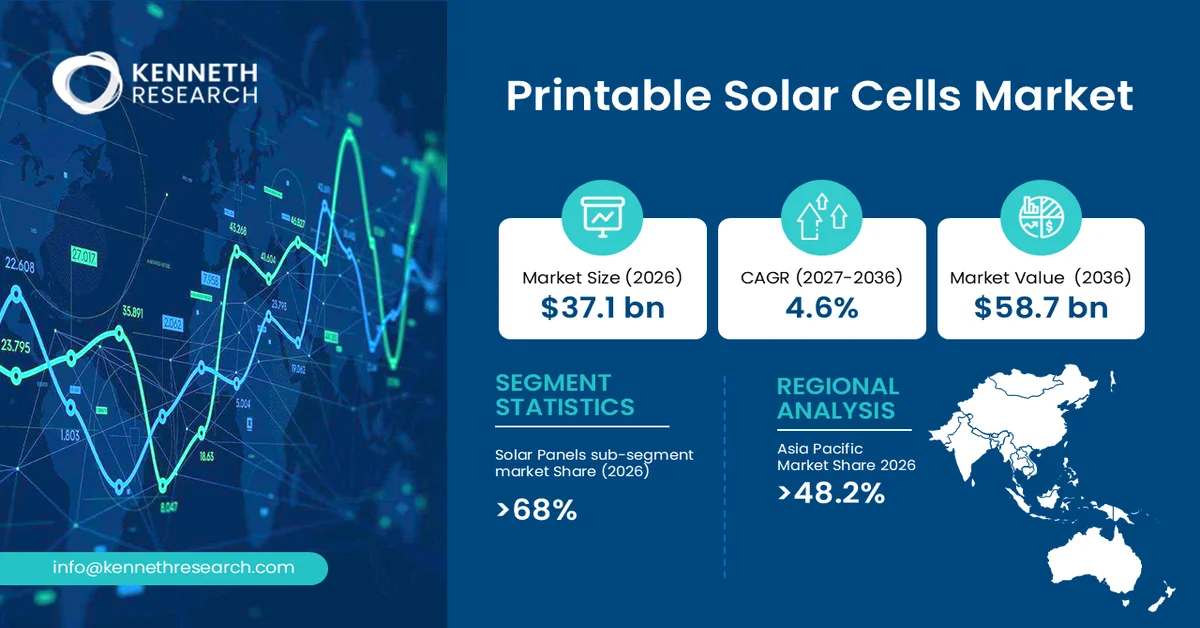
Printable Solar Cells Market size was valued at USD 37.1 billion in 2026 and is projected to reach USD 58.7 billion by the end of 2036, rising at a CAGR of 4.6% during the forecast period, i.e., 2027–2036. In 2027, the industry size of the global printable solar cells is estimated at USD 39 billion.
The primary growth driver of the printable solar cells market is the increasing demand for lightweight, flexible, and scalable photovoltaic technologies that can be manufactured through printing and coating processes.
The printable solar cells market comprises photovoltaic technologies in which active solar-cell layers and associated functional materials are deposited onto substrates using printing, coating, or other solution-processable manufacturing techniques. Depending on the technology, printable cells can employ organic semiconductors, perovskite materials, or other printable photovoltaic compounds to convert sunlight into electricity.
Key characteristics include lightweight construction, flexible form factors, customizable designs, potentially low-temperature processing, and compatibility with high-throughput manufacturing approaches such as roll-to-roll production. Printable solar cells can therefore be manufactured on flexible substrates and adapted to surfaces that are difficult to accommodate with conventional rigid photovoltaic panels.
Key Printable Solar Cells Market Insights Summary:
Key Takeaways: Market Trends & Insights
- printable solar cells market is projected to grow from USD 37.1 billion in 2026 to USD 58.7 billion by 2036, expanding at a 4.6% CAGR.
- Asia-Pacific accounted for the largest regional share at 48.2% in 2026, supported by established photovoltaic manufacturing ecosystems and strong solar technology development in Japan and China.
- Solar Panels remained the leading Application segment with a 68% share in 2026, supported by the expanding use of printable photovoltaic technologies for flexible and adaptable solar-generation applications.
- Bulk Heterojunction Solar Cells are expected to witness continued adoption because their donor–acceptor architecture is compatible with solution processing, printing, and flexible photovoltaic manufacturing.
Market Drivers
- Advancements in scalable printing and manufacturing technologies
- Growing demand for flexible and application-specific solar technologies
- Increasing integration of photovoltaics into buildings and unconventional surfaces
- Continued development of printable perovskite, organic, and other thin-film photovoltaic materials
Challenges
- Durability and Long-Term Reliability
- Scaling Laboratory Technologies to Commercial Manufacturing
Printable Solar Cells Market: Market Overview & Supply Chain
Global adoption of printable solar cells is increasing as the photovoltaic industry expands beyond conventional rigid module formats toward lightweight, flexible, customizable, and application-specific power-generation solutions. Advances in printing, coating, and solution-processing technologies are improving the feasibility of producing photovoltaic layers on flexible substrates, while continued growth in solar deployment is creating a broader commercial environment for emerging PV technologies. The International Energy Agency reported that global solar PV generation increased by about 480 TWh in 2024, recording the largest increase among all electricity-generation sources.
The printable solar cells value chain begins with photovoltaic inks, semiconductor materials, conductive materials, substrates, electrodes, encapsulation materials, and other functional inputs required for printable device fabrication. Material suppliers formulate and supply active and conductive compounds to photovoltaic manufacturers, which deposit these materials through printing, coating, spraying, or related solution-processing techniques. Cell manufacturers subsequently assemble photovoltaic layers, electrodes, and protective structures before testing and integrating cells into modules or application-specific products.
Printable Solar Cells Market: Growth Drivers & Challenges
Growth Drivers
- Advancements in scalable printing and manufacturing technologies: Advances in printing, coating, and atmospheric-processing techniques are strengthening the commercial potential of printable solar cells. These approaches can enable photovoltaic materials to be deposited directly onto suitable substrates while supporting flexible device architectures and continuous manufacturing. The U.S. National Renewable Energy Laboratory (NREL) is developing ink-based material systems and manufacturing processes that include inkjet printing, spray deposition, slot-die coating, and roll-to-roll deposition using microgravure printing.
- Growing demand for flexible and application-specific solar technologies: Growing demand for lightweight, flexible, and application-specific photovoltaic solutions is creating opportunities for printable solar cells beyond conventional rigid panels. Printable technologies can potentially be deposited onto flexible, curved, lightweight, or otherwise unconventional surfaces, enabling applications across building-integrated photovoltaics, portable power, consumer electronics, automotive surfaces, and distributed-energy systems. This flexibility allows manufacturers to address applications where traditional module construction can create design or installation constraints. Research into emerging photovoltaic technologies is also focused on improving manufacturability, efficiency, reliability, and integration into diverse form factors.
Challenges
- Durability and long-term reliability: Durability remains a major restraint for printable solar cells because many emerging photovoltaic materials and printed device architectures can be more sensitive to moisture, oxygen, heat, ultraviolet exposure, and mechanical stress than established silicon technologies. These vulnerabilities can affect power output, product warranties, and the suitability of printable modules for long-duration outdoor applications. The U.S. Department of Energy notes that emerging thin-film technologies require additional protection for long-lasting outdoor operation and that newer photovoltaic technologies must improve stability before achieving broad commercial deployment.
- Scaling laboratory technologies to commercial manufacturing: Moving printable solar-cell technologies from laboratory-scale demonstrations to consistent, high-volume manufacturing remains a significant challenge. Printing and coating processes must maintain uniform material deposition, electrical performance, device architecture, and production yield across increasingly large areas. Differences in ink formulation, substrate characteristics, drying conditions, layer interfaces, and process control can create manufacturing variability. The U.S. Department of Energy identifies efficiency, stability, and large-scale low-cost manufacturing as important commercialization barriers for emerging photovoltaic technologies.
Printable Solar Cells Market Size and Forecast:
| Report Attribute | Details |
|---|---|
| Base Year |
2026 |
| Forecast Period |
2027-2036 |
| CAGR |
4.6% |
| Base Year Market Size (2026) |
USD 37.1 billion |
| Forecast Year Market Size (2036) |
USD 58.7 billion |
| Regional Scope |
|
Printable Solar Cells Market Segmentation Analysis:
Application Segment Analysis
In the Application segment, the Solar Panels sub-segment is anticipated to capture the largest market share of 68% in 2026.
Its dominance is supported by the continued expansion of photovoltaic deployment and the growing integration of printable technologies into lightweight, flexible, and application-specific panel designs. Printable manufacturing can enable photovoltaic layers to be deposited onto flexible substrates, creating opportunities for solar panels that can be adapted to surfaces and applications where conventional rigid modules are less suitable. The U.S. Department of Energy identifies roll-to-roll processing as a pathway for producing lightweight and flexible photovoltaic modules and highlights the potential for low-cost manufacturing using solution-processable materials. On the supply side, advances in printable inks, deposition methods, encapsulation, and continuous manufacturing are improving the scalability of solar-panel production.
Technology Type Segment Analysis
In the Technology segment, the Bulk Heterojunction Solar Cells sub-segment is projected to grow as the technology provides an established architecture for solution-processable organic photovoltaic devices. Bulk heterojunction structures combine donor and acceptor materials within an active layer, creating an extensive interface that supports exciton separation and charge transport. The U.S. Department of Energy identifies bulk heterojunction structures as an important architecture for polymer-based photovoltaic cells and highlights their compatibility with solution processing.
The technology also aligns with printable manufacturing because the active layer can be deposited from solution, supporting coating and printing approaches. DOE-supported research has specifically examined roll-to-roll printing of bulk heterojunction organic solar cells, reinforcing the technology's relevance to scalable manufacturing.
Our in-depth analysis of the global printable solar cells market includes the following segments:
|
Segment |
Sub-segment |
|
Technology |
|
|
Application |
|
|
End Use |
|
Printable Solar Cells Market – Regional Analysis
Asia-Pacific Regional Insights:
Asia-Pacific accounted for 48.2% of the printable solar cells market in 2026, supported by extensive photovoltaic manufacturing capabilities, expanding renewable-energy deployment, strong electronics manufacturing ecosystems, and government support for solar technologies. The region provides an established industrial base for printable photovoltaic materials, coating technologies, flexible substrates, and module manufacturing. China is particularly important to the regional supply chain; the National Energy Administration reported that the country added 2.78 billion kW of new solar generation capacity in 2024, reinforcing its position as a major photovoltaic production and deployment center.
Japan benefits from an established solar industry and continued government support for renewable-energy deployment. Japan's Ministry of Economy, Trade and Industry continues to operate renewable-energy procurement mechanisms supporting solar power, while its energy policy increasingly emphasizes next-generation photovoltaic technologies and applications.
China remains the region's principal manufacturing hub, with the Ministry of Industry and Information Technology reporting continued expansion across major photovoltaic manufacturing stages during 2024, including solar cells and modules.
North Regional Insights:
North America represents an important growth market for printable solar cells, supported by expanding photovoltaic deployment, domestic solar-manufacturing initiatives, advanced materials research, and increasing interest in flexible and next-generation photovoltaic technologies. The U.S. government is strengthening domestic solar manufacturing through incentives, research funding, and supply-chain development, creating opportunities for emerging technologies alongside conventional PV.
U.S. remains the principal market in the region, benefiting from a large solar industry, advanced research infrastructure, and federal programs supporting domestic photovoltaic manufacturing and technology development.
Canada provides additional opportunities through continued photovoltaic deployment and clean-energy investment. Canada's PV ecosystem is supported by federal and provincial policies, while growing distributed-generation activity creates potential applications for lightweight and flexible solar technologies.
Printable Solar Cells Market Competitive Landscape
Here is a list of upstream, downstream, and key players operating in the global printable solar cells market competitive ecosystem:
- Heliatek GmbH (Germany)
- Company Overview
- Business Strategy
- Key Product Offerings
- Financial Performance
- Key Performance Indicators
- Risk Analysis
- Recent Development
- Regional Presence
- SWOT Analysis
- ASCA GmbH & Co. KG (France)
- Epishine AB (Sweden)
Recent Developments
- February 2026: Heliatek installed its HeliaSol® organic solar modules on the façades of three towers at the BMW Group vehicle plant in Dingolfing, Germany.
- March 2026: Heliatek reported a new photovoltaic installation at the ANDRITZ Separation GmbH site in Vierkirchen, combining roof and façade applications of its HeliaSol solar films.
Frequently Asked Question
In 2026, the printable solar cells market exceeded USD 37.1 billion.
The printable solar cells market is projected to reach USD 58.7 billion by the end of 2036, expanding at a CAGR of 4.6% over the forecast period (2027–2036).
The major players in the market are Heliatek GmbH, ASCA GmbH & Co. KG, Epishine AB, and others.
In the Application segment, the Solar Panels sub-segment is anticipated to capture the largest market share of 68% in the future and exhibit lucrative growth opportunities during 2027–2036.
Asia-Pacific is projected to hold the largest market share of 48.2% by the end of 2036 and provide more business opportunities in the future.
Why Choose Kenneth Research ?
-
Insight with Impact : We don’t just gather data — we uncover stories, trends, and opportunities that fuel business growth.
-
Experts Who Get It : Our team speaks your industry’s language and knows what really matters to your customers and market.
-
Custom-Built for You : Forget one-size-fits-all. We craft research and consulting solutions as unique as your business vision.
-
Partners, Not Just Providers : We work with you, not for you — collaborating closely to turn insights into smart, strategic moves.
-
Results That Speak : Our work powers brands, startups, and industry leaders alike — with a track record of ideas that work in the real world.
Report ID: 1252 |
Published Date: 01 Sep 2026 |
Report Format: |
Delivery Timeline: 48-72 Business Hours

Copyright © 2025 Kenneth Research. All rights reserved. Terms of Use | Privacy Policy
