Report ID: 1199 |
Published Date: 27 Aug 2026 |
Report Format: |
Delivery Timeline: 48-72 Business Hours
Polymer Resin Market Outlook:
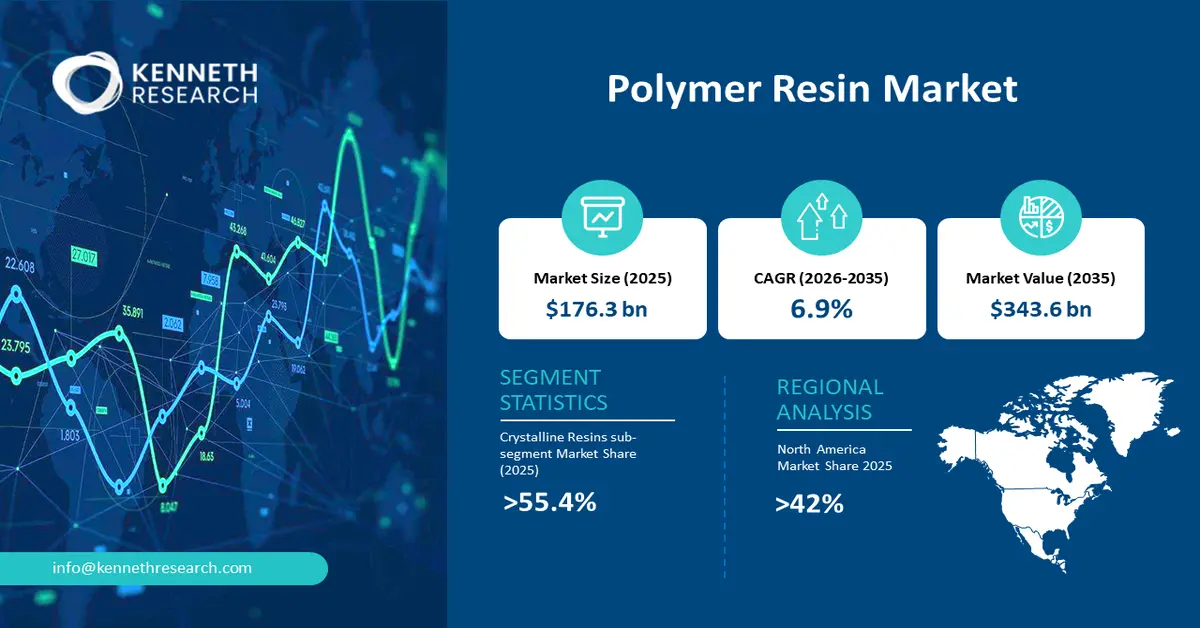
Polymer Resin Market size was valued at USD 176.3 billion in 2025 and is projected to reach USD 343.6 billion by the end of 2035, rising at a CAGR of 6.9% during the forecast period, i.e., 2026-2035. In 2026, the industry size of polymer resin is estimated at USD 188.1 billion.
The primary growth driver for the polymer resin market is the expanding demand for lightweight, durable, and high-performance materials across packaging, automotive, construction, electrical, and consumer goods industries. Rising industrial production and manufacturing activity continue to accelerate resin consumption, while increasing investments in circular plastics and advanced polymer technologies further support market expansion.
The polymer resin market comprises the global production, processing, distribution, and commercialization of synthetic and bio-based polymer resins that serve as essential raw materials for manufacturing plastic products, composite materials, coatings, adhesives, fibers, and engineered components. Polymer resins are broadly categorized into thermoplastics, thermosets, elastomers, and specialty resins, each offering distinct mechanical, thermal, and chemical properties suited to diverse industrial applications.
These materials are valued for their lightweight nature, corrosion resistance, processability, durability, electrical insulation, and design flexibility, enabling manufacturers to produce cost-effective components with enhanced performance. Polymer resins can be processed through molding, extrusion, casting, blow molding, and additive manufacturing techniques to meet specific product requirements across multiple industries.
The market plays a critical role in global manufacturing by supporting sectors such as packaging, automotive, construction, electrical and electronics, healthcare, consumer goods, and industrial equipment. Continuous material innovation, increasing adoption of recyclable and bio-based polymers, and the development of high-performance engineering resins are strengthening the market's industrial relevance while supporting sustainability and resource-efficiency objectives across modern manufacturing value chains.
Key Polymer Resin Market Insights Summary:
Key Takeaways: Market Trends & Insights
- Crystalline Resins dominated the Product segment, accounting for 55.4% of the global polymer resin market in 2025, driven by their superior strength, chemical resistance, and widespread industrial applications.
- North America held the largest regional share of 42% in 2025, supported by a well-established petrochemical industry, advanced manufacturing infrastructure, and strong demand from key end-use sectors
- Asia Pacific is expected to witness the fastest growth during the forecast period, fueled by expanding manufacturing activities, rising infrastructure investments, and increasing polymer consumption in China and Japan
- Growing emphasis on recyclable, bio-based, and circular polymer solutions is accelerating innovation and encouraging investments in sustainable resin production technologies
- Increasing demand for lightweight, high-performance materials across packaging, automotive, electrical & electronics, and construction industries will continue to drive long-term market expansion
Market Drivers
- Rising demand for lightweight materials across automotive, packaging, and construction
- Expansion of circular economy initiatives and advanced recycling technologies
- Increasing adoption of high-performance engineering polymers in electronics and electrical applications
- Growing investments in bio-based and sustainable polymer resin development
Challenges
- Volatility in petrochemical feedstock prices and supply chains
- Intensifying environmental regulations and compliance requirements
Polymer Market Overview & Supply Chain
Growing demand for high-performance, lightweight, and versatile materials across packaging, automotive, electronics, construction, healthcare, and renewable energy industries is driving the global adoption of polymer resins. Manufacturers increasingly rely on advanced polymer formulations to improve product durability, corrosion resistance, energy efficiency, and processing flexibility while meeting evolving sustainability regulations through recyclable and bio-based resin solutions. Governments and international organizations are also promoting circular economy initiatives that encourage innovation in resin production and recycling technologies. According to the OECD's Global Plastics Outlook (2022), global plastics production reached 460 million tonnes, highlighting the indispensable role of polymer-based materials across modern industrial value chains and reinforcing the need for more sustainable resin manufacturing and lifecycle management. This industrial dependence continues to stimulate investments in advanced polymer technologies, material innovation, and circular production systems.
The polymer resin market operates through a multi-stage value chain beginning with the procurement of feedstocks such as crude oil, natural gas liquids, bio-based raw materials, and recycled plastic waste. Petrochemical producers convert these inputs into monomers including ethylene, propylene, styrene, and vinyl chloride, which are subsequently polymerized into commodity, engineering, and specialty resins. Resin manufacturers further enhance material properties through compounding, blending, and additive incorporation to satisfy application-specific performance requirements. The finished resins are distributed through chemical distributors, direct supply agreements, and regional logistics networks to processors utilizing extrusion, injection molding, blow molding, thermoforming, and compression molding technologies. End users span packaging, automotive, construction, electrical and electronics, healthcare, consumer goods, textiles, and industrial manufacturing sectors. Major stakeholders include feedstock suppliers, petrochemical companies, resin producers, compounders, equipment manufacturers, converters, distributors, original equipment manufacturers (OEMs), recyclers, regulatory agencies, and sustainability organizations collaborating to improve material efficiency and circularity across the value chain.
Polymer Resin Market: Growth Drivers & Challenges
Growth Drivers:
- Rising demand for lightweight materials across industrial manufacturing: The increasing preference for lightweight yet durable materials across automotive, packaging, construction, and electrical industries is a major growth driver for the polymer resin market. Polymer resins enable manufacturers to reduce component weight while maintaining mechanical strength, corrosion resistance, and design flexibility, helping improve energy efficiency and lower transportation costs. Their versatility also supports complex product designs and high-volume manufacturing processes, making them indispensable for modern industrial production. Simultaneously, sustainability goals are encouraging the replacement of heavier conventional materials with advanced polymer solutions that can be recycled or engineered for longer service life. According to the International Energy Agency (IEA), global electric car sales exceeded 17 million units in 2024, substantially increasing demand for lightweight polymer components used in battery systems, vehicle interiors, electrical insulation, and thermal management. As electrification and advanced manufacturing continue to expand, polymer resin producers are expected to accelerate innovation in high-performance and specialty material formulations.
- Expansion of circular economy initiatives and advanced recycling technologies: Growing emphasis on circular economy principles is reshaping the polymer resin industry by encouraging the development of recyclable, recycled-content, and bio-based resin solutions. Manufacturers are investing in mechanical and advanced recycling technologies to recover valuable polymer feedstocks and reduce dependence on virgin petrochemical resources. These initiatives are supported by evolving regulatory frameworks, corporate sustainability commitments, and customer demand for environmentally responsible materials across packaging, consumer goods, and industrial applications. Advanced polymer engineering is also enabling improved material performance while facilitating easier recycling and lifecycle management. Looking ahead, increased collaboration among resin producers, recyclers, technology providers, and downstream manufacturers is expected to strengthen closed-loop material systems, improve supply chain resilience, and accelerate commercialization of next-generation sustainable polymer resins, creating long-term opportunities for innovation and competitive differentiation across global markets.
Challenges:
- Volatility in petrochemical feedstock prices and supply chains: The polymer resin market remains highly dependent on petrochemical feedstocks such as ethylene, propylene, and other hydrocarbon derivatives, making it vulnerable to fluctuations in crude oil and natural gas markets. Supply disruptions caused by geopolitical tensions, refinery outages, transportation bottlenecks, or trade restrictions can significantly affect raw material availability and procurement costs. This volatility compresses manufacturer margins, complicates long-term pricing strategies, and increases uncertainty across downstream industries that rely on predictable resin supplies. Smaller producers are particularly challenged by limited purchasing power and reduced flexibility in absorbing cost increases. Over the long term, companies are expected to diversify sourcing strategies, increase regional production capabilities, and invest in recycled and bio-based feedstocks to improve supply resilience. However, conventional petrochemical inputs are likely to remain dominant for the foreseeable future, sustaining exposure to raw material price cycles.
- Intensifying environmental regulations and compliance requirements: Governments worldwide are implementing stricter regulations on plastic waste management, carbon emissions, chemical safety, and recycled-content requirements, creating significant compliance challenges for polymer resin manufacturers. Meeting evolving environmental standards often requires substantial investments in cleaner production technologies, product reformulation, emissions control systems, certification processes, and advanced recycling infrastructure. These expenditures can increase operational costs while extending product development and commercialization timelines. In addition, customers are placing greater emphasis on sustainable sourcing and circular material solutions, compelling manufacturers to balance environmental performance with product quality and cost competitiveness. Looking ahead, companies that proactively develop recyclable, low-carbon, and bio-based resin portfolios are expected to strengthen their competitive position, whereas firms that delay sustainability investments may face regulatory risks, reduced customer acceptance, and diminished access to environmentally conscious markets.
Polymer Resin Market Size and Forecast:
| Report Attribute | Details |
|---|---|
| Base Year |
2025 |
| Forecast Period |
2026-2035 |
| CAGR |
6.9% |
| Base Year Market Size (2025) |
USD 176.3 billion |
| Forecast Year Market Size (2035) |
USD 343.6 billion |
| Regional Scope |
|
Polymer Resin Market Segmentation Analysis:
Product Segment Analysis
In the product segment, the crystalline resins sub-segment is anticipated to capture the largest market share of 55.4% by the end of 2025.
Crystalline resins dominate the product segment owing to their superior mechanical strength, chemical resistance, dimensional stability, and excellent wear performance, making them the preferred choice across automotive, packaging, industrial machinery, electrical, and consumer goods applications. Their semi-ordered molecular structure enables higher stiffness and heat resistance than many amorphous alternatives, allowing manufacturers to produce durable components that withstand demanding operating environments. Demand has been further reinforced by increasing industrial automation, vehicle lightweighting initiatives, and the expansion of high-performance packaging solutions requiring reliable and cost-efficient polymer materials. On the supply side, well-established petrochemical production infrastructure, mature processing technologies, and extensive global distribution networks ensure consistent availability and competitive pricing. According to the U.S. Census Bureau, the United States had 1,285 employer establishments engaged in Plastics Material and Resin Manufacturing (NAICS 325211) in 2023, reflecting a robust manufacturing ecosystem supporting resin production and downstream industrial demand. Looking ahead, continuous innovation in engineering-grade crystalline polymers, recyclable resin formulations, and advanced processing technologies is expected to reinforce the segment's leadership across diverse end-use industries.
Thermoplastic Resin Segment Analysis
The thermoplastic resins are projected to grow as the second-largest segment in the polymer resin market due to four converging demand drivers.
The thermoplastic resin segment is projected to witness strong growth due to its exceptional processing flexibility, recyclability, and compatibility with high-volume manufacturing techniques such as injection moulding, extrusion, thermoforming, and blow moulding. Industries including automotive, packaging, healthcare, electronics, and consumer goods increasingly favour thermoplastics because they can be repeatedly softened and reshaped without significant degradation, enabling efficient production and supporting circular economy objectives. Manufacturers are also adopting advanced thermoplastic grades to reduce product weight, improve chemical resistance, and enhance mechanical performance while lowering production costs. On the supply side, established global production capacity, continuous innovation in engineering thermoplastics, and expanding investments in recycled and bio-based resin technologies are improving material availability and broadening application potential. According to the U.S. Bureau of Economic Analysis, the gross output of U.S. plastic material and resin manufacturing reached approximately USD 109.7 billion in 2023, reflecting robust industrial demand for thermoplastic materials across downstream manufacturing sectors. Looking ahead, increasing electrification, sustainable packaging initiatives, and advanced manufacturing technologies are expected to further accelerate adoption of thermoplastic resins in both mature and emerging markets.
Our in-depth analysis of the global polymer resin market includes the following segments:
|
Segment |
Sub-segment |
|
Type |
|
|
Application |
|
|
Product |
|
|
Thermosetting |
|
|
Form |
|
Polymer Resin Market Regional Insights:
North America Market Trends & Insights:
North America polymer resin market is projected to hold the largest revenue share of 42% by the end of 2025.
It is the leading regional market. Its dominance is supported by an extensive petrochemical manufacturing base, advanced polymer processing infrastructure, strong research and development capabilities, and sustained demand from packaging, automotive, construction, healthcare, and electrical industries. The region benefits from abundant feedstock availability, integrated chemical value chains, and continuous investments in high-performance and sustainable resin technologies. Regulatory initiatives promoting advanced recycling, circular material use, and manufacturing innovation further strengthen the regional ecosystem. Additionally, the presence of globally integrated resin producers and sophisticated logistics networks enables efficient production and distribution of commodity, engineering, and specialty polymers. According to the U.S. Bureau of Economic Analysis (BEA), gross output for U.S. plastic product manufacturing reached approximately USD 248.3 billion in 2023, underscoring the scale of downstream manufacturing activities that drive sustained demand for polymer resins across North America.
The United States serves as the region's primary growth engine due to its large-scale petrochemical complexes, advanced resin production capacity, strong innovation ecosystem, and diversified industrial demand. Continuous investments in specialty polymers, recycling technologies, and advanced manufacturing enhance its competitive position in global resin markets.
Canada complements regional leadership through its abundant natural gas resources, integrated petrochemical industry, and strategic role in supplying feedstocks and polymer materials to North American manufacturing. Canadian producers are also expanding investments in sustainable plastics, circular economy initiatives, and low-carbon industrial processes, strengthening the region's long-term resilience and supporting the growing adoption of high-performance polymer resins across multiple end-use sectors.
Asia Pacific Market Trends & Insights:
Asia Pacific is emerging as a high-growth region for the polymer resin market, supported by rapid industrialization, expanding manufacturing capacity, and rising demand from packaging, automotive, electronics, construction, healthcare, and consumer goods industries. The region has become a global manufacturing hub, encouraging sustained investments in petrochemical complexes, polymer processing facilities, and advanced materials research. Government initiatives promoting domestic manufacturing, infrastructure development, circular economy practices, and sustainable industrial production are further strengthening demand for polymer resins. At the same time, increasing adoption of engineering plastics, recyclable polymers, and bio-based resin technologies is creating opportunities for product innovation. The expansion of e-commerce, renewable energy installations, electric mobility, and consumer product manufacturing is expected to sustain long-term resin consumption, while improvements in recycling infrastructure and regulatory frameworks will support the transition toward more resource-efficient polymer production.
China remains the primary growth engine within the region due to its extensive petrochemical industry, large-scale polymer manufacturing capacity, and dominant position in global manufacturing. Strong demand from packaging, electronics, automotive, and infrastructure sectors continues to encourage investments in high-performance and sustainable resin production.
Japan contributes through its leadership in specialty polymers, precision materials engineering, and advanced manufacturing technologies. Japanese companies emphasize innovation in high-value engineering resins, environmentally responsible material development, and next-generation applications for electronics, healthcare, and automotive industries, reinforcing the region's technological competitiveness and supporting the continued evolution of the polymer resin market.
Leading Companies Operating in the Global Polymer Resin Market:
Here is a list of upstream, downstream, and key players operating in the global polymer resin market competitive ecosystem:
- BASF SE (Germany)
- Company Overview
- Business Strategy
- Key Product Offerings
- Financial Performance
- Key Performance Indicators
- Risk Analysis
- Recent Development
- Regional Presence
- SWOT Analysis
- Dow Inc. (United States)
- LyondellBasell Industries N.V. (Netherlands)
- ExxonMobil Chemical (United States)
- SABIC (Saudi Arabia)
- INEOS Group (United Kingdom)
- LG Chem Ltd. (South Korea)
Recent Developments
- In June 2025, BASF SE announced the successful startup of its new world-scale Hexamethylenediamine (HMD) plant in Chalampé, France. The new facility increases BASF's HMD production capacity and strengthens its polyamide (PA 6.6) value chain, supporting demand from the automotive, engineering plastics, and high-performance fiber industries. The investment enhances supply security in Europe and reinforces BASF's long-term strategy in engineering polymer resins.
- In June 2025, Dow Inc. launched INNATE™ TF 220 Precision Packaging Resin, a new polyethylene resin designed for recyclable biaxially oriented polyethylene (BOPE) flexible packaging. The product supports high-performance packaging while enabling design for recyclability and advancing circular economy goals. The launch strengthens Dow's sustainable polymer resin portfolio and accelerates the adoption of recyclable packaging materials across global markets.
Frequently Asked Question
In 2025, the polymer resin market exceeded USD 176.3 billion.
The polymer resin market is projected to reach USD 343.6 billion by the end of 2035, expanding at a CAGR of 6.9% over the forecast period (2026-2035).
The major players in the market are BASF SE, Dow Inc., LyondellBasell Industries N.V., ExxonMobil Chemical, SABIC, INEOS Group, LG Chem Ltd., Mitsubishi Chemical Group Corporation, DuPont de Nemours, Inc., Covestro AG, Evonik Industries AG, Formosa Plastics Corporation, Braskem S.A., Celanese Corporation, Arkema S.A., Eastman Chemical Company, Chevron Phillips Chemical Company LLC, Reliance Industries Limited, Hanwha Solutions Corporation, Sumitomo Chemical Co., Ltd., Asahi Kasei Corporation, Borealis AG, Versalis S.p.A., Trinseo PLC, LANXESS AG, and others.
In the product segment, the crystalline resins sub-segment is anticipated to capture the largest market share of 55.4% in the future and exhibit lucrative growth opportunities during 2026–2035. this growth trajectory is largely attributed to increasing demand for lightweight, durable, and high-performance materials across automotive, packaging, construction, electrical, and industrial manufacturing applications.
North America is projected to hold the largest market share of 42% by the end of 2025 and provide more business opportunities in the future. Continuous investments in advanced petrochemical production, sustainable polymer technologies, and manufacturing innovation across the U.S. and Canada are fostering the region's dominance.
Why Choose Kenneth Research ?
-
Insight with Impact : We don’t just gather data — we uncover stories, trends, and opportunities that fuel business growth.
-
Experts Who Get It : Our team speaks your industry’s language and knows what really matters to your customers and market.
-
Custom-Built for You : Forget one-size-fits-all. We craft research and consulting solutions as unique as your business vision.
-
Partners, Not Just Providers : We work with you, not for you — collaborating closely to turn insights into smart, strategic moves.
-
Results That Speak : Our work powers brands, startups, and industry leaders alike — with a track record of ideas that work in the real world.
Report ID: 1199 |
Published Date: 27 Aug 2026 |
Report Format: |
Delivery Timeline: 48-72 Business Hours

Copyright © 2025 Kenneth Research. All rights reserved. Terms of Use | Privacy Policy
