Report ID: 1203 |
Published Date: 01 Sep 2026 |
Report Format: |
Delivery Timeline: 48-72 Business Hours
Polymer Derived Ceramics Market Outlook:
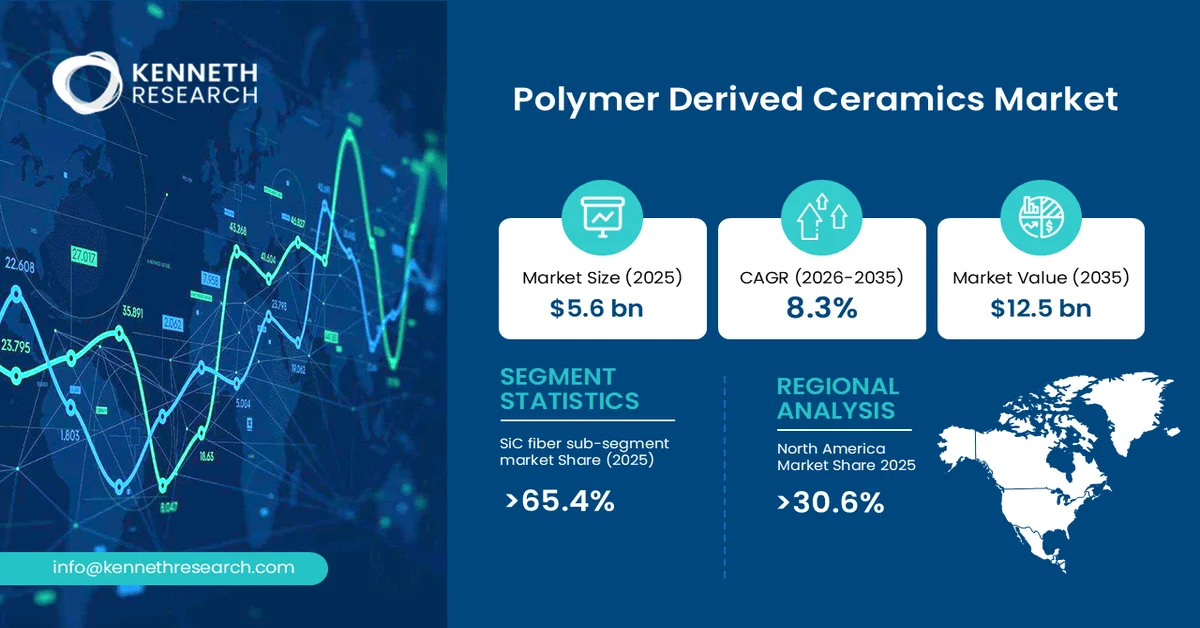
Polymer Derived Ceramics Market size was valued at USD 5.6 billion in 2025 and is projected to reach USD 12.5 billion by the end of 2035, rising at a CAGR of 8.3% during the forecast period, i.e., 2026-2035. In 2026, the industry size of polymer derived ceramics is estimated at USD 6.1 billion.
The primary growth driver for the polymer derived ceramics market is increasing demand for lightweight, thermally stable, and chemically resistant materials in high-temperature industrial applications. Polymer-derived ceramics enable tailored ceramic compositions and complex geometries, supporting advanced component development where conventional ceramics face processing, weight, or design limitations.
Polymer derived ceramics (PDCs) are advanced ceramic materials produced by converting specially formulated polymeric precursors into inorganic ceramic structures through controlled thermal treatment. This processing route enables manufacturers to create ceramics with tailored compositions, microstructures, and geometries that can be difficult to achieve through conventional ceramic-processing methods.
Key characteristics include high-temperature stability, resistance to oxidation and chemical degradation, low density, and the ability to form fibers, coatings, matrices, and intricately shaped components. Common PDC material systems include silicon carbide, silicon oxycarbide, silicon nitride, and related ceramic compositions. Their properties can be adjusted through precursor chemistry, processing conditions, fillers, and reinforcement strategies.
Key Polymer Derived Ceramics Market Insights Summary:
Key Takeaways: Market Trends & Insights
- SiC Fiber dominated the Type segment with a 65.4% market share in 2025
- North America led the regional market with a 30.6% market share in 2025
- The polymer derived ceramics market was valued at USD 5.6 billion in 2025 and is projected to reach USD 12.5 billion by 2035
- The market is projected to expand at a CAGR of 8.3% during 2026-2035
- Aerospace is identified as the fastest-growing Application segment, supported by demand for lightweight and high-temperature materials for advanced aerospace components
Market Drivers
- Expansion of high-temperature ceramic applications in hydrogen turbines
- Growing requirement for lightweight, high-performance aerospace materials
- Advancement of precursor chemistry and ceramic-processing technologies
- Increasing adoption of ceramic-based components in energy and extreme-environment applications
Challenges
- Pyrolysis-induced defects and process complexity
- Limited scalability and qualification of advanced PDC components
Polymer Derived Ceramics Market Overview & Supply Chain
Global adoption of Polymer Derived Ceramics (PDCs) is increasing as manufacturers seek materials capable of maintaining performance under extreme thermal, chemical, and mechanical conditions while enabling lightweight and increasingly complex component designs. PDC processing also offers advantages in producing fibers, coatings, matrices, and near-net-shape components, strengthening its relevance to aerospace, energy, electronics, transportation, and advanced manufacturing. Aerospace is particularly important because ceramic-based materials can support high-temperature components where conventional metallic materials face performance constraints.
The Polymer Derived Ceramics value chain begins with raw-material and precursor suppliers providing silicon-containing polymers, ceramic-forming precursors, fillers, reinforcements, additives, and specialty processing chemicals. Material producers then formulate and process these inputs through precursor synthesis, shaping, pyrolysis, infiltration, coating, fiber formation, or composite fabrication, depending on the targeted ceramic architecture. Specialized manufacturers may integrate PDC materials into fibers, coatings, matrices, or finished components and perform thermal treatment, machining, joining, and quality-control operations. Distribution typically involves direct supplier relationships, specialty material distributors, technical representatives, and established aerospace or industrial procurement channels. End users include aerospace and defense manufacturers, energy equipment producers, automotive companies, electronics manufacturers, and research organizations.
Polymer Derived Ceramics Market: Growth Drivers & Challenges
Growth Drivers:
- Expansion of high-temperature ceramic applications in hydrogen turbines: The transition toward hydrogen-based power generation is creating new opportunities for polymer-derived ceramic technologies, particularly silicon carbide fiber-reinforced ceramic matrix composites and protective coatings. These materials can withstand demanding thermal and chemical environments, making them relevant to turbine hot-section components where conventional materials face performance limitations. Government-backed R&D is accelerating this opportunity: the U.S. Department of Energy selected a project focused on protective coatings for SiC-fiber-reinforced SiC composites in hydrogen-fueled turbines, with DOE funding of $799,998. Such programs strengthen technology validation, manufacturing know-how, and integration capabilities across the advanced-materials ecosystem.
- Growing requirement for lightweight, high-performance aerospace materials: Aerospace manufacturers increasingly require materials that combine low weight with resistance to extreme temperatures, oxidation, creep, and mechanical loading. Polymer-derived ceramic systems can address these requirements through silicon carbide fibers, ceramic matrices, environmental barrier coatings, and other engineered architectures. Their precursor-based processing route can also facilitate complex shapes and tailored material structures, supporting the development of advanced propulsion and thermal-management components. This creates a pathway for PDC technologies to move beyond laboratory applications toward increasingly integrated aerospace systems. The future implication is a broader materials-development ecosystem involving fiber producers, ceramic-processing specialists, coating developers, aerospace OEMs, and research organizations.
Challenges:
- Pyrolysis-induced defects and process complexity: A fundamental restraint is the difficulty of controlling dimensional change and defect formation during polymer-to-ceramic conversion. Pyrolysis causes substantial structural transformation, while constrained components can develop cracking, warping, residual stresses, and porosity. This makes process parameters highly application-specific and increases the technical burden of producing dense, reliable components. The industry impact is particularly significant for complex geometries and larger components, where defects can compromise mechanical performance and require additional processing or redesign. Commercially, manufacturers may face higher qualification requirements, longer development cycles, and greater production complexity than with more established ceramic-processing routes.
- Limited scalability and qualification of advanced PDC components: Scaling polymer-derived ceramic technologies from specialized production to repeatable industrial manufacturing remains challenging because material behavior depends strongly on precursor chemistry, shaping conditions, pyrolysis atmosphere, thermal history, and component geometry. Small variations across these stages can affect microstructure and final properties, making process standardization difficult. This creates an important industry constraint where aerospace, energy, and other demanding applications require predictable performance and extensive qualification before material substitution is commercially acceptable. The resulting development burden can discourage manufacturers from adopting PDCs when established materials already have qualified supply chains and mature production processes. Commercial opportunities therefore depend not only on material performance but also on demonstrating consistent manufacturing quality, reliable long-term behavior, and compatibility with existing production infrastructure.
Polymer Derived Ceramics Market Size and Forecast:
| Report Attribute | Details |
|---|---|
| Base Year |
2025 |
| Forecast Year |
2026-2035 |
| CAGR |
8.3% |
| Base Year Market Size (2025) |
USD 5.6 billion |
| Forecast Year Market Size (2035) |
USD 12.5 billion |
| Regional Scope |
|
Polymer Derived Ceramics Market Segmentation Analysis:
Type Segment Analysis
In the type segment, the SiC fiber sub-segment is anticipated to capture the largest market share of 65.4% by the end of 2025.
SiC Fiber dominates the type segment because it provides the reinforcement architecture required to unlock the high-temperature strength, oxidation resistance, damage tolerance, and low-weight advantages of ceramic matrix composites. Demand is supported by aerospace propulsion, hypersonic systems, power-generation turbines, and other extreme-environment applications where metallic alternatives face temperature and durability constraints. The U.S. Department of Energy is actively supporting SiC-fiber manufacturing development; its 2022 program sought to improve continuous processing of novel SiC-fiber precursors and develop specialized fiber-winding equipment, demonstrating continued supply-chain investment. Aerospace demand provides an important downstream foundation: the FAA reported an estimated 213,756 active general-aviation aircraft in 2024, indicating a substantial aviation equipment base requiring continued materials innovation and component development.
Application Segment Analysis
The Aerospace is projected to grow as the second-largest segment in the polymer derived ceramics market due to four converging demand drivers.
erospace is projected to be the fastest-growing Application segment because aircraft and propulsion developers increasingly require materials capable of operating at elevated temperatures while reducing component weight and cooling requirements. This is particularly relevant to SiC/SiC ceramic matrix composites, environmental barrier coatings, and other PDC-enabled architectures used in engine hot sections. Demand is reinforced by the recovery and expansion of global aviation activity. ICAO reported 4.7 billion passengers carried on scheduled services in 2024, with global passenger traffic increasing 10.6% in revenue passenger-kilometres from the previous year. The expanding aircraft utilization base encourages OEMs and engine manufacturers to pursue materials that improve efficiency and durability.
Our in-depth analysis of the global polymer derived ceramics market includes the following segments:
|
Segment |
Sub-segment |
|
Type |
|
|
Application |
|
Polymer Derived Ceramics Market Regional Insights:
North America Market Trends & Insights:
North America polymer derived ceramics market is projected to hold the largest revenue share of 30.6% by the end of 2025.
Regional leadership is underpinned by an established aerospace and defense manufacturing base, advanced materials R&D capabilities, sophisticated ceramic-matrix-composite supply chains, and sustained investment in high-temperature materials. The United States provides the largest industrial ecosystem, supported by aerospace OEMs, defense programs, national laboratories, universities, and government-backed materials-development initiatives. Canada complements this ecosystem through established aerospace manufacturing, advanced-materials capabilities, and integrated North American supply chains.
The U.S. benefits from extensive aerospace, defense, energy, and advanced-manufacturing infrastructure, alongside federal R&D programs supporting ceramic composites and high-temperature materials. Its large OEM and supplier base supports both consumption and commercialization.
Canada strengthens North American supply-chain depth through aerospace manufacturing, MRO, advanced engineering, and export-oriented production. Government industrial strategy continues to emphasize aerospace innovation, investment, and technology commercialization, supporting long-term demand for advanced materials.
Asia-Pacific Market Trends & Insights:
Asia-Pacific is emerging as an important growth region for polymer-derived ceramics, supported by expanding aerospace, semiconductor, energy, automotive, and advanced-manufacturing activity. Regional demand is increasingly shaped by the need for lightweight, thermally stable, wear-resistant, and chemically durable materials for high-performance components. Government industrial policies are also strengthening the technology ecosystem. Japan, in particular, is pursuing next-generation aircraft technologies, including lightweight composite applications and higher-efficiency production processes, through initiatives led by the Ministry of Economy, Trade and Industry (METI).
China offers a broad industrial base spanning aerospace, electronics, energy, automotive, and advanced manufacturing. Continued development of strategic manufacturing capabilities can support domestic demand for high-performance ceramic materials while encouraging localized production and technology development.
Japan has a highly developed aerospace and precision-manufacturing ecosystem and is actively supporting next-generation aircraft development, including composite-material applications and higher-efficiency production technologies. Government initiatives focused on aircraft technology and supply-chain capability should create additional opportunities for PDC suppliers serving aerospace and other advanced industrial applications.
Leading Companies Operating in the Global Polymer Derived Ceramics Market:
Here is a list of upstream, downstream, and key players operating in the global polymer derived ceramics market competitive ecosystem:
- COI Ceramics, Inc. (United States)
- Company Overview
- Business Strategy
- Key Product Offerings
- Financial Performance
- Key Performance Indicators
- Risk Analysis
- Recent Development
- Regional Presence
- SWOT Analysis
- Astro Met, Inc. (United States)
- Schunk Group (Germany)
- Pyromeral Systems (France)
- Ultramet, Inc. (United States)
- Starfire Systems, Inc. (United States)
Recent Developments
- In March 2026, Pyromeral Systems will participate in CERAMITEC 2026 in Munich, demonstrating PyroXide, PyroKarb, and PyroSiC composites that are up to 4 times lighter than Inconel and 2 times lighter than titanium.
- In January 2025, Starfire Systems Inc. filed a patent application for a new class of Polycarbosilane Pre-Ceramic Polymers, designed to produce solid melt-processible polymers for Silicon Carbide (SiC) fibers and Ceramic Matrix Composites (CMCs) for aerospace, defense, and semiconductor applications.
Frequently Asked Question
In 2025, the polymer derived ceramics market exceeded USD 5.6 billion.
The polymer derived ceramics market is projected to reach USD 12.5 billion by the end of 2035, expanding at a CAGR of 8.3% over the forecast period (2026-2035).
The major players in the market are COI Ceramics, Inc., Astro Met, Inc., Schunk Group, Pyromeral Systems, Ultramet, Inc., Starfire Systems, Inc., and others.
In the type segment, the SiC Fiber sub-segment is anticipated to capture the largest market share of 65.4% in the future and exhibit lucrative growth opportunities during 2026-2035. This growth trajectory is largely attributed to increasing demand for lightweight, high-temperature, and high-performance materials in aerospace and other extreme-environment applications.
North America is projected to hold the largest market share of 30.6% by the end of 2035 and provide more business opportunities in the future. Continuous aerospace and advanced-materials development in the United States and Canada is fostering the region's dominance.
Why Choose Kenneth Research ?
-
Insight with Impact : We don’t just gather data — we uncover stories, trends, and opportunities that fuel business growth.
-
Experts Who Get It : Our team speaks your industry’s language and knows what really matters to your customers and market.
-
Custom-Built for You : Forget one-size-fits-all. We craft research and consulting solutions as unique as your business vision.
-
Partners, Not Just Providers : We work with you, not for you — collaborating closely to turn insights into smart, strategic moves.
-
Results That Speak : Our work powers brands, startups, and industry leaders alike — with a track record of ideas that work in the real world.
Report ID: 1203 |
Published Date: 01 Sep 2026 |
Report Format: |
Delivery Timeline: 48-72 Business Hours

Copyright © 2025 Kenneth Research. All rights reserved. Terms of Use | Privacy Policy
