Report ID: 1225 |
Published Date: 14 Sep 2026 |
Report Format: |
Delivery Timeline: 48-72 Business Hours
Polymer Additive Manufacturing Market Outlook:
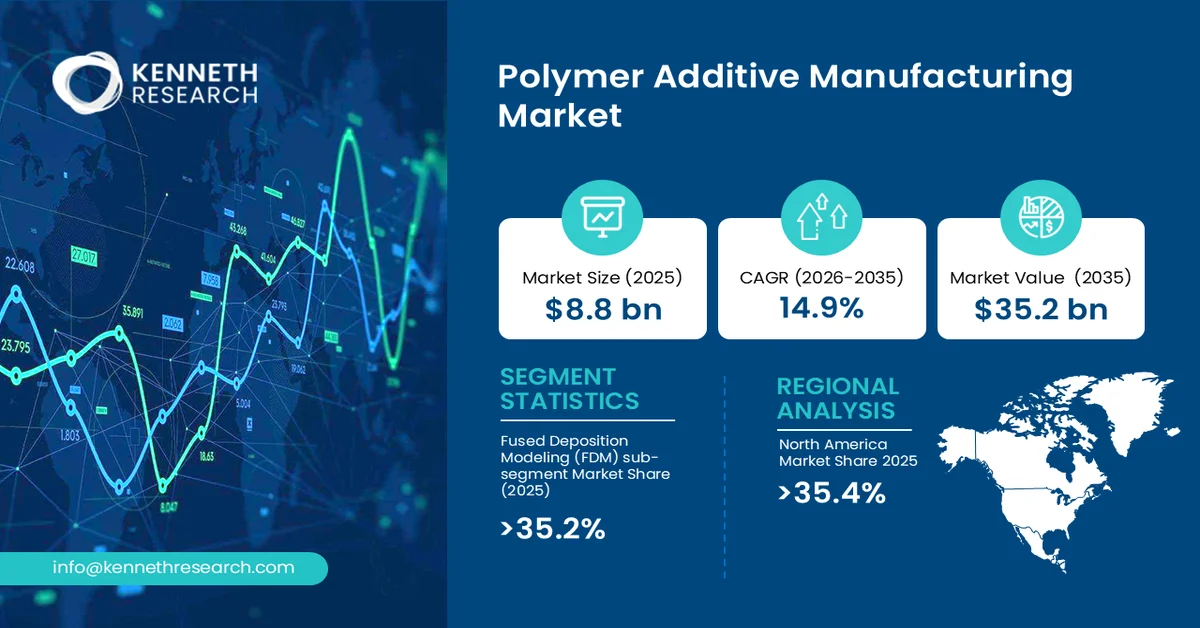
Polymer Additive Manufacturing Market size was valued at USD 8.8 billion in 2025 and is projected to reach USD 35.2 billion by the end of 2035, expanding at a CAGR of 14.9% during the forecast period, i.e., 2026–2035. In 2026, the industry size of the polymer additive manufacturing is estimated at USD 10.1 billion.
The primary growth driver of the polymer additive manufacturing market is the increasing adoption of 3D printing for customized, lightweight, and geometrically complex polymer components.
The polymer additive manufacturing market comprises additive manufacturing systems, materials, software, and associated technologies used to fabricate three-dimensional components from polymer-based materials through layer-by-layer deposition, curing, sintering, or other additive processes.
The market encompasses technologies such as Fused Deposition Modeling (FDM), selective laser sintering, stereolithography, digital light processing, and other polymer-based printing approaches. Materials include thermoplastics, thermosetting polymers, photopolymers, and other specialized polymer formulations.
Key Polymer Additive Manufacturing Market Insights Summary:
Key Takeaways: Polymer Additive Manufacturing Market
- The polymer additive manufacturing market is projected to grow from USD 8.8 billion in 2025 to USD 35.2 billion by 2035, registering a 14.9% CAGR during the forecast period.
- North America accounted for the largest regional share at 35.4% in 2025, supported by established additive-manufacturing capabilities and strong adoption across industrial applications.
- Fused Deposition Modeling (FDM) was the leading Printing Technology segment, accounting for 35.2% in 2025, supported by its broad compatibility with thermoplastics and suitability for prototyping, tooling, and functional components.
- Thermoplastics represent an important Material Type segment because of their suitability for extrusion-based printing and availability in engineering-grade and high-performance formulations.
Market Drivers
- Increasing adoption of additive manufacturing for customized production.
- Advances in polymer materials and process control.
- Growing demand for lightweight and complex polymer components.
- Increasing integration of digital design, automation, and process monitoring.
Challenges
- Material qualification and process consistency.
- Scaling from prototyping to production.
Polymer Additive Manufacturing Market Overview & Supply Chain
The polymer additive manufacturing market is expanding as manufacturers increasingly use polymer 3D printing for rapid prototyping, customized components, tooling, lightweight structures, and increasingly functional end-use parts. Polymer-based additive manufacturing offers design flexibility and can reduce material waste compared with subtractive manufacturing. NIST identifies polymers as a major area of additive-manufacturing research and is developing measurement tools and standards covering polymer behavior, materials characterization, and process optimization.
The supply chain begins with petrochemical and specialty-chemical producers supplying polymer feedstocks, followed by resin manufacturers and material compounders that develop application-specific grades, filaments, powders, pellets, and photopolymer formulations. Additive-manufacturing equipment manufacturers then integrate these materials with printing hardware, software, motion systems, thermal controls, lasers, extrusion systems, or other process technologies. System integrators and service providers support machine installation, process qualification, design optimization, and production implementation. Downstream users include aerospace, automotive, healthcare, electronics, consumer products, industrial machinery, and research organizations.
Polymer Additive Manufacturing Market: Growth Drivers & Challenges
Growth Drivers:
- Increasing adoption of additive manufacturing for customized production: The growing use of additive manufacturing for customized, lightweight, and geometrically complex components is strengthening demand for polymer-based printing technologies. Polymer AM enables manufacturers to produce parts directly from digital designs while reducing tooling requirements and supporting rapid design iterations. The U.S. Department of Energy highlights the ability of advanced polymers to support manufacturing of higher-quality products with tailored properties and intricate geometries, including applications in automotive and aerospace.
- Advances in polymer materials and process control: Advances in polymer formulations, process monitoring, material characterization, and digital control are expanding the potential applications of polymer additive manufacturing. NIST's 2025 photopolymer additive manufacturing workshop identified material and hardware innovation, standardized metrology, AI-driven data infrastructure, and regulatory readiness as important areas for accelerating industrial adoption. These developments are helping address limitations associated with consistency, dimensional accuracy, curing behavior, and repeatability.
Challenges:
- Material qualification and process consistency: The need for consistent material performance and repeatable printing remains a major challenge for polymer additive manufacturing. Polymer behavior can vary with processing temperature, cooling conditions, material formulation, and printing parameters, affecting dimensional accuracy, mechanical properties, surface quality, and part-to-part consistency. NIST continues to identify materials characterization, process control, and qualification as important requirements for broader industrial adoption of additive manufacturing. These requirements can increase development and validation costs for manufacturers seeking to move polymer AM from prototyping into production.
- Scaling from prototyping to production: Scaling polymer additive manufacturing into higher-volume production remains challenging because manufacturers must balance printing speed, dimensional accuracy, surface quality, material performance, and post-processing requirements. Large-format polymer AM research identifies material selection, interlayer bonding, surface quality, production speed, recyclability, and post-processing as important considerations when scaling production. Production economics can therefore become less attractive when multiple finishing or quality-control steps are required. Equipment manufacturers are responding through larger build volumes, faster deposition systems, automation, and improved process monitoring. However, manufacturers must still establish reliable workflows before replacing conventional production methods.
Polymer Additive Manufacturing Market Size and Forecast:
| Report Attribute | Details |
|---|---|
| Base Year |
2025 |
| Forecast Year |
2026-2035 |
| CAGR |
14.9% |
| Base Year Market Size (2025) |
USD 8.8 billion |
| Forecast Year Market Size (2035) |
USD 35.2 billion |
| Regional Scope |
|
Polymer Additive Manufacturing Market Segmentation Analysis:
Printing Type Segment Analysis
In the Printing Technology segment, the Fused Deposition Modeling (FDM) sub-segment is anticipated to capture the largest market share of 35.2% in 2025.
Its leading position is supported by the widespread use of material-extrusion technology for producing polymer components, prototypes, tooling, and customized parts. NIST identifies material extrusion as an important polymer additive manufacturing process in which polymer filament is melted, extruded through a nozzle, deposited layer by layer, and subsequently solidified.
FDM benefits from its compatibility with thermoplastic materials, relatively straightforward processing, and flexibility across prototyping and production applications. The technology also supports reduced scrap compared with conventional manufacturing approaches, strengthening its appeal for material-efficient production.
Material Type Segment Analysis
In the Material Type segment, the Thermoplastics sub-segment is expected to witness strong demand as manufacturers increasingly adopt polymer additive manufacturing for lightweight, durable, and customizable components. Thermoplastics are particularly suitable for material-extrusion processes because they can be melted, deposited layer by layer, and solidified during printing. NIST identifies thermoplastic material extrusion as a major polymer additive manufacturing process and conducts research into polymer rheology, crystallization, temperature, stress, and resulting mechanical properties to improve process reliability.
The growing availability of engineering-grade thermoplastics is expanding applications beyond basic prototyping toward functional components, tooling, aerospace parts, automotive components, and industrial products. NIST's polymer AM program also focuses on developing measurement standards and characterization methods that can support wider industrial adoption of polymer materials.
Our in-depth analysis of the global polymer additive manufacturing market includes the following segments:
|
Segment |
Sub-segment |
|
Printing Technology |
|
|
Material Type |
|
|
Material Form |
|
|
Application |
|
|
End Use Industry |
|
Polymer Additive Manufacturing Market Regional Insights:
North America Market Trends & Insights:
North America accounted for 35.4% of the polymer additive manufacturing market in 2025, making it the dominant regional market. The region benefits from a mature advanced-manufacturing ecosystem, strong research infrastructure, established aerospace and automotive industries, and early adoption of additive manufacturing technologies. The U.S. National Institute of Standards and Technology (NIST) continues to support polymer additive manufacturing through research focused on polymer characteristics, measurement standards, and process technologies.
The U.S. remains the principal market in the region, supported by government-backed advanced-manufacturing initiatives and a broad network of public-private manufacturing innovation institutes. NIST's Manufacturing USA program specifically supports technologies including additive manufacturing and aims to strengthen U.S. leadership in advanced manufacturing.
Canada is also strengthening its capabilities through government-supported research in polymeric products, high-performance composites, and 3D printing. Canada's National Research Council identifies polymer and composite manufacturing and 3D printing among its advanced-manufacturing research areas.
Europe Market Trends & Insights:
Asia-Pacific represents a significant growth market for polymer additive manufacturing, supported by expanding industrial digitization, advanced manufacturing capabilities, and increasing adoption of 3D printing for prototyping, tooling, customized components, and production applications. Japan and China are particularly important markets because of their established manufacturing ecosystems and growing focus on additive manufacturing technologies. Japan’s Ministry of Economy, Trade and Industry (METI) identifies additive manufacturing as an important manufacturing technology with commercial applications across aerospace, medical equipment, prototyping, and energy.
Japan benefits from its strong precision-manufacturing, automotive, electronics, and machine-tool industries. Government initiatives are supporting broader adoption and commercialization of additive manufacturing as part of efforts to strengthen Japan’s manufacturing competitiveness.
China provides substantial growth opportunities because of its large manufacturing base and increasing use of 3D printing across industrial applications. Recent regional industry developments indicate rapid expansion of Chinese 3D printing equipment and materials capabilities, including polymer-based systems.
Leading Companies Operating in the Global Polymer Additive Manufacturing Market:
Here is a list of upstream, downstream, and key players operating in the global polymer additive manufacturing market competitive ecosystem:
- Stratasys(United States)
- Company Overview
- Business Strategy
- Key Product Offerings
- Financial Performance
- Key Performance Indicators
- Risk Analysis
- Recent Development
- Regional Presence
- SWOT Analysis
- 3D Systems(United States)
- EOS(Germany)
- HP(United States)
Recent Developments
- June 2026 —Stratasys introduced a certified flame-retardant FDM material for rail applications, expanding its FDM materials portfolio for transportation applications requiring enhanced safety performance.
- April 2026 —3D Systems introduced the SLA 825 Dual production system and AddiTrak™ factory software, combining higher-throughput polymer printing with real-time fleet monitoring, process control, and analytics.
Frequently Asked Question
In 2025, the polymer additive manufacturing market exceeded USD 8.8 billion.
The polymer additive manufacturing market is projected to reach USD 35.2 billion by the end of 2035, expanding at a CAGR of 14.9% over the forecast period (2026–2035).
The major players in the market are Stratasys, 3D Systems, EOS, HP, Arkema, BASF, and others.
In the Printing Technology segment, the Fused Deposition Modeling (FDM) sub-segment is anticipated to capture the largest market share of 35.2% in the future and exhibit lucrative growth opportunities during 2026–2035.
North America is projected to hold the largest market share of 35.4% by the end of 2035 and provide more business opportunities in the future.
Why Choose Kenneth Research ?
-
Insight with Impact : We don’t just gather data — we uncover stories, trends, and opportunities that fuel business growth.
-
Experts Who Get It : Our team speaks your industry’s language and knows what really matters to your customers and market.
-
Custom-Built for You : Forget one-size-fits-all. We craft research and consulting solutions as unique as your business vision.
-
Partners, Not Just Providers : We work with you, not for you — collaborating closely to turn insights into smart, strategic moves.
-
Results That Speak : Our work powers brands, startups, and industry leaders alike — with a track record of ideas that work in the real world.
Report ID: 1225 |
Published Date: 14 Sep 2026 |
Report Format: |
Delivery Timeline: 48-72 Business Hours

Copyright © 2025 Kenneth Research. All rights reserved. Terms of Use | Privacy Policy
