Report ID: 1204 |
Published Date: 01 Sep 2026 |
Report Format: |
Delivery Timeline: 48-72 Business Hours
Polycarbonate Composites Market Outlook:
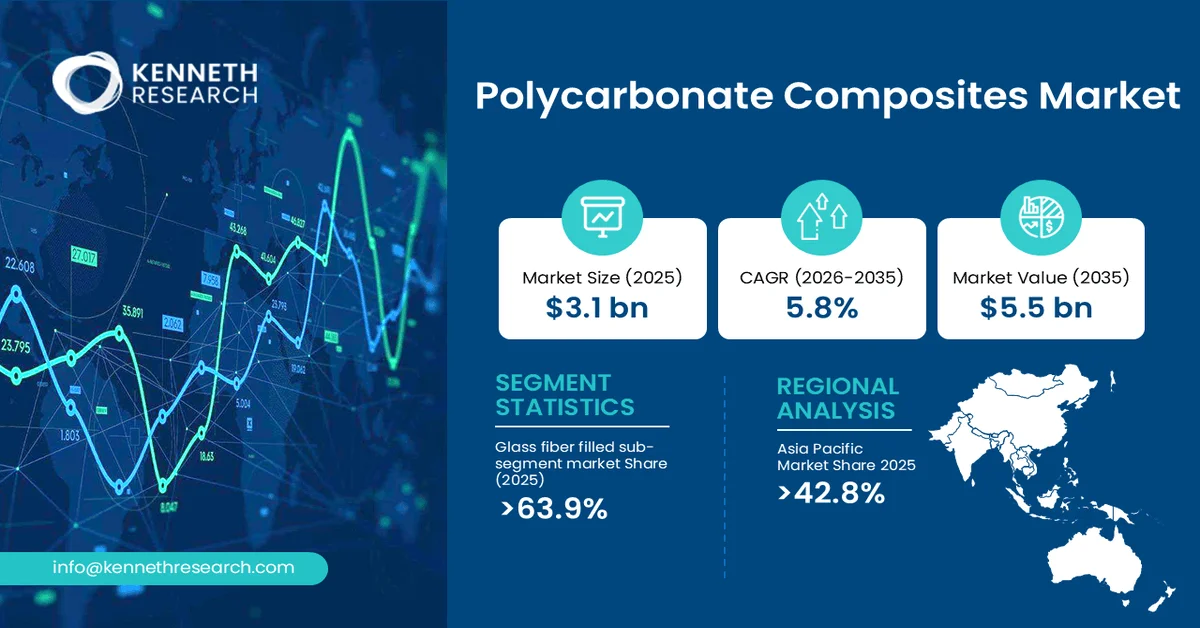
Polycarbonate Composites Market size was valued at USD 3.1 billion in 2025 and is projected to reach USD 5.5 billion by the end of 2035, rising at a CAGR of 5.8% during the forecast period, i.e., 2026-2035. In 2026, the industry size of polycarbonate composites is estimated at USD 3.3 billion.
Electric vehicle expansion is strengthening demand for lightweight, durable engineering materials, including polycarbonate composites, as automakers seek weight-efficient components without sacrificing safety or functional performance. The IEA reports that electric car sales exceeded 17 million in 2024, with electric models representing more than 20% of new-car sales worldwide, highlighting electrification.
Polycarbonate Composites are engineered thermoplastic materials in which a polycarbonate resin matrix is combined with reinforcing or modifying constituents to enhance mechanical, thermal, dimensional, or processing performance. The resulting materials retain the inherent advantages of polycarbonate, including impact resistance, design flexibility, electrical insulation, and relatively low density, while reinforcement can improve stiffness, strength, dimensional stability, heat resistance, and resistance to deformation.
The market encompasses the production and commercial use of these compounded materials across applications requiring a balance of durability, lightweight construction, surface quality, and manufacturability. Reinforcement types can include glass fiber and other performance-enhancing additives, with formulation selected according to component requirements and processing conditions.
Key Polycarbonate Composites Market Insights Summary:
Key Takeaways: Market Trends & Insights
- Polycarbonate Composites Market is valued at USD 3.1 billion in 2025 and projected to reach USD 5.5 billion by 2035
- The market is expected to expand at a CAGR of 5.8% during 2026-2035
- Glass Fiber Filled leads the Reinforcement Type segment with a 63.9% market share in 2025
- Consumer Electronics & IT Hardware represents the second key analysis segment within the End Use category, supported by expanding electronics manufacturing and demand for lightweight high-performance materials
- Asia Pacific dominates the polycarbonate composites market with a 42.8% market share in 2025, supported by manufacturing and electronics activity across China and India
Market Drivers
- Vehicle lightweighting and fuel-efficiency requirements
- Expansion of high-performance electronics and electrical components
- Increasing demand for engineered thermoplastics in complex molded parts
- Greater material optimization through reinforced and application-specific formulations
Challenges
- Complex recycling and end-of-life processing
- Processing sensitivity and material qualification complexity
Polycarbonate Composites Market Overview & Supply Chain
Global adoption of polycarbonate composites is increasing as manufacturers prioritize lightweighting, durability, functional integration, and design flexibility across transportation, electrical and electronic equipment, industrial components, and consumer products. The material’s combination of polycarbonate’s impact resistance with reinforcement-enhanced stiffness and dimensional stability supports substitution of heavier conventional materials while enabling complex molded geometries. This is particularly relevant to vehicle electrification, where weight efficiency can improve energy performance and accommodate additional technology without compromising component functionality.
The polycarbonate composites value chain begins with upstream suppliers of polycarbonate resin, glass fibers, additives, stabilizers, colorants, and other performance modifiers. Resin and reinforcement producers supply standardized or application-specific inputs to compounders, which formulate, melt-blend, reinforce, pelletize, and quality-test grades according to targeted mechanical, thermal, electrical, and processing requirements. Compounders and material producers then distribute finished compounds through direct sales, specialty distributors, and regional technical-sales networks. Downstream processors—including injection molders, extrusion companies, and component manufacturers—convert the compounds into finished or semi-finished parts. End users span automotive and mobility manufacturers, electronics and IT hardware producers, electrical equipment companies, industrial manufacturers, and consumer-product companies.
Polycarbonate Composites Market: Growth Drivers & Challenges
Growth Drivers:
- Rising vehicle efficiency and lightweighting requirements: Increasing vehicle-efficiency requirements are strengthening demand for lightweight engineering materials, creating an important growth pathway for polycarbonate composites. Composite formulations can combine low weight with impact resistance, stiffness, dimensional stability, and design flexibility, making them suitable for interior systems, structural-adjacent components, electrical housings, and other automotive applications. The U.S. Department of Transportation’s National Highway Traffic Safety Administration announced in 2022 that Corporate Average Fuel Economy standards would increase fuel efficiency by 8% annually for model years 2024–2025 and 10% for model year 2026. This regulatory direction encourages automakers to pursue material substitution, component redesign, and weight optimization alongside powertrain improvements.
- Expansion of high-performance electronics and electrical components: Growth in electronics and electrical equipment is supporting demand for polycarbonate composites because manufacturers increasingly require materials that combine mechanical durability, electrical insulation, dimensional stability, heat resistance, and design flexibility. Polycarbonate-based composites can be tailored through reinforcement and additives to meet the functional requirements of housings, connectors, enclosures, structural frames, and other precision-molded components. Their processability also supports complex geometries and part integration, helping manufacturers consolidate functions while controlling component weight and assembly requirements. The continuing convergence of computing, communications, connected devices, and industrial electronics is expanding the range of applications in which engineering thermoplastics can replace conventional materials or support new component designs.
Challenges:
- Complex recycling and end-of-life processing: The multi-material structure of reinforced polycarbonate creates a significant end-of-life challenge because the polymer matrix and reinforcing fibers must be processed without excessively degrading their respective properties. Mechanical recycling can alter fiber length, orientation, dispersion, and polymer molecular characteristics, making recycled material less predictable for demanding applications. This creates qualification requirements for compounders and OEMs, particularly where consistent mechanical performance, appearance, dimensional stability, or safety characteristics are critical. Commercially, the challenge can increase sorting, processing, testing, and quality-control requirements while limiting the range of applications suitable for recycled feedstock. Research published in 2022 also identifies depreciation in mechanical properties of recycled fibers as a constraint on higher-value composite applications.
- Processing sensitivity and material qualification complexity: Polycarbonate composites require careful control of formulation and processing because reinforcement changes the material’s flow behavior, orientation, shrinkage, mechanical response, and dimensional characteristics. The resulting properties can vary with fiber distribution, processing conditions, component geometry, and molding parameters. This creates a technical barrier for manufacturers attempting to qualify one material across different component designs or production platforms. Commercial implications include longer validation cycles, higher tooling and testing requirements, greater dependence on compounder expertise, and potential redesign costs when a formulation does not deliver the expected performance in production. These considerations can make material substitution less straightforward than simply comparing nominal resin properties.
Polycarbonate Composites Market Size and Forecast:
| Report Attribute | Details |
|---|---|
| Base Year |
2025 |
| Forecast Period |
2026-2035 |
| CAGR |
5.8% |
| Base Year Market Size (2025) |
USD 3.1 billion |
| Forecast Year Market Size (2035) |
USD 5.5 billion |
| Regional Scope |
|
Polycarbonate Composites Market Segmentation Analysis:
Reinforcement Type Segment Analysis
In the reinforcement type segment, the glass fiber filled sub-segment is anticipated to capture the largest market share of 63.9% by the end of 2025.
Glass fiber filled polycarbonate composites dominate the reinforcement-type segment because they provide a practical balance of stiffness, strength, dimensional stability, impact performance, thermal resistance, and cost for demanding molded components. Their established processing compatibility with injection molding also supports adoption in automotive, electrical, electronics, industrial equipment, and consumer applications where repeatable dimensions and structural performance are important. The reinforcement is particularly attractive for applications requiring greater rigidity than unfilled polycarbonate while retaining thermoplastic processing advantages. Supply-side maturity is another important factor: glass fiber is widely available, and compounders can tailor fiber loading, surface treatment, additives, and polycarbonate grades to meet application-specific requirements. U.S. Department of Energy material describes glass and carbon fiber composites as the primary materials used in wind-turbine blades, while noting that fiber-reinforced composites are also central to the wind-energy supply chain.
End Use Segment Analysis
The consumer electronics & it hardware is projected to grow as the second-largest segment in the polycarbonate composites marketdue to four converging demand drivers.
Consumer Electronics & IT Hardware is positioned for continued growth as demand for smartphones, computers, connected devices, and data-intensive technologies expands. Industry adoption is increasingly shaped by AI-enabled devices, cloud computing, connectivity upgrades, and higher-performance computing, increasing the need for lightweight, durable, and electrically suitable materials. Polycarbonate composites can support these requirements through improved mechanical performance and design flexibility. Looking ahead, continued electronics innovation, device miniaturization, and manufacturing-capacity expansion should support broader adoption of polycarbonate composites in IT hardware and consumer electronics applications.
Our in-depth analysis of the global polycarbonate composites market includes the following segments:
|
Segment |
Sub-segment |
|
Reinforcement Type |
|
|
Base Resin System |
|
|
Grade Type |
|
|
Functional Additive |
|
|
End Use |
|
Polycarbonate Composites Market Regional Insights:
Asia Pacific Market Trends & Insights:
Asia Pacific polycarbonate composites market is projected to hold the largest revenue share of 42.8% by the end of 2025.
Regional demand is reinforced by large-scale production and consumption across China and India, while government-backed industrial policies, manufacturing incentives, and technology investments strengthen the supply environment. China’s electronics manufacturing base provides an important downstream demand center: in 2024, the value added of China’s electronic information manufacturing industry increased 11.8% year on year, according to the Ministry of Industry and Information Technology.
China remains the region’s key manufacturing hub, supported by its electronics, telecommunications, automotive, and industrial supply chains.
India is strengthening its position through expanding electronics manufacturing, domestic production capabilities, and investment-oriented industrial policies. Together, these markets support regional consumption while encouraging material suppliers and processors to expand capacity and develop higher-performance composite solutions. The outlook for Asia Pacific remains favorable as electronics localization, advanced manufacturing, and infrastructure development continue creating opportunities for polycarbonate composite applications.
North America Market Trends & Insights:
North America represents an attractive secondary market for polycarbonate composites, supported by sophisticated manufacturing infrastructure, strong demand for lightweight and high-performance materials, and established automotive, electronics, aerospace, and industrial equipment sectors. Market demand is increasingly influenced by material lightweighting, product durability, design flexibility, and sustainability requirements. Government initiatives supporting advanced manufacturing, domestic technology development, resilient supply chains, and materials innovation are creating a favorable environment for composite adoption.
The United States remains the region's primary industrial and technology hub, with strong opportunities arising from semiconductor manufacturing, automotive electrification, aerospace, consumer electronics, and advanced manufacturing. Continued investment in domestic production capabilities can expand demand for engineered materials used in lightweight components and protective applications.
Canada offers complementary opportunities through its focus on advanced manufacturing, polymer processing, high-performance thermoplastic composites, lightweighting, and sustainable materials. Canada's National Research Council is actively supporting polymer and composite manufacturing technologies, including high-performance thermoplastic systems and recyclable composite solutions.
Leading Companies Operating in the Global Polycarbonate Composites Market:
Here is a list of upstream, downstream, and key players operating in the global polycarbonate composites market competitive ecosystem:
- Teijin Limited (Japan)
- Company Overview
- Business Strategy
- Key Product Offerings
- Financial Performance
- Key Performance Indicators
- Risk Analysis
- Recent Development
- Regional Presence
- SWOT Analysis
- Formosa Chemicals & Fibre Corporation (Taiwan)
- Ensinger GmbH (Germany)
- Covestro AG (Germany)
Recent Developments
- In August 2025, Teijin Limited announced that pipes molded from its biomass-derived polycarbonate resin have been adopted for the world's first pipe organ made from bioplastic, which will be exhibited at the Expo 2025 Osaka. The resin is produced using the mass balance approach and offers the same physical properties as conventional petroleum-derived PC.
- In June 2026, Covestro announced that its Bayblend® T85X R35 CQ, a polycarbonate/ABS blend containing 35% post-consumer recycled content, has been adopted for interior components in the Lexus ES. The material delivers a 25% reduction in global warming potential compared to fossil-based alternatives and marks one of the first integrations of such high recycled content in visible premium automotive interior parts.
Frequently Asked Question
In 2025, the polycarbonate composites market exceeded USD 3.1 billion.
The polycarbonate composites market is projected to reach USD 5.5 billion by the end of 2035, expanding at a CAGR of 5.8% over the forecast period (2026-2035).
The major players in the market are Teijin Limited, Formosa Chemicals & Fibre Corporation, Ensinger GmbH, Covestro AG, and others.
In the reinforcement type segment, the Glass Fiber Filled sub-segment is anticipated to capture the largest market share of 63.9% in the future and exhibit lucrative growth opportunities during 2026-2035. This growth trajectory is largely attributed to increasing demand for lightweight and high-performance materials.
Asia Pacific is projected to hold the largest market share of 42.8% by the end of 2025 and provide more business opportunities in the future. Continued electronics manufacturing and industrial development in China and India are fostering the region's dominance.
Why Choose Kenneth Research ?
-
Insight with Impact : We don’t just gather data — we uncover stories, trends, and opportunities that fuel business growth.
-
Experts Who Get It : Our team speaks your industry’s language and knows what really matters to your customers and market.
-
Custom-Built for You : Forget one-size-fits-all. We craft research and consulting solutions as unique as your business vision.
-
Partners, Not Just Providers : We work with you, not for you — collaborating closely to turn insights into smart, strategic moves.
-
Results That Speak : Our work powers brands, startups, and industry leaders alike — with a track record of ideas that work in the real world.
Report ID: 1204 |
Published Date: 01 Sep 2026 |
Report Format: |
Delivery Timeline: 48-72 Business Hours

Copyright © 2025 Kenneth Research. All rights reserved. Terms of Use | Privacy Policy
