Report ID: 1205 |
Published Date: 01 Sep 2026 |
Report Format: |
Delivery Timeline: 48-72 Business Hours
Plastics Polymers Resins Market Outlook:
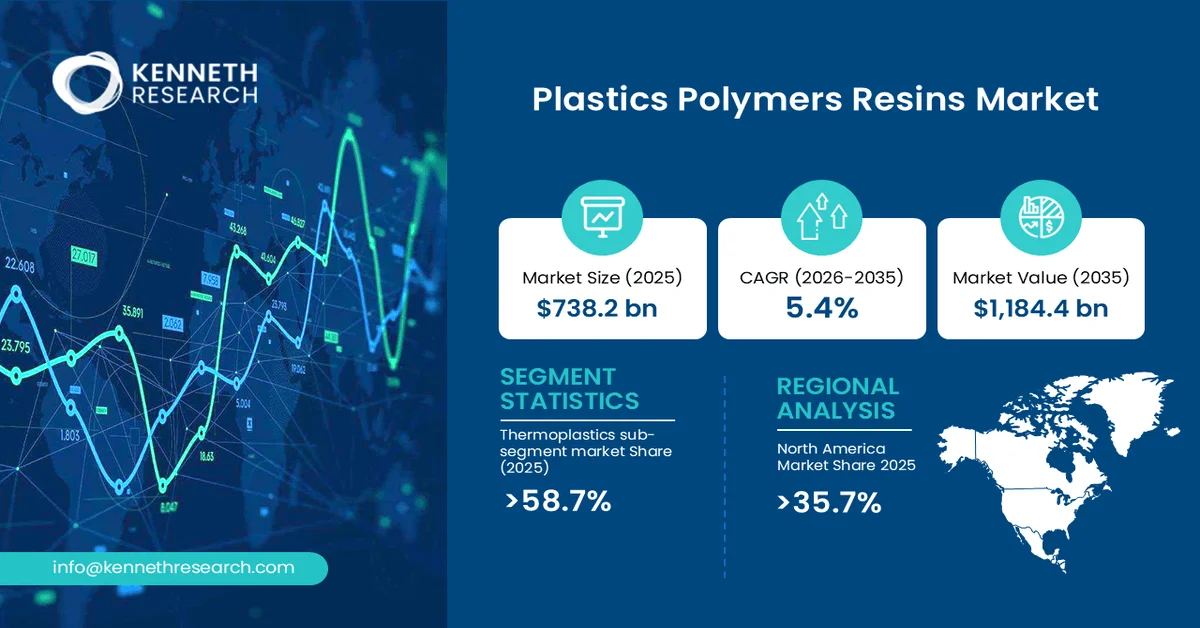
Plastics Polymers Resins Market size was valued at USD 738.2 billion in 2025 and is projected to reach USD 1,184.4 billion by the end of 2035, rising at a CAGR of 5.4% during the forecast period, i.e., 2026-2035. In 2026, the industry size of plastics polymers resins is estimated at USD 739 billion.
The primary growth driver for the plastics polymers resins market is expanding demand from packaging, construction, transportation, and consumer-oriented industries, supported by increasing production activity and broader material substitution.
The plastics polymers resins market comprises the production and supply of polymeric materials and resin-based feedstocks that are processed into plastic products, components, films, packaging, coatings, molded articles, and other industrial goods. The market encompasses materials differentiated by chemical structure, processing behavior, performance characteristics, and end-use requirements, including thermoplastic and other polymer categories.
A defining characteristic of these materials is their ability to provide combinations of lightweight construction, durability, chemical resistance, insulation, flexibility, processability, and design versatility. Depending on formulation and processing technology, polymers and resins can be converted through techniques such as extrusion, injection molding, blow molding, thermoforming, and related manufacturing processes.
Industrial relevance is broad because polymers function as essential material inputs across manufacturing value chains. They support applications spanning food and consumer packaging, construction products, automotive components, electrical and electronic equipment, healthcare products, and numerous industrial goods.
Key Plastics Polymers Resins Market Insights Summary:
Key Takeaways: Market Trends & Insights
- Market value reached USD 738.2 billion in 2025 and is projected to reach USD 1,184.4 billion by 2035
- The market is forecast to expand at a CAGR of 5.4% during 2026-2035
- Thermoplastics represented the largest Type segment with a 58.7% market share in 2025
- Packaging is identified as the second and fastest analysis segment within the Application category
- North America led the market with a 35.7% market share in 2025, supported by the United States and Canada
Market Drivers
- Expanding demand for lightweight and high-performance materials
- Accelerating circularity and advanced recycling technologies
- Rising demand for plastics in packaging and consumer-product applications
- Increasing adoption of specialized polymers across healthcare, electronics, and advanced manufacturing
Challenges
- Feedstock price volatility and margin pressure
- Fragmented recycling infrastructure and material complexity
Plastics Polymers Resins Market Overview & Supply Chain
Adoption of plastics, polymers, and resins continues to expand because these materials combine lightweighting, durability, chemical resistance, design flexibility, and efficient processability across packaging, construction, transportation, electronics, healthcare, and industrial manufacturing. Their importance is also increasing as manufacturers balance performance requirements with circularity and resource-efficiency objectives.
The plastics polymers resins market value chain begins with raw-material inputs, primarily hydrocarbon-based feedstocks and chemical intermediates, alongside increasingly relevant recycled and bio-based feedstocks. Upstream producers convert these inputs into monomers and subsequently polymerize them into resins with defined molecular, thermal, mechanical, and processing characteristics. Resin manufacturers compound, modify, and pelletize materials according to downstream performance specifications, incorporating additives, fillers, reinforcements, or recycled content where required. Distribution then connects resin producers with compounders, converters, processors, and industrial customers through direct sales, distributors, trading companies, and integrated supply arrangements. Downstream manufacturers transform resins into films, sheets, fibers, molded components, containers, pipes, coatings, and other products using extrusion, injection molding, blow molding, thermoforming, and related technologies.
Plastics Polymers Resins Market: Growth Drivers & Challenges
Growth Drivers:
- Expanding demand for lightweight and high-performance materials: The growing preference for lightweight, durable, and versatile materials across transportation, packaging, medical equipment, electronics, and industrial applications is strengthening demand for plastics, polymers, and resins. These materials allow manufacturers to reduce component weight while maintaining required mechanical performance, chemical resistance, insulation, and design flexibility. The U.S. Department of Energy identifies plastics as important for lightweighting vehicles and aircraft, energy-efficient packaging, and medical devices, demonstrating their cross-industry functional relevance. The agency reported that more than 300 million metric tons of new plastic are generated globally each year. This broad production base supports continued investment in polymer grades, additives, composites, and processing technologies tailored to increasingly specialized applications.
- Accelerating circularity and advanced recycling technologies: The transition toward a more circular plastics economy is creating demand for improved resin formulations, recyclable polymer architectures, recycled feedstocks, and advanced processing technologies. Regulatory pressure, sustainability commitments, waste-management challenges, and customer requirements are encouraging producers and converters to redesign materials for recovery and reuse. Chemical recycling, depolymerization, mechanical recycling, and upcycling can expand the range of plastic waste streams suitable for material recovery, while innovations in polymer chemistry can improve recyclability without sacrificing performance. This trend is also encouraging closer collaboration among resin producers, technology developers, recyclers, packaging manufacturers, brand owners, and research institutions.
Challenges:
- Feedstock price volatility and margin pressure: The market remains exposed to fluctuations in hydrocarbon-based feedstock economics because crude oil, natural gas, and refining costs influence the cost structure of primary polymer production. When feedstock prices move sharply, resin producers can face difficulty maintaining stable margins, particularly when downstream customers resist immediate price adjustments. The commercial impact extends across procurement planning, inventory management, contract negotiations, and capacity utilization. Producers may need to adjust operating rates or renegotiate supply agreements, while converters can experience uncertainty in product costing and customer pricing. This volatility also complicates investment decisions for capacity expansion and technology upgrades because expected project economics can change with underlying feedstock conditions.
- Fragmented recycling infrastructure and material complexity: The transition toward circular plastics is constrained by heterogeneous waste streams, contamination, incompatible polymers, additives, and uneven collection and sorting infrastructure. These factors make it difficult to consistently produce recycled resins that meet the technical specifications demanded by packaging, automotive, healthcare, electronics, and other performance-sensitive applications. The resulting quality variability raises processing costs and can narrow the range of viable end uses, weakening the commercial case for recycled materials. For resin producers and converters, this creates procurement uncertainty and can require additional sorting, purification, compounding, and quality-control capabilities. Fragmented regulatory frameworks across jurisdictions further complicate investment decisions and cross-border supply chains.
Plastics Polymers Resins Market Size and Forecast:
| Report Attribute | Details |
|---|---|
| Base Year |
2025 |
| Forecast Period |
2026-2035 |
| CAGR |
5.4% |
| Base Year Market Size (2025) |
USD 738.2 billion |
| Forecast Year Market Size (2035) |
USD 1,184.4billion |
| Regional Scope |
|
Plastics Polymers Resins Market Segmentation Analysis:
Type Segment Analysis
In the type segment, the thermoplastics sub-segment is anticipated to capture the largest market share of 58.7% by the end of 2025.
Thermoplastics dominate the market because their reversible heat-softening behavior enables efficient shaping, remolding, and processing through established manufacturing methods such as injection molding and extrusion. This processing flexibility supports broad adoption in packaging, automotive components, construction products, electronics, healthcare products, and consumer goods. Their combination of lightweight characteristics, durability, chemical resistance, and design flexibility also enables manufacturers to substitute heavier or less versatile materials in numerous applications. Supply-side advantages reinforce adoption because major commodity thermoplastics—including polyethylene, polypropylene, PVC, polystyrene, and PET—are produced through mature, large-scale manufacturing and conversion ecosystems.
Application Segment Analysis
The packaging is projected to grow as the second-largest segment in the plastics polymers resins market due to four converging demand drivers.
Packaging is projected to grow as a key application for plastics, polymers, and resins because these materials provide lightweight protection, barrier performance, durability, sealability, and design flexibility across food, beverages, pharmaceuticals, personal care, and consumer products. E-commerce and changing consumption patterns are also sustaining demand for protective and convenient packaging formats, while manufacturers increasingly favor recyclable mono-material structures and higher-performance resin formulations. Eurostat reported that 35.9 kg of plastic packaging waste was generated per EU inhabitant in 2021, demonstrating the substantial material use associated with packaging applications. The supply side benefits from established conversion technologies and broad availability of polyethylene, polypropylene, PET, and other packaging-grade resins, allowing converters to manufacture films, bottles, trays, closures, pouches, and rigid containers at scale.
Our in-depth analysis of the global plastics polymers resins market includes the following segments:
|
Segment |
Sub-segment |
|
Type |
|
|
Application |
|
|
Processing Technique |
|
|
Source |
|
Plastics Polymers Resins Market Regional Insights:
North America Market Trends & Insights:
North America plastics polymers resins market is projected to hold the largest revenue share of 35.7% by the end of 2025.
Regional leadership is supported by an integrated petrochemical and plastics manufacturing ecosystem, abundant hydrocarbon feedstocks, established resin-production capacity, sophisticated conversion infrastructure, and substantial downstream demand from packaging, construction, automotive, healthcare, and consumer industries. The United States provides the region’s principal production and technology base, while Canada contributes feedstock resources, resin manufacturing, and plastics-processing capabilities. Investment in petrochemical infrastructure and manufacturing modernization continues to reinforce supply-chain depth. Regulatory initiatives increasingly emphasize recycling, resource efficiency, and improved plastics management, encouraging investment in advanced materials and circular production systems.
The United States remains the principal regional production hub, benefiting from extensive petrochemical infrastructure and strong integration between natural-gas liquids, chemical manufacturing, and downstream plastics production.
Canada complements this structure through resin manufacturing and plastics conversion, with Statistics Canada formally identifying synthetic resin, plastics-material, and thermoplastic-resin manufacturing within its chemical manufacturing classification. Together, both countries provide complementary feedstock, production, processing, and end-use capabilities that strengthen North America's competitive position.
Europe Market Trends & Insights:
Europe remains an important market for plastics, polymers, and resins because of its established manufacturing base, sophisticated converting industry, strong packaging ecosystem, and demand from automotive, construction, healthcare, electronics, and consumer-goods applications. Industrial activity is increasingly shaped by the region’s transition toward circular production, encouraging manufacturers to improve recyclability, incorporate secondary feedstocks, and develop lower-impact polymer solutions. Government initiatives are reinforcing this transition: the European Commission’s Plastics Strategy promotes changes in how plastics are designed, produced, used, and recycled, while the Packaging and Packaging Waste Regulation establishes requirements covering packaging manufacture, composition, reuse, recovery, and waste management.
Germany benefits from a broad chemical and manufacturing ecosystem, supporting demand for engineering polymers, packaging materials, automotive plastics, and industrial resins. Its national circular-economy strategy emphasizes resource efficiency, reuse, waste avoidance, and strengthening domestic industry, creating opportunities for recycling and circular-material technologies.
France is also positioning plastics production around circularity, with policy support for chemical recycling and investments aimed at converting difficult plastic waste into feedstocks. These developments should encourage technology deployment, advanced recycling capacity, and demand for recycled and higher-performance resin grades across both countries.
Leading Companies Operating in the Global Plastics Polymers Resins Market:
Here is a list of upstream, downstream, and key players operating in the global plastics polymers resins market competitive ecosystem:
- BASF SE (Germany)
- Company Overview
- Business Strategy
- Key Product Offerings
- Financial Performance
- Key Performance Indicators
- Risk Analysis
- Recent Development
- Regional Presence
- SWOT Analysis
- Dow Inc. (United States)
- LyondellBasell Industries N.V. (Netherlands)
- Covestro AG (Germany)
- Borealis AG (Austria)
Recent Developments
- In June 2026, BASF started operations at its expanded Ecoflex® plant in Ludwigshafen, increasing production capacity for the biodegradable polyester from 14,000 to 74,000 metric tons per year while ramping up compounding capacity for Ecovio®.
- In September 2025, Covestro expanded production of its NIA-PFAS super-durable flexible powder coating polyester resins (Uralac® Premium P 8000 and P 9000) to the Asia-Pacific region at its Pingtung site in Taiwan, reducing carbon emissions from long-distance transport.
Frequently Asked Question
In 2025, the plastics polymers resins market exceeded USD 738.2 billion.
The plastics polymers resins market is projected to reach USD 1,184.4 billion by the end of 2035, expanding at a CAGR of 5.4% over the forecast period (2026-2035).
The major players in the market are BASF SE, Dow Inc., LyondellBasell Industries N.V., Covestro AG, Borealis AG, and others.
In the type segment, the thermoplastics sub-segment is anticipated to capture the largest market share of 58.7% in the future and exhibit lucrative growth opportunities during 2026-2035. This growth trajectory is largely attributed to the broad adoption of thermoplastics across packaging, automotive, construction, electronics, healthcare, and consumer goods applications.
North America is projected to hold the largest market share of 35.7% by the end of 2025 and provide more business opportunities in the future. Continuous investments in petrochemical infrastructure, resin production, plastics processing, and downstream manufacturing across the United States and Canada are fostering the region's dominance.
Why Choose Kenneth Research ?
-
Insight with Impact : We don’t just gather data — we uncover stories, trends, and opportunities that fuel business growth.
-
Experts Who Get It : Our team speaks your industry’s language and knows what really matters to your customers and market.
-
Custom-Built for You : Forget one-size-fits-all. We craft research and consulting solutions as unique as your business vision.
-
Partners, Not Just Providers : We work with you, not for you — collaborating closely to turn insights into smart, strategic moves.
-
Results That Speak : Our work powers brands, startups, and industry leaders alike — with a track record of ideas that work in the real world.
Report ID: 1205 |
Published Date: 01 Sep 2026 |
Report Format: |
Delivery Timeline: 48-72 Business Hours

Copyright © 2025 Kenneth Research. All rights reserved. Terms of Use | Privacy Policy
