Report ID: 1406 |
Published Date: 25 Sep 2026 |
Report Format: |
Delivery Timeline: 48-72 Business Hours
Plant-Based Energy Drink Market Outlook:
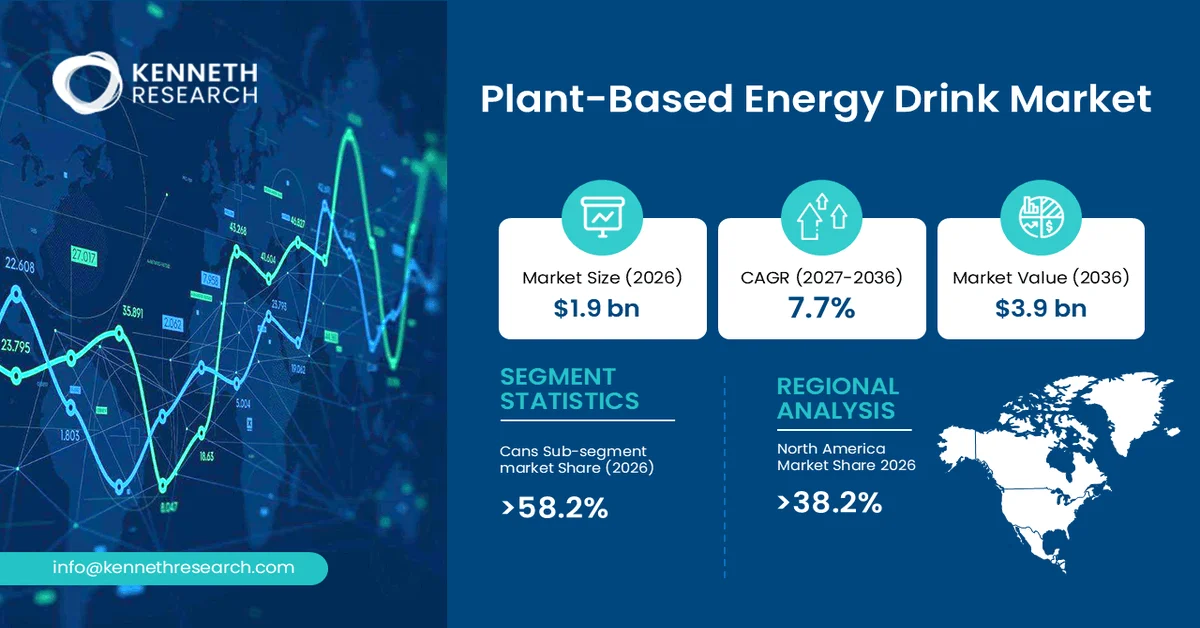
Plant-Based Energy Drink Market size was valued at USD 1.9 billion in 2026 and is projected to reach USD 3.9 billion by the end of 2036, rising at a CAGR of 7.7% during the forecast period, i.e., 2027-2036. In 2027, the industry size of the plant-based energy drink is estimated at USD 2 billion.
The primary growth driver for the plant-based energy drink market is the growing consumer preference for natural, plant-derived ingredients and beverages perceived as healthier alternatives to conventional energy drinks.
The plant-based energy drink market comprises energy beverages formulated primarily with plant-derived ingredients and designed to provide energy, alertness, or functional benefits. These products may contain naturally sourced caffeine from ingredients such as green tea, coffee, guarana, yerba mate, or other botanical sources, together with plant-based flavoring, sweetening, and functional ingredients.
The market includes packaged ready-to-drink beverages distributed through supermarkets, convenience stores, specialty retailers, foodservice channels, and online platforms. Product development increasingly focuses on natural formulations, clean-label positioning, plant-based ingredients, and convenient packaging formats such as cans. Manufacturers compete through ingredient innovation, flavor development, functional positioning, packaging differentiation, and expansion across retail and foodservice distribution channels.
Key Plant-Based Energy Drink Market Insights Summary:
Key Takeaways: Market Trends & Insights
- The plant-based energy drink market is projected to grow from USD 1.9 billion in 2026 to USD 3.9 billion by 2036, registering a 7.7% CAGR during 2027-2036.
- Rising consumer preference for natural, plant-derived, and functional beverages is supporting product innovation and market expansion.
- Cans dominate the packaging type segment, accounting for 58.2% in 2026, supported by convenience, portability, durability, and efficient distribution.
- North America leads the market with a 38.2% share in 2026, supported by established beverage manufacturing, strong retail networks, and demand for natural and functional beverages across the U.S. and Canada.
Market Drivers
- Rising demand for natural and functional beverages
- Expansion of natural caffeine-based formulations
- Growing consumer preference for plant-derived and clean-label ingredients
- Increasing product innovation and premiumization in ready-to-drink beverages
Challenges
- Caffeine safety, formulation, and regulatory compliance
- Higher formulation and raw-material complexity
Plant-Based Energy Drink Market Overview & Supply Chain
The plant-based energy drink market is expanding as beverage consumers increasingly seek products positioned around natural ingrediensts, functional benefits, and convenient consumption. Demand is supported by growing interest in plant-derived caffeine sources, clean-label formulations, and beverages that provide energy and alertness while aligning with changing preferences for more natural product compositions.
The supply chain begins with raw materials such as plant-based caffeine sources, botanical extracts, natural flavors, sweeteners, functional ingredients, water, and other formulation inputs. Ingredient suppliers provide these materials to beverage manufacturers, which formulate, blend, process, and package finished products. Packaging suppliers provide cans, closures, labels, and related materials, while contract manufacturers may support production and filling requirements.
Plant-Based Energy Drink Market: Growth Drivers & Challenges
Growth Drivers:
- Rising demand for natural and functional beverages: The increasing consumer preference for beverages perceived as natural, functional, and better aligned with wellness-oriented lifestyles is supporting the expansion of plant-based energy drink offerings. Manufacturers are responding by incorporating botanical extracts, plant-derived caffeine, natural flavors, and other functional ingredients into ready-to-drink formulations. This shift is encouraging beverage companies to diversify beyond conventional energy drink formulations and develop products with differentiated nutritional and ingredient profiles.
- Expansion of natural caffeine-based formulations: The growing use of naturally sourced caffeine ingredients is strengthening product innovation within the plant-based energy drink industry. Manufacturers can use caffeine-containing botanicals such as green tea, coffee, guarana, and yerba mate to differentiate formulations while reinforcing natural and plant-based positioning. This enables brands to develop products around energy, alertness, flavor, and functional attributes rather than competing solely on conventional stimulant formulations. Natural caffeine-based products can also support premium positioning when manufacturers emphasize recognizable botanical sources and transparent ingredient communication.
Challenges:
- Caffeine safety, formulation, and regulatory compliance: Caffeine management presents an important commercial challenge because energy drinks must balance effective energy positioning with responsible formulation and labeling. The challenge becomes more complex when manufacturers combine multiple caffeine-containing botanical ingredients, as the total caffeine contribution must be assessed across the complete formulation. Regulatory requirements and consumer expectations can also increase the need for accurate ingredient disclosure, product testing, quality control, and substantiation of marketing claims.
- Higher formulation and raw-material complexity: Plant-based energy drinks can face higher formulation complexity because manufacturers must achieve a consistent combination of energy functionality, taste, stability, shelf life, and natural ingredient positioning. Botanical extracts and plant-derived ingredients can vary in flavor, potency, availability, and processing characteristics, making large-scale formulation more demanding than standardized conventional formulations. Supply variability can also affect procurement costs and production planning, particularly when manufacturers depend on specialized botanical ingredients or certified plant-based inputs.
Plant-Based Energy Drink Market Size and Forecast:
| Report Attribute | Details |
|---|---|
| Base Year |
2026 |
| Forecast Period |
2027-2036 |
| CAGR |
7.7% |
| Base Year Market Size (2026) |
USD 1.9 billion |
| Forecast Year Market Size (2036) |
USD 3.9 billion |
| Regional Scope |
|
Plant-Based Energy Drink Market Segmentation Analysis:
Packaging Type Segment Analysis
In the packaging type segment, the cans sub-segment is anticipated to capture the largest market share of 58.2% by the end of 2026.
Cans are widely preferred for energy drinks because they provide portability, convenience, durability, and efficient storage and transportation. Their lightweight structure enables manufacturers and distributors to optimize logistics while supporting single-serve consumption across retail, convenience, foodservice, and on-the-go channels. Cans also provide extensive surface area for branding, nutritional information, ingredient communication, and product differentiation, enabling beverage companies to strengthen shelf visibility and premium positioning. For plant-based energy drink manufacturers, cans are particularly suitable for ready-to-drink formulations because they support convenient consumption while maintaining a standardized packaging format across product variants. Going forward, continued innovation in can design, recyclable materials, printing, and packaging efficiency is expected to reinforce the position of cans as the leading packaging format.
Product Type Segment Analysis
In the product type segment, the natural caffeine-based drinks sub-segment is anticipated to witness strong growth as consumers increasingly seek energy beverages formulated with recognizable, plant-derived caffeine sources. Natural caffeine-based drinks can incorporate ingredients such as green tea, coffee, guarana, and yerba mate, allowing manufacturers to differentiate products through botanical sourcing and clean-label positioning. This product category also enables beverage companies to combine energy functionality with natural flavors and other plant-based functional ingredients, supporting product diversification and premium positioning. Manufacturers are increasingly focusing on formulation quality, ingredient transparency, flavor development, and convenient ready-to-drink formats to strengthen consumer acceptance.
Our in-depth analysis of the global plant-based energy drink market includes the following segments:
|
Segment |
Sub-segment |
|
Product Type |
|
|
Ingredient Source |
|
|
Packaging Type |
|
|
Distribution Channel |
|
|
Consumer Group |
|
|
Application |
|
Plant-Based Energy Drink Market Regional Insights:
North America Market Trends & Insights:
North America is anticipated to dominate the plant-based energy drink market, accounting for 38.2% of the market in 2026. The region’s leadership is supported by a mature ready-to-drink beverage industry, strong consumer acceptance of functional beverages, extensive retail and convenience-store networks, and continued product innovation around natural and plant-derived ingredients.
The U.S. is the leading country in North America, supported by extensive beverage manufacturing capabilities, strong demand for functional and ready-to-drink products, and widespread retail availability.
Canada represents another important market, benefiting from established beverage distribution networks and strong commercial integration with the U.S. Its proximity to the U.S. market also supports cross-border product distribution and expansion opportunities for beverage manufacturers.
Asia-Pacific Market Trends & Insights:
Asia-Pacific represents a significant growth region for the plant-based energy drink market, supported by expanding beverage consumption, urbanization, rising disposable incomes, and growing interest in functional and naturally positioned products. The region provides manufacturers with opportunities to develop beverages tailored to local preferences while leveraging established food and beverage manufacturing capabilities.
Japan offers opportunities through its sophisticated beverage industry, advanced convenience-store network, and established consumer acceptance of functional and health-oriented beverages.
China provides substantial opportunities because of its large consumer base, expanding modern retail infrastructure, and growing beverage industry. Official Chinese statistics reported that beverage retail sales increased 6.9% year over year during January–February 2024, indicating continued activity across the broader beverage category.
Leading Companies Operating in the Global Plant-Based Energy Drink Market:
Here is a list of upstream, downstream, and key players operating in the global plant-based energy drink market competitive ecosystem:
- GURU Organic Energy (Canada)
- Company Overview
- Business Strategy
- Key Product Offerings
- Financial Performance
- Key Performance Indicators
- Risk Analysis
- Recent Development
- Regional Presence
- SWOT Analysis
- Yerbaé Brands (U.S)
- Guayakí Yerba Mate (U.S)
- Lotus Plant Power (U.S)
- O’cean Beverages (India)
Recent Developments
- March 2026: GURU introduced GURU Zero Orange Raspberry Sorbet in March 2026, extending its sorbet-inspired zero-sugar series after the January Dragon Fruit Cherry Sorbet launch. The development strengthens GURU's flavor innovation pipeline and expands its range of plant-based energy options.
- January 2025 — Yerbaé announced an agreement with Safety Shot to be acquired in January 2025. The announcement described Yerbaé as a producer of clean, plant-based energy beverages and stated that the combination was intended to create operational synergies and support growth in wellness and functional beverages.
Frequently Asked Question
In 2026, the plant-based energy drink market exceeded USD 1.9 billion.
The plant-based energy drink market is projected to reach USD 3.9 billion by the end of 2036, expanding at a CAGR of 7.7% over the forecast period (2027-2036).
The major players in the market are GURU Organic Energy, Monster Beverage, Yerbaé Brands, Lotus Plant Power, O’cean Beverages, and others.
In the packaging type segment, the cans sub-segment is anticipated to capture the largest market share of 58.2% in the future and exhibit lucrative growth opportunities during 2027-2036.
North America is projected to hold the largest market share of 38.2% by the end of 2026 and provide more business opportunities in the future.
Why Choose Kenneth Research ?
-
Insight with Impact : We don’t just gather data — we uncover stories, trends, and opportunities that fuel business growth.
-
Experts Who Get It : Our team speaks your industry’s language and knows what really matters to your customers and market.
-
Custom-Built for You : Forget one-size-fits-all. We craft research and consulting solutions as unique as your business vision.
-
Partners, Not Just Providers : We work with you, not for you — collaborating closely to turn insights into smart, strategic moves.
-
Results That Speak : Our work powers brands, startups, and industry leaders alike — with a track record of ideas that work in the real world.
Report ID: 1406 |
Published Date: 25 Sep 2026 |
Report Format: |
Delivery Timeline: 48-72 Business Hours

Copyright © 2025 Kenneth Research. All rights reserved. Terms of Use | Privacy Policy
