Report ID: 1265 |
Published Date: 28 Sep 2026 |
Report Format: |
Delivery Timeline: 48-72 Business Hours
Photonic Integrated Sensor Market Outlook:
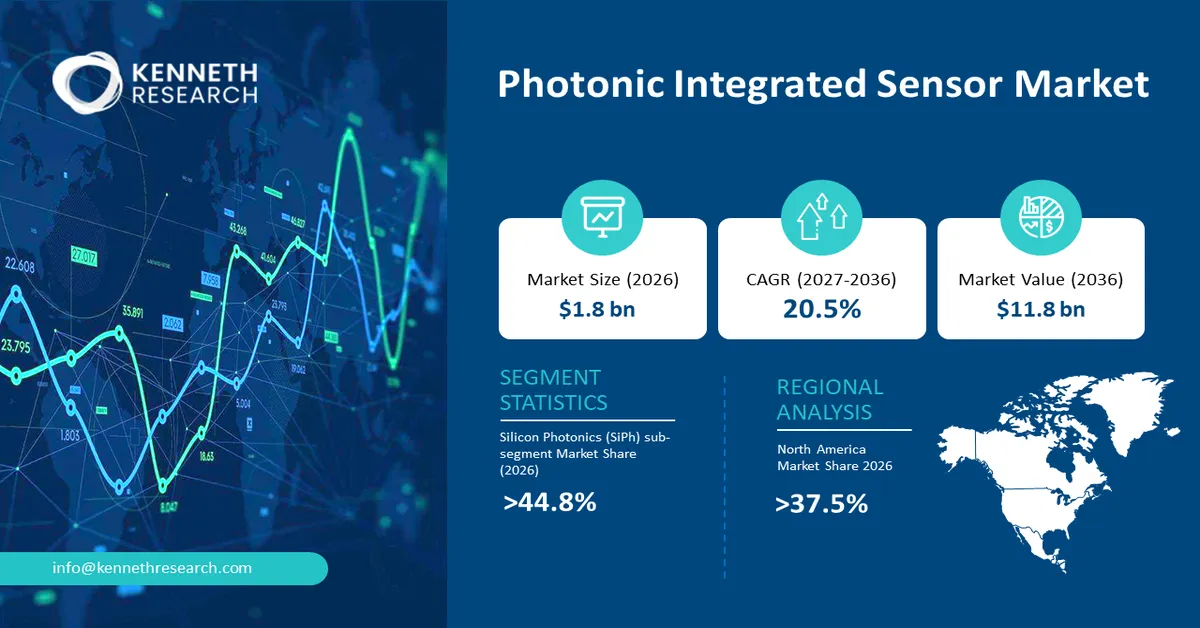
Photonic Integrated Sensor Market size was valued at USD 1.8 billion in 2026 and is projected to reach USD 11.8 billion by 2036, rising at a CAGR of 20.5% during the forecast period, i.e., 2027-2036. In 2027, the industry size of the photonic integrated sensor is estimated at USD 2.2 billion.
The primary growth driver for the photonic integrated sensor market is the expanding use of silicon photonics to develop compact, high-performance sensing systems. Silicon-based photonic platforms can integrate optical components onto semiconductor substrates, reducing system size, power requirements, and integration complexity compared with conventional bulk-optical architectures.
The photonic integrated sensor market comprises integrated optical sensing technologies that combine light sources, waveguides, detectors, modulators, and related optical components on or within a compact photonic platform. These sensors detect physical, chemical, biological, or environmental changes through optical signals and can provide high sensitivity, compact form factors, and fast measurement capabilities.
Applications span industrial monitoring, healthcare diagnostics, aerospace and defense, environmental monitoring, telecommunications, automotive systems, and scientific instrumentation. Increasing integration with semiconductor manufacturing processes is enabling photonic sensors to become smaller, more scalable, and easier to incorporate into complex electronic and optical systems. Government-backed research is also expanding the technology base:
Key Photonic Integrated Sensor Market Insights Summary:
Key Takeaways: Market Trends & Insights
- Photonic integrated sensor market projected to grow from USD 1.8 billion in 2026 to USD 11.8 billion by 2036 at a 20.5% CAGR
- North America accounted for the largest regional share at 37.5% in 2026, supported by advanced semiconductor, photonics research, and sensing technology capabilities
- Silicon Photonics (SiPh) remains the leading Material segment with a 44.8% share in 2026, supported by CMOS compatibility, compact integration, and scalable manufacturing potential
- Optical Sensors represent a key Product Type segment, supported by growing demand for compact, high-sensitivity sensing across industrial, healthcare, environmental, and scientific applications
Market Drivers
- Rising demand for compact precision sensors
- Increasing integration of photonic and electronic components
- Expansion of silicon photonics manufacturing ecosystems
- Growing applications in industrial, healthcare, defense, and quantum sensing
Challenges
- Manufacturing Complexity and Cost
- Integration of Optical and Electronic Components
Photonic Integrated Sensor Market Overview & Supply Chain
The photonic integrated sensor market is expanding as photonic components become increasingly integrated into compact sensing platforms for precision measurement, industrial monitoring, healthcare, aerospace, and quantum applications. Integrated photonics offers advantages in size, weight, power consumption, and manufacturing scalability, supporting broader deployment of chip-scale sensing technologies. NIST's ongoing work demonstrates integrated photonic sensing for applications including temperature measurement, acceleration, and other precision-metrology functions.
The value chain begins with suppliers of semiconductor wafers, optical materials, photonic components, lasers, detectors, waveguides, and packaging materials. Photonic integrated circuit manufacturers then design and fabricate sensor chips, integrate optical and electronic components, and conduct testing and calibration. Finished sensor modules are supplied to equipment manufacturers, system integrators, research organizations, and industrial end users.
Photonic Integrated Sensor Market: Growth Drivers & Challenges
Growth Drivers:
- Growing adoption of integrated photonics for precision sensing: Increasing demand for compact, low-power, and high-precision sensing technologies is supporting adoption of photonic integrated circuits across industrial, scientific, healthcare, and defense applications. NIST's recent work demonstrates chip-scale integrated sensors for temperature and acceleration measurement, highlighting the expanding capabilities of integrated photonic sensing platforms. Silicon photonics also enables integration of optical and electronic functions on semiconductor platforms, improving scalability and reducing system complexity.
- Expansion of silicon photonics ecosystems: Growing investment in silicon photonics research, manufacturing capabilities, and commercialization is strengthening the supply base for photonic integrated sensors. Government-backed initiatives are supporting development of photonic integrated circuits for sensing, quantum technologies, communications, and advanced computing. In India, MeitY established a Silicon Photonics Centre of Excellence at IIT Madras to support PIC design, packaging, training, and future commercialization.
Challenges:
- Manufacturing complexity and cost: The manufacturing of photonic integrated sensors requires precise fabrication, packaging, alignment, and testing processes, which can increase production complexity and costs. Integrating optical, electronic, and sensing functions on a single platform also requires advanced process control and specialized manufacturing capabilities. NIST notes that increasing PIC complexity and density creates growing requirements for manufacturing process control and metrology. For manufacturers, achieving consistent performance while maintaining high wafer yields remains important for commercial scalability. The challenge is particularly relevant as the market moves from laboratory prototypes toward high-volume sensor production.
- Integration of optical and electronic components: Combining lasers, photodetectors, amplifiers, waveguides, and sensing elements on compact photonic platforms remains technically demanding. NIST highlights that silicon is not naturally suitable for laser integration, while other active components can remain comparatively bulky and power-intensive. This creates challenges related to heterogeneous integration, thermal management, packaging, and overall system reliability. Manufacturers must balance sensor performance with compactness, power efficiency, manufacturability, and cost.
Photonic Integrated Sensor Market Size and Forecast:
| Report Attribute | Details |
|---|---|
| Base Year |
2026 |
| Forecast Period |
2027-2036 |
| CAGR |
20.5% |
| Base Year Market Size (2026) |
USD 1.8 billion |
| Forecast Year Market Size (2036) |
USD 11.8 billion |
| Regional Scope |
|
Photonic Integrated Sensor Market Segmentation Analysis:
Material Segment Analysis
In the Material segment, Silicon Photonics (SiPh) is anticipated to capture the largest market share of 44.8% by the end of 2026.
SiPh enables smaller footprints, lower power requirements, manufacturing scalability, and integration with electronic components, making it attractive for precision sensing and measurement applications. NIST highlights these advantages for photonic integrated circuits and is developing silicon-on-insulator photonic sensors for temperature measurement and other sensing applications.
The technology is also expanding into advanced applications requiring compact and robust sensing architectures. NIST demonstrated an integrated photonic platform capable of interrogating chip-scale temperature and acceleration sensors, illustrating the potential for SiPh-based systems in precision measurement. Growing adoption across industrial monitoring, aerospace and defense, healthcare, environmental measurement, and emerging quantum applications is expected to strengthen demand for silicon photonic sensor platforms.
Product Type Segment Analysis
In the Product Type segment, Optical Sensors are expected to witness strong demand as integrated photonic technologies enable compact, sensitive, and low-power measurement systems. Optical sensing platforms can measure parameters such as temperature, acceleration, radiation, and chemical characteristics while supporting miniaturized system architectures. NIST is developing chip-scale photonic sensors for precision temperature measurement and other sensing applications, demonstrating the suitability of integrated photonics for high-accuracy measurement.
The technology is also expanding into industrial and medical applications. NIST's photonic dosimetry work uses nanofabricated photonic sensors for high-resolution radiation measurement, while an NSF-backed SBIR project is developing integrated photonic Raman analyzers for real-time chemical analysis.
Our in-depth analysis of the global photonic integrated sensor market includes the following segments:
|
Segment |
Sub-segment |
|
Product Type |
|
|
By Material |
|
|
By Application |
|
Photonic Integrated Sensor Market Regional Insights:
North America Market Trends & Insights:
North America accounted for 37.5% of the photonic integrated sensor market in 2026, supported by advanced semiconductor manufacturing capabilities, strong photonics research infrastructure, and increasing development of chip-scale sensing technologies. The region benefits particularly from the U.S. ecosystem, where government-backed research institutions are advancing integrated photonics for precision measurement, quantum sensing, and advanced manufacturing.
The U.S. represents the principal market in the region, supported by research and commercialization activity spanning silicon photonics, photonic integrated circuits, and precision sensing. NIST's photonic thermometry program is developing chip-scale photonic integrated-circuit sensors while emphasizing advantages such as low power consumption, small footprint, fast response, and manufacturing scalability.
Canada contributes through its advanced photonics, semiconductor, telecommunications, and research ecosystem, creating opportunities for integrated optical sensing technologies. Overall, North America's combination of advanced R&D, semiconductor-compatible fabrication, and growing commercialization activity strengthens its position in the global market.
Asia-Pacific Market Trends & Insights:
Asia-Pacific represents an important growth region for the photonic integrated sensor market, supported by expanding semiconductor capabilities, photonics research, and demand for advanced sensing technologies. Japan and China are strengthening their ecosystems through government-backed research and development in photonics, semiconductor integration, and next-generation sensing.
Japan benefits from a mature precision-manufacturing and photonics ecosystem. Japan's JST is supporting research that combines photonics with information, materials, communication, and sensing technologies, while NEDO is also evaluating future sensing-device technologies for applications expected toward 2035.
China is expanding its photonic-integration capabilities through semiconductor and optical-device development. In 2024, China's Wuhan East Lake High-Tech Development Zone reported a silicon-photonics integration breakthrough involving heterogeneous integration of an indium-phosphide laser with an SOI wafer, demonstrating progress toward highly integrated photonic platforms.
Leading Companies Operating in the Global Photonic Integrated Sensor Market:
Here is a list of upstream, downstream, and key players operating in the global photonic integrated sensor market competitive ecosystem:
- Intel Corporation (United States)
- Company Overview
- Business Strategy
- Key Product Offerings
- Financial Performance
- Key Performance Indicators
- Risk Analysis
- Recent Development
- Regional Presence
- SWOT Analysis
- Hamamatsu Photonics K.K (Japan)
- STMicroelectronics (Switzerland)
- Lumentum Holdings (United States)
Recent Developments
- June 2026 - Intel continued advancing its silicon photonics platform, including optical compute interconnect technology that integrates silicon photonics with CMOS electronics.
- January 2026 - Lumentum showcased next-generation ultrafast, UV, and 3D-sensing laser platforms at Photonics West 2026.
Frequently Asked Question
In 2026, the photonic integrated sensor market is valued at USD 1.8 billion.
The market is projected to reach USD 11.8 billion by 2036, expanding at a CAGR of 20.5% during 2027-2036.
Major participants include Intel Corporation, Hamamatsu Photonics, STMicroelectronics, Lumentum Holdings, and Coherent Corp.
In the Material segment, Silicon Photonics (SiPh) is anticipated to maintain the leading position, accounting for 44.8% in 2026.
North America is projected to remain the leading regional market, accounting for 37.5% in 2026, supported by advanced photonics research, semiconductor capabilities, and growing development of integrated sensing technologies in the U.S. and Canada.
Why Choose Kenneth Research ?
-
Insight with Impact : We don’t just gather data — we uncover stories, trends, and opportunities that fuel business growth.
-
Experts Who Get It : Our team speaks your industry’s language and knows what really matters to your customers and market.
-
Custom-Built for You : Forget one-size-fits-all. We craft research and consulting solutions as unique as your business vision.
-
Partners, Not Just Providers : We work with you, not for you — collaborating closely to turn insights into smart, strategic moves.
-
Results That Speak : Our work powers brands, startups, and industry leaders alike — with a track record of ideas that work in the real world.
Report ID: 1265 |
Published Date: 28 Sep 2026 |
Report Format: |
Delivery Timeline: 48-72 Business Hours

Copyright © 2025 Kenneth Research. All rights reserved. Terms of Use | Privacy Policy
