Report ID: 1212 |
Published Date: 01 Sep 2026 |
Report Format: |
Delivery Timeline: 48-72 Business Hours
Perovskite Solar Cell Market Outlook:
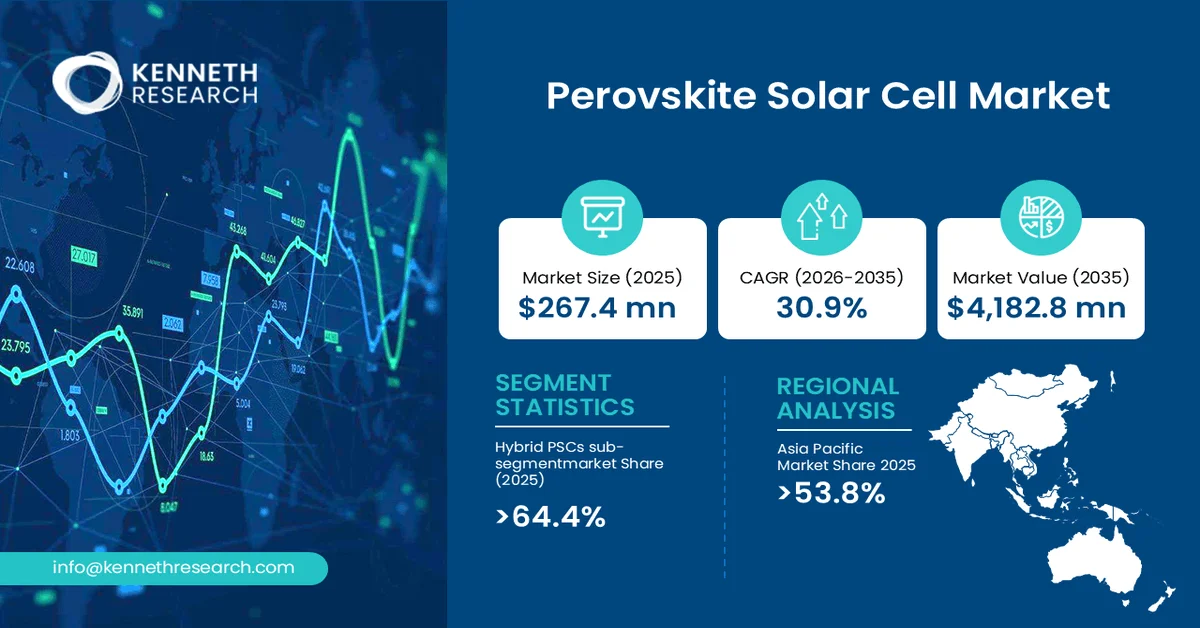
Perovskite Solar Cell Market size was valued at USD 267.4 million in 2025 and is projected to reach USD 4,182.8 million by the end of 2035, rising at a CAGR of 30.9% during the forecast period, i.e., 2026-2035. In 2026, the industry size of perovskite solar cells is estimated at USD 370.9 million.
The primary growth driver is the push to commercialize high-performance, low-cost photovoltaic technologies that can complement conventional silicon. Perovskite materials offer tunable light absorption, compatibility with tandem architectures, and thin-film manufacturing routes, encouraging sustained investment in scalable fabrication, durability improvements, and technology validation for next-generation solar power applications.
The perovskite solar cell market comprises the development, production, integration, and commercialization of photovoltaic cells and modules that use metal-halide perovskite materials as the primary light-absorbing layer. These devices are a form of thin-film photovoltaics in which the active perovskite layer can be deposited through coating, printing, or vacuum-based processes onto a supporting substrate.
A defining characteristic is the material’s compositional flexibility, which enables its optical and electronic properties to be adjusted for different photovoltaic architectures. This supports both single-junction configurations and tandem designs in which perovskite absorbers are combined with another photovoltaic material. Perovskite cells can therefore be developed for rigid modules as well as emerging lightweight and flexible formats.
Key Perovskite Solar Cell Market Insights Summary:
Key Takeaways: Market Trends & Insights
- Hybrid PSCs dominated the type segment with a 64.4% share in 2025, supported by their compatibility with established photovoltaic technologies and tandem architectures
- The perovskite solar cell market is projected to expand from USD 370.9 Million in 2026 to USD 4,182.8 Million by 2035, reflecting strong commercialization potential
- Flexible Perovskite Solar Cells are positioned for rapid growth as lightweight and conformable photovoltaic designs open opportunities across portable, building-integrated, transportation, and aerospace applications
- Asia-Pacific leads the market with a 53.8% share in 2025, supported by China’s extensive photovoltaic manufacturing ecosystem and Japan’s focus on perovskite commercialization
- Commercialization remains dependent on overcoming long-term stability, durability, scalable manufacturing, process consistency, and bankability challenges before widespread deployment
Market Drivers
- Government support for commercialization and domestic photovoltaic manufacturing
- Increasing integration of perovskites with established photovoltaic platforms
- Advances in flexible and lightweight photovoltaic product architectures
- Progress in scalable manufacturing, durability, and long-term technology validation
Challenges
- Limited long-term stability and durability
- Difficulty scaling laboratory performance into bankable manufacturing
Perovskite Solar Cell Market Overview & Supply Chain
Global adoption of perovskite solar cell technology is increasing as photovoltaic manufacturers, research institutions, and energy developers seek higher-performance architectures that can complement established silicon technologies. Perovskites offer tunable light absorption, compatibility with tandem configurations, and potential for thin-film manufacturing, making them relevant to the next phase of photovoltaic innovation. This expanding deployment base creates a larger addressable ecosystem for next-generation photovoltaic technologies, while ongoing efforts to improve durability, manufacturability, efficiency at scale, and bankability support the transition of perovskite cells from laboratory research toward industrial applications.
The perovskite solar cell value chain begins with the sourcing and preparation of precursor chemicals, conductive materials, substrates, encapsulants, transport layers, and other specialized inputs required to construct photovoltaic devices. Material suppliers and chemical manufacturers provide formulations that can be engineered for different device architectures and deposition methods. Cell manufacturers then formulate precursor inks or vapor-deposition inputs, deposit functional layers onto substrates, assemble electrical contacts, and integrate cells into modules. Module production incorporates interconnection, laser patterning, sealing, encapsulation, and quality testing, with manufacturing strategies varying according to rigid, flexible, or tandem configurations. Distribution channels connect technology developers and module producers with project developers, system integrators, utilities, commercial and industrial customers, and specialized solar-equipment distributors.
Perovskite Solar Cell Market: Growth Drivers & Challenges
Growth Drivers:
- Rising government support for commercialization and domestic manufacturing: Government-backed research, development, and demonstration programs are accelerating the transition of perovskite photovoltaics from laboratory innovation toward commercially viable manufacturing. Public funding reduces technology risk by supporting improvements in efficiency, durability, process control, module design, and validation—areas that remain critical for bankability. In the United States, the Department of Energy’s Advancing U.S. Thin-Film Solar Photovoltaics funding program allocated $44 million for research, development, and demonstration projects, including initiatives involving perovskite tandem technologies. The program explicitly targets domestic manufacturing and stronger solar supply chains. This type of institutional support can encourage private-sector participation, expand pilot production capabilities, and strengthen collaboration between technology developers, manufacturers, and research institutions.
- Increasing integration of perovskites with established photovoltaic platforms: The integration of perovskite materials with established photovoltaic technologies is creating a pathway for higher-performing solar architectures without requiring an entirely separate generation of energy infrastructure. Perovskites can be engineered to absorb portions of the solar spectrum that conventional silicon cells utilize less effectively, making them particularly suitable as an additional photovoltaic layer in tandem configurations. This expands the technology’s commercial relevance beyond standalone perovskite cells and creates opportunities for manufacturers to leverage existing silicon-related expertise, equipment, supply networks, and deployment channels. For module producers, tandem architectures can provide a route toward differentiated products where efficiency and power density are important purchasing considerations. Continued progress in interface engineering, deposition methods, device stability, and module integration should broaden the range of applications suitable for perovskite tandems.
Challenges:
- Limited long-term stability and durability: The fundamental challenge is the susceptibility of perovskite materials and adjacent device layers to degradation triggered by moisture, oxygen, heat, illumination, and electrical stress. These interacting mechanisms can progressively reduce photovoltaic performance and complicate the design of reliable encapsulation and protective layers. The resulting uncertainty affects module qualification, warranty structures, financing decisions, and investor confidence because utility-scale buyers require predictable performance over extended operating periods. It also increases development costs as manufacturers must conduct accelerated aging, outdoor exposure, and reliability testing before commercialization. The U.S. Department of Energy identifies stability and durability as a primary hurdle to commercial success. Future progress depends on more robust material formulations, interface engineering, encapsulation, and standardized field validation.
- Difficulty scaling laboratory performance into bankable manufacturing: A second restraint is the gap between high-performing laboratory devices and reproducible large-area modules manufactured through industrial processes. Scaling introduces challenges in coating uniformity, defect control, interconnection, layer compatibility, process repeatability, and maintaining electrical performance across larger surfaces. These issues can reduce manufacturing yield and increase quality-control requirements, weakening the economic advantages associated with potentially simpler perovskite processing. For module manufacturers, inconsistent performance also complicates production planning, certification, warranties, and integration with established photovoltaic supply chains. The commercial implication is that investors and project developers may hesitate to commit to large deployments until manufacturers establish dependable production processes and independently validated module performance.
Perovskite Solar Cell Market Size and Forecast:
| Report Attribute | Details |
|---|---|
| Base Year |
2025 |
| Forecast Period |
2026-2035 |
| CAGR |
30.9% |
| Base Year Market Size (2025) |
USD 267.4 million |
| Forecast Year Market Size (2035) |
USD 4,182.8 million |
| Regional Scope |
|
Perovskite Solar Cell Market Segmentation Analysis:
Type Segment Analysis
In the type segment, the hybrid PSCs sub-segment is anticipated to capture the largest market share of 64.4% by the end of 2025.
Hybrid perovskite solar cells dominate the Type segment because they combine the high-performance characteristics of perovskite absorbers with established photovoltaic technologies, particularly silicon. Their tandem architecture provides manufacturers with a practical pathway to enhance power-conversion performance while leveraging existing crystalline-silicon manufacturing capabilities, supply chains, and deployment infrastructure. Demand is reinforced by the continued expansion of solar installations, particularly across Asia-Pacific, where large-scale photovoltaic manufacturing and deployment create a strong ecosystem for next-generation cell technologies. On the supply side, hybrid architectures benefit from established silicon production expertise while perovskite developers focus on improving deposition, interfaces, stability, and module integration. Future adoption is expected to remain centered on tandem designs as manufacturers pursue greater efficiency without completely replacing established PV production infrastructure.
Product Segment Analysis
The flexible perovskite solar cells is projected to grow as the second-largest segment in the perovskite solar cell market due to four converging demand drivers.
Flexible perovskite solar cells are projected to grow rapidly because their lightweight, bendable architecture expands photovoltaic deployment beyond conventional rigid panels. Demand is emerging from applications where low mass, compact storage, conformability, and deployability are commercially important, including portable power, building-integrated systems, transportation, and aerospace. NASA reports that its CubeSat Launch Initiative has launched over 150 CubeSats, illustrating an established and expanding ecosystem of compact spacecraft where lightweight and deployable power technologies can provide meaningful design advantages. Flexible perovskites are particularly attractive for such applications because their thin-film construction can support rollable or conformal designs while retaining strong light-absorption characteristics. On the supply side, DOE-backed research is advancing flexible module architectures, including rollable devices and alternative transparent conductive layers, while NREL research continues to improve scalable coating and processing methods.
Our in-depth analysis of the global perovskite solar cell market includes the following segments:
|
Segment |
Sub-segment |
|
Structure |
|
|
Product |
|
|
Type |
|
|
Technology |
|
|
Application |
|
Perovskite Solar Cell Market Regional Insights:
Asia Pacific Market Trends & Insights:
Asia Pacific perovskite solar cell market is projected to hold the largest revenue share of 53.8% by the end of 2025.
Asia-Pacific is the dominant region for the perovskite solar cell market, supported by its deep photovoltaic manufacturing base, expanding renewable-energy deployment, strong materials ecosystem, and active public-sector investment in next-generation solar technologies. China provides the region’s largest production and consumption platform, while Japan contributes advanced research, commercialization programs, and demand for space-efficient photovoltaic formats. The National Energy Administration reported that China’s photovoltaic power-generation capacity reached 610 million kilowatts at the end of 2023, underscoring the scale of the regional solar ecosystem and the industrial base available for next-generation technologies.
China’s extensive module, equipment, materials, and project-development capabilities provide potential advantages for scaling perovskite technologies.
Japan complements this manufacturing strength through advanced research, commercialization programs, and policy support. Japan’s Ministry of Economy, Trade and Industry is pursuing perovskite commercialization through coordinated measures covering mass-production technology, production capacity, demand creation, supply-chain development, and demonstration. Limited suitable land and demand for lightweight, deployable solar formats further strengthen Japan’s case for perovskites. Together, China’s manufacturing depth and Japan’s commercialization focus reinforce Asia-Pacific’s long-term leadership.
North America Market Trends & Insights:
North America is an important emerging market for perovskite solar cells, supported by strong photovoltaic research capabilities, an established clean-energy investment ecosystem, and growing interest in domestic solar manufacturing. Demand is being shaped by the need for higher-performance photovoltaic technologies that can complement conventional silicon and by applications requiring lightweight, flexible, or tandem solar architectures. In the United States, government initiatives are emphasizing commercialization, manufacturability, durability, and domestic supply-chain development. The U.S. Department of Energy is supporting industrial perovskite research through programs designed to move tandem technologies toward commercial production and improve their reliability.
The United States remains the region's principal innovation and commercialization hub, with national laboratories, universities, startups, and established solar companies participating across materials development, device engineering, manufacturing, and field validation. DOE programs also support flexible and tandem perovskite technologies, expanding potential applications beyond conventional solar modules.
Canada is developing a complementary ecosystem through government-backed industrial research and commercialization programs. The National Research Council of Canada is supporting perovskite projects targeting flexible solar films, building-integrated photovoltaics, indoor applications, and outdoor module commercialization. Together, the two countries provide a strong platform for North American perovskite innovation and future manufacturing expansion.
Leading Companies Operating in the Global Perovskite Solar Cell Market:
Here is a list of upstream, downstream, and key players operating in the global perovskite solar cell market competitive ecosystem:
- Oxford PV (United Kingdom)
- Company Overview
- Business Strategy
- Key Product Offerings
- Financial Performance
- Key Performance Indicators
- Risk Analysis
- Recent Development
- Regional Presence
- SWOT Analysis
- Microquanta Semiconductor (China)
- Saule Technologies (Poland)
- Swift Solar (United States)
- LONGi Green Energy Technology (China)
Recent Developments
- In July 2026, LONGi Green Energy Technology set a new world record of 35.5% power conversion efficiency for a crystalline silicon-perovskite tandem solar cell, certified by the European Solar Test Installation (ESTI), building on its previous records of 34.85% in April 2025 and 33.9% in November 2023.
- In June 2026, Oxford PV achieved 25.6% efficiency for a perovskite-silicon tandem module across the full area of a commercial-sized panel, certified by Fraunhofer ISE. The module uses Matrix Shingle architecture—cells cut into strips and overlapped like roof tiles—eliminating inactive gaps and reducing resistive losses. The company plans to launch a 26% product in 2026 and target 27% by 2027.
Frequently Asked Question
In 2025, the perovskite solar cell market exceeded USD 267.4 million.
The perovskite solar cell market is projected to reach USD 4,182.8 million by the end of 2035, expanding at a CAGR of 30.9% over the forecast period (2026-2035).
The major players in the market are Oxford PV, Microquanta Semiconductor, Saule Technologies, Swift Solar, LONGi Green Energy Technology and others.
In the type segment, the hybrid PSCs sub-segment is anticipated to capture the largest market share of 64.4% in the future and exhibit lucrative growth opportunities during 2026-2035. This growth trajectory is largely attributed to the increasing integration of perovskites with established photovoltaic platforms.
Asia-Pacific is projected to hold the largest market share of 53.8% by the end of 2025 and provide more business opportunities in the future. Strong photovoltaic manufacturing capabilities in China and advanced perovskite commercialization initiatives in Japan are fostering the region's dominance.
Why Choose Kenneth Research ?
-
Insight with Impact : We don’t just gather data — we uncover stories, trends, and opportunities that fuel business growth.
-
Experts Who Get It : Our team speaks your industry’s language and knows what really matters to your customers and market.
-
Custom-Built for You : Forget one-size-fits-all. We craft research and consulting solutions as unique as your business vision.
-
Partners, Not Just Providers : We work with you, not for you — collaborating closely to turn insights into smart, strategic moves.
-
Results That Speak : Our work powers brands, startups, and industry leaders alike — with a track record of ideas that work in the real world.
Report ID: 1212 |
Published Date: 01 Sep 2026 |
Report Format: |
Delivery Timeline: 48-72 Business Hours

Copyright © 2025 Kenneth Research. All rights reserved. Terms of Use | Privacy Policy
