Report ID: 1470 |
Published Date: 28 Sep 2026 |
Report Format: |
Delivery Timeline: 48-72 Business Hours
Packaging Primers Market Outlook:
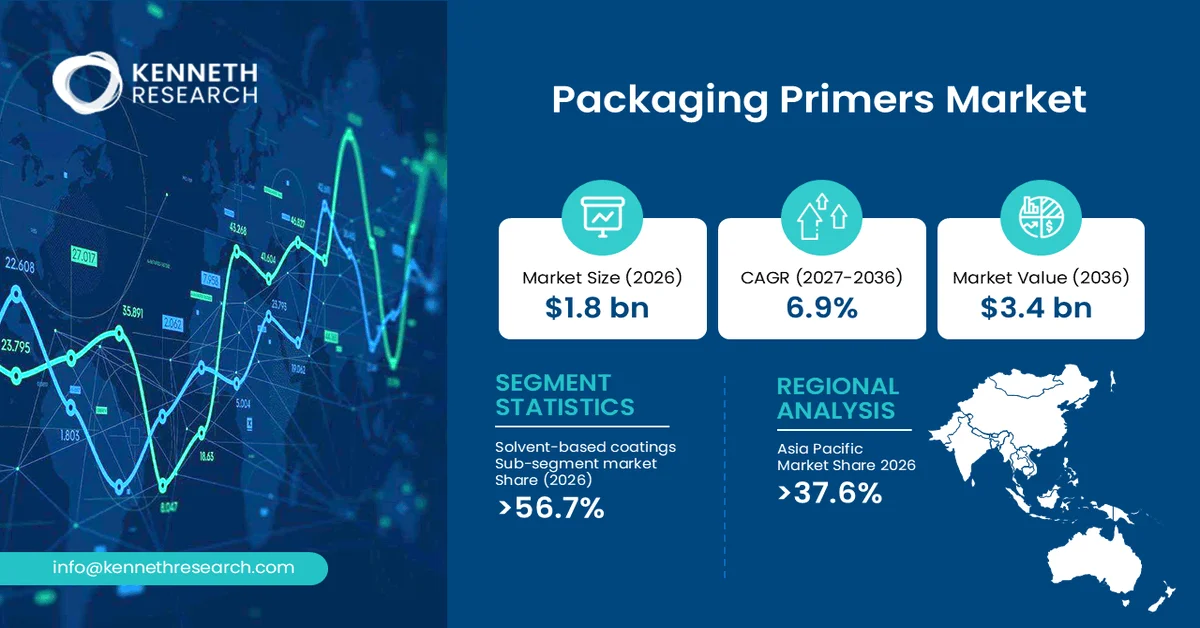
Packaging Primers Market size was valued at USD 1.8 billion in 2026 and is projected to reach USD 3.4 billion by the end of 2036, rising at a CAGR of 6.9% during the forecast period, i.e., 2027-2036. In 2027, the industry size of the packaging primers is estimated at USD 1.9 billion.
The primary growth driver for the packaging primers market is the increasing demand for high-performance packaging that provides stronger adhesion, printability, barrier performance, and surface protection.
The packaging primers market comprises specialized coating formulations applied to packaging substrates to improve surface properties and promote adhesion between the substrate and subsequent layers, such as inks, coatings, adhesives, laminates, and barrier materials. Packaging primers can be formulated using solvent-based, water-based, and other chemistries according to substrate characteristics, processing requirements, and end-use performance specifications.
Key characteristics include adhesion enhancement, surface modification, print receptivity, chemical and abrasion resistance, and compatibility with downstream converting processes. These formulations are applied across materials such as plastic films, paper, paperboard, metal, and other packaging substrates used in flexible and rigid packaging formats.
Key Packaging Primers Market Insights Summary:
Key Takeaways: Market Trends & Insights
- Packaging primers market projected to grow from USD 1.8 billion in 2026 to USD 3.4 billion by 2036 at a CAGR of 6.9%
- Asia-Pacific accounted for the largest regional share at 37.6% in 2026, supported by its extensive packaging manufacturing base and strong demand across flexible packaging and consumer-goods applications
- Solvent-Based Coatings dominated the primer analysis segment with a 56.7% share in 2026, supported by established adhesion, drying, and converting performance
- Film represented the second key segment under application, benefiting from expanding use of flexible and multilayer packaging structures that require effective surface treatment
Market Drivers
- Increasing demand for sustainable and high-performance packaging
- Expansion of flexible and multilayer packaging applications
- Growing need for improved printing, coating, and lamination adhesion
- Increasing development of application-specific and lower-emission primer formulations
Challenges
- Formulation and regulatory compliance complexity
- Compatibility across diverse packaging substrates
Packaging Primers Market Overview & Supply Chain
The adoption of packaging primers is increasing as packaging manufacturers and converters seek stronger adhesion, improved printability, and reliable performance across increasingly sophisticated packaging structures. Primers are particularly relevant to flexible films and coated or laminated packaging, where surface compatibility can directly affect printing, laminating, and downstream converting performance. The growing use of multilayer structures and surface-treated packaging materials is consequently supporting demand for formulations that improve adhesion between substrates and inks, coatings, adhesives, or barrier layers. At the same time, sustainability considerations are encouraging packaging producers to optimize material usage and develop packaging structures that can meet evolving environmental requirements.
The supply chain for the packaging primers market begins with raw-material suppliers providing resins, polymers, solvents, additives, pigments, adhesion promoters, and other formulation ingredients. Primer manufacturers combine these inputs through formulation, blending, dispersion, quality testing, and process-control operations to produce application-specific coating systems. Depending on the formulation, manufacturers develop products for different substrates, printing processes, coating technologies, and converting conditions. Finished primers are supplied to packaging converters, film manufacturers, printers, laminators, and other industrial users through direct sales, distributors, and specialty chemical channels.
Packaging Primers Market: Growth Drivers & Challenges
Growth Drivers:
- Increasing demand for sustainable and high-performance packaging: The shift toward more sustainable packaging is encouraging converters and coating manufacturers to develop primer systems that maintain adhesion and print performance while supporting evolving material and environmental requirements. Packaging structures increasingly need to balance functionality, material efficiency, recyclability, and compatibility with different substrates. This creates demand for primers capable of supporting water-based, lower-emission, and other formulation approaches without compromising downstream converting performance. Regulatory and procurement initiatives are also increasing attention on the chemical composition and sustainability characteristics of packaging-related materials.
- Expansion of flexible and multilayer packaging applications: The increasing use of flexible and multilayer packaging is another important growth driver for the packaging primers market. These structures commonly combine different substrates and functional layers to achieve properties such as barrier protection, durability, printability, and product preservation. However, differences in surface energy and material characteristics can create adhesion challenges during printing, coating, and lamination. Primers help address these challenges by modifying substrate surfaces and improving compatibility between successive layers.
Challenges:
- Formulation and regulatory compliance complexity: Primer manufacturers face increasing complexity in developing formulations that satisfy performance requirements while complying with evolving environmental and chemical regulations. Solvent selection, emissions, chemical composition, substrate compatibility, and application conditions can all affect formulation decisions. Changes in regulatory requirements may require manufacturers and converters to reformulate products, qualify alternative raw materials, conduct additional testing, and modify production processes.
- Compatibility across diverse packaging substrates: The wide range of packaging substrates and converting processes creates a technical challenge for primer suppliers. Plastic films, paper-based materials, metal surfaces, coated substrates, and multilayer structures can exhibit substantially different surface characteristics and processing requirements. A formulation that performs effectively on one substrate may require modification when used with another material or under different printing, coating, drying, or lamination conditions. Inconsistent adhesion can lead to defects, reduced print quality, delamination, or production inefficiencies for converters.
Packaging Primers Market Size and Forecast:
| Report Attribute | Details |
|---|---|
| Base Year |
2026 |
| Forecast Period |
2027-2036 |
| CAGR |
6.9% |
| Base Year Market Size (2026) |
USD 1.8 billion |
| Forecast Year Market Size (2036) |
USD 3.4 billion |
| Regional Scope |
|
Packaging Primers Market Segmentation Analysis:
Primer Segment Analysis
In the primer analysis segment, the solvent-based coatings sub-segment is anticipated to capture the largest market share of 56.7% by the end of 2026.
Its leading position is supported by established compatibility with packaging-film converting, printing, coating, and lamination processes, where consistent wetting, adhesion, and rapid drying are important for high-throughput production. Solvent-based systems can provide reliable adhesion across challenging substrates and can be formulated for specific film, ink, adhesive, and coating combinations. Their established processing infrastructure and familiarity among packaging converters also support continued commercial adoption.
Application Segment Analysis
In the application segment, the film sub-segment is projected to witness strong growth as flexible films increasingly require reliable surface treatment for printing, coating, metallization, and lamination processes. Primers improve adhesion and surface compatibility between film substrates and subsequent functional layers, helping converters maintain consistent product quality during high-speed production. The broad use of polyethylene, polypropylene, polyester, and other polymer films across food, beverage, pharmaceutical, personal care, and industrial packaging supports recurring demand for specialized primer formulations.
Our in-depth analysis of the global packaging primers market includes the following segments:
|
Segment |
Sub-segment |
|
By Primer |
|
|
Application |
|
Packaging Primers Market Regional Insights:
Asia-Pacific Market Trends & Insights:
Asia-Pacific is anticipated to remain the dominant region in the packaging primers market, accounting for 37.6% of the market in 2026.
The region’s position is supported by its extensive packaging manufacturing base, strong film and flexible-packaging production, and expanding demand from food, beverages, personal care, pharmaceuticals, and consumer goods. The concentration of packaging converters and downstream manufacturing activities creates a broad customer base for primer suppliers and supports localized production and distribution networks.
Japan represents a technologically mature packaging market characterized by sophisticated converting, printing, and material-processing capabilities. Primer demand is supported by requirements for precise adhesion, surface quality, and compatibility across advanced packaging structures.
China provides a large manufacturing and consumption base for packaging materials, supported by extensive food, beverage, consumer-goods, and industrial production. The country's manufacturing scale and expanding demand for processed and packaged products create opportunities for primer manufacturers serving films, laminates, coatings, and printed packaging.
North America Market Trends & Insights:
North America represents a significant secondary region for the packaging primers market, supported by established flexible-packaging manufacturing, sophisticated printing and converting capabilities, and demand from food, beverage, pharmaceutical, personal care, and industrial applications. The region’s packaging industry is increasingly focused on recyclable structures, material efficiency, and performance optimization, creating opportunities for primer technologies that improve adhesion and surface compatibility while supporting evolving packaging designs.
The United States has a mature packaging-converting ecosystem with extensive capabilities across film production, printing, laminating, coating, and extrusion. Demand for primers is supported by the need for consistent adhesion and surface performance across diverse packaging substrates.
Canada provides opportunities through its food, beverage, consumer-goods, and industrial packaging sectors, alongside increasing attention to film recycling and packaging circularity.
Leading Companies Operating in the Global Packaging Primers Market:
Here is a list of upstream, downstream, and key players operating in the global packaging primers market competitive ecosystem:
- BASF SE (Germany)
- Company Overview
- Business Strategy
- Key Product Offerings
- Financial Performance
- Key Performance Indicators
- Risk Analysis
- Recent Development
- Regional Presence
- SWOT Analysis
- Mica Corporation (U.S)
- Hubergroup (Germany)
- Flint Group (Luxemborg)
- Sherlin Williams (U.S)
Recent Developments
- June 2026 –Mica announced the appointment of Elliot Siegel as an R&D Laboratory Technician, strengthening its research and development capabilities. The appointment supports Mica’s continued development of water-based primers and coatings for flexible packaging and its broader focus on adhesion and sustainable packaging technologies.
- April 2026 –Flint Group launched the new Flint Group Packaging Solutions identity, reinforcing its packaging-focused strategy across inks, coatings, services, and related solutions.
Frequently Asked Question
In 2026, the packaging primers market exceeded USD 1.8 billion.
The packaging primers market is projected to reach USD 3.4 billion by the end of 2036, expanding at a CAGR of 6.9% over the forecast period (2027-2036).
The major players in the market are BASF SE, Mica Corporation, hubergroup, and Flint Group, and others.
In the primer segment, the solvent-based coatings sub-segment is anticipated to capture the largest market share of 56.7% in the future and exhibit lucrative growth opportunities during 2027-2036.
Asia-Pacific is projected to hold the largest market share of 37.6% by the end of 2026 and provide more business opportunities in the future.
Why Choose Kenneth Research ?
-
Insight with Impact : We don’t just gather data — we uncover stories, trends, and opportunities that fuel business growth.
-
Experts Who Get It : Our team speaks your industry’s language and knows what really matters to your customers and market.
-
Custom-Built for You : Forget one-size-fits-all. We craft research and consulting solutions as unique as your business vision.
-
Partners, Not Just Providers : We work with you, not for you — collaborating closely to turn insights into smart, strategic moves.
-
Results That Speak : Our work powers brands, startups, and industry leaders alike — with a track record of ideas that work in the real world.
Report ID: 1470 |
Published Date: 28 Sep 2026 |
Report Format: |
Delivery Timeline: 48-72 Business Hours

Copyright © 2025 Kenneth Research. All rights reserved. Terms of Use | Privacy Policy
