Report ID: 1244 |
Published Date: 01 Sep 2026 |
Report Format: |
Delivery Timeline: 48-72 Business Hours
Organic Solar Cell Market Outlook:
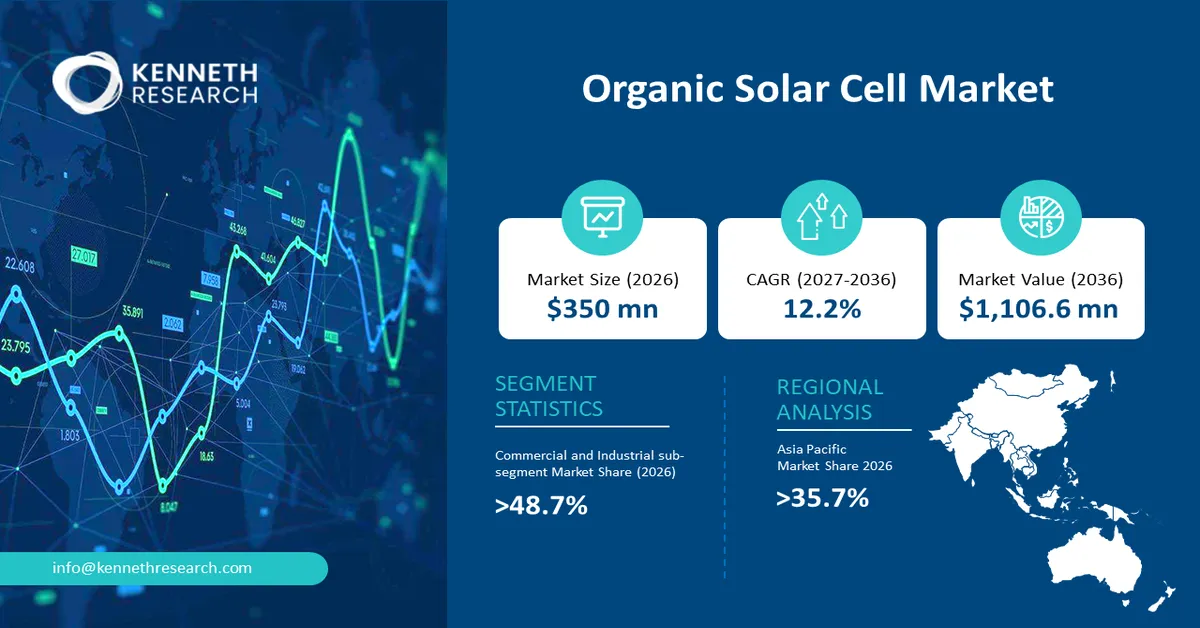
Organic Solar Cell Market size was valued at USD 350 million in 2026 and is projected to reach USD 1,106.6 million by the end of 2036, rising at a CAGR of 12.2% during the forecast period, i.e., 2027-2036. In 2027, the industry size of the organic solar cell is estimated at USD 392.7 million.
The primary growth driver of the organic solar cell market is increasing demand for lightweight, flexible, and application-specific photovoltaic technologies.
The organic solar cell market encompasses photovoltaic cells that use organic semiconductor materials to convert sunlight into electricity through the photovoltaic effect. Unlike conventional silicon-based solar technologies, organic solar cells generally use carbon-based semiconducting compounds, including polymeric and small-molecule materials, as active layers. Their distinguishing characteristics include lightweight construction, mechanical flexibility, semitransparency, tunable optical properties, and potential compatibility with solution-based or low-temperature manufacturing processes.
The technology is particularly relevant for applications requiring adaptable form factors or integration into nontraditional surfaces. Organic solar cells can potentially be incorporated into building façades, windows, portable power products, wearables, sensors, and other distributed-energy applications. Their manufacturing characteristics also create opportunities for roll-to-roll processing and customized module designs.
Key Organic Solar Cell Market Insights Summary:
Key Takeaways: Market Trends & Insights
- Organic solar cell market projected to grow from USD 350 million in 2026 to USD 1,106.6 million by 2036 at a 12.2% CAGR.
- Asia-Pacific accounted for the largest regional share at 35.7% in 2026, supported by strong photovoltaic manufacturing capabilities, renewable-energy deployment, and advanced solar technology development in Japan and China.
- Commercial and Industrial is expected to remain the leading End-user segment with a 48.7% market share in 2026, driven by growing interest in lightweight, flexible, and building-integrated photovoltaic solutions.
- Polymer Organic Solar Cells are positioned for continued growth due to their flexibility, lightweight characteristics, and compatibility with scalable solution-processing and printing technologies.
Market Drivers
- Growing demand for flexible and application-specific photovoltaics
- Advancements in low-cost and high-throughput manufacturing
- Increasing integration of photovoltaics into buildings, windows, and flexible surfaces
- Rising investment in next-generation photovoltaic materials and device technologies
Challenges
- Limited Long-Term Stability and Durability
- Efficiency and Scale-Up Constraints
Organic Solar Cell Market Overview & Supply Chain
Global adoption of organic solar cells is increasing as photovoltaic developers, electronics manufacturers, and building-system companies seek lightweight, flexible, and adaptable power-generation technologies for applications where conventional rigid modules are less suitable. The expansion of renewable electricity generation is also creating a broader environment for alternative photovoltaic technologies. Japan's Agency for Natural Resources and Energy reported that solar power accounted for 9.8% of the country's total electricity generation in FY2023, highlighting the country's strong solar-energy ecosystem and potential environment for advanced photovoltaic technologies.
The organic solar cell value chain begins with organic semiconductor materials, polymers or small-molecule active materials, conductive layers, substrates, electrodes, encapsulation materials, and other functional inputs. Material suppliers provide these inputs to cell manufacturers, which formulate active layers and fabricate photovoltaic devices through deposition, coating, printing, and related manufacturing processes. Manufacturers then assemble cells into modules or application-specific power-generating products, followed by testing, encapsulation, quality control, and system integration.
Organic Solar Cell Market: Growth Drivers & Challenges
Growth Drivers:
- Growing demand for flexible and application-specific photovoltaics: The increasing need for lightweight, flexible, and application-specific power-generation technologies is creating new opportunities for organic solar cells. Unlike conventional rigid photovoltaic technologies, organic photovoltaic devices can be fabricated on flexible substrates and tailored for applications requiring unusual form factors, transparency, or lightweight construction. This expands their potential use across commercial buildings, façades, windows, portable electronics, wearables, and other distributed-power applications. The U.S. Department of Energy highlights flexible substrates and the ability to integrate organic photovoltaics into materials such as windows and fabrics as important technology benefits.
- Advancements in low-cost and high-throughput manufacturing: Advances in solution processing, printing, coating, and roll-to-roll manufacturing are strengthening the commercial potential of organic solar cells. Organic semiconductor materials can support manufacturing approaches that are less dependent on conventional high-temperature processing, creating opportunities for continuous production and flexible module formats. These characteristics can help manufacturers develop customized photovoltaic products for building-integrated applications, portable electronics, smart surfaces, and other emerging markets. As manufacturing processes mature, improvements in material utilization, coating uniformity, encapsulation, device architecture, and production automation can enhance consistency and reduce production complexity.
Challenges:
- Limited long-term stability and durability: Long-term stability remains a major restraint on the commercial expansion of organic solar cells. Organic photovoltaic devices can be sensitive to oxygen, moisture, heat, irradiation, mechanical stress, and changes in active-layer morphology, potentially causing performance degradation during operation. The U.S. Department of Energy identifies efficiency limitations and long-term reliability as significant barriers for organic photovoltaics and notes that research is focused on improved encapsulation, contact materials, and device architectures to extend operating life. These durability concerns affect product warranties, financing decisions, outdoor deployment, and the ability of manufacturers to compete directly with established photovoltaic technologies.
- Efficiency and scale-up constraints: Organic solar cell manufacturers face challenges in simultaneously achieving high conversion efficiency, reliable performance, scalable production, and commercially competitive costs. Laboratory advances do not automatically translate into large-area modules because coating uniformity, material utilization, morphology control, interfacial stability, and manufacturing consistency become more difficult as device dimensions increase. Recent research highlights efficiency, long-term operational stability, scalable processing, and manufacturing cost as interconnected requirements for real-world OPV deployment.
Organic Solar Cell Market Size and Forecast:
| Report Attribute | Details |
|---|---|
| Base Year |
2026 |
| Forecast Period |
2027-2036 |
| CAGR |
12.2% |
| Base Year Market Size (2026) |
USD 350 million |
| Forecast Year Market Size (2036) |
USD 1106.6 million |
| Regional Scope |
|
Organic Solar Cell Market Segmentation Analysis:
End-user Segment Analysis
In the End-user segment, the Commercial and Industrial sub-segment is anticipated to capture the largest market share of 48.7% by the end of 2026.
Demand is supported by the growing need for photovoltaic solutions that can be integrated into commercial buildings, façades, windows, lightweight structures, and other surfaces where conventional rigid modules may be less suitable. Organic photovoltaics offer flexibility, low weight, and potential integration with building materials, making them relevant to distributed commercial power applications. The U.S. Department of Energy identifies building-integrated photovoltaics as a particularly attractive application for OPV because organic absorbers can enable colored or transparent devices. The technology's compatibility with flexible substrates also creates opportunities for customized commercial installations and architectural applications.
Cell Type Segment Analysis
In the Cell Type segment, the Polymer Organic Solar Cells sub-segment is projected to grow as manufacturers seek flexible photovoltaic architectures that can be produced through solution-based and scalable processing. Polymer-based cells use long-chain molecular systems as the electron-donating material, enabling active-layer formulations compatible with coating and printing approaches. The European Commission’s PARACRYST project, launched in 2024, specifically focuses on understanding polymer organization to develop more stable organic solar cells, demonstrating continued public-sector research emphasis on polymer-based OPV materials.
Polymer formulations are also benefiting from research into thickness-tolerant blends, improved molecular structures, and enhanced thermal stability. The EU-funded IDEAL project reported development of polymer:non-fullerene blends designed to maintain performance at increased film thicknesses, supporting the scalability of OPV fabrication.
Our in-depth analysis of the global organic solar cell market includes the following segments:
|
Segment |
Sub-segment |
|
Cell Type |
|
|
Application |
|
|
End User |
|
Organic Solar Cell Market Regional Insights:
Asia-Pacific Market Trends & Insights:
Asia-Pacific accounted for 35.7% of the organic solar cell market in 2026, supported by strong photovoltaic manufacturing capabilities, expanding renewable-energy deployment, technology development, and government initiatives promoting next-generation solar technologies. The region benefits from established solar supply chains, a large electronics manufacturing base, and increasing interest in lightweight and flexible photovoltaic solutions. China and Japan are particularly important because their established photovoltaic ecosystems provide manufacturers with access to materials, processing expertise, research capabilities, and downstream applications.
Japan is strengthening its position in next-generation photovoltaics through government-supported research, demonstrations, and commercialization initiatives. Japan’s Ministry of Economy, Trade and Industry has established a public-private council specifically focused on expanding deployment and strengthening industrial competitiveness in next-generation solar cells, including perovskite technologies.
China benefits from extensive photovoltaic manufacturing infrastructure and continued policy support for renewable-energy development. The Ministry of Industry and Information Technology reported continued growth across the country's photovoltaic manufacturing chain in 2024, reinforcing the region’s strong production ecosystem for emerging solar technologies.
North America Market Trends & Insights:
North America represents an important growth market for organic solar cells, supported by expanding renewable-energy deployment, advanced materials research, building-integrated photovoltaic opportunities, and demand for lightweight and flexible power-generation technologies. The region's established electronics and advanced-materials ecosystem provides a strong foundation for developing organic photovoltaic products for commercial buildings, smart surfaces, consumer electronics, automotive applications, and indoor energy harvesting. Government-backed clean-energy programs are also encouraging domestic photovoltaic manufacturing, technology innovation, and supply-chain development.
U.S. remains the principal country market in the region, supported by substantial clean-energy investment, research activity, and demand for innovative photovoltaic technologies. Organic solar cells can complement conventional PV in applications requiring flexible, transparent, lightweight, or customized power-generation surfaces.
Canada provides opportunities through its clean-energy transition and advanced research environment. The country's focus on renewable electricity, low-carbon technologies, and building efficiency can create opportunities for organic photovoltaic integration, particularly in specialized commercial, architectural, and distributed-energy applications.
Leading Companies Operating in the Global Organic Solar Cell Market:
Here is a list of upstream, downstream, and key players operating in the global organic solar cell market competitive ecosystem:
- Heliatek GmbH (Germany)
- Company Overview
- Business Strategy
- Key Product Offerings
- Financial Performance
- Key Performance Indicators
- Risk Analysis
- Recent Development
- Regional Presence
- SWOT Analysis
- ASCA GmbH & Co. KG (Germany)
- Epishine AB (Sweden)
Recent Developments
- September 2025 - Heliatek installed HeliaSol® organic solar film modules at Cologne Bonn Airport on the chimney of a combined heat and power plant, demonstrating the application of flexible OPV films on a large, unconventional surface.
- October 2024 - Epishine announced that MClimate's CO2 Display lite LoRaWAN® was powered by Epishine's indoor organic solar cells, demonstrating integration of OPV technology into an indoor air-quality monitoring device.
Frequently Asked Question
In 2026, the organic solar cell market exceeded USD 350 million.
The organic solar cell market is projected to reach USD 1,106.6 million by the end of 2036, expanding at a CAGR of 12.2% over the forecast period (2027–2036).
The major players in the market are Heliatek GmbH, ASCA GmbH & Co. KG, Epishine AB, and others.
In the End-user segment, the Commercial and Industrial sub-segment is anticipated to capture the largest market share of 48.7% in the future and exhibit lucrative growth opportunities during 2027–2036.
Asia-Pacific is projected to hold the largest market share of 35.7% by the end of 2026 and provide more business opportunities in the future.
Why Choose Kenneth Research ?
-
Insight with Impact : We don’t just gather data — we uncover stories, trends, and opportunities that fuel business growth.
-
Experts Who Get It : Our team speaks your industry’s language and knows what really matters to your customers and market.
-
Custom-Built for You : Forget one-size-fits-all. We craft research and consulting solutions as unique as your business vision.
-
Partners, Not Just Providers : We work with you, not for you — collaborating closely to turn insights into smart, strategic moves.
-
Results That Speak : Our work powers brands, startups, and industry leaders alike — with a track record of ideas that work in the real world.
Report ID: 1244 |
Published Date: 01 Sep 2026 |
Report Format: |
Delivery Timeline: 48-72 Business Hours

Copyright © 2025 Kenneth Research. All rights reserved. Terms of Use | Privacy Policy
