Report ID: 1249 |
Published Date: 01 Sep 2026 |
Report Format: |
Delivery Timeline: 48-72 Business Hours
Nuclear Power Plant Equipment Market Outlook:
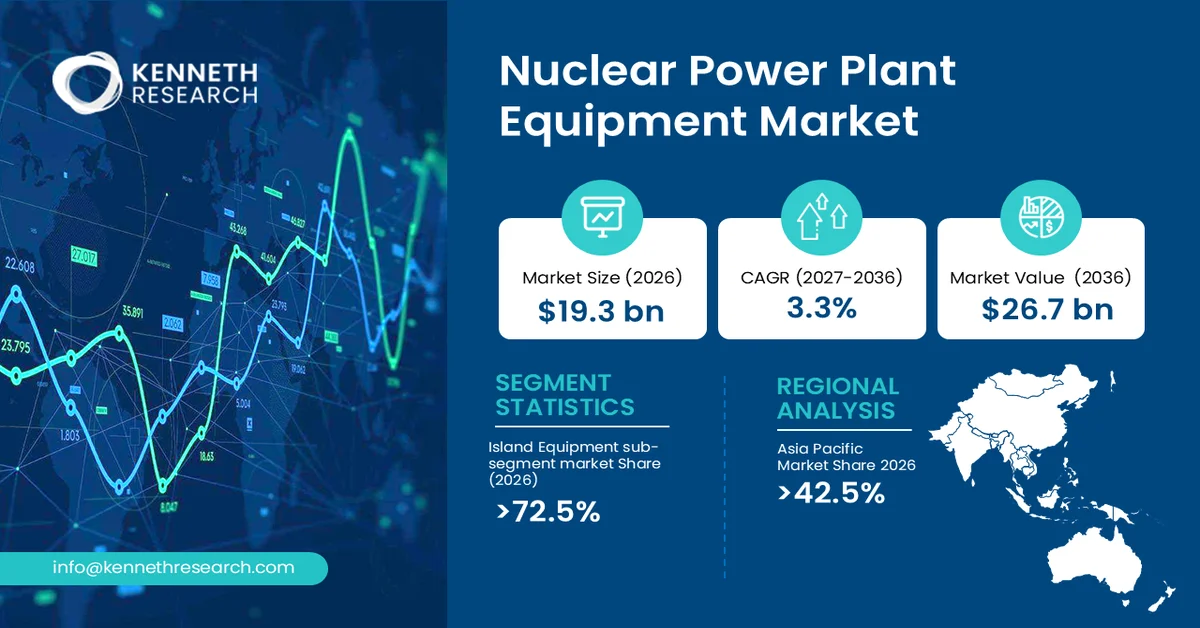
Nuclear Power Plant Equipment Market size was valued at USD 19.3 Billion in 2026 and is projected to reach USD 26.7 Billion by the end of 2036, rising at a CAGR of 3.3% during the forecast period, i.e., 2027–2036. In 2027, the industry size of the global nuclear power plant equipment is estimated at USD 19.9 Billion.
The primary growth driver is rising investment in nuclear plant life extension, ageing management, and new-build programmes. IAEA reporting indicates that ageing reactor fleets are prompting investment in long-term operation programmes, while governments and utilities pursue reliable nuclear generation and additional capacity, supporting sustained demand for specialised plant equipment and replacement components.
The nuclear power plant equipment market comprises the equipment, systems, components, and associated hardware used to construct, operate, maintain, modernise, and extend the service life of nuclear power plants. It encompasses equipment supporting the reactor island and other plant areas, including systems responsible for heat generation, steam production, power conversion, cooling, control, monitoring, safety, electrical functions, and supporting plant operations.
Key characteristics of the market include stringent nuclear-grade quality requirements, extensive regulatory oversight, long procurement cycles, high engineering complexity, and the need for specialised manufacturing and certification capabilities. Equipment must satisfy demanding requirements for reliability, safety, materials performance, traceability, and operational durability. The market therefore depends on specialised suppliers and coordinated procurement across interconnected nuclear supply chains.
Key Nuclear Power Plant Equipment Market Insights Summary:
Key Takeaways: Market Trends & Insights
- Nuclear Power Plant Equipment Market is projected to reach USD 26.7 billion by 2036 from USD 19.3 billion in 2026, expanding at a 3.3% CAGR over 2027–2036
- Island Equipment is the leading application segment with a 72.5% market share in 2026, driven by nuclear plant construction, modernisation, and specialised equipment demand
- Pressurized Water Reactor is identified as the second and fastest analysis segment, supported by active PWR construction, established engineering capabilities, and mature equipment supply chains
- Asia Pacific is the dominant regional market with a 42.5% market share in 2026, led by nuclear investment and equipment demand in China and Japan
- North America is the secondary region, with the United States and Canada offering opportunities through nuclear fleet maintenance, plant modernisation, advanced-reactor development, and SMR programmes
Market Drivers
- Nuclear plant life extension and ageing-management programmes
- Deployment of advanced reactors and small modular reactor technologies
- Government support for domestic nuclear supply-chain resilience
- Increasing Demand for Reliable Low-Carbon Electricity
Challenges
- Limited nuclear-grade supplier capacity and skilled workforce
- Complex and fragmented regulatory requirements
Nuclear Power Plant Equipment Market Overview & Supply Chain
Adoption of nuclear power plant equipment is increasing globally as governments and utilities seek dependable low-emission electricity, strengthen energy security, and extend the operating life of existing nuclear assets while advancing new reactor programmes. Equipment demand is closely linked to reactor construction, refurbishment, safety upgrades, digitalisation, maintenance, and replacement of critical components. Technological developments in advanced reactors and small modular reactors are also encouraging suppliers to adapt manufacturing, quality-assurance, and engineering capabilities.
The nuclear power plant equipment value chain begins with specialised inputs including nuclear-grade metals, forgings, castings, electrical materials, instrumentation components, control systems, valves, pumps, and engineered materials sourced from qualified suppliers. Equipment manufacturers then transform these inputs into reactor, island, turbine, electrical, cooling, safety, and auxiliary systems through highly controlled engineering and production processes. Quality assurance, traceability, testing, certification, and regulatory compliance are embedded throughout manufacturing. Distribution typically occurs through direct procurement, approved vendor networks, engineering-procurement-construction contractors, and long-term utility agreements. End users include nuclear utilities, plant operators, reactor developers, and government-backed nuclear organisations. Major stakeholders span equipment manufacturers, component suppliers, reactor designers, EPC contractors, utilities, regulators, technical support organisations, standards bodies, and specialised service providers.
Nuclear Power Plant Equipment Market: Growth Drivers & Challenges
Growth Drivers
- Expansion of new nuclear capacity at existing sites: The expansion of nuclear generation programmes is creating direct demand for reactor, island, electrical, cooling, safety, and auxiliary equipment. Reusing established nuclear sites can reduce infrastructure-development complexity because existing grid connections, industrial infrastructure, workforce capabilities, and regulatory knowledge may be leveraged for new projects. This creates opportunities for equipment manufacturers across both conventional reactors and emerging reactor technologies. The U.S. Department of Energy reported in 2024 that more than 60 gigawatts of new nuclear capacity could potentially be built at operating or recently retired nuclear power plant sites.
- Increasing demand for reliable low-carbon electricity: Growing electricity requirements are strengthening the strategic role of nuclear generation because nuclear plants can provide continuous power without direct carbon emissions during electricity production. This is particularly relevant as electricity systems integrate variable renewable generation, electrify industrial processes, and accommodate increasing requirements from digital infrastructure and other high-load applications. For equipment suppliers, the resulting emphasis on reliable nuclear generation supports demand for high-performance systems that improve plant availability, operational resilience, safety, monitoring, and maintenance. It also encourages utilities to modernise existing facilities rather than relying solely on new construction.
Challenges
- Limited nuclear-grade supplier capacity and skilled workforce: A major restraint is the specialised supplier base required to manufacture, qualify, inspect, and maintain nuclear-grade equipment. Nuclear components must satisfy stringent quality and traceability requirements, while manufacturers need specialised engineering capabilities and personnel familiar with nuclear standards. The OECD Nuclear Energy Agency identifies a declining number of nuclear-grade suppliers and loss of skills in some regions as specific supply-chain challenges. This can restrict sourcing options, increase dependence on established vendors, and complicate procurement for utilities and reactor developers. Commercially, constrained supplier capacity can extend qualification and manufacturing cycles, increase coordination requirements, and make project schedules more vulnerable to disruptions at individual vendors.
- Complex and fragmented regulatory requirements: Regulatory complexity can restrain equipment procurement because nuclear projects must satisfy detailed safety, quality, design, and certification requirements that may differ across jurisdictions. Suppliers serving international markets can therefore face repeated engineering reviews, documentation requirements, qualification processes, and adaptations to different codes and standards. The IAEA notes that varying legislative frameworks and related regulatory requirements can require nuclear projects to be tailored to individual jurisdictions, while differences in codes and standards can impede innovation. Commercially, this increases the administrative and technical burden associated with market entry and can discourage smaller manufacturers from serving multiple nuclear markets.
Nuclear Power Plant Equipment Market Size and Forecast:
| Report Attribute | Details |
|---|---|
| Base Year |
2026 |
| Forecast Period |
2027-2036 |
| CAGR |
3.3% |
| Base Year Market Size (2026) |
USD 19.3 Billion |
| Forecast Year Market Size (2036) |
USD 26.7 Billion |
| Regional Scope |
|
Nuclear Power Plant Equipment Market Segmentation Analysis:
Carrier Segment Analysis
In the carrier segment, Island Equipment sub-segment is anticipated to capture the largest market share of 72.5% by the end of 2026.
Island Equipment dominates the nuclear power plant equipment market because it encompasses critical systems and components located within the nuclear island, where reactor safety, heat generation, containment, cooling, and core-support functions are concentrated. Demand is supported by new reactor construction, plant modernisation, safety upgrades, and replacement of specialised equipment across operating facilities. The segment also benefits from stringent qualification requirements that favour established nuclear-grade manufacturers and reinforce long-term supplier relationships. Supply-side capabilities are also expanding through digitalised inspection, manufacturing oversight, and equipment qualification. Future adoption should remain supported by continued reactor construction and lifecycle requirements for nuclear-island systems.
Reactor Segment Analysis
The Pressurized Water Reactor is projected to grow as the second-largest segment in the nuclear power plant equipment market due to four converging demand drivers.
The Pressurized Water Reactor (PWR) segment is projected to grow because PWR technology remains central to current nuclear construction and provides an established platform for utilities seeking proven reactor designs. Demand is supported by new-build programmes, replacement and modernisation requirements, and the expansion of nuclear generation in Asia and other markets. Adoption benefits from an established engineering ecosystem, experienced operators, qualified equipment suppliers, and mature regulatory knowledge, which can reduce technology-transition barriers for projects. Supply-side maturity should continue supporting deployment, while ongoing reactor construction and fleet modernisation create opportunities for specialised equipment suppliers. Future growth is therefore expected to remain closely linked to PWR new-build pipelines and lifecycle investment.
Our in-depth analysis of the global nuclear power plant equipment market includes the following segments:
|
Segment |
Sub-segment |
|
Carrier |
|
|
Reactor |
|
Nuclear Power Plant Equipment Market Regional Insights:
Asia Pacific Trends & Insights:
Asia Pacific nuclear power plant equipment market is projected to hold the largest revenue share of 42.5% by the end of 2026.
It is supported by concentrated nuclear construction activity, expanding electricity requirements, established nuclear manufacturing capabilities, and sustained government backing for nuclear development. The region combines large operating fleets with active new-build programmes, creating demand across reactor equipment, island systems, electrical infrastructure, cooling systems, instrumentation, and lifecycle replacement equipment.
China is the region’s principal growth engine, supported by a large domestic reactor programme, extensive equipment manufacturing capabilities, and continued government approval of new nuclear units.
Japan represents a complementary market, with demand driven by reactor restarts, existing-fleet maintenance, safety-related upgrades, and long-term plant management. Japan’s Ministry of Economy, Trade and Industry states that 12 nuclear reactors were operating as of January 2024, reflecting continued progress in reactor restarts under strengthened safety requirements. Together, China and Japan provide a combination of new-build procurement, operational fleet requirements, refurbishment, and specialised nuclear equipment demand.
North America Trends & Insights:
North America remains an important market for nuclear power plant equipment because of its established reactor fleet, extensive nuclear engineering capabilities, and renewed emphasis on energy security and dependable low-carbon electricity. Demand is supported by plant life-extension programmes, refurbishment, reactor restarts, advanced-reactor development, and investment in domestic nuclear supply chains.
The United States represents the region's principal equipment opportunity, with federal policy supporting reactor operation extensions, advanced-reactor demonstrations, plant restarts, domestic fuel infrastructure, and new nuclear deployment. The ADVANCE Act is also intended to facilitate deployment of new reactor technologies, strengthening the longer-term pipeline for specialised equipment and engineering services.
Canada offers complementary opportunities through its established CANDU ecosystem and growing SMR programme. Government initiatives are supporting SMR research, manufacturing capabilities, waste-management solutions, and supply-chain development, while utilities and provincial stakeholders evaluate new nuclear applications. Together, the two countries provide a combination of large-fleet maintenance demand, advanced-reactor development, component manufacturing, and emerging SMR procurement opportunities.
Leading Companies Operating in the Nuclear Power Plant Equipment Market:
Here is a list of upstream, downstream, and key players operating in the global nuclear power plant equipment competitive ecosystem:
- Westinghouse Electric Company LLC (United States)
- Company Overview
- Business Strategy
- Key Product Offerings
- Financial Performance
- Key Performance Indicators
- Risk Analysis
- Recent Development
- Regional Presence
- SWOT Analysis
- Framatome S.A. (France)
- China National Nuclear Corporation (China)
- NuScale Power, LLC (United States)
- Rolls-Royce Holdings plc (United Kingdom)
- Bharat Heavy Electricals Limited (BHEL) (India)
Recent Developments
- In August 2026, China National Nuclear Corporation (CNNC) received State Council approval for eight new reactor units, including six Hualong One reactors and two demonstration units of the upgraded Hualong One 2.0 version. The approved units cover Jinqimen, Taipingling, Zhuanghe, and Laiyang nuclear power plants across Zhejiang, Guangdong, Liaoning, and Shandong provinces. To date, 10 Hualong One units are in commercial operation globally, with another 37 approved and under construction.
- In July 2026, Bharat Heavy Electricals Limited (BHEL) reported a capital expenditure of Rs. 671 Crore during FY 2025-26 toward modernization and capacity expansion, including approximately Rs. 70 Crore for its Tiruchirappalli unit. BHEL has supplied equipment for 5.4 GW of nuclear power units and is executing turbine generator overhauling at India's 500 MW Prototype Fast Breeder Reactor (PFBR) at Kalpakkam, which achieved first criticality in April 2026 and is progressing toward grid synchronization.
Frequently Asked Question
In 2026, the nuclear power plant equipment market exceeded USD 19.3 billion.
The nuclear power plant equipment market is projected to reach USD 26.7 billion by the end of 2036, expanding at a CAGR of 3.3% over the forecast period (2027–2036).
he major players in the market are Westinghouse Electric Company LLC, Framatome S.A., China National Nuclear Corporation, NuScale Power, LLC, Rolls-Royce Holdings plc, Bharat Heavy Electricals Limited (BHEL), and others.
In the Carrier segment, the Island Equipment sub-segment is anticipated to capture the largest market share of 72.5% in the future and exhibit lucrative growth opportunities during 2027–2036. This growth trajectory is largely attributed to continued nuclear plant construction, modernisation, and demand for specialised nuclear-island equipment.
Asia Pacific is projected to hold the largest market share of 42.5% by the end of 2036 and provide more business opportunities in the future. Continuous nuclear construction, fleet modernisation, and investment in China and Japan are fostering the region's dominance.
Why Choose Kenneth Research ?
-
Insight with Impact : We don’t just gather data — we uncover stories, trends, and opportunities that fuel business growth.
-
Experts Who Get It : Our team speaks your industry’s language and knows what really matters to your customers and market.
-
Custom-Built for You : Forget one-size-fits-all. We craft research and consulting solutions as unique as your business vision.
-
Partners, Not Just Providers : We work with you, not for you — collaborating closely to turn insights into smart, strategic moves.
-
Results That Speak : Our work powers brands, startups, and industry leaders alike — with a track record of ideas that work in the real world.
Report ID: 1249 |
Published Date: 01 Sep 2026 |
Report Format: |
Delivery Timeline: 48-72 Business Hours

Copyright © 2025 Kenneth Research. All rights reserved. Terms of Use | Privacy Policy
