Report ID: 1280 |
Published Date: 01 Sep 2026 |
Report Format: |
Delivery Timeline: 48-72 Business Hours
Next-Generation Energy Storage Systems Market Outlook:
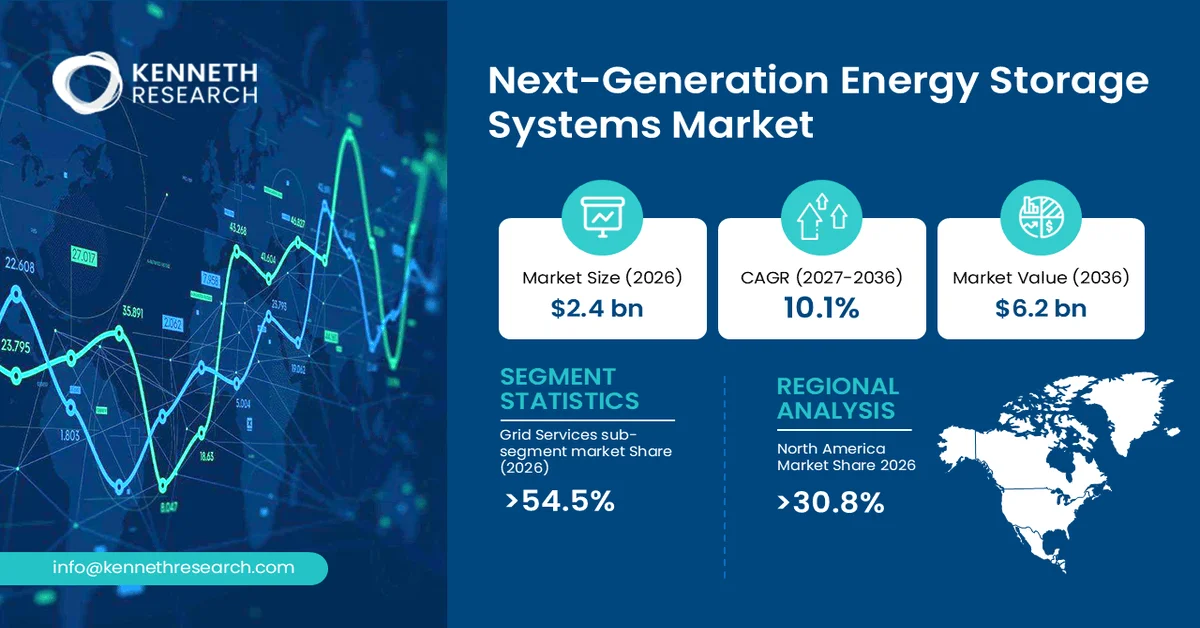
Next-Generation Energy Storage Systems Market size was valued at USD 2.4 billion in 2026 and is projected to reach USD 6.2 billion by the end of 2036, rising at a CAGR of 10.1% during the forecast period, i.e., 2027-2036. In 2027, the industry size of the next-generation energy storage systems is estimated at USD 2.6 billion.
The primary growth driver for the next-generation energy storage systems market is the increasing need for grid flexibility and reliability as power systems integrate variable renewable generation.
The next-generation energy storage systems market encompasses advanced technologies that store electrical or thermal energy and release it when required to improve power-system flexibility, reliability, resilience, and efficiency. These systems include advanced battery technologies, emerging electrochemical storage, long-duration storage, thermal storage, mechanical systems, and other innovative solutions designed to address the evolving requirements of modern energy infrastructure.
Key characteristics include high energy and power performance, rapid response capabilities, scalability, enhanced safety, longer operating life, and compatibility with renewable-energy and intelligent-grid applications.
Key Next-Generation Energy Storage Systems Market Insights Summary:
Key Takeaways: Market Trends & Insights
- Next-Generation Energy Storage Systems Market projected to grow from USD 2.4 billion in 2026 to USD 6.2 billion by 2036 at a 10.1% CAGR.
- North America accounted for the largest regional share at 30.8% in 2026, supported by grid modernization, utility-scale storage deployment, renewable-energy integration, and advanced energy infrastructure across the U.S. and Canada.
- Grid Services is expected to remain the leading Application segment with a 54.5% market share in 2026, driven by increasing demand for grid flexibility, frequency regulation, renewable-energy balancing, and power-system resilience.
- Advanced Lithium-ion is projected to witness strong growth within the Technology segment, supported by established manufacturing capabilities, high energy density, rapid response performance, and expanding adoption in stationary energy-storage applications.
Market Drivers
- Accelerating renewable-energy integration and grid modernization.
- Rising demand for long-duration energy storage and grid resilience.
- Increasing electrification and peak-load management requirements.
- Advancements in battery chemistry, energy-management systems, and storage safety technologies.
Challenges
- Safety, reliability, and regulatory compliance requirements.
- Supply chain vulnerabilities and manufacturing scale-up constraints.
Next-Generation Energy Storage Systems Market Overview & Supply Chain
The adoption of next-generation energy storage systems is increasing globally as electricity networks incorporate more variable renewable generation and require greater flexibility, reliability, and resilience. Advanced storage technologies can shift electricity across periods of supply and demand, support renewable integration, provide backup power, and deliver grid-balancing functions. Government policy is also strengthening deployment conditions. In April 2024, the U.S. Department of Energy simplified environmental review procedures for certain battery and flywheel energy-storage projects, specifically to reduce costs and delays associated with development.
The industry value chain begins with raw-material and component suppliers providing battery materials, electrolytes, electrode materials, separators, power electronics, thermal-management components, control systems, and other specialized inputs. Technology developers then design cells, modules, power-conversion systems, battery-management systems, and integrated storage architectures. System manufacturers assemble and test complete storage units before deployment through engineering, procurement, and construction contractors, energy developers, utilities, and specialized integrators.
Next-Generation Energy Storage Systems Market: Growth Drivers & Challenges
Growth Drivers
- Rising need for grid flexibility and renewable energy integration: The increasing penetration of variable renewable electricity is strengthening demand for next-generation energy storage systems capable of balancing fluctuations between generation and consumption. Storage can absorb excess electricity when renewable output is high and discharge it when generation falls, while also supporting frequency and voltage regulation. The U.S. Government Accountability Office identifies utility-scale storage as a technology that can improve grid reliability, reduce costs, and facilitate greater adoption of variable solar and wind generation. This is encouraging utilities and grid operators to evaluate advanced batteries, long-duration storage, and other technologies for increasingly complex grid-service requirements.
- Increasing demand for long-duration and advanced storage technologies: The shift toward more flexible electricity systems is encouraging investment in storage technologies that can serve applications beyond short-duration balancing. Utilities and energy developers increasingly require systems capable of addressing extended periods of renewable intermittency, peak demand, resilience requirements, and transmission constraints. This is creating opportunities for advanced lithium-ion systems as well as flow batteries, thermal storage, compressed-air systems, pumped storage, and other emerging technologies. Technology developers are consequently focusing on improving energy density, cycle performance, safety, operating duration, and lifecycle economics.
Challenges
- Safety, reliability, and regulatory compliance requirements: The deployment of next-generation energy storage systems faces significant safety and regulatory challenges because large-scale installations involve high-energy equipment, complex electrical interfaces, thermal-management systems, and potentially hazardous operating conditions. Governments and industry bodies are consequently strengthening requirements covering system design, installation, transportation, operation, emergency response, and decommissioning. The UK Department for Energy Security and Net Zero issued dedicated grid-scale energy-storage health and safety guidance in 2024 to clarify applicable standards and improve industry understanding of safety requirements.
- Supply chain vulnerabilities and manufacturing scale-up constraints: Supply chain dependency and manufacturing scale-up remain important restraints for the next-generation energy storage systems market. Advanced storage technologies require specialized materials, cells, power electronics, control components, and manufacturing capabilities, while emerging chemistries often lack mature supplier ecosystems. The U.S. Department of Energy has identified vulnerabilities associated with dependence on overseas components for lithium-ion grid storage and noted that alternative long-duration technologies still face underdeveloped supply chains.
Next-Generation Energy Storage Systems Market Size and Forecast:
| Report Attribute | Details |
|---|---|
| Base Year |
2026 |
| Forecast Period |
2027-2036 |
| CAGR |
10.1% |
| Base Year Market Size (2026) |
USD 2.4 billion |
| Forecast Year Market Size (2036) |
USD 6.2 billion |
| Regional Scope |
|
Next-Generation Energy Storage Systems Market Segmentation Analysis:
Application Segment Analysis
In the Application segment, the Grid Services sub-segment is anticipated to capture the largest market share of 54.5% by the end of 2036. Its dominance is supported by the expanding need for technologies that can improve grid flexibility, reliability, resilience, and power-quality management as electricity systems incorporate more variable renewable generation. Energy storage can provide frequency regulation, contingency reserves, peak management, renewable-energy smoothing, and other balancing functions, making it increasingly valuable to utilities and grid operators. The U.S. Department of Energy identifies energy storage as a critical technology for modernizing the electricity grid and supporting clean-energy integration.
The segment is also benefiting from increased deployment of utility-scale storage and greater integration of storage into grid-planning strategies. Utilities are increasingly evaluating storage as an alternative or complement to conventional infrastructure for managing changing load profiles and renewable generation.
Technology Type Segment Analysis
In the Technology segment, Advanced Lithium-ion is projected to grow strongly as utilities, renewable-energy developers, and other energy-intensive users seek storage technologies that combine high energy density, rapid response, established manufacturing capabilities, and improving lifecycle performance. Lithium-ion systems are increasingly deployed for grid storage, renewable-energy integration, peak management, and backup applications, benefiting from an established technology ecosystem and expanding production capacity.
Industry adoption is also supported by continuing investment in domestic battery manufacturing and technology development. Supply-side improvements in cell chemistry, battery-management systems, thermal management, and manufacturing automation are improving system performance and operational reliability.
Our in-depth analysis of the global next-generation energy storage systems market includes the following segments:
|
Segment |
Sub-segment |
|
Application |
|
|
Technology |
|
|
End User |
|
Next-Generation Energy Storage Systems Market Regional Insights:
North America Market Trends & Insights:
North America accounted for the largest regional share of 30.8% in 2026, supported by strong utility-scale storage deployment, grid modernization programs, advanced technology development, and growing renewable-energy integration. The region benefits from substantial investment in electricity infrastructure and an established ecosystem spanning utilities, technology developers, research institutions, and energy project developers. Government initiatives are also strengthening the deployment environment.
The U.S. represents the principal market within the region, supported by rapid utility-scale battery deployment and increasing integration of storage into electricity-system planning. The U.S. Energy Information Administration reported that operators added 5 GW of utility-scale battery capacity during the first seven months of 2024, demonstrating strong investment momentum.
Canada is also strengthening its storage ecosystem through government-backed grid modernization and renewable-energy initiatives. In 2024, the Canadian government supported battery storage projects designed to improve renewable integration and grid reliability, including projects connected with wind generation.
Asia-Pacific Market Trends & Insights:
Asia-Pacific represents a strategically important market for next-generation energy storage systems, supported by expanding renewable-energy deployment, rapid electrification, industrial modernization, and growing requirements for grid flexibility. Governments across the region are strengthening energy-storage capabilities to accommodate variable renewable generation, improve electricity-system resilience, and support the transition toward lower-carbon power systems. The region also benefits from a deep battery manufacturing ecosystem, established electronics supply chains, and increasing investment in advanced energy technologies.
Japan is advancing energy-storage adoption through its focus on grid resilience, renewable integration, energy security, and advanced battery technology. The country's sophisticated manufacturing ecosystem and expertise in battery research provide a strong foundation for next-generation storage development.
China represents another major regional growth engine, supported by its extensive battery manufacturing base, large renewable-energy sector, and rapidly expanding electricity infrastructure. Increasing deployment of energy storage alongside solar and wind generation is creating opportunities for advanced lithium-ion, sodium-ion, and other emerging technologies.
Leading Companies Operating in the Global Next-Generation Energy Storage Systems Market:
Here is a list of upstream, downstream, and key players operating in the global next-generation energy storage systems market competitive ecosystem:
- CATL (China)
- Company Overview
- Business Strategy
- Key Product Offerings
- Financial Performance
- Key Performance Indicators
- Risk Analysis
- Recent Development
- Regional Presence
- SWOT Analysis
- Tesla (United States)
- Fluence (United States)
Recent Developments
- August 2026 —Form Energy secured a Series G financing round to scale manufacturing of its iron-air battery systems and accelerate commercial deployments.
- July 2026 —CATL announced a collaboration with Alfen to deploy its advanced sodium-ion battery energy storage systems across Europe.
Frequently Asked Question
In 2026, the next-generation energy storage systems market exceeded USD 2.4 billion.
The next-generation energy storage systems market is projected to reach USD 6.2 billion by the end of 2036, expanding at a CAGR of 10.1% over the forecast period (2027–2036).
The major players in the market are CATL, Tesla, Fluence, Wärtsilä, BYD Energy Storage, Form Energy, ESS Inc., and others.
In the Application segment, the Grid Services sub-segment is anticipated to capture the largest market share of 54.5% in the future and exhibit lucrative growth opportunities during 2027–2036.
North America is projected to hold the largest market share of 30.8% by the end of 2026 and provide more business opportunities in the future.
Why Choose Kenneth Research ?
-
Insight with Impact : We don’t just gather data — we uncover stories, trends, and opportunities that fuel business growth.
-
Experts Who Get It : Our team speaks your industry’s language and knows what really matters to your customers and market.
-
Custom-Built for You : Forget one-size-fits-all. We craft research and consulting solutions as unique as your business vision.
-
Partners, Not Just Providers : We work with you, not for you — collaborating closely to turn insights into smart, strategic moves.
-
Results That Speak : Our work powers brands, startups, and industry leaders alike — with a track record of ideas that work in the real world.
Report ID: 1280 |
Published Date: 01 Sep 2026 |
Report Format: |
Delivery Timeline: 48-72 Business Hours

Copyright © 2025 Kenneth Research. All rights reserved. Terms of Use | Privacy Policy
