Report ID: 1268 |
Published Date: 01 Sep 2026 |
Report Format: |
Delivery Timeline: 48-72 Business Hours
Modular Packaging Equipment Market Outlook:
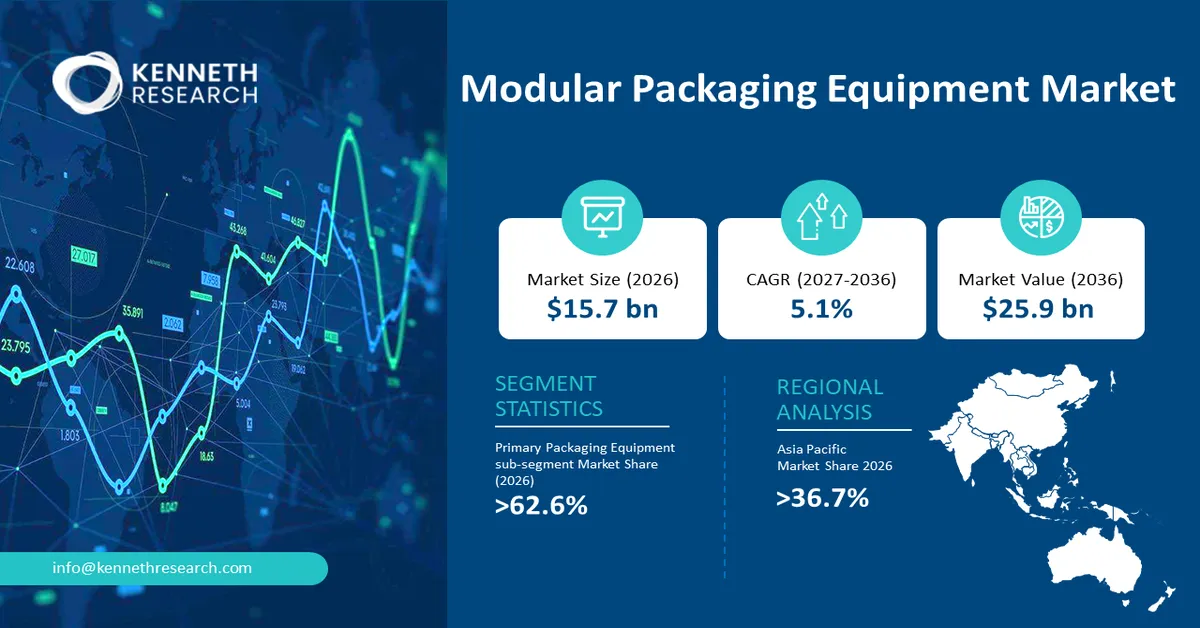
Modular Packaging Equipment Market size was valued at USD 15.7 billion in 2026 and is projected to reach USD 25.9 billion by the end of 2036, rising at a CAGR of 5.1% during the forecast period, i.e., 2027-2036. In 2027, the industry size of the modular packaging equipment is estimated at USD 16.5 billion.
A primary growth driver is rising investment in packaging automation and equipment modernization as manufacturers seek higher throughput, consistent quality, flexible production, and lower manual intervention.
The modular packaging equipment market comprises packaging machinery designed with configurable, interoperable modules that can be combined, replaced, or reconfigured to perform distinct packaging operations. These systems can cover feeding, filling, dosing, forming, sealing, labeling, inspection, coding, conveying, wrapping, case packing, and related material-handling functions. Their defining characteristics include modular architecture, scalable line configuration, integration with automation and control systems, changeover flexibility, and the ability to adapt equipment to different products, package formats, production requirements, and plant layouts. Modular designs can also support phased capacity expansion, equipment upgrades, maintenance, and integration with connected manufacturing environments.
Industrially, the market serves manufacturers that require dependable packaging processes across food and beverages, pharmaceuticals, personal care, consumer goods, chemicals, and other packaged products. Government policy discussions in India similarly identify packaging machinery as part of the broader food-processing equipment ecosystem and emphasize technology adoption, research, innovation, and modernization as priorities for improving industrial competitiveness.
Key Modular Packaging Equipment Market Insights Summary:
Key Takeaways: Market Trends & Insights
- The modular packaging equipment market is projected to grow from USD 15.7 billion in 2026 to USD 25.9 billion by 2036, expanding at a CAGR of 5.1% during 2027-2036
- Primary Packaging Equipment dominates the Type segment with a 62.6% market share in 2026, supported by demand for product protection, hygiene, shelf-life management, and efficient packaging operations
- Automatic Systems represent the second fastest-growing segment, driven by increasing demand for continuous production, consistent packaging quality, labor optimization, and integration with factory automation
- Asia Pacific leads the regional landscape with a 36.7% market share in 2026, supported by manufacturing expansion, automation investment, and established industrial ecosystems across China and Japan
- North America remains a significant secondary region, with the United States and Canada providing opportunities through manufacturing modernization, automation adoption, supply-chain resilience, and flexible packaging-line upgrades
Market Drivers
- Expansion of smart manufacturing and connected factory infrastructure
- Increasing requirements for packaging-line efficiency, traceability, and quality assurance
- Growing adoption of robotics and digitally integrated production systems
- Need for scalable equipment capable of supporting frequent product and format changes
Challenges
- Integration Complexity Across Multi-Vendor Equipment
- High Customization and Changeover Requirements
Modular Packaging Equipment Market Overview & Supply Chain
Global adoption of modular packaging equipment is increasing as manufacturers seek flexible, scalable, and automation-ready systems that can accommodate changing product formats, shorter production runs, hygiene requirements, and evolving packaging specifications. The equipment is particularly relevant to food and beverage processing, where packaging is integral to product protection, shelf-life management, traceability, and efficient downstream distribution. Government-backed industry evidence reinforces this relevance: India’s Ministry of Food Processing Industries reports that food processing accounted for 12.41% of employment in the total registered/organized sector, based on the Annual Survey of Industries 2022-23. This industrial footprint supports continued investment in packaging technologies that improve throughput, product consistency, hygiene, and operational flexibility.
The modular packaging equipment value chain begins with input suppliers providing stainless steel, engineering plastics, electrical components, sensors, drives, controllers, motors, robotics components, and packaging-contact materials. Equipment manufacturers then engineer, fabricate, assemble, integrate, and test modular systems, often combining mechanical platforms with controls, inspection, conveying, filling, sealing, labeling, and end-of-line capabilities. System integrators and technology partners connect equipment with plant-level automation and production-management environments. Distribution occurs through direct manufacturer sales, specialized machinery distributors, engineering contractors, and regional service networks. End users include food and beverage processors, pharmaceutical manufacturers, personal-care companies, consumer-goods producers, and industrial manufacturers.
Modular Packaging Equipment Market: Growth Drivers & Challenges
Growth Drivers:
- Rising industrial automation and productivity requirements: Manufacturers are increasingly adopting automated packaging equipment to improve throughput, process consistency, quality control, and workforce utilization. Modular architectures strengthen this trend because individual machines, robotic cells, sensors, inspection systems, and controls can be integrated or upgraded without requiring a complete production-line replacement. This allows manufacturers to modernize packaging operations incrementally while responding to changing product formats and production requirements. Government-backed evidence demonstrates the operational value of this transition. A 2023 U.S.
- Demand for flexible and reconfigurable production: Packaging manufacturers face increasing pressure to accommodate product diversification, shorter production cycles, frequent format changes, and customized packaging requirements. Conventional dedicated machinery can create operational constraints when production environments require repeated changeovers or different packaging configurations. Modular equipment addresses this challenge by enabling manufacturers to combine standardized machine modules, change individual process components, and configure equipment around specific production requirements. This flexibility is particularly valuable for producers serving multiple product categories, where packaging operations must adapt without extensive equipment replacement or prolonged downtime. Modular architectures can also facilitate phased investment, allowing companies to add functionality as production needs evolve.
Challenges:
- Integration complexity across multi-vendor equipment: A major restraint is the technical complexity involved in integrating modular equipment supplied by different manufacturers. Packaging lines commonly combine filling, conveying, inspection, labeling, sealing, and end-of-line systems, each potentially using different control architectures, communication protocols, software environments, and mechanical interfaces. The root cause is limited standardization across equipment ecosystems and the continued coexistence of legacy machinery with newer digitally enabled modules. This creates commissioning difficulties, increases dependence on specialist system integrators, and can complicate troubleshooting and maintenance. Commercially, buyers may face higher engineering requirements and greater lifecycle costs, reducing the immediate attractiveness of modular upgrades compared with more standardized solutions.
- High customization and changeover requirements: The flexibility that makes modular packaging equipment attractive can also create operational complexity when manufacturers handle diverse products, packaging formats, materials, and production specifications. Frequent configuration changes require appropriate tooling, machine settings, recipes, validation procedures, cleaning routines, and operator intervention. The root cause is the growing need to support varied product portfolios without compromising packaging quality or production continuity. Poorly managed changes can increase downtime, complicate scheduling, and place additional demands on technical personnel, particularly where equipment modules are not designed around coordinated changeover procedures. Commercial implications include higher implementation and training requirements, more complicated maintenance strategies, and pressure on suppliers to provide extensive customization rather than standardized equipment.
Modular Packaging Equipment Market Size and Forecast:
| Report Attribute | Details |
|---|---|
| Base Year |
2026 |
| Forecast Period |
2027-2036 |
| CAGR |
5.1% |
| Base Year Market Size (2026) |
USD 15.7 billion |
| Forecast Year Market Size (2036) |
USD 25.9 billion |
| Regional Scope |
|
Modular Packaging Equipment Market Segmentation Analysis:
Type Segment Analysis
In the type segment, the Primary Packaging Equipment sub-segment is anticipated to capture the largest market share of 62.6% by the end of 2026.
Primary packaging equipment dominates because it performs the first packaging operation that directly contains and protects the product, making it fundamental to product integrity, hygiene, shelf-life, labeling, and consumer presentation. Demand is supported by the broad requirement across food, beverages, pharmaceuticals, personal care, and consumer products for filling, forming, sealing, capping, and related operations. Regulatory attention also reinforces the segment’s importance: the UK government classifies primary packaging as packaging used to contain a single sales unit at the point of purchase, while its extended producer-responsibility framework requires producers to distinguish primary packaging within packaging-data reporting. This regulatory visibility encourages manufacturers to improve control over packaging formats, materials, and production processes.
Automation Level Segment Analysis
The Automatic Systems is projected to grow as the second-largest segment in the modular packaging equipment market due to four converging demand drivers.
Automatic systems are projected to expand rapidly as manufacturers prioritize continuous production, consistent packaging quality, labor optimization, and integration with broader factory-automation architectures. Demand is particularly relevant where packaging operations involve repetitive picking, handling, filling, sealing, inspection, or product transfer that can be standardized and automated. Government-backed analysis from the UK Department for Business, Energy & Industrial Strategy identifies food and drink manufacturing as an important application area for robotics and automation, including packaging, picking, and preparation, and projects productivity in the sector to increase by 4.6% relative to the baseline by 2035 through robotics and autonomous systems adoption. This provides a strong structural rationale for automated packaging investment.
Our in-depth analysis of the global modular packaging equipment market includes the following segments:
|
Segment |
Sub-segment |
|
Type |
|
|
Automation Level |
|
Modular Packaging Equipment Market Regional Insights:
Asia Pacific Market Trends & Insights:
Asia Pacific modular packaging equipment market is projected to hold the largest revenue share of 36.7% by the end of 2026.
Asia Pacific remains the dominant regional market for modular packaging equipment, supported by its extensive manufacturing base, expanding packaged-goods production, rising automation investment, and large concentration of food, beverage, pharmaceutical, electronics, and consumer-goods manufacturers. The region’s industrial depth creates sustained demand for packaging systems that can accommodate higher production requirements, multiple formats, and increasingly automated operations.
China leads regional demand through its broad manufacturing ecosystem, extensive domestic consumer base, and substantial equipment-investment activity. Its packaging-equipment opportunity is reinforced by the scale and diversity of food, beverage, pharmaceutical, chemical, and consumer-product manufacturing.
Japan represents a complementary high-value market, characterized by sophisticated manufacturing capabilities and strong emphasis on precision, factory automation, quality control, and equipment reliability. Japanese manufacturers and packaging operators provide an established customer base for modular systems that can integrate advanced controls and automation. Together, China and Japan strengthen Asia Pacific’s position through a combination of manufacturing scale, technology intensity, equipment modernization, and established industrial supply chains.
North America Market Trends & Insights:
North America represents an attractive secondary market for modular packaging equipment, supported by sophisticated manufacturing operations, strong demand for automation, and increasing emphasis on resilient domestic production. Manufacturers across food and beverage, pharmaceuticals, consumer goods, and industrial products are upgrading packaging operations to improve flexibility, traceability, quality control, and production efficiency. Government initiatives are reinforcing this environment through support for advanced manufacturing, domestic supply-chain development, automation, and packaging-related innovation.
The United States offers the larger opportunity within the region because of its extensive industrial base, established automation ecosystem, and continued investment in domestic manufacturing capabilities. Government-backed manufacturing programs are also supporting technology commercialization and supply-chain resilience, which can stimulate demand for modern production equipment.
Canada provides a complementary opportunity through its manufacturing modernization agenda and increasing adoption of automation. Canadian government initiatives specifically support advanced manufacturing projects incorporating robotics, artificial intelligence, and automated production systems, creating an environment conducive to flexible packaging-line modernization. Together, the United States and Canada offer equipment manufacturers opportunities across both large-scale industrial operations and smaller producers seeking adaptable automation solutions.
Leading Companies Operating in the Global Modular Packaging Equipment Market:
Here is a list of upstream, downstream, and key players operating in the modular packaging equipment market competitive ecosystem:
- Krones AG (Germany)
- Company Overview
- Business Strategy
- Key Product Offerings
- Financial Performance
- Key Performance Indicators
- Risk Analysis
- Recent Development
- Regional Presence
- SWOT Analysis
- Syntegon Technology (Germany)
- IMA Group (Italy)
- Coesia Group (Italy)
- Sidel Group (France)
Recent Developments
- In May 2026, Krones introduced Robobox SynFlow, the first system to use robotics for container distribution into lanes, featuring a tripod robot that intelligently groups incoming containers and closes gaps on the fly to ensure consistent packer supply. The system handles up to 105,000 containers per hour, reduces line footprint by approximately 10%, and uses high-performance permanent-magnet motors that require up to 50% less power than conventional asynchronous motors.
- In October 2025, Syntegon introduced its SVX series vertical packaging machine to the Indian market, a modular platform delivering up to 300 bags per minute with a minimum footprint of just 850mm (SVX Compact). The series features interchangeable modules for future upgrades including premium bag formats and sustainable materials, with user-friendly HMI for faster format changes and hygienic stainless-steel design for easier cleaning.
Frequently Asked Question
In 2026, the modular packaging equipment market exceeded USD 15.7 billion.
The modular packaging equipment market is projected to reach USD 25.9 billion by the end of 2036, expanding at a CAGR of 5.1% over the forecast period (2027-2036).
The major players in the market are Krones AG, Syntegon Technology, IMA Group, Coesia Group, Sidel Group, and others.
In the Type segment, the Primary Packaging Equipment sub-segment is anticipated to capture the largest market share of 62.6% in the future and exhibit lucrative growth opportunities during 2027-2036. This growth trajectory is largely attributed to the broad requirement for product protection, hygiene, shelf-life management, and efficient packaging operations.
Asia Pacific is projected to hold the largest market share of 36.7% by the end of 2026 and provide more business opportunities in the future. Continuous manufacturing expansion and automation investments across China and Japan are fostering the region's dominance.
Why Choose Kenneth Research ?
-
Insight with Impact : We don’t just gather data — we uncover stories, trends, and opportunities that fuel business growth.
-
Experts Who Get It : Our team speaks your industry’s language and knows what really matters to your customers and market.
-
Custom-Built for You : Forget one-size-fits-all. We craft research and consulting solutions as unique as your business vision.
-
Partners, Not Just Providers : We work with you, not for you — collaborating closely to turn insights into smart, strategic moves.
-
Results That Speak : Our work powers brands, startups, and industry leaders alike — with a track record of ideas that work in the real world.
Report ID: 1268 |
Published Date: 01 Sep 2026 |
Report Format: |
Delivery Timeline: 48-72 Business Hours

Copyright © 2025 Kenneth Research. All rights reserved. Terms of Use | Privacy Policy
