Report ID: 1211 |
Published Date: 14 Sep 2026 |
Report Format: |
Delivery Timeline: 48-72 Business Hours
Mobile Robotics Polymer Materials Market Outlook:
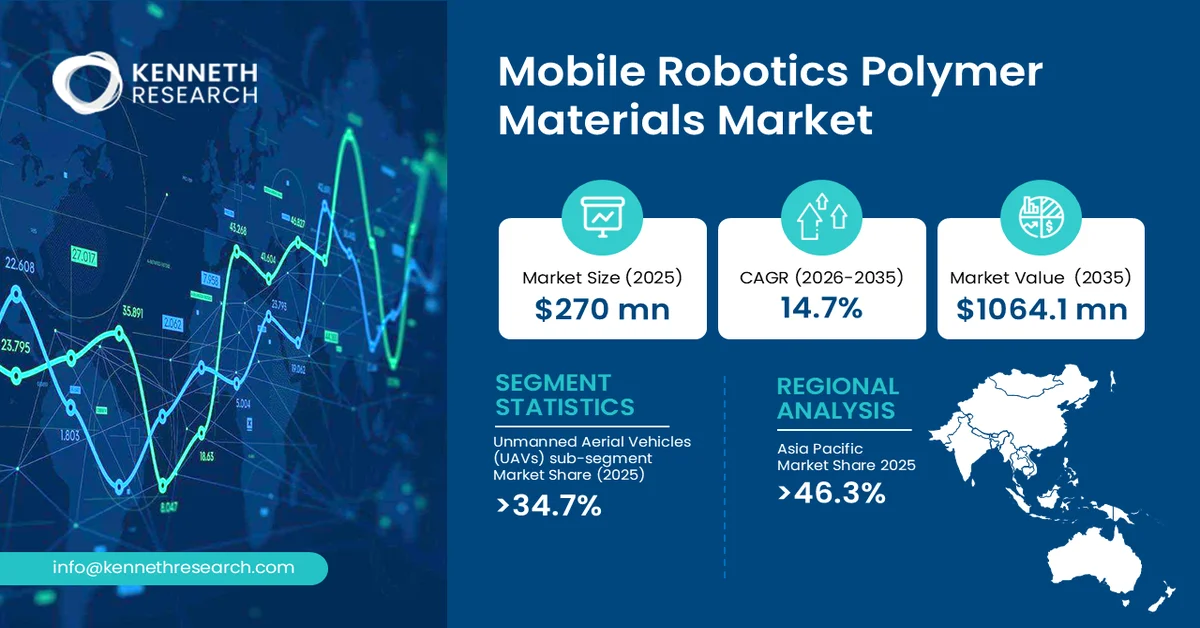
Mobile Robotics Polymer Materials Market size was valued at USD 270 million in 2025 and is projected to reach USD 1,064.1 million by the end of 2035, expanding at a CAGR of 14.7% during the forecast period, i.e., 2026-2035. In 2026, the industry size of the mobile robotics polymer materials is estimated at USD 309.7 million.
The primary growth driver of the mobile robotics polymer materials market is the rapid expansion of mobile robotic platforms across logistics, inspection, surveillance, manufacturing, and delivery applications.
The mobile robotics polymer materials market comprises polymeric materials used in the construction and functional components of mobile robotic platforms, including unmanned aerial vehicles, autonomous mobile robots, automated guided vehicles, unmanned ground vehicles, and other mobile robotic systems.
Key characteristics include the ability to replace heavier conventional materials, enable complex component geometries, support miniaturized designs, and improve the durability and energy efficiency of mobile robotic systems. Polymer materials can be incorporated into housings, structural components, protective covers, connector systems, sensor enclosures, and other robotic parts.
Key Mobile Robotics Polymer Materials Market Insights Summary:
Key Takeaways: Mobile Robotics Polymer Materials Market
- Mobile Robotics Polymer Materials Market is projected to grow from USD 270 million in 2025 to USD 1,064.1 million by 2035, registering a 14.7% CAGR during the forecast period.
- Asia Pacific accounted for the largest regional share at 46.3% in 2025, supported by strong robotics manufacturing, industrial automation, and expanding deployment of mobile robotic platforms across Japan and China.
- Unmanned Aerial Vehicles (UAVs) represented the leading Robotics Platform segment with a 34.7% share in 2025, driven by increasing applications in inspection, surveillance, mapping, agriculture, and other autonomous operations.
- Engineering Thermoplastics are expected to remain a key Material Type segment because of their combination of lightweight construction, mechanical strength, impact resistance, dimensional stability, and processing flexibility.
Market Drivers
- Expansion of mobile robotics across industrial applications.
- Growing demand for lightweight and high-performance materials.
- Increasing adoption of autonomous mobile robotic platforms.
- Rising use of advanced polymer materials for robotic components.
Challenges
- Material qualification and performance validation.
- Sustainability and end-of-life management.
Mobile Robotics Polymer Materials Market Overview & Supply Chain
Adoption of polymer materials in mobile robotics is increasing as robotics platforms expand across logistics, manufacturing, inspection, agriculture, defense, and other applications. Lightweight polymers can support lower system weight, impact resistance, component consolidation, and greater design flexibility, making them relevant to increasingly mobile and energy-sensitive robotic platforms. China’s National Bureau of Statistics reported that industrial robot output reached 556,000 sets in 2024, demonstrating the expanding industrial robotics ecosystem that supports demand for specialized materials and components.
The mobile robotics polymer materials market value chain begins with petrochemical and polymer producers supplying base resins, additives, reinforcements, stabilizers, and performance modifiers. Material compounders then formulate grades with specific mechanical, thermal, chemical, electrical, and weight-performance characteristics. Polymer processors and component manufacturers convert these materials through injection molding, extrusion, thermoforming, additive manufacturing, and other techniques into housings, structural parts, and other robotic elements.
Mobile Robotics Polymer Materials Market: Growth Drivers & Challenges
Growth Drivers:
- Expansion of mobile robotics across industrial applications: The increasing deployment of mobile robots across manufacturing, logistics, inspection, defense, and other dynamic environments is strengthening demand for specialized polymer materials. Mobile platforms require materials that can balance low weight with mechanical durability, impact resistance, flexibility, and environmental performance. The U.S. National Institute of Standards and Technology (NIST) notes that mobile robotic systems are expanding beyond traditional roles as they become more adaptable, faster, agile, and capable of operating in dynamic environments.
- Growing demand for lightweight and high-performance materials: The shift toward lighter and more efficient robotic platforms is increasing the importance of advanced polymer materials. Mobile robots must carry their own power systems, sensors, processors, communication equipment, and payloads, making weight reduction an important design objective. Engineering thermoplastics and other advanced polymer formulations can provide a combination of strength, durability, chemical resistance, electrical insulation, and design flexibility while offering opportunities to reduce component weight. NIST research highlights the growing role of non-traditional materials, including rubbers and elastomers, in robotics and identifies material modeling and testing as important requirements for advancing robotic technologies.
Challenges:
- Material qualification and performance validation: The increasing technical requirements of mobile robotic platforms create challenges in qualifying polymer materials for demanding operating environments. Materials must demonstrate consistent mechanical performance, dimensional stability, wear resistance, thermal behavior, and durability while remaining suitable for lightweight designs. For mobile platforms operating outdoors or in unpredictable environments, material performance can also be affected by temperature, moisture, chemicals, impact, and repeated mechanical loading. NIST identifies material testing, measurement, and modeling as important challenges for robotics, particularly where non-traditional materials are incorporated into robotic structures.
- Sustainability and end-of-life management: The increasing use of polymer materials in robotics creates a growing need to address recyclability, material recovery, and end-of-life management. Mobile robotic systems can contain multiple polymer grades, additives, reinforced materials, and bonded assemblies, making separation and recovery more difficult than recycling homogeneous plastic products. This can create sustainability concerns for manufacturers seeking to reduce environmental impacts while maintaining the performance required by robotic applications.
Mobile Robotics Polymer Materials Market Size and Forecast:
| Report Attribute | Details |
|---|---|
| Base Year |
2025 |
| Forecast Year |
2026-2035 |
| CAGR |
14.7% |
| Base Year Market Size (2025) |
USD 270 million |
| Forecast Year Market Size (2035) |
USD 1064.1 million |
| Regional Scope |
|
Mobile Robotics Polymer Materials Market Segmentation Analysis:
Robotics Platform Segment Analysis
In the Robotics Platform segment, the Unmanned Aerial Vehicles (UAVs) sub-segment is anticipated to capture the largest market share of 34.7% in 2025.
Its leading position is supported by the expanding use of UAVs for agriculture, inspection, mapping, monitoring, surveillance, and other applications where lightweight construction and mobility are critical. Government-backed research is also expanding the practical use of UAV platforms. The U.S. Department of Agriculture's Agricultural Research Service is developing autonomous UAV systems for crop monitoring, including drone-based sensing and data collection for agricultural applications.
The growing functional requirements of UAVs are strengthening demand for polymer materials that can provide low weight, impact resistance, dimensional stability, and design flexibility for airframes, housings, sensor enclosures, and protective components. On the supply side, material manufacturers are developing advanced polymer grades and composites suitable for lightweight robotic structures. Future demand is expected to benefit from increasing UAV autonomy, expanded sensing capabilities, and broader deployment across commercial and industrial applications.
Material Type Segment Analysis
The Engineering Thermoplastics segment is projected to grow as mobile robotics manufacturers seek materials that combine lightweight construction with mechanical strength, impact resistance, dimensional stability, and processing flexibility. These properties make engineering thermoplastics suitable for housings, structural parts, protective covers, sensor enclosures, and other components used across mobile robotic platforms. Japan’s NEDO specifically supports research into new robot materials, including resin-based technologies, with the objective of reducing the weight of critical robotic materials while improving energy efficiency and lowering deployment costs.
Demand is further supported by the increasing deployment of mobile robots in logistics, manufacturing, delivery, inspection, and other applications where weight and durability influence operating performance. On the supply side, polymer producers and compounders are developing application-specific grades that can be processed through established manufacturing techniques while meeting demanding mechanical and environmental requirements.
Our in-depth analysis of the global mobile robotics polymer materials market includes the following segments:
|
Segment |
Sub-segment |
|
Material Type |
|
|
Robotics Platform |
|
Mobile Robotics Polymer Materials Market Regional Insights:
Asia-Pacific Market Trends & Insights:
Asia Pacific accounted for 46.3% of the mobile robotics polymer materials market in 2025, making it the dominant region. Regional leadership is supported by extensive robotics manufacturing, rapid industrial automation, advanced electronics production, and growing deployment of mobile robotic platforms. Japan and China provide particularly strong demand environments because of their established robotics ecosystems and manufacturing capabilities. The International Federation of Robotics reported that Asia accounted for 74% of new industrial robot deployments in 2024, highlighting the region’s importance within the broader robotics ecosystem.
Japan is a technologically mature robotics market with strong capabilities in robot manufacturing, automation, electronics, and precision engineering. Its established robotics industry creates opportunities for polymer suppliers providing lightweight, durable, and high-performance materials for robotic structures and components.
China represents another major regional growth engine, supported by its extensive manufacturing base and rapidly expanding robotics deployment. The country accounted for 54% of global industrial robot deployments in 2024, reinforcing its position as a major center for robotics production and adoption.
North America Market Trends & Insights:
North America represents an important market for mobile robotics polymer materials, supported by advanced manufacturing, warehouse automation, aerospace and defense applications, and growing development of autonomous robotic systems. The region benefits from established polymer and specialty-material producers alongside sophisticated robotics OEMs and system integrators. In the U.S., NIST's Manufacturing USA program specifically supports advanced manufacturing technologies spanning robotics and additive manufacturing, strengthening the ecosystem for innovative materials and robotic component development.
U.S. remains the principal regional market, supported by advanced manufacturing capabilities, robotics research, and demand for sophisticated mobile platforms. NIST identifies mobile robots, machine vision, artificial intelligence, and manufacturing robotics among important areas for advancing next-generation robotic systems.
Canada is strengthening its advanced manufacturing ecosystem through government-supported research covering robotics, polymer manufacturing, high-performance thermoplastics, composites, additive manufacturing, and mobile manufacturing systems.
Leading Companies Operating in the Global Mobile Robotics Polymer Materials Market:
Here is a list of upstream, downstream, and key players operating in the global Mobile mobile robotics polymer materials market competitive ecosystem:
- SABIC(Saudi Arabia)
- Company Overview
- Business Strategy
- Key Product Offerings
- Financial Performance
- Key Performance Indicators
- Risk Analysis
- Recent Development
- Regional Presence
- SWOT Analysis
- BASF(Germany)
- Celanese(United States)
Recent Developments
- August 2025 —SABIC introduced the MEGAMOLDING™ platform, designed to enable manufacturing of large, high-performance thermoplastic parts by combining materials expertise with tooling, processing, and equipment capabilities.
- June 2025 —BASF announced the expansion of its sustainable plastics portfolio through the introduction of its reduced Product Carbon Footprint (rPCF) range for engineering plastics and thermoplastic polyurethanes.
Frequently Asked Question
In 2025, the mobile robotics polymer materials market exceeded USD 270 million.
The mobile robotics polymer materials market is projected to reach USD 1,064.1 million by the end of 2035, expanding at a CAGR of 14.7% over the forecast period (2026–2035).
The major players in the market are SABIC, BASF, Celanese, Mitsubishi Chemical Group, Asahi Kasei, and others.
In the Robotics Platform segment, the Unmanned Aerial Vehicles (UAVs) sub-segment is anticipated to capture the largest market share of 34.7% in the future and exhibit lucrative growth opportunities during 2026–2035.
Asia Pacific is projected to hold the largest market share of 46.3% by the end of 2025 and provide more business opportunities in the future.
Why Choose Kenneth Research ?
-
Insight with Impact : We don’t just gather data — we uncover stories, trends, and opportunities that fuel business growth.
-
Experts Who Get It : Our team speaks your industry’s language and knows what really matters to your customers and market.
-
Custom-Built for You : Forget one-size-fits-all. We craft research and consulting solutions as unique as your business vision.
-
Partners, Not Just Providers : We work with you, not for you — collaborating closely to turn insights into smart, strategic moves.
-
Results That Speak : Our work powers brands, startups, and industry leaders alike — with a track record of ideas that work in the real world.
Report ID: 1211 |
Published Date: 14 Sep 2026 |
Report Format: |
Delivery Timeline: 48-72 Business Hours

Copyright © 2025 Kenneth Research. All rights reserved. Terms of Use | Privacy Policy
