Report ID: 1243 |
Published Date: 01 Sep 2026 |
Report Format: |
Delivery Timeline: 48-72 Business Hours
LNG Bunkering Market Outlook:
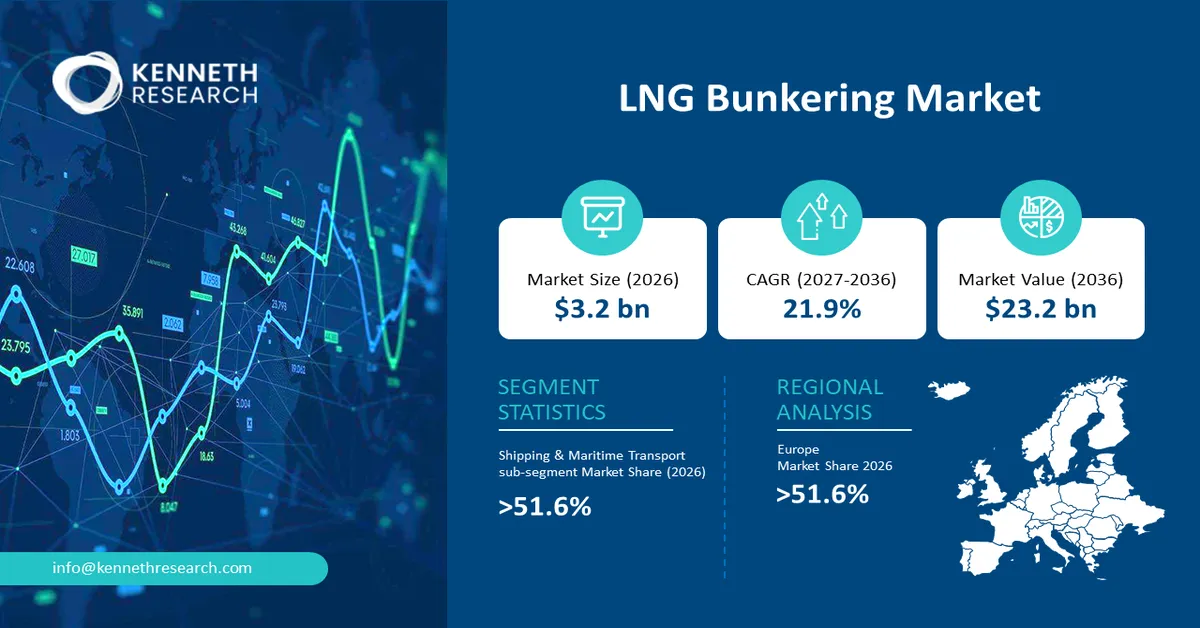
LNG Bunkering Market size was valued at USD 3.2 billion in 2026 and is projected to reach USD 23.2 billion by the end of 2036, rising at a CAGR of 21.9% during the forecast period, i.e., 2027-2036. In 2027, the industry size of the LNG bunkering is estimated at USD 3.9 billion.
The primary growth driver of the LNG bunkering market is the increasing adoption of LNG-fueled vessels as shipping operators seek to comply with tightening maritime emissions requirements.
The LNG bunkering market encompasses the infrastructure, equipment, and services involved in supplying liquefied natural gas (LNG) as marine fuel to LNG-fueled vessels. LNG bunkering involves transferring LNG from a dedicated supply source to a receiving vessel through established delivery methods, including ship-to-ship, truck-to-ship, and terminal-to-ship operations.
Key characteristics include cryogenic fuel handling, specialized storage and transfer equipment, controlled bunkering procedures, safety systems, trained personnel, and coordination between bunker suppliers, vessel operators, ports, and maritime authorities. International standards address bunkering transfer systems, operational procedures, personnel qualifications, and risk assessment requirements.
Key LNG Bunkering Market Insights Summary:
Key Takeaways: Market Trends & Insights
- LNG bunkering market projected to grow from USD 3.2 billion in 2026 to USD 23.2 billion by 2036 at a 21.9% CAGR.
- Europe accounted for the largest regional share at 51.6% in 2026, supported by established maritime infrastructure, LNG availability, and strong alternative-fuel adoption.
- Shipping & Maritime Transport is expected to remain the leading End-use segment with a 51.6% market share in 2026, driven by increasing deployment of LNG-capable vessels and demand for lower-emission marine fuels.
- Ship-to-Ship (STS) bunkering is projected to witness strong growth as its flexible delivery model enables efficient LNG transfer without complete dependence on fixed onshore infrastructure.
Market Drivers
- Tightening maritime emissions regulations
- Expansion of LNG-fueled vessel fleets and bunkering infrastructure
- Growing investment in port-based alternative-fuel infrastructure
- Increasing adoption of LNG propulsion across commercial shipping and maritime transport
Challenges
- High Infrastructure and Capital Requirements
- Methane Emissions and Long-Term Fuel Transition Uncertainty
LNG Bunkering Market: Market Overview & Supply Chain
Global adoption of LNG bunkering is increasing as ship operators pursue lower-emission marine-fuel options and ports expand alternative-fuel infrastructure. Regulatory measures supporting cleaner maritime transport, combined with growing deployment of LNG-fueled vessels, are encouraging investment in specialized storage, transfer systems, and bunkering vessels. The Port of Rotterdam Authority reported that LNG bunkering volumes at Rotterdam increased from 406,599 m³ in 2022 to 619,243 m³ in 2023, demonstrating increasing utilization of LNG as a marine fuel at a major European bunkering hub.
The LNG bunkering value chain begins with natural gas procurement and liquefaction, followed by LNG storage at terminals and specialized distribution facilities. LNG is then transported through pipelines, LNG carriers, bunker barges, road tankers, or other dedicated logistics systems to strategically located maritime fueling points. Bunkering operators manage cryogenic storage, transfer equipment, safety systems, metering, and fueling operations before supplying LNG to vessel operators. Delivery can occur through ship-to-ship, truck-to-ship, terminal-to-ship, or other specialized methods depending on port infrastructure and vessel requirements.
LNG Bunkering Market: Growth Drivers & Challenges
Growth Drivers:
- Tightening maritime emissions regulations: The implementation of stricter maritime decarbonization requirements is accelerating demand for LNG bunkering as shipping companies seek commercially available lower-emission fuel options. Regulatory pressure is encouraging vessel owners to adopt alternative-fuel propulsion while simultaneously motivating ports and bunker suppliers to expand compatible infrastructure. The International Maritime Organization (IMO) approved its Net-Zero Framework in April 2025, including a mandatory marine fuel standard and a global greenhouse-gas pricing mechanism. The framework is intended to apply to large ocean-going ships above 5,000 gross tonnage, which account for 85% of total CO₂ emissions from international shipping.
- Expansion of LNG-fueled vessel fleets and bunkering infrastructure: The increasing deployment of LNG-fueled commercial vessels is strengthening demand for dependable bunkering infrastructure across major maritime routes. Shipping companies are adopting dual-fuel and LNG propulsion systems to improve operational flexibility while preparing fleets for increasingly stringent emissions requirements. This trend is creating a reinforcing cycle in which greater vessel availability encourages ports and fuel suppliers to develop LNG bunkering capabilities, while broader bunker availability reduces operational barriers to fleet conversion.
Challenges:
- High Infrastructure and Capital Requirements: LNG bunkering requires specialized cryogenic storage, transfer equipment, safety systems, trained personnel, and compatible port infrastructure, creating substantial upfront investment requirements. The challenge is particularly pronounced at ports where LNG demand is not yet sufficient to justify dedicated bunkering facilities. Government analysis in the UK has identified both the limited availability of alternative-fuel facilities and the high installation costs associated with supplying and storing such fuels as barriers to wider adoption. These infrastructure requirements can lengthen project development timelines, increase financing complexity, and create coordination challenges between ports, fuel suppliers, and vessel operators.
- Methane Emissions and Long-Term Fuel Transition Uncertainty: Concerns regarding methane emissions and the long-term position of LNG within maritime decarbonization strategies represent another significant restraint. While LNG can support emissions reduction compared with conventional marine fuels in certain applications, methane leakage and methane slip create environmental considerations that can weaken its long-term sustainability credentials. The International Maritime Organization (IMO) continues to examine methane emissions, including LNG-related slippage values, within its lifecycle assessment framework for marine fuels.
LNG Bunkering Market Size and Forecast:
| Report Attribute | Details |
|---|---|
| Base Year |
2026 |
| Forecast Period |
2027-2036 |
| CAGR |
21.9% |
| Base Year Market Size (2026) |
USD 3.2 billion |
| Forecast Year Market Size (2036) |
USD 23.2 billion |
| Regional Scope |
|
LNG Bunkering Market Segmentation Analysis:
End-use Segment Analysis
In the End-use segment, the Shipping & Maritime Transport sub-segment is anticipated to capture the largest market share of 51.6% by the end of 2026.
LNG bunkering demand is strengthening as shipowners seek fuel solutions compatible with evolving emissions requirements while maintaining operational flexibility through dual-fuel propulsion systems. Port operators and bunker suppliers are correspondingly expanding LNG storage, transfer, and fueling capabilities along major maritime routes. The European Commission's monitoring of maritime transport reported that LNG accounted for 7.5% of total fuel consumption in its monitored fleet in 2024, with container ships, Ro-Pax vessels, and passenger ships among the principal users outside LNG carriers. This growing penetration across diverse vessel categories is strengthening the commercial case for LNG bunkering infrastructure.
Bunkering Method Segment Analysis
The Ship-to-Ship (STS) bunkering method is projected to grow significantly as LNG-fueled vessels increasingly require flexible, efficient, and high-volume refueling at major maritime hubs. STS operations allow bunker vessels to transfer LNG directly to receiving ships, reducing dependence on fixed terminal infrastructure and enabling fueling while vessels remain operational at port. Adoption is being supported by the expansion of dedicated LNG bunker vessels, improved transfer technologies, standardized safety procedures, and growing experience among port authorities and operators. The Port of Barcelona reported that its ship-to-ship LNG bunkering operations tripled in 2023 compared with 2021, following the commissioning of a dedicated LNG bunkering barge. This demonstrates the operational flexibility and scalability of STS infrastructure.
Our in-depth analysis of the LNG bunkering market includes the following segments:
|
Segment |
Sub-segment |
|
Bunkering Method |
|
|
Vessel Type (End User Fleet) |
|
|
End Use |
|
LNG Bunkering Market Regional Insights:
Europe Market Trends & Insights:
Europe accounted for 51.6% of the LNG bunkering market in 2026, supported by its established maritime trade network, expanding LNG infrastructure, stringent emissions policies, and strong concentration of major commercial ports. The region is strengthening alternative-fuel infrastructure through the EU's Alternative Fuels Infrastructure Regulation, which establishes requirements for LNG bunkering infrastructure at relevant TEN-T core ports. The European Commission also reports that 67 ports in Europe currently offer LNG bunkering services, demonstrating the region's developed fueling ecosystem. Continued investment in LNG terminals, bunker vessels, storage systems, and port infrastructure is expected to reinforce Europe's position as a leading maritime LNG hub.
Germany is strengthening its role through expanding LNG import and terminal infrastructure, providing additional supply flexibility for maritime fuel markets. Germany's growing LNG infrastructure also supports the development of alternative-fuel availability around major ports and industrial centers.
France benefits from its extensive coastline, major commercial ports, established LNG terminals, and growing alternative-fuel infrastructure. The European Commission identifies France among the region's leading LNG-importing markets, while its ports are increasingly integrated into Europe's broader LNG bunkering network.
North America Market Trends & Insights:
North America represents an important growth region for the LNG bunkering industry, supported by expanding LNG supply infrastructure, established maritime trade corridors, and increasing interest in alternative marine fuels. The U.S. benefits from a mature LNG production and distribution ecosystem, while Canada is developing additional LNG infrastructure along its Pacific coast. Regulatory initiatives are also supporting safer and more standardized alternative-fuel bunkering operations.
The U.S. remains the region's principal LNG bunkering market, supported by extensive LNG infrastructure, major maritime ports, and established marine-fuel operations.
Canada is strengthening its position through expanding LNG infrastructure, particularly in British Columbia. Government-backed development of projects such as LNG Canada and Cedar LNG is improving regional LNG availability and creating a stronger foundation for future marine-fuel applications.
Leading Companies Operating in the Global LNG Bunkering Market:
Here is a list of upstream, downstream, and key players operating in the global LNG bunkering market competitive ecosystem:
- Axpo Holding AG (Switzerland)
- Company Overview
- Business Strategy
- Key Product Offerings
- Financial Performance
- Key Performance Indicators
- Risk Analysis
- Recent Development
- Regional Presence
- SWOT Analysis
- Shell plc (United Kingdom)
- TotalEnergies SE (France)
- Gasum Ltd. (Finland)
Recent Developments
- August 2026 – Axpo and Vitol completed the first LNG bunkering operation at the Port of Civitavecchia in Italy, supplying LNG to a major international cruise vessel.
- February 2025 – Gasum chartered a new LNG and bio-LNG bunker vessel, scheduled to begin serving customers in 2027.
Frequently Asked Question
In 2026, the LNG bunkering market market exceeded USD 3.2 billion.
The LNG bunkering market market is projected to reach USD 23.2 billion by the end of 2036, expanding at a CAGR of 21.9% over the forecast period (2027–2036).
The major players in the market are Shell, TotalEnergies, CMA CGM, Gasum, Axpo, and others.
In the End-use segment, the Shipping & Maritime Transport sub-segment is anticipated to capture the largest market share of 51.6% in the future and exhibit lucrative growth opportunities during 2027–2036.
Europe is projected to hold the largest market share of 51.6% by the end of 2026 and provide more business opportunities in the future.
Why Choose Kenneth Research ?
-
Insight with Impact : We don’t just gather data — we uncover stories, trends, and opportunities that fuel business growth.
-
Experts Who Get It : Our team speaks your industry’s language and knows what really matters to your customers and market.
-
Custom-Built for You : Forget one-size-fits-all. We craft research and consulting solutions as unique as your business vision.
-
Partners, Not Just Providers : We work with you, not for you — collaborating closely to turn insights into smart, strategic moves.
-
Results That Speak : Our work powers brands, startups, and industry leaders alike — with a track record of ideas that work in the real world.
Report ID: 1243 |
Published Date: 01 Sep 2026 |
Report Format: |
Delivery Timeline: 48-72 Business Hours

Copyright © 2025 Kenneth Research. All rights reserved. Terms of Use | Privacy Policy
