Report ID: 1411 |
Published Date: 25 Sep 2026 |
Report Format: |
Delivery Timeline: 48-72 Business Hours
Lithium Compound For Battery Application Market Outlook:
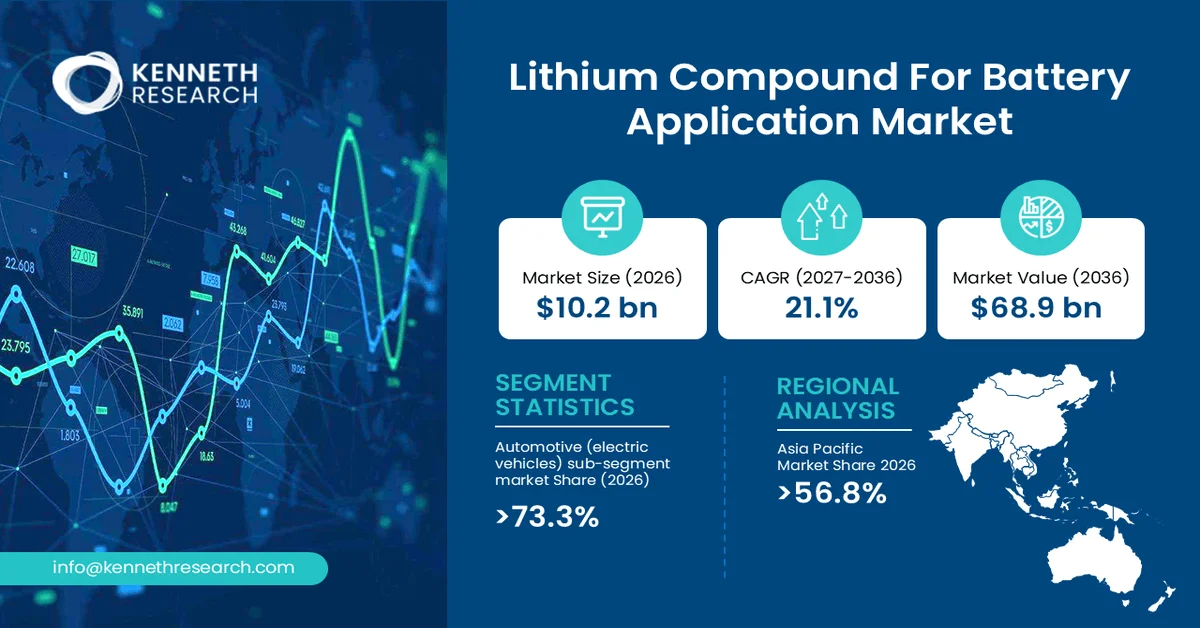
Lithium Compound For Battery Application Market size was valued at USD 10.2 billion in 2026 and is projected to reach USD 68.9 billion by the end of 2036, rising at a CAGR of 21.1% during the forecast period, i.e., 2027-2036. In 2027, the industry size of the lithium compound for battery application is estimated at USD 12.3 billion.
The primary growth driver for the lithium compound for battery application market is the rapid expansion of electric vehicle adoption, which is increasing demand for lithium-based battery materials, particularly lithium carbonate and other lithium compounds used in battery manufacturing.
The lithium compound for battery application market comprises lithium-based chemical compounds manufactured, processed, and supplied for use in rechargeable battery systems, particularly lithium-ion batteries used in electric vehicles, energy storage systems, consumer electronics, and other electrified applications. Key compounds include lithium carbonate, lithium hydroxide, lithium chloride, and other lithium-based materials that serve as feedstocks or intermediates in battery-material production.
The market encompasses the upstream processing of lithium resources into battery-grade compounds and their subsequent supply to cathode-material and battery manufacturers. Lithium compounds are particularly important in the production of cathode active materials, where their chemical properties enable the electrochemical reactions required for rechargeable battery operation.
Key Lithium Compound For Battery Application Market Insights Summary:
Key Takeaways: Market Trends & Insights
- Lithium compound for battery application market projected to grow from USD 10.2 billion in 2026 to USD 68.9 billion by 2036 at a 21.1% CAGR.
- Asia-Pacific accounted for the largest regional share at 56.8% in 2026, driven by established lithium-processing and battery-manufacturing ecosystems and strong electric-vehicle activity in Japan and China.
- Automotive (Electric Vehicles) is expected to remain the leading End Use segment with a 73.3% market share in 2026, supported by accelerating electric-vehicle adoption and rising demand for lithium-ion batteries.
- Lithium Carbonate will continue to witness strong demand as an important battery-grade lithium compound used in cathode-material production, supported by expanding battery manufacturing and electric-mobility applications.
Market Drivers
- Accelerating electric vehicle adoption and automotive electrification
- Expansion of battery energy storage systems
- Increasing investment in lithium extraction, refining, and battery-material supply chains
- Advancements in lithium-ion battery chemistry and manufacturing technologies
Challenges
- Supply chain concentration and geopolitical exposure
- Price volatility and investment uncertainty
Lithium Compound For Battery Application Market Overview & Supply Chain
The adoption of lithium compounds for battery applications is increasing globally as electric mobility, battery energy storage, and broader electrification accelerate demand for lithium-ion batteries. Lithium compounds are strategically important inputs for cathode-material production, making their availability and processing capacity critical to the performance and expansion of battery supply chains.
The value chain of the lithium compound for battery application market begins with lithium-bearing resources, including hard-rock minerals such as spodumene and lithium-rich brines, which are extracted through mining and brine-processing operations. These feedstocks undergo concentration, conversion, refining, and purification to produce battery-grade compounds such as lithium carbonate and lithium hydroxide.
Lithium Compound For Battery Application Market: Growth Drivers & Challenges
Growth Drivers:
- Accelerating electric vehicle adoption: The rapid expansion of electric vehicles is increasing demand for lithium compounds because lithium-based batteries require refined lithium materials as essential inputs for cathode production. As automotive manufacturers expand EV portfolios and battery producers scale cell manufacturing, demand is transmitted upstream to lithium compound producers and refiners. Going forward, continued electrification of passenger vehicles, commercial fleets, and other mobility applications should strengthen demand for battery-grade lithium carbonate and other lithium compounds, while encouraging producers to improve processing efficiency, product purity, and supply reliability.
- Expansion of battery energy storage systems: The increasing deployment of battery energy storage systems is creating an additional demand channel for lithium compounds beyond electric vehicles. Grid-scale storage, renewable-energy integration, commercial backup systems, and distributed energy resources increasingly depend on rechargeable battery technologies capable of storing electricity and releasing it when required. Lithium-ion systems remain important because of their established manufacturing ecosystem, scalability, energy efficiency, and compatibility with rapidly expanding renewable-power infrastructure. As utilities and energy developers deploy storage alongside solar and wind generation, battery manufacturers require continued access to lithium-based inputs for cell and cathode production.
Challenges:
- Supply chain concentration and geopolitical exposure: The lithium compound industry faces significant supply-chain concentration across mining, chemical conversion, and refining activities. Lithium resources are geographically unevenly distributed, while processing capacity is concentrated in a smaller number of countries and companies. This creates exposure to geopolitical tensions, trade restrictions, transportation disruptions, environmental permitting delays, and changes in industrial policy. For lithium compound manufacturers, disruptions at any stage can affect feedstock availability, processing costs, delivery schedules, and customer commitments.
- Price volatility and investment uncertainty: Lithium compound producers face investment uncertainty because lithium prices can respond sharply to changes in battery demand, new mining capacity, inventory levels, technology preferences, and project commissioning schedules. Periods of rapid supply expansion can place downward pressure on prices and weaken the economics of higher-cost extraction and conversion projects, while sudden demand acceleration can create tighter conditions and encourage price increases. This volatility complicates investment decisions because lithium processors must commit substantial capital to facilities designed for long operating periods while future battery chemistry and demand patterns continue to evolve.
Lithium Compound For Battery Application Market Size and Forecast:
| Report Attribute | Details |
|---|---|
| Base Year |
2026 |
| Forecast Period |
2027-2036 |
| CAGR |
21.1% |
| Base Year Market Size (2026) |
USD 10.2 billion |
| Forecast Year Market Size (2036) |
USD 68.9 billion |
| Regional Scope |
|
Lithium Compound For Battery Application Market Segmentation Analysis:
End Use Type Segment Analysis
In the end use segment, the automotive (electric vehicles) sub-segment is anticipated to capture the largest market share of 73.3% in 2026.
Its dominance is primarily supported by the rapid electrification of passenger and commercial transportation, which directly increases consumption of lithium compounds for battery-cell and cathode-material manufacturing. The International Energy Agency (IEA) reported that global electric car sales exceeded 20 million in 2025, representing 25% of total new car sales worldwide. This sustained vehicle adoption is increasing battery production requirements and, consequently, demand for battery-grade lithium compounds. Automotive OEMs are expanding EV portfolios, while battery manufacturers are increasing cell-production capacity and strengthening regional supply chains.
Compound Type Segment Analysis
In the compound segment, the lithium carbonate sub-segment is projected to grow strongly as it remains an important lithium feedstock for battery-material manufacturing, particularly for cathode chemistries where lithium carbonate is an established raw material. Increasing EV deployment and expanding stationary battery storage are strengthening downstream requirements for lithium-based cathode materials. Battery manufacturers are also seeking reliable supplies of high-purity lithium compounds to maintain consistent cathode production and reduce supply-chain risks. In the future, continued battery manufacturing expansion, EV adoption, energy-storage deployment, and supply-chain localization should support demand for lithium carbonate while encouraging investment in additional processing capacity and diversified sourcing.
Our in-depth analysis of the global lithium compound for battery application market includes the following segments:
|
Segment |
Sub-segment |
|
Compound |
|
|
End User Industry |
|
Lithium Compound For Battery Application Market Regional Insights:
Asia-Pacific Market Trends & Insights:
Asia-Pacific is anticipated to capture the largest market share of 56.8% in 2026, supported by its strong concentration of lithium processing, battery-material production, battery-cell manufacturing, and electric-vehicle supply chains.
Japan maintains an important position through battery technology development, automotive manufacturing, and government-backed supply-security programs. Japan's Ministry of Economy, Trade and Industry has approved multiple battery supply-chain projects involving major automotive and battery companies, supporting domestic production capabilities.
China represents the region's largest industrial hub, supported by extensive battery-material processing and rapidly expanding EV manufacturing.
North America Market Trends & Insights:
North America is supported by expanding demand for lithium compounds from electric vehicles, battery energy-storage systems, and domestic battery-material manufacturing. The region's industrial strategy increasingly emphasizes supply-chain resilience, domestic processing, and reduced dependence on concentrated overseas sources. Automotive manufacturers and battery producers are developing localized manufacturing networks, creating opportunities for lithium compound suppliers that can provide consistent battery-grade materials under long-term agreements.
The U.S. represents the principal demand center, with opportunities arising from EV manufacturing, grid-scale storage, domestic battery production, and efforts to establish resilient critical-mineral supply chains. The country is also attracting investment across lithium extraction and downstream processing.
Canada complements the regional ecosystem through its critical-mineral resources, clean-energy strategy, automotive manufacturing base, and growing emphasis on domestic battery-material processing.
Leading Companies Operating in the Global Lithium Compound For Battery Application Market:
Here is a list of upstream, downstream, and key players operating in the global lithium compound for battery application market competitive ecosystem:
- Rio Tinto (United Kingdom)
- Company Overview
- Business Strategy
- Key Product Offerings
- Financial Performance
- Key Performance Indicators
- Risk Analysis
- Recent Development
- Regional Presence
- SWOT Analysis
- Albemarle Corporation (U.S)
- Ganfeng Lithium Co., Ltd. (China)
- Sinomine Resource Group (China)
- Chengxin Lithium Group (China)
- Yahua Industrial Group (China)
Recent Developments
- In February 2026, Albemarle Corporation announced that it would idle the remaining operating train at its Kemerton lithium hydroxide processing plant in Western Australia and place Train 1 into care and maintenance immediately.
- In December 2024, Rio Tinto announced on December 12, 2024, that it had approved a US$2.5 billion investment to expand its Rincon lithium project in Argentina. The project is designed for a total capacity of 60,000 tonnes per year of battery-grade lithium carbonate, comprising the existing starter plant and the expansion plant.
Frequently Asked Question
In 2026, the lithium compound for battery application market exceeded USD 10.2 billion.
The lithium compound for battery application market is projected to reach USD 68.9 billion by the end of 2036, expanding at a CAGR of 21.1% over the forecast period (2027-2036).
The major players in the market are Albemarle Corporation, SQM, Ganfeng Lithium Co., Ltd., Tianqi Lithium Corporation, Rio Tinto, and others.
In the end use segment, the automotive (Electric Vehicles) sub-segment is anticipated to capture the largest market share of 73.3% in the future and exhibit lucrative growth opportunities during 2027-2036.
Asia-Pacific is projected to hold the largest market share of 56.8% by the end of 2026 and provide more business opportunities in the future.
Why Choose Kenneth Research ?
-
Insight with Impact : We don’t just gather data — we uncover stories, trends, and opportunities that fuel business growth.
-
Experts Who Get It : Our team speaks your industry’s language and knows what really matters to your customers and market.
-
Custom-Built for You : Forget one-size-fits-all. We craft research and consulting solutions as unique as your business vision.
-
Partners, Not Just Providers : We work with you, not for you — collaborating closely to turn insights into smart, strategic moves.
-
Results That Speak : Our work powers brands, startups, and industry leaders alike — with a track record of ideas that work in the real world.
Report ID: 1411 |
Published Date: 25 Sep 2026 |
Report Format: |
Delivery Timeline: 48-72 Business Hours

Copyright © 2025 Kenneth Research. All rights reserved. Terms of Use | Privacy Policy
