Report ID: 1210 |
Published Date: 01 Sep 2026 |
Report Format: |
Delivery Timeline: 48-72 Business Hours
Liquid Hydrogen Market Outlook:
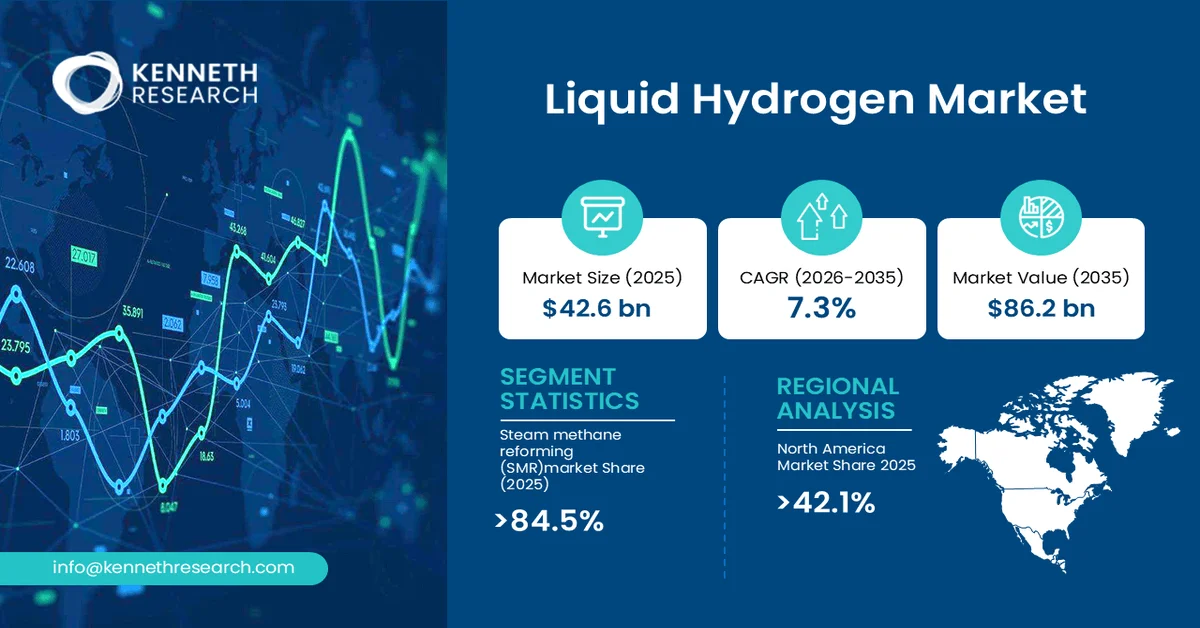
Liquid Hydrogen Market size was valued at USD 42.6 billion in 2025 and is projected to reach USD 86.2 billion by 2035, expanding at a CAGR of 7.3% during 2026-2035. In 2026, the industry size of liquid hydrogen is estimated at USD 45.7 billion.
The primary growth driver for the liquid hydrogen market is the expanding need for hydrogen across industrial, transportation, energy, and emerging clean-energy applications.
The liquid hydrogen market comprises the production, liquefaction, storage, transportation, distribution, and utilization of hydrogen in its cryogenic liquid form. Liquid hydrogen is produced by cooling gaseous hydrogen to extremely low temperatures, enabling substantially greater volumetric energy density and facilitating transportation where gaseous hydrogen infrastructure is unsuitable or insufficient.
The market includes hydrogen producers, liquefaction facilities, cryogenic storage tanks, tankers and trailers, loading and unloading systems, distribution infrastructure, and end-use applications. Liquid hydrogen is particularly relevant where hydrogen must be transported over longer distances or supplied in high volumes. The U.S. Department of Energy identifies cryogenic liquid hydrogen trucks as an existing delivery option and notes that liquid hydrogen is stored at approximately −253°C, highlighting the specialized infrastructure required for its distribution.
Key Liquid Hydrogen Market Insights Summary:
Key Takeaways: Market Trends & Insights
- The liquid hydrogen market is projected to grow from USD 42.6 billion in 2025 to USD 86.2 billion by 2035, registering a 7.3% CAGR.
- North America remains the dominant regional market, supported by established hydrogen production capabilities, industrial demand, and government-backed hydrogen infrastructure development.
- Liquid hydrogen requires cryogenic infrastructure because it is stored at approximately −253°C, creating demand for insulated storage tanks, specialized transfer systems, and cryogenic transportation.
- Cryogenic tanker trucks provide an established distribution option for moving liquid hydrogen, particularly where pipeline infrastructure is unavailable or unsuitable.
Market Drivers
- Growing hydrogen demand across established industrial applications
- Expansion of hydrogen transportation and storage infrastructure
- Government support for hydrogen supply-chain development
- Increasing investment in lower-emission hydrogen production
Challenges
- High energy requirements and cost of hydrogen liquefaction
- Boil-off losses and stringent cryogenic storage requirements
Liquid Hydrogen Market: Market Overview & Supply Chain
The liquid hydrogen market is supported by growing requirements for high-volume hydrogen transportation, particularly where pipeline infrastructure is unavailable or economically unsuitable. The U.S. Department of Energy states that hydrogen can be transported as a liquid through cryogenic tanker trucks, while liquefaction enables larger quantities to be moved over longer distances.
The value chain begins with hydrogen feedstock and production, followed by purification and liquefaction. Production facilities then transfer liquefied hydrogen into highly insulated cryogenic storage tanks. The distribution stage includes cryogenic tanks, liquid tankers, loading systems, transfer equipment, and specialized logistics services, before hydrogen reaches industrial, transportation, energy, aerospace, and other end users. The Cryogenic Tanks/Tankers distribution segment is particularly important because liquid hydrogen must be maintained at cryogenic temperatures throughout storage and transportation.
Liquid Hydrogen Market: Growth Drivers & Challenges
Growth Drivers:
- Expanding global hydrogen demand: Growing hydrogen consumption across refining, ammonia, methanol, and emerging industrial applications is strengthening the underlying demand for liquid hydrogen. The International Energy Agency (IEA) reported that global hydrogen demand reached almost 100 million tonnes in 2024, with traditional industrial sectors accounting for the overwhelming majority of consumption. This expanding demand supports investment across the hydrogen value chain, including production, liquefaction, cryogenic storage, transportation, and distribution infrastructure. Liquid hydrogen is particularly relevant where hydrogen must be transported in high volumes or over distances that make conventional gaseous delivery less practical.
- Continued reliance on established hydrogen production infrastructure: The maturity of natural-gas-based hydrogen production provides an established supply base for the market. The U.S. Department of Energy identifies natural-gas reforming as a mature hydrogen-production pathway and states that 95% of U.S. hydrogen production is made through natural-gas reforming. Steam methane reforming is specifically identified as the dominant reforming process.
Challenges:
- High energy requirements for liquefaction: Liquefaction remains a major challenge because hydrogen must be cooled to cryogenic temperatures before it can be transported as a liquid. The U.S. Department of Energy states that current hydrogen liquefaction technology consumes more than 30% of hydrogen's energy content, adding significantly to production and distribution costs.
- Boil-off losses and cryogenic storage requirements: Liquid hydrogen must be maintained at extremely low temperatures, creating demanding requirements for tanks, transfer systems, insulation, and transportation equipment. DOE identifies cryogenic liquid tanks as the primary method for storing large quantities of liquid hydrogen and notes that heat entering the tank can cause hydrogen to boil, increasing internal pressure and potentially requiring venting or recompression.
Liquid Hydrogen Market Size and Forecast:
| Report Attribute | Details |
|---|---|
| Base Year |
2025 |
| Forecast Period |
2026-2035 |
| CAGR |
7.3% |
| Base Year Market Size (2025) |
USD 42.6 billion |
| Forecast Year Market Size (2035) |
USD 86.2 billion |
| Regional Scope |
|
Liquid Hydrogen Market Segmentation Analysis:
Production Type Segment Analysis
In the production segment, steam methane reforming (SMR) is the dominant sub-segment, accounting for 84.5% of the market in 2025.
Its strong position reflects the maturity of natural-gas-based hydrogen production, established feedstock infrastructure, and widespread industrial experience with reforming technologies.
The U.S. Department of Energy identifies natural-gas reforming as a mature hydrogen-production pathway and notes that SMR is the principal process used within this pathway. The process uses high-temperature steam and methane to generate hydrogen, followed by water-gas shift and purification stages. SMR's established industrial base provides an important advantage for liquid hydrogen suppliers because hydrogen produced through centralized reforming can subsequently undergo purification and liquefaction before entering cryogenic distribution networks. Existing natural-gas infrastructure, engineering expertise, and large-scale production capabilities therefore support the continued role of SMR in the liquid hydrogen supply chain.
Distribution Method Segment Analysis
The cryogenic tanks/tankers segment is expected to gain importance as liquid hydrogen requires specialized infrastructure for safe storage and transportation. The U.S. Department of Energy identifies cryogenic liquid tanker trucks as an established delivery method, particularly where hydrogen demand is not sufficient to justify dedicated pipeline infrastructure. Liquid tankers can carry substantially larger quantities of hydrogen than gaseous tube trailers, supporting cost-effective distribution over longer distances.
Cryogenic storage is also essential because liquid hydrogen must remain at extremely low temperatures. DOE identifies super-insulated cryogenic vessels as the principal technology for storing large quantities of liquid hydrogen and highlights boil-off management as an important operational requirement.
Our in-depth analysis of the global liquid hydrogen market includes the following segments:
|
Segment |
Sub-segment |
|
Production |
|
|
Distribution Method |
|
|
Application |
|
|
End User |
|
Liquid Hydrogen Market Regional Insights:
North America Market Trends & Insights:
North America accounted for the largest share of the liquid hydrogen market at 42.1% in 2025, supported by established hydrogen production infrastructure, industrial demand, advanced cryogenic technologies, and government initiatives aimed at expanding hydrogen production and distribution.
The U.S. represents the leading market in the region, benefiting from established hydrogen production capabilities and federal programs supporting hydrogen infrastructure and lower-emission production. The U.S. Department of Energy continues to support hydrogen production, storage, delivery, and fueling technologies, strengthening the regional ecosystem for liquid hydrogen.
Canada is also emerging as an important market. Natural Resources Canada reported in its 2024 Hydrogen Strategy Progress Report that more than 80 low-carbon hydrogen production projects were at various development stages, demonstrating growing investment across Canada's hydrogen value chain. The government has also identified production, distribution, end use, infrastructure, and codes and standards as strategic priorities.
Europe Market Trends & Insights:
Asia Pacific is the secondary regional market for liquid hydrogen, with Japan and China representing key countries. Regional growth is supported by government-led hydrogen strategies, industrial decarbonization initiatives, expanding hydrogen infrastructure, and efforts to establish international hydrogen supply chains.
Japan is a particularly important market because the government is actively developing a large-scale hydrogen economy. Japan's Hydrogen Society Promotion Act, enacted in 2024, provides support for low-carbon hydrogen supply and utilization, including support for the development of hydrogen hubs. Japan's 2025 energy policy also emphasizes the construction of large-scale low-carbon hydrogen supply chains and continued cost reduction.
China provides another major growth opportunity because of its expanding hydrogen-production ecosystem and government emphasis on integrating hydrogen with renewable energy and hard-to-abate industrial sectors. China's renewable-energy planning increasingly incorporates hydrogen, ammonia, and methanol production, creating potential demand for hydrogen infrastructure and distribution systems.
Leading Companies Operating in the Global Liquid Hydrogen Market:
Here is a list of upstream, downstream, and key players operating in the global liquid hydrogen market competitive ecosystem:
- Linde(United Kingdom)
- Company Overview
- Business Strategy
- Key Product Offerings
- Financial Performance
- Key Performance Indicators
- Risk Analysis
- Recent Development
- Regional Presence
- SWOT Analysis
- Air Products(United States)
- Plug Power(United States)
Recent Developments
- January 2026 – Air Products announced new contracts to supply liquid hydrogen to NASA, building on its role in supplying liquid hydrogen for space-launch operations. The company had completed the first fill of NASA's large hydrogen storage sphere at Kennedy Space Center in 2025.
- March 2026 – Plug Power reported that its Louisiana hydrogen plant came online during the first half of 2025. Together with its Georgia and Tennessee facilities, the company's production network has the capacity to produce up to 40 tons of liquid hydrogen per day.
Frequently Asked Question
The liquid hydrogen market was valued at USD 45.7 billion in 2026.
The market is projected to reach USD 86.2 billion by 2035, expanding at a 7.3% CAGR during 2026–2035.
Steam Methane Reforming (SMR) is the leading production segment, accounting for 84.5% in 2025. SMR remains an established hydrogen-production pathway, although lower-emission production technologies are gaining attention.
Cryogenic Tanks/Tankers represent the specified distribution-method segment. These systems are essential for storing and transporting liquid hydrogen because it must be maintained under cryogenic conditions. The U.S. Department of Energy identifies liquid hydrogen delivery and storage as requiring specialized cryogenic infrastructure.
North America is the dominant region, accounting for 42.1% in 2025, with the U.S. and Canada serving as the key markets. Government programs in the U.S. continue to support hydrogen production, infrastructure, storage, and emerging applications.
Why Choose Kenneth Research ?
-
Insight with Impact : We don’t just gather data — we uncover stories, trends, and opportunities that fuel business growth.
-
Experts Who Get It : Our team speaks your industry’s language and knows what really matters to your customers and market.
-
Custom-Built for You : Forget one-size-fits-all. We craft research and consulting solutions as unique as your business vision.
-
Partners, Not Just Providers : We work with you, not for you — collaborating closely to turn insights into smart, strategic moves.
-
Results That Speak : Our work powers brands, startups, and industry leaders alike — with a track record of ideas that work in the real world.
Report ID: 1210 |
Published Date: 01 Sep 2026 |
Report Format: |
Delivery Timeline: 48-72 Business Hours

Copyright © 2025 Kenneth Research. All rights reserved. Terms of Use | Privacy Policy
