Report ID: 1227 |
Published Date: 28 Sep 2026 |
Report Format: |
Delivery Timeline: 48-72 Business Hours
LEO Satellite Market Outlook:
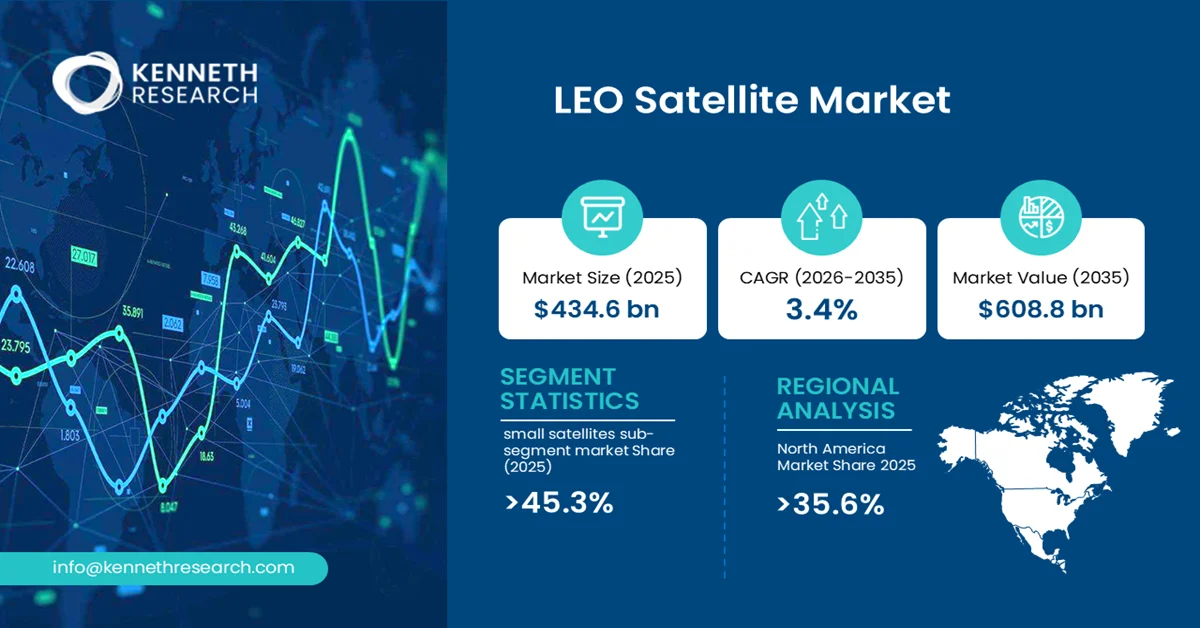
LEO Satellite Market size was valued at USD 434.6 million in 2025 and is projected to reach USD 608.8 million by the end of 2035, rising at a CAGR of 3.4% during the forecast period, i.e., 2026-2035. In 2026, the industry size of the LEO satellite is estimated at USD 450.6 million.
The primary growth driver is rising demand for high-speed, low-latency connectivity and rapid space-to-ground data delivery. NASA’s 2022 TBIRD demonstration transmitted data from low Earth orbit at 200 gigabits per second, highlighting how advances in optical communications can strengthen LEO’s value for broadband, scientific, and Earth-observation missions and services globally.
The LEO satellite market comprises spacecraft, payloads, communications systems, ground infrastructure, and related services associated with satellites operating in low Earth orbit. LEO systems are distinguished by relatively low orbital altitude, shorter signal paths, frequent movement relative to ground locations, and the ability to operate individually or as coordinated constellations. These characteristics support applications including broadband connectivity, Earth observation, scientific research, navigation support, Internet of Things services, and government missions.
The market spans satellite design and manufacturing, launch and deployment, payload technologies, satellite communications, tracking and control, data transmission, ground terminals, and operational services. Constellation-based architectures are particularly relevant where continuous or broad-area coverage is required. Their proximity to Earth can support lower communication latency and high-throughput data exchange, while optical and radio-frequency links enable connections between spacecraft and terrestrial infrastructure.
Key LEO Satellite Market Insights Summary:
Key Takeaways: Market Trends & Insights
- The LEO satellite market is valued at USD 434.6 million in 2025 and is projected to reach USD 608.8 million by 2035
- The market is projected to expand at a 3.4% CAGR during 2026–2035, supported by increasing demand for low-latency connectivity, Earth observation, scientific missions and space-based data services
- Small Satellites represent the leading segment by Satellite Mass, accounting for a 45.3% market share in 2025, supported by compact architectures, standardized platforms and constellation-based deployment models
- North America is the dominant regional market, holding a 35.6% market share in 2025, with the United States serving as the principal technology, investment and commercial space center and Canada strengthening the regional ecosystem
- Communication is identified as the second and fastest analysis segment by Application, driven by broadband connectivity, direct-to-device services, terrestrial–satellite network integration and growing demand for resilient communications
Market Drivers
- LEO broadband and direct-to-device connectivity
- Advances in high-capacity optical and inter-satellite communications
- Proliferation of small satellites and standardized spacecraft architectures
- Government investment in resilient space-based communications and Earth-observation infrastructure
Challenges
- Orbital congestion and debris management
- Complex regulatory and spectrum coordination
LEO Satellite Market Overview & Supply Chain
Global adoption of LEO satellites is increasing as governments, commercial operators, research institutions, and telecommunications providers seek scalable platforms for communications, Earth observation, scientific missions, defense applications, and data services. LEO’s proximity to Earth supports lower-latency connectivity, frequent observation opportunities, and deployment of distributed satellite architectures. Technological progress in miniaturized spacecraft, payload integration, onboard processing, propulsion, and inter-satellite communications is also expanding the range of commercially and institutionally viable missions.
The LEO satellite value chain begins with specialized inputs including semiconductor components, radiation-tolerant electronics, sensors, optical systems, structural materials, batteries, propulsion components, antennas, and software. Satellite manufacturers and system integrators combine these inputs into spacecraft platforms and payloads, followed by testing, qualification, assembly, and mission integration. Launch providers and dedicated rideshare services then transport spacecraft to their designated orbital environments, while ground-segment suppliers provide antennas, tracking systems, command infrastructure, data-processing capabilities, and network equipment. Distribution occurs through direct government procurement, institutional programs, commercial satellite operators, telecommunications providers, and specialized service companies. End users include governments, defense organizations, telecommunications operators, scientific institutions, agricultural and industrial enterprises, and consumers.
LEO Satellite Market: Growth Drivers & Challenges
Growth Drivers:
- Expansion of satellite-to-mobile connectivity: The integration of LEO satellites with terrestrial mobile networks is opening a new demand pathway for satellite capacity. Direct-to-device architectures can extend connectivity beyond conventional cellular coverage without requiring users to replace standard handsets, making LEO infrastructure relevant to remote communities, maritime users, emergency response, transportation, and IoT applications. In January 2024, SpaceX launched its first Starlink satellites equipped with Direct to Cell capabilities, designed to enable texting, calling, and browsing through mobile-network integration. The development demonstrates how LEO platforms are moving from dedicated satellite terminals toward mass-market connectivity models. This convergence can broaden addressable applications, encourage telecommunications partnerships, and stimulate demand for specialized payloads, ground infrastructure, and constellation capacity.
- Advances in high-capacity optical communications: Rapid development of optical inter-satellite and space-to-ground communications is strengthening the technical proposition of LEO networks. Laser links can enable high-throughput data transfer while supporting interconnected satellite architectures that reduce dependence on individual ground-station contacts. This is particularly valuable for Earth-observation missions, scientific spacecraft, defense systems, and data-intensive commercial services where rapid movement of information is strategically important. Improved optical terminals, pointing technologies, onboard processing, and network orchestration are consequently encouraging operators to design satellites as elements of integrated space networks rather than isolated assets. The resulting architecture can improve data-routing flexibility, responsiveness, and service continuity while creating additional opportunities for payload and communications-equipment suppliers.
Challenges:
- Orbital congestion and debris management: The rapid deployment of LEO spacecraft is intensifying congestion in commercially attractive orbital bands, increasing the operational complexity of constellation management. The root cause is the accumulation of active satellites, defunct spacecraft, rocket bodies, and fragmentation debris within finite orbital environments. Operators must devote greater resources to space situational awareness, conjunction assessment, maneuver planning, propulsion reserves, and end-of-life disposal. This raises mission-management costs and can reduce usable spacecraft capacity when avoidance requirements interfere with planned operations. Commercially, the challenge also increases engineering and compliance requirements for new spacecraft and may complicate insurance and financing decisions for missions operating in crowded regimes.
- Complex regulatory and spectrum coordination: LEO operators face a fragmented regulatory environment because satellite constellations operate across national jurisdictions while relying on internationally coordinated orbital and radio-frequency resources. The root cause is the need to reconcile national licensing, spectrum allocation, orbital-debris requirements, landing and gateway permissions, cybersecurity expectations, and cross-border service rules. These requirements can lengthen deployment schedules and increase legal, compliance, engineering, and coordination costs, particularly for operators pursuing multinational coverage. Regulatory uncertainty can also affect constellation architecture because frequency rights, orbital parameters, and service authorization requirements must be considered alongside technical design decisions. Commercially, this creates execution risk and can favor operators with substantial regulatory expertise and established government relationships.
LEO Satellite Market Size and Forecast:
| Report Attribute | Details |
|---|---|
| Base Year |
2025 |
| Forecast Period |
2026-2035 |
| CAGR |
3.4% |
| Base Year Market Size (2025) |
USD 434.6 million |
| Forecast Year Market Size (2035) |
USD 608.8 million |
| Regional Scope |
|
LEO Satellite Market Segmentation Analysis:
Satellite Mass Segment Analysis
In the satellite mass segment, the small satellites sub-segment is anticipated to capture the largest market share of 45.3% by the end of 2025.
Small satellites dominate the LEO market because their compact architectures enable lower development complexity, flexible mission design, and comparatively accessible launch opportunities. Demand is supported by expanding use in Earth observation, communications, scientific research, technology demonstrations, and distributed constellation architectures. NASA’s continued CubeSat activity illustrates institutional adoption: its CubeSat Launch Initiative has launched over 150 CubeSats through its program, demonstrating sustained demand for standardized small-spacecraft platforms. On the supply side, standardized spacecraft buses, modular payload interfaces, commercial rideshare services, miniaturized electronics, and increasingly capable onboard systems allow manufacturers to produce mission-specific platforms with greater repeatability. These developments also enable operators to deploy multiple spacecraft rather than relying on a single large platform, improving architectural flexibility and replacement options.
Application Segment Analysis
The communication is projected to grow as the second-largest segment in the LEO satellite market due to four converging demand drivers.
The communication segment is projected to grow rapidly as LEO constellations increasingly complement terrestrial networks with low-latency broadband, direct-to-device connectivity, and resilient links for remote and mobile users. Demand is being reinforced by telecommunications operators, governments, enterprises, and consumers seeking coverage where terrestrial infrastructure is unavailable or difficult to deploy. Industry adoption is also moving toward integrated terrestrial–satellite networks, standardized 5G non-terrestrial networks, and inter-satellite links. On the supply side, advances in phased-array antennas, digital payloads, optical communications, onboard processing, and mass-produced spacecraft are improving network capacity and scalability.
Our in-depth analysis of the global Global LEO satellite market includes the following segments:
|
Segment |
Sub-segment |
|
Satellite Mass |
|
|
Frequency Band |
|
|
Propulsion Type |
|
|
Application |
|
|
End Use |
|
LEO Satellite Market Regional Insights:
North America Market Trends & Insights:
North America LEO satellite market is projected to hold the largest revenue share of 35.6% by the end of 2025.
It is supported by a mature commercial space ecosystem, substantial government procurement, established launch infrastructure, advanced satellite manufacturing capabilities, and strong private-sector investment. The region benefits from close coordination among space agencies, defense organizations, telecommunications companies, launch providers, and satellite manufacturers. Regulatory frameworks in the United States and Canada increasingly support commercial LEO deployment, connectivity, Earth observation, and space-based services.
The United States remains the principal regional technology and investment center, supported by major launch capabilities, commercial constellation development, government space programs, and a large downstream customer base. NASA is also advancing commercial LEO capabilities through partnerships with private companies, strengthening the transition toward commercially operated orbital infrastructure.
Canada complements the regional ecosystem through satellite communications, Earth observation, spacecraft components, and remote-connectivity initiatives. Government support includes investment in LEO capacity to improve broadband access in rural and remote communities, reinforcing domestic demand and commercial deployment opportunities.
Asia Pacific Market Trends & Insights:
Asia Pacific is emerging as a strategically important LEO satellite region because governments and commercial operators are pursuing satellite connectivity, Earth observation, navigation, scientific missions, and space-based infrastructure. Demand is supported by large and geographically diverse populations, remote and maritime territories, expanding digital infrastructure, and the need for resilient communications beyond terrestrial networks. Industrial activity is broadening from government-led programs toward commercial spacecraft manufacturing, launch services, satellite communications, and downstream data applications. Government initiatives are also encouraging greater private-sector participation and indigenous technology development.
China is strengthening its LEO ecosystem through satellite-internet constellation development, domestic launch capabilities, and coordinated space–Earth information infrastructure. Its policy direction supports greater integration of satellite communications with future terrestrial networks, creating opportunities for constellation manufacturing, launch services, network equipment, and downstream applications.
India is developing a more commercially oriented space ecosystem through regulatory reform, private-sector participation, indigenous communications technology, and satellite broadband initiatives. Government-backed programs are encouraging domestic companies to develop LEO satellite components and related telecommunications technologies, while ISRO continues expanding national satellite communications capabilities.
Leading Companies Operating in the Global LEO Satellite Market:
Here is a list of upstream, downstream, and key players operating in the Global LEO satellite market competitive ecosystem:
- SpaceX (Starlink) (United States)
- Company Overview
- Business Strategy
- Key Product Offerings
- Financial Performance
- Key Performance Indicators
- Risk Analysis
- Recent Development
- Regional Presence
- SWOT Analysis
- Eutelsat OneWeb (France/United Kingdom)
- Telesat (Canada)
- Thales Alenia Space (France/Italy)
- The Boeing Company (United States)
- Planet Labs PBC (United States)
Recent Developments
- In March 2026, Telesat announced plans to incorporate 500 MHz of military Ka-band spectrum into the first 156 satellites of its Lightspeed constellation, responding to rising global demand from allied defence organizations. The Mil-Ka capacity, adjacent to existing commercial Ka-band frequencies, will be integrated without affecting deployment timelines, with the first two production satellites scheduled for December 2026 launch.
- In May 2026, Planet Labs PBC launched three additional Pelican satellites, including the first satellite delivered under a satellite services agreement with the Swedish Armed Forces. The spacecraft are equipped with NVIDIA's Jetson AI platform for on-orbit edge computing and capture 50 cm class resolution imagery. In July 2026, Planet launched Pelican-11, a tech demonstration satellite for its second-generation Pelican fleet designed to provide up to 30 cm class resolution.
Frequently Asked Question
In 2025, the LEO satellite market exceeded USD 434.6 million.
The LEO satellite market is projected to reach USD 608.8 million by the end of 2035, expanding at a CAGR of 3.4% over the forecast period (2026-2035).
The major players in the market are SpaceX (Starlink), Eutelsat OneWeb, Telesat, Thales Alenia Space, The Boeing Company, Planet Labs PBC, and others.
In the satellite mass segment, the small satellites sub-segment is anticipated to capture the largest market share of 45.3% in the future and exhibit lucrative growth opportunities during 2026-2035. This growth trajectory is largely attributed to expanding use in Earth observation, communications, scientific research, and distributed constellation architectures.
North America is projected to hold the largest market share of 35.6% by the end of 2025 and provide more business opportunities in the future. Continuous investments in satellite communications, commercial constellation development, launch capabilities, and government space programs across the United States and Canada are fostering the region's dominance.
Why Choose Kenneth Research ?
-
Insight with Impact : We don’t just gather data — we uncover stories, trends, and opportunities that fuel business growth.
-
Experts Who Get It : Our team speaks your industry’s language and knows what really matters to your customers and market.
-
Custom-Built for You : Forget one-size-fits-all. We craft research and consulting solutions as unique as your business vision.
-
Partners, Not Just Providers : We work with you, not for you — collaborating closely to turn insights into smart, strategic moves.
-
Results That Speak : Our work powers brands, startups, and industry leaders alike — with a track record of ideas that work in the real world.
Report ID: 1227 |
Published Date: 28 Sep 2026 |
Report Format: |
Delivery Timeline: 48-72 Business Hours

Copyright © 2025 Kenneth Research. All rights reserved. Terms of Use | Privacy Policy
