Report ID: 1213 |
Published Date: 01 Sep 2026 |
Report Format: |
Delivery Timeline: 48-72 Business Hours
Lead Acid Battery for Energy Storage Market Outlook:
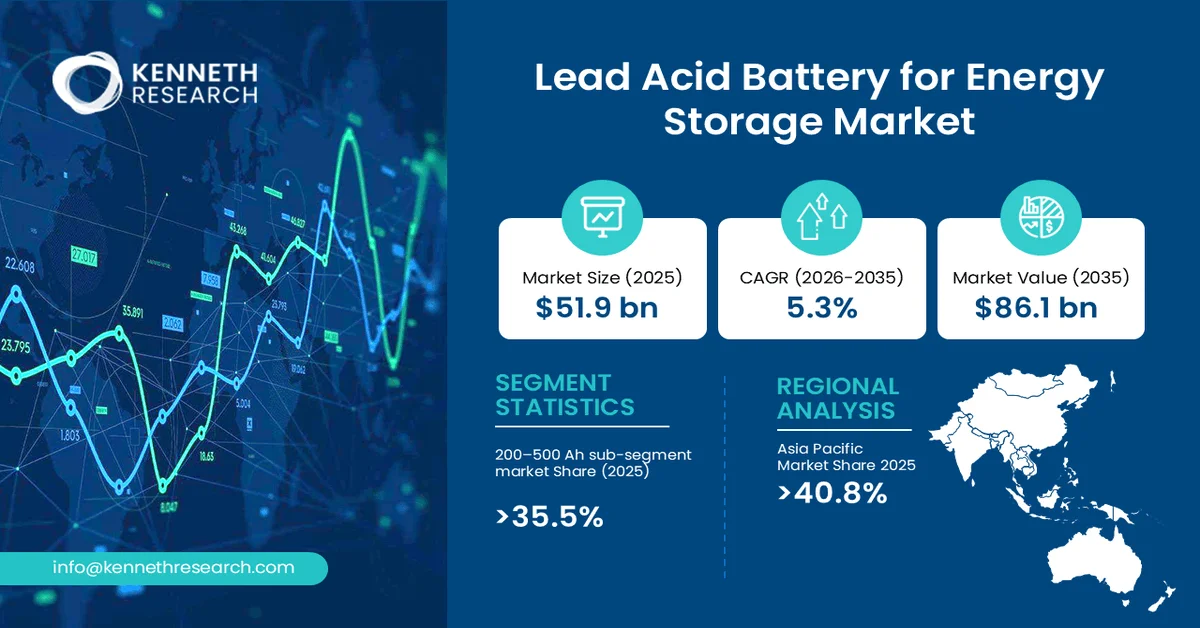
Lead Acid Battery for Energy Storage Market size was valued at USD 51.9 billion in 2025 and is projected to reach USD 86.1 billion by the end of 2035, rising at a CAGR of 5.3% during the forecast period, i.e., 2026-2035. In 2026, the industry size of lead acid battery for energy storage is estimated at USD 54.1 billion.
The primary growth driver is the accelerating deployment of renewable power and the resulting need for dependable energy storage. Lead-acid batteries offer a mature, proven electrochemical platform for stationary applications, supporting backup power, grid services, renewable-energy integration, and power-quality management where cost, availability, and established recycling infrastructure influence procurement decisions.
The lead acid battery for energy storage market covers rechargeable stationary battery systems that use lead-based electrodes and a sulfuric-acid electrolyte to store electricity for later discharge. These batteries are available in conventional flooded and valve-regulated configurations and can be engineered for standby, backup, cycling, and stationary storage duties. Their operating characteristics include established manufacturing processes, relatively simple electrochemical architecture, robust availability of raw materials, and mature handling and recycling practices.
In energy-storage applications, systems can be deployed alongside renewable generation, within utility infrastructure, or at commercial and industrial sites to provide stored power when generation is unavailable or when grid conditions require flexibility. The technology is industrially relevant because storage assets help manage renewable intermittency, maintain continuity of electricity supply, and support power-system reliability. Lead-acid technology also remains relevant where buyers prioritize proven supply chains, serviceability, established safety practices, and lifecycle recovery capabilities. Its role is therefore defined by practical stationary-storage requirements rather than by mobility applications.
Key Lead Acid Battery for Energy Storage Market Insights Summary:
Key Takeaways: Market Trends & Insights
- Lead Acid Battery for Energy Storage Market reached USD 51.9 billion in 2025 and is projected to reach USD 86.1 billion by 2035
- The market is expected to expand at a 5.3% CAGR during 2026-2035
- The 200–500 Ah capacity segment held the largest share at 35.5% in 2025
- Utility-owned storage represents the second and fastest-growing segment by form
- Asia-Pacific led the market with a 40.8% share in 2025, supported by strong activity in China and India
Market Drivers
- Expansion of renewable energy and grid flexibility requirements
- Demand for reliable backup and distributed power resilience
- Increasing deployment of energy storage for commercial and industrial power management
- Continued technological improvement and lifecycle optimization of lead-acid storage systems
Challenges
- Limited deep-cycling performance and energy density
- Intensifying competition from alternative battery chemistries
Lead Acid Battery for Energy Storage Market Overview & Supply Chain
Global adoption of energy-storage batteries is increasing as power systems accommodate higher penetration of variable renewable generation and require greater flexibility, reliability, and backup capability. Battery storage is increasingly relevant across utility-scale electricity systems, distributed energy resources, commercial facilities, and critical infrastructure because it can shift electricity over time, support grid stability, manage congestion, and provide backup during outages. This trend is reinforced by government and intergovernmental energy-transition policies that prioritize storage alongside renewable-power deployment.
The lead acid battery for energy storage market value chain begins with sourcing lead-bearing materials, sulfuric acid, plastics, separators, additives, and other components required for electrode and battery assembly. Upstream participants include mining and metal-processing companies, chemical suppliers, component manufacturers, and recyclers that provide primary or recovered materials. Battery manufacturers convert these inputs into plates, separators, cells, modules, and complete stationary-storage systems through casting, paste preparation, curing, assembly, formation, testing, and system integration. Distribution then moves through battery distributors, electrical-equipment suppliers, system integrators, and specialized energy-storage channels, depending on project scale and procurement structure. End users include utilities, renewable-energy developers, commercial and industrial facilities, telecommunications operators, data centers, and critical infrastructure operators.
Lead Acid Battery for Energy Storage Market: Growth Drivers & Challenges
Growth Drivers:
- Expansion of renewable energy and grid flexibility requirements: The increasing integration of solar and wind generation is creating a stronger requirement for dependable storage that can balance variable electricity supply, provide backup, and improve power-system flexibility. Lead-acid batteries benefit from this environment because their established technology base supports stationary applications where reliability, serviceability, and mature supply infrastructure are important purchasing considerations. Their role is particularly relevant for backup systems, renewable-energy installations, telecommunications infrastructure, and other applications requiring dependable stored electricity. Industry development is also being supported by continued product innovation from established battery manufacturers. In 2025, Exide Industries announced the launch of a new-generation lead-acid-based Battery Energy Storage Solution, specifically showcasing the technology for utilities and industrial applications.
- Demand for reliable backup and distributed power resilience: Growing dependence on continuous electricity is strengthening demand for stationary storage capable of maintaining power availability during grid disturbances, outages, and periods of supply instability. Lead-acid batteries are well positioned in this environment because they offer a mature solution for backup applications across telecommunications, industrial facilities, commercial operations, infrastructure, and critical services. Their established operating characteristics allow system integrators and facility operators to deploy familiar architectures with established maintenance practices and supply channels. The technology can also complement renewable generation by storing electricity for subsequent use when generation conditions change. As businesses increasingly prioritize operational continuity and resilience, procurement decisions are likely to consider not only energy-storage performance but also technology maturity, availability of replacement components, service networks, and end-of-life handling.
Challenges:
- Limited deep-cycling performance and energy density: A fundamental restraint is the mismatch between conventional lead-acid architecture and storage applications requiring frequent, deep charge-discharge cycles. Repeated deep cycling accelerates degradation, reducing usable service life and increasing replacement requirements. The U.S. Department of Energy identifies the relationship between depth of discharge and cycle life as a significant technical challenge for lead-acid storage, particularly when systems must achieve competitive levelized storage economics. Commercially, this can require additional battery capacity or more conservative operating strategies to preserve durability, increasing system footprint, replacement exposure, and lifecycle costs. The constraint is especially relevant as storage projects increasingly perform more active grid-balancing duties rather than serving solely as standby assets.
- Intensifying competition from alternative battery chemistries: Lead-acid technology faces increasing competitive pressure from battery chemistries designed around higher-performance stationary-storage requirements. Lithium-ion and emerging alternatives can provide characteristics that are advantageous for applications demanding compact installations, frequent cycling, or extended operational flexibility. This creates a commercial challenge because project developers increasingly evaluate storage technologies on total lifecycle performance rather than initial equipment cost alone. Lead-acid suppliers must consequently compete through application-specific economics, reliability, established recycling pathways, and improvements in operating performance rather than relying solely on technological maturity. The competitive pressure can also influence investment priorities, system-integrator preferences, and procurement specifications, particularly for new utility and renewable-energy projects.
Lead Acid Battery for Energy Storage Market Size and Forecast:
| Report Attribute | Details |
|---|---|
| Base Year |
2025 |
| Forecast Period |
2026-2035 |
| CAGR |
5.3% |
| Base Year Market Size (2025) |
USD 51.9 billion |
| Forecast Year Market Size (2035) |
USD 86.1 billion |
| Regional Scope |
|
Lead Acid Battery for Energy Storage Market Segmentation Analysis:
Capacity Segment Analysis
In the capacity segment, the 200–500 Ah sub-segment is anticipated to capture the largest market share of 35.5% by the end of 2025.
The 200–500 Ah capacity segment dominates because it aligns well with the practical requirements of stationary energy-storage installations that need meaningful backup capability without the footprint and configuration complexity associated with very large individual battery units. Demand is supported by renewable-power integration, backup requirements, telecommunications infrastructure, commercial facilities, and distributed energy systems, where modular battery configurations enable system integrators to tailor storage capacity to site-specific loads. Adoption also benefits from the mature manufacturing ecosystem for lead-acid cells, established component supply, standardized installation practices, and broad service expertise. Supply-side maturity should support continued availability of batteries within established capacity ranges, while future demand is likely to favor modular, serviceable configurations that balance storage requirements, installation constraints, reliability, and lifecycle economics.
Form Segment Insights
The utility-owned is projected to grow as the second-largest segment in the lead acid battery for energy storage market due to four converging demand drivers.
The utility-owned segment is projected to grow as electric utilities increasingly deploy stationary batteries to improve grid flexibility, manage electricity-price differentials, integrate variable renewable generation, and strengthen system reliability. Utility ownership can provide greater control over storage dispatch and enables batteries to participate directly in grid-support functions, making this form increasingly relevant as power systems become more dynamic. Adoption is also being encouraged by the expansion of utility-scale storage projects and the growing integration of solar and wind resources. The U.S. Energy Information Administration reported that, at the end of 2023, U.S. electricity utilities operated 575 batteries, with a combined capacity of 15,814 megawatts, while utility-reported plans indicated substantial additional capacity through 2028. This development strengthens opportunities for established stationary technologies, including lead-acid systems, in applications where reliability, mature supply chains, and operational familiarity remain important.
Our in-depth analysis of the global lead acid battery for energy storage market includes the following segments:
|
Segment |
Sub-segment |
|
Capacity |
|
|
Form |
|
|
Application |
|
Lead Acid Battery for Energy Storage Market Regional Insights:
Asia Pacific Market Trends & Insights:
Asia Pacific lead acid battery for energy storage market is projected to hold the largest revenue share of 40.8% by the end of 2025.
Asia-Pacific leads the market with a 40.8% share in 2025, supported by extensive electricity infrastructure, expanding renewable generation, established battery manufacturing capabilities, and increasing investment in stationary storage. China is a major production and deployment center, while India is strengthening domestic battery manufacturing and storage infrastructure through policy support. Regional utilities, industrial operators, renewable developers, and infrastructure providers are increasingly incorporating storage to improve grid flexibility and power reliability. China’s National Energy Administration reported that new energy-storage installations reached 73.76 million kilowatts by the end of 2024, highlighting the scale of regional storage deployment and the investment environment supporting battery technologies.
China remains the regional anchor because of its large electricity system, extensive renewable-energy deployment, industrial manufacturing ecosystem, and active government support for energy-storage development. Its storage expansion is strengthening demand for diverse battery technologies and associated system components.
India is emerging as another important regional market as renewable integration, grid modernization, and domestic manufacturing policies stimulate storage investment. The Ministry of Heavy Industries' battery-storage program explicitly supports domestic manufacturing and stationary-storage demand, strengthening the country's supply-chain foundation.
North America Market Trends & Insights:
North America represents an important market for stationary energy storage, supported by grid modernization, renewable-power integration, resilience requirements, and increasing electrification of commercial and industrial activity. Utilities and energy developers are adopting storage to improve system flexibility, manage variable generation, and strengthen reliability, while industrial users increasingly view battery systems as tools for continuity of operations and power-quality management. Government initiatives are reinforcing this environment. In the United States, the Department of Energy continues to support storage innovation, grid resilience, and domestic manufacturing through programs under its Energy Storage Grand Challenge and related initiatives. Canada is likewise supporting renewable-energy projects incorporating battery storage, creating opportunities for suppliers and system integrators.
The United States is the principal North American demand center, driven by utility-scale storage deployment, renewable integration, data-center and industrial power requirements, and federal efforts to strengthen domestic battery supply chains. DOE is also addressing battery-storage supply-chain risks and encouraging greater domestic manufacturing capability.
Canada offers complementary opportunities through renewable-energy development and grid-electrification programs. Its government-backed storage projects demonstrate increasing integration of batteries with wind and other renewable resources, while funding programs support deployment and technology development.
Leading Companies Operating in the Global Lead Acid Battery for Energy Storage Market:
Here is a list of upstream, downstream, and key players operating in the global lead acid battery for energy storage market competitive ecosystem:
- EnerSys (United States)
- Company Overview
- Business Strategy
- Key Product Offerings
- Financial Performance
- Key Performance Indicators
- Risk Analysis
- Recent Development
- Regional Presence
- SWOT Analysis
- Exide Technologies (United States)
- Clarios (formerly Johnson Controls Power Solutions) (United States)
- East Penn Manufacturing Company (United States)
- GS Yuasa International Ltd. (Japan)
- Exide Industries Ltd. (India)
Recent Developments
- In December 2024, GS Yuasa Energy Solutions delivered a high-cycle SLR-1000 lead-acid battery system integrated with a Siemens Managed EV Charging and Microgrid platform to Ameren Missouri. The system stores solar-generated electricity and charges EVs, with SLR-1000 batteries capable of withstanding 5,000 cycles at 70% depth of discharge—more than double the capacity of conventional products—and is expected to be used in renewable energy and power storage systems.
- In March 2025, EnerSys announced integration of embedded monitoring technology into its DataSafe® Thin Plate Pure Lead (TPPL) batteries for data centre backup power, enabling real-time tracking of voltage and temperature parameters for proactive maintenance.
Frequently Asked Question
In 2025, the lead acid battery for energy storage market exceeded USD 51.9 billion.
The lead acid battery for energy storage market is projected to reach USD 86.1 billion by the end of 2035, expanding at a CAGR of 5.3% over the forecast period (2026-2035).
The major players in the market are EnerSys, Exide Technologies, Clarios (formerly Johnson Controls Power Solutions), East Penn Manufacturing Company, GS Yuasa International Ltd., Exide Industries Ltd., and others.
In the capacity segment, the 200–500 Ah sub-segment is anticipated to capture the largest market share of 35.5% in the future and exhibit lucrative growth opportunities during 2026-2035. This growth trajectory is largely attributed to demand from stationary backup, renewable-energy, telecommunications, and distributed energy applications.
Asia-Pacific is projected to hold the largest market share of 40.8% by the end of 2025 and provide more business opportunities in the future. Continuous investments in energy storage, renewable-energy integration, and battery manufacturing in China and India are fostering the region's dominance.
Why Choose Kenneth Research ?
-
Insight with Impact : We don’t just gather data — we uncover stories, trends, and opportunities that fuel business growth.
-
Experts Who Get It : Our team speaks your industry’s language and knows what really matters to your customers and market.
-
Custom-Built for You : Forget one-size-fits-all. We craft research and consulting solutions as unique as your business vision.
-
Partners, Not Just Providers : We work with you, not for you — collaborating closely to turn insights into smart, strategic moves.
-
Results That Speak : Our work powers brands, startups, and industry leaders alike — with a track record of ideas that work in the real world.
Report ID: 1213 |
Published Date: 01 Sep 2026 |
Report Format: |
Delivery Timeline: 48-72 Business Hours

Copyright © 2025 Kenneth Research. All rights reserved. Terms of Use | Privacy Policy
