Report ID: 1415 |
Published Date: 25 Sep 2026 |
Report Format: |
Delivery Timeline: 48-72 Business Hours
Intelligent Automation Market Outlook:
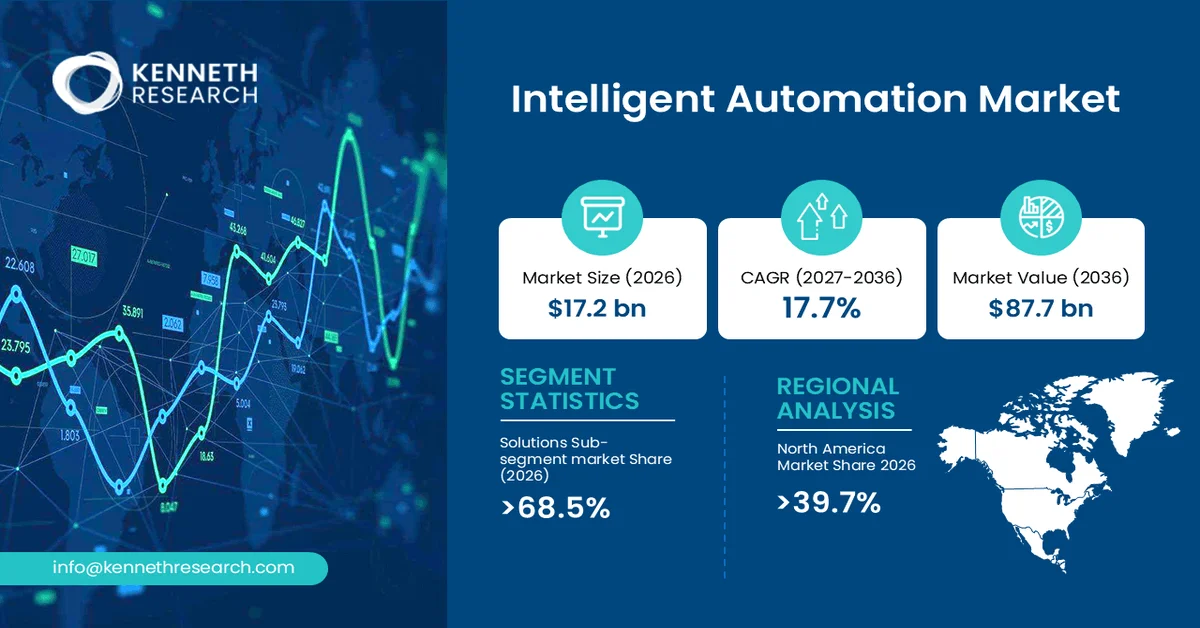
Intelligent Automation Market size was valued at USD 17.2 billion in 2026 and is projected to reach USD 87.7 billion by the end of 2036, rising at a CAGR of 17.7% during the forecast period, i.e., 2027-2036. In 2027, the industry size of the intelligent automation is estimated at USD 20.2 billion.
A primary growth driver is the accelerating adoption of AI-enabled technologies to improve workforce performance, automate repetitive activities, and support higher-value decision-making. OECD research reports that four in five surveyed workers said AI improved their performance, reinforcing the business case for integrating intelligent automation into operational workflows and productivity-focused transformation programs.
Intelligent automation market refers to the ecosystem of software, platforms, technologies, and services that combine automation with artificial intelligence to execute, coordinate, optimize, and continuously improve business processes. It integrates capabilities such as robotic process automation, machine learning, natural language processing, computer vision, intelligent document processing, workflow orchestration, and decision-support technologies.
A key characteristic is the ability to move beyond rule-based task automation by incorporating data-driven learning, contextual analysis, prediction, and adaptive decision-making. Intelligent automation can therefore support both structured and semi-structured processes while reducing manual intervention and improving process consistency.
Key Intelligent Automation Market Insights Summary:
Key Takeaways: Market Trends & Insights
- Solutions accounted for 68.5% market share in 2026 within the business model segment
- North America hold 39.7% market share in 2026, supported by strong technology adoption and enterprise investment
- The intelligent automation market is projected to reach USD 87.7 billion by 2036
- The market is expected to expand at a CAGR of 17.7% from 2027 to 2036
- Machine and deep learning is identified as the second and fastest analysis segment within the technology category
Market Drivers
- AI adoption across manufacturing and enterprise operations
- Growing demand for intelligent process optimization
- Expansion of cloud-based automation and AI infrastructure
- Increasing integration of machine learning with enterprise workflows
Challenges
- Integration complexity and legacy-system constraints
- Data governance, security, and trust barriers
Intelligent Automation Market Overview & Supply Chain
Adoption of intelligent automation is increasing globally as enterprises combine artificial intelligence, workflow automation, machine learning, and data-driven decision systems to improve operational resilience, productivity, and process quality. Its relevance extends across manufacturing, logistics, financial services, healthcare, energy, retail, telecommunications, and government operations, where organizations increasingly require automated handling of complex and high-volume processes.
The intelligent automation value chain begins with input sources, including computing infrastructure, cloud resources, enterprise data, application programming interfaces, software development tools, sensors, and specialized AI models. Technology developers and platform providers transform these inputs into automation software, machine learning capabilities, workflow engines, intelligent document processing systems, analytics platforms, and orchestration tools. Production therefore centers on software engineering, model development, systems integration, testing, cybersecurity, and deployment rather than conventional physical manufacturing. Distribution occurs through direct enterprise sales, cloud marketplaces, channel partners, systems integrators, managed-service providers, and technology consultants. End users include manufacturers, healthcare organizations, financial institutions, retailers, logistics operators, energy companies, telecommunications providers, and public-sector organizations.
Intelligent Automation Market: Growth Drivers & Challenges
Growth Drivers:
- AI adoption across manufacturing and enterprise operations: The expansion of artificial intelligence across industrial operations is accelerating demand for intelligent automation because enterprises increasingly seek systems that can interpret operational data, identify patterns, optimize workflows, and support decisions with limited manual intervention. Manufacturing is particularly important because intelligent automation can connect production processes with predictive maintenance, computer vision, production planning, inventory management, and quality-control applications.
- Growing demand for intelligent process optimization: Enterprises are increasingly moving from isolated task automation toward end-to-end process optimization, creating a broader opportunity for intelligent automation platforms. Organizations can combine workflow orchestration, machine learning, natural language processing, document intelligence, analytics, and decision-support capabilities to automate processes that previously required substantial human intervention. This shift can improve process consistency while allowing employees to focus on activities requiring judgment, customer interaction, and specialized expertise.
Challenges:
- Integration complexity and legacy-system constraints: A major restraint is the difficulty of integrating intelligent automation with fragmented enterprise architectures and legacy information systems. Many organizations operate heterogeneous applications, databases, and workflows that were developed independently and lack standardized interfaces or consistent data structures. This creates substantial implementation complexity because automation platforms must connect systems, reconcile data formats, preserve existing controls, and operate reliably across multiple environments.
- Data governance, security, and trust barriers: Intelligent automation depends heavily on reliable enterprise data and increasingly involves AI systems that can influence operational decisions. Weak data governance, unclear accountability, cybersecurity exposure, and concerns about explainability can therefore constrain deployment, particularly in highly regulated or business-critical environments. Organizations must determine how automated systems access sensitive information, validate outputs, manage permissions, monitor performance, and respond when systems behave unexpectedly.
Intelligent Automation Market Size and Forecast:
| Report Attribute | Details |
|---|---|
| Base Year |
2026 |
| Forecast Period |
2027-2036 |
| CAGR |
17.7% |
| Base Year Market Size (2026) |
USD 17.2 billion |
| Forecast Year Market Size (2036) |
USD 87.7 billion |
| Regional Scope |
|
Intelligent Automation Market Segmentation Analysis:
Business Model Segment Analysis
In the business model segment, solutions sub-segment is anticipated to capture the largest market share of 68.5% by the end of 2026.
The solutions segment dominates the intelligent automation market because enterprises increasingly prefer integrated technology platforms that combine automation, artificial intelligence, analytics, workflow orchestration, and decision-support capabilities within existing technology environments. Demand is being reinforced by organizations seeking scalable tools that can automate repetitive processes while improving operational visibility and employee productivity. Adoption is particularly strong among larger enterprises, where complex workflows and established digital infrastructures provide suitable environments for deploying integrated automation solutions. Eurostat reported that 41% of large EU enterprises used AI technologies in 2024, compared with 21% of medium-sized and 11% of small enterprises, demonstrating stronger technology adoption among organizations with greater implementation capacity.
Technology Segment Analysis
The machine and deep learning is projected to grow as the second-largest segment in the intelligent automation market due to four converging demand drivers.
Machine and deep learning is projected to grow strongly within the intelligent automation market as enterprises increasingly require systems capable of learning from operational data, identifying patterns, predicting outcomes, and improving automated decisions. Demand is being driven by applications such as predictive maintenance, fraud detection, demand forecasting, intelligent customer service, quality monitoring, and process optimization. Government evidence indicates that adoption is progressing within business environments: the UK Office for National Statistics reported that 17% of businesses with 250 or more employees used data processing through machine learning in 2024, highlighting its relevance among larger organizations with complex data-intensive operations. Supply-side development is supported by expanding availability of cloud computing, pretrained models, specialized AI infrastructure, development frameworks, and enterprise-ready machine-learning platforms.
Our in-depth analysis of the intelligent automation market includes the following segments:
|
Segment |
Sub-segment |
|
Technology |
|
|
Business Model |
|
|
Application |
|
|
Vertical |
|
Intelligent Automation Market Regional Insights:
North America Market Trends & Insights:
North America intelligent automation market is projected to hold the largest revenue share of 39.7% by the end of 2026.
North America remains the dominant region for the intelligent automation market, supported by the strong concentration of technology providers, advanced enterprise IT infrastructure, high investment in artificial intelligence, and early adoption of automation across major industries. The region’s input-specified market-share position reflects its established ecosystem spanning software development, cloud computing, data infrastructure, systems integration, and enterprise technology procurement.
The United States represents the principal country market, supported by its large technology ecosystem, substantial enterprise base, advanced cloud infrastructure, and extensive investment across AI-enabled software and automation.
Canada complements regional development through its growing AI ecosystem, research capabilities, and increasing business adoption. Canadian adoption is particularly evident in information and cultural industries, professional, scientific and technical services, and finance and insurance, where AI deployment is becoming increasingly integrated into operational activities. Together, the United States and Canada provide a strong combination of technology supply, enterprise demand, research capacity, and investment that should sustain North America’s leadership as intelligent automation becomes more deeply embedded across business processes.
Asia Pacific Market Trends & Insights:
Asia Pacific represents a strong secondary region for the intelligent automation market, supported by expanding digital transformation, large manufacturing bases, growing enterprise technology adoption, and increasing demand for productivity-enhancing automation. Industrial activity across electronics, automotive, machinery, chemicals, logistics, and consumer products creates diverse deployment opportunities for intelligent automation across production, quality management, supply chains, and enterprise workflows.
China is the principal country opportunity within the region, benefiting from its extensive manufacturing ecosystem and strong policy emphasis on intelligent manufacturing, industrial digitalization, and AI-enabled production. Government programs are encouraging enterprises to upgrade equipment, develop smart factories, and integrate intelligent technologies throughout production and supply-chain processes.
India offers a complementary growth opportunity through expanding digital infrastructure, manufacturing modernization, technology services, and enterprise adoption of AI-enabled solutions. For suppliers, both markets provide opportunities to develop industry-specific automation platforms, intelligent manufacturing solutions, and integration services tailored to local industrial requirements.
Leading Companies Operating in the Global Intelligent Automation Market:
Here is a list of upstream, downstream, and key players operating in intelligent automation market competitive ecosystem:
- UiPath (United States)
- Company Overview
- Business Strategy
- Key Product Offerings
- Financial Performance
- Key Performance Indicators
- Risk Analysis
- Recent Development
- Regional Presence
- SWOT Analysis
- IBM Corporation (United States)
- Automation Anywhere (United States)
- Blue Prism (SS&C Technologies) (United Kingdom/United States)
- Appian Corporation (United States)
Recent Developments
- In May 2026, Automation Anywhere unveiled Enterprise Claw, a new capability developed in collaboration with Cisco, NVIDIA, Okta, and OpenAI to run claw-style AI agents across enterprise systems.
EnterpriseClaw is designed to deploy autonomous AI agents across cloud platforms, desktops, on-premises systems, and secured enterprise networks, enabling AI-driven work to run securely under centralized control. The feature is in public preview with general availability expected later this year. - In April 2026, Appian Corporation announced new capabilities in agentic automation and AI-assisted spec-driven development.
The Appian Platform enhancements include AI agents embedded directly in business processes with improved structure and guardrails, integration with Model Context Protocol (MCP) for secure external system access, and a technology partnership with Snowflake. AI-assisted spec-driven development enables extraction of specifications from legacy applications to accelerate application modernization.
Frequently Asked Question
In 2026, the intelligent automation market exceeded USD 17.2 billion.
The intelligent automation market is projected to reach USD 87.7 billion by the end of 2036, expanding at a CAGR of 17.7% over the forecast period (2027-2036).
The major players in the market are UiPath, IBM Corporation, Automation Anywhere, Blue Prism (SS&C Technologies), Appian Corporation, and others.
In the business model segment, the solutions sub-segment is anticipated to capture the largest market share of 68.5% in the future and exhibit lucrative growth opportunities during 2027-2036. This growth trajectory is largely attributed to increasing demand for integrated automation platforms that improve operational efficiency and process optimization.
North America is projected to hold the largest market share of 39.7% by the end of 2026 and provide more business opportunities in the future. Continuous investments in artificial intelligence, cloud infrastructure, enterprise technology, and automation across the United States and Canada are fostering the region's dominance.
Why Choose Kenneth Research ?
-
Insight with Impact : We don’t just gather data — we uncover stories, trends, and opportunities that fuel business growth.
-
Experts Who Get It : Our team speaks your industry’s language and knows what really matters to your customers and market.
-
Custom-Built for You : Forget one-size-fits-all. We craft research and consulting solutions as unique as your business vision.
-
Partners, Not Just Providers : We work with you, not for you — collaborating closely to turn insights into smart, strategic moves.
-
Results That Speak : Our work powers brands, startups, and industry leaders alike — with a track record of ideas that work in the real world.
Report ID: 1415 |
Published Date: 25 Sep 2026 |
Report Format: |
Delivery Timeline: 48-72 Business Hours

Copyright © 2025 Kenneth Research. All rights reserved. Terms of Use | Privacy Policy
