Report ID: 1246 |
Published Date: 14 Sep 2026 |
Report Format: |
Delivery Timeline: 48-72 Business Hours
Hydrogen Fuel Market Outlook:
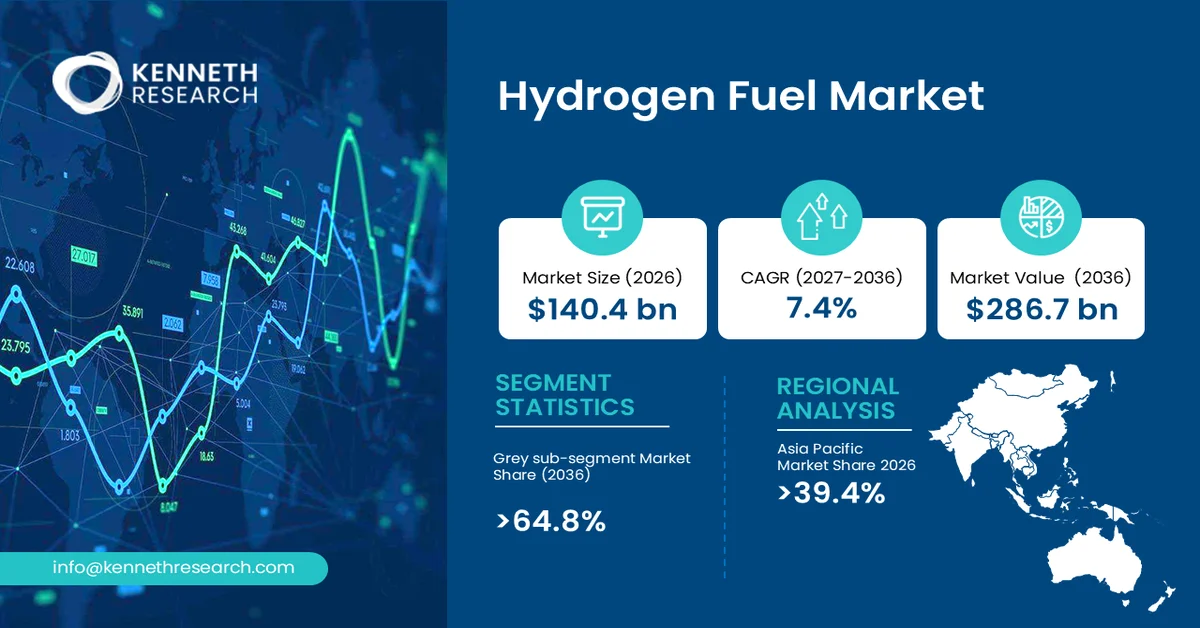
Hydrogen Fuel Market size was valued at USD 140.4 billion in 2026 and is projected to reach USD 286.7 billion by the end of 2036, rising at a CAGR of 7.4% during the forecast period, i.e., 2027–2036. In 2027, the industry size of the hydrogen fuel market is estimated at USD 150.8 billion.
The primary growth driver for the hydrogen fuel market is expanding demand for hydrogen across refining, chemicals, steel, power generation, and emerging energy applications.
The hydrogen fuel market encompasses the production, processing, storage, distribution, and utilization of hydrogen as an energy carrier or fuel across industrial and energy applications. Hydrogen is produced through multiple pathways, including natural-gas reforming, coal gasification, water electrolysis, and other production technologies. Based on its production pathway and emissions profile, hydrogen is commonly classified as grey, blue, green, and other low-carbon forms.
Its key characteristics include high energy density by mass, compatibility with fuel-cell technologies, potential for long-duration energy storage, and the ability to support decarbonization in applications where direct electrification can be challenging.
Key Hydrogen Fuel Market Insights Summary:
Key Takeaways: Market Trends & Insights
- The hydrogen fuel market is projected to grow from USD 140.4 billion in 2026 to USD 286.7 billion by 2036, registering a 7.4% CAGR.
- Asia-Pacific accounted for the largest regional share at 39.4% in 2026, supported by strong industrial hydrogen demand and government-backed hydrogen development in Japan and China.
- Grey Hydrogen remains the leading Source segment with a 64.8% share in 2026, benefiting from established production infrastructure and extensive industrial use.
- Power and Heat Generation represents an important emerging Application opportunity, particularly in Japan and Korea, where hydrogen-based power projects and policy support are progressing.
Market Drivers
- Expanding industrial hydrogen demand
- Rising adoption in emerging energy applications
- Government-backed hydrogen strategies and clean-energy incentives
- Increasing investment in hydrogen production and infrastructure
Challenges
- High production costs and financing uncertainty.
- Limited infrastructure and regulatory complexity.
Hydrogen Fuel Market: Market Overview & Supply Chain
The hydrogen fuel market is expanding as hydrogen remains an important industrial feedstock while gradually developing into an energy carrier for power generation, transport, synthetic fuels, and other emerging applications. Demand is still concentrated in established industrial uses such as refining, ammonia, methanol, and direct reduced iron, while newer applications are beginning to create additional demand. The International Energy Agency reports that global hydrogen demand surpassed 100 Mt in 2025, with traditional industrial and refining uses accounting for almost all consumption.
The market supply chain begins with feedstock and energy suppliers providing natural gas, coal, renewable electricity, water, and other inputs required for hydrogen production. Producers then manufacture hydrogen through pathways including natural-gas reforming, coal-based production, electrolysis, and fossil-fuel processes combined with carbon capture. Downstream infrastructure includes compression, liquefaction, storage, pipelines, transport equipment, terminals, and refueling facilities.
Hydrogen Fuel Market: Growth Drivers & Challenges
Growth Drivers
- Expanding Industrial Hydrogen Demand: Hydrogen demand is expanding across established industrial applications, particularly refining, chemicals, ammonia, methanol, and steel. The International Energy Agency reported that global hydrogen demand reached almost 100 Mt in 2024, with traditional industrial applications accounting for the overwhelming majority of consumption. This established demand base encourages producers to expand hydrogen capacity and enables investment in storage, transportation, compression, and related infrastructure. Government-backed initiatives are also supporting new hydrogen ecosystems. In the U.S., the Department of Energy announced up to USD 2.2 billion in awards for two Regional Clean Hydrogen Hubs in 2024, supporting hydrogen production, storage, delivery, and end-use infrastructure.
- Rising Adoption of Hydrogen in Emerging Energy Applications: Hydrogen is increasingly being evaluated for applications where direct electrification can be technically difficult, including power generation, heavy-duty transportation, energy storage, and high-temperature industrial processes. Hydrogen-capable turbines, fuel cells, and hydrogen-derived fuels are creating additional pathways for market expansion. The power sector is particularly important in Asia, where Japan and Korea are advancing hydrogen-based electricity-generation projects supported by government policies.
Challenges
- High Production Costs and Financing Uncertainty: The cost gap between conventional fossil-based hydrogen and low-emissions alternatives remains a major challenge for market expansion. The International Energy Agency reports that renewable hydrogen production can currently cost 1.5 to 6 times more than unabated fossil-based production, creating difficulty in securing competitive offtake agreements and investment for new projects. High capital requirements for electrolyzers, renewable power, carbon-capture equipment, compression, and associated infrastructure can further increase project-financing complexity.
- Limited Infrastructure and Regulatory Complexity: Insufficient transportation, storage, and distribution infrastructure remains another significant constraint. Hydrogen production and consumption have historically occurred at the same location, limiting the development of large-scale transport networks. As production becomes geographically separated from end users, pipelines, storage facilities, terminals, and specialized transport infrastructure will become increasingly important. The IEA notes that hydrogen infrastructure development remains limited and that delays can prevent producers from connecting supply with potential consumers.
Hydrogen Fuel Market Size and Forecast:
| Report Attribute | Details |
|---|---|
| Base Year |
2026 |
| Forecast Year |
2027-2036 |
| CAGR |
7.4% |
| Base Year Market Size (2025) |
USD 140.4 billion |
| Forecast Year Market Size (2035) |
USD 286.7 billion |
| Regional Scope |
|
Hydrogen Fuel Market: Segment Analysis:
Source Segment Analysis
In the Source segment, the Grey sub-segment is anticipated to capture the largest market share of 64.8% by the end of 2036.
Its leading position is supported by the established use of natural-gas-based hydrogen production across refining, chemicals, ammonia, methanol, and other industrial applications. Existing production infrastructure, mature process technology, and established industrial offtake networks provide grey hydrogen with a significant commercial advantage over newer production pathways. The International Energy Agency reports that hydrogen production remains dominated by unabated fossil fuels, reflecting the continued importance of conventional production routes within the global hydrogen supply chain. Grey hydrogen also benefits from established feedstock availability and integration with existing industrial facilities, allowing producers to supply hydrogen without requiring entirely new production and distribution ecosystems.
Application Type Segment Analysis
In the Application segment, Power and Heat Generation is emerging as an important growth area as utilities and energy companies explore hydrogen for thermal-power decarbonization and flexible energy supply. Hydrogen can be blended with natural gas in existing gas turbines or used as a dedicated fuel, creating opportunities to reduce emissions while utilizing portions of existing power-generation infrastructure. Japan's NEDO has been supporting hydrogen-power technology development, including large-scale gas-turbine demonstrations and hydrogen supply-chain technologies.
Japan is also advancing practical demonstrations of hydrogen co-firing. NEDO reported that Kansai Electric Power began a large-scale hydrogen co-firing demonstration at the Himeji No. 2 Power Station, using an existing gas turbine and targeting operational, maintenance, and safety technologies for hydrogen power generation. China is similarly developing hydrogen applications in power generation, with the National Energy Administration reporting progress in hydrogen blending tests for heavy-duty gas turbines and pure-hydrogen turbine demonstrations.
Our in-depth analysis of the global hydrogen fuel market includes the following segments:
|
Segment |
Sub-segment |
|
By Source |
|
|
By Application |
|
Hydrogen Fuel Market – Regional Analysis:
Asia-Pacific Market Trends & Insights:
Asia-Pacific is the dominant region, accounting for 39.4% in 2026, supported by strong industrial hydrogen demand, established refining and chemical industries, expanding power-sector applications, and active government support for hydrogen supply chains.
Japan has established a policy framework supporting low-carbon hydrogen supply and utilization, including measures for supply-chain development and demand creation in sectors such as power generation.
China is another major regional market, supported by its large industrial base and expanding hydrogen ecosystem. Government-led energy and industrial policies are encouraging hydrogen technology development and broader utilization. Japan and China together provide opportunities for hydrogen producers, electrolyzer and reforming-technology suppliers, storage and transportation providers, and power-generation companies. Continued investment in hydrogen infrastructure, industrial decarbonization, and emerging power applications should reinforce Asia-Pacific's market leadership.
North America Market Trends & Insights:
North America represents a significant secondary market, supported by government-backed hydrogen strategies, clean-energy investment, and expanding industrial applications.
The U.S. is the leading country in the region, with federal programs focused on hydrogen production, delivery, storage, fuel cells, and technology validation. The U.S. Department of Energy's National Hydrogen Strategy and Roadmap provides a framework for scaling hydrogen across multiple economic sectors.
Canada is also strengthening its hydrogen ecosystem through production projects, infrastructure development, and clean-hydrogen investment incentives. Natural Resources Canada reported in 2024 that more than 80 low-carbon hydrogen projects were announced, under consideration, or under development, demonstrating expanding investment activity across the country's hydrogen value chain.
Together, the U.S. and Canada offer opportunities for hydrogen producers, infrastructure developers, electrolyzer manufacturers, and industrial end users. Growth is expected to be supported by decarbonization of heavy industry and transportation, development of hydrogen hubs and corridors, and increasing integration of hydrogen into North America's broader clean-energy system.
Hydrogen Fuel Market: Competitive Landscape
Here is a list of upstream, downstream, and key players operating in the global hydrogen fuel market competitive ecosystem:
- Air Liquide (France)
- Company Overview
- Business Strategy
- Key Product Offerings
- Financial Performance
- Key Performance Indicators
- Risk Analysis
- Recent Development
- Regional Presence
- SWOT Analysis
- Linde (United Kingdom)
- Air Products (United States)
Recent Developments
- July 2026 —Air Liquide reported that its ELYgator 200 MW electrolyzer project in Rotterdam reached a major construction milestone with installation of the first PEM electrolyzer modules.
- June 2026 —Air Products finalized an agreement with Yara relating to renewable ammonia from the NEOM Green Hydrogen Project in Saudi Arabia, while also announcing portfolio changes involving its Louisiana clean-energy project.
Frequently Asked Question
In 2026, the hydrogen fuel market was valued at USD 140.4 billion.
The market is projected to reach USD 286.7 billion by 2036, expanding at a CAGR of 7.4% during the forecast period.
Key companies include Air Liquide, Linde, Air Products, Plug Power, and Sinopec, among other hydrogen producers and technology providers.
In the Source segment, Grey Hydrogen is anticipated to remain dominant, supported by established production infrastructure and extensive use across traditional industrial applications.
Asia-Pacific is projected to remain the leading region, supported by strong industrial hydrogen demand and government-backed development of new hydrogen applications, particularly in Japan and China.
Why Choose Kenneth Research ?
-
Insight with Impact : We don’t just gather data — we uncover stories, trends, and opportunities that fuel business growth.
-
Experts Who Get It : Our team speaks your industry’s language and knows what really matters to your customers and market.
-
Custom-Built for You : Forget one-size-fits-all. We craft research and consulting solutions as unique as your business vision.
-
Partners, Not Just Providers : We work with you, not for you — collaborating closely to turn insights into smart, strategic moves.
-
Results That Speak : Our work powers brands, startups, and industry leaders alike — with a track record of ideas that work in the real world.
Report ID: 1246 |
Published Date: 14 Sep 2026 |
Report Format: |
Delivery Timeline: 48-72 Business Hours

Copyright © 2025 Kenneth Research. All rights reserved. Terms of Use | Privacy Policy
