Report ID: 1206 |
Published Date: 01 Sep 2026 |
Report Format: |
Delivery Timeline: 48-72 Business Hours
Hydrogen Energy Storage Market Outlook:
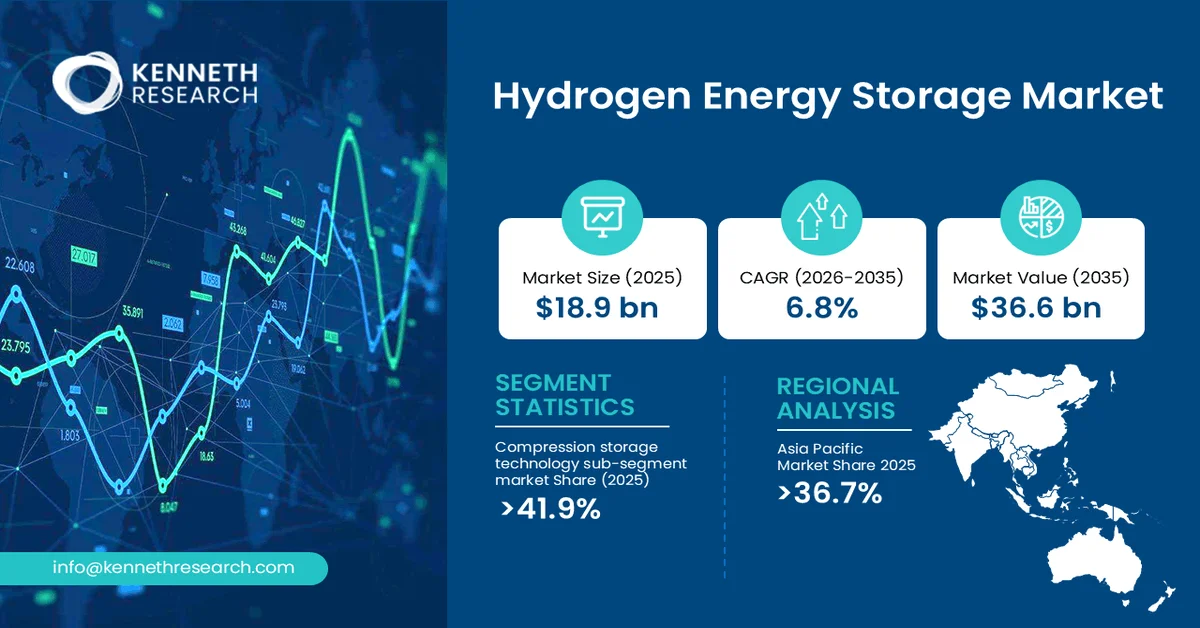
Hydrogen Energy Storage Market size was valued at USD 18.9 billion in 2025 and is projected to reach USD 36.6 billion by the end of 2035, rising at a CAGR of 6.8% during the forecast period, i.e., 2026-2035. In 2026, the industry size of hydrogen energy storage is estimated at USD 20.2 billion.
A primary growth driver is the integration of hydrogen with renewable power to provide long-duration and seasonal energy storage. The U.S. Department of Energy’s 2022 financing for Advanced Clean Energy Storage demonstrates support for storing renewable energy as hydrogen and dispatching it later, strengthening the commercial case for hydrogen storage.
The hydrogen energy storage market comprises technologies, equipment, systems, and related services that convert electricity or other energy inputs into hydrogen, retain that hydrogen for later use, and reconvert or deliver it when energy is required. The market spans hydrogen production interfaces, storage media and vessels, compression, liquefaction, material-based storage, underground storage, and associated balance-of-system infrastructure. Key characteristics include the ability to decouple energy production from consumption, accommodate variable renewable generation, and support storage over durations that can extend beyond conventional short-duration batteries.
Depending on the application, hydrogen may be stored as compressed gas, cryogenic liquid, or within materials or geological formations. Industrial relevance stems from hydrogen’s dual role as an energy carrier and industrial feedstock. Storage systems can connect renewable electricity with power generation, industrial operations, transport, and hydrogen supply networks, while helping manage intermittency, improve system flexibility, and provide dispatchable energy when direct electricity use is constrained at scale.
Key Hydrogen Energy Storage Market Insights Summary:
Key Takeaways: Market Trends & Insights
- Asia-Pacific held a 36.7% market share in 2025, led by China and Japan
- Compression Storage Technology dominated with a 41.9% share in 2025, supported by technological maturity and established infrastructure
- Industrial applications are expected to expand as hydrogen adoption grows across refining, chemicals, steel, and manufacturing
- China strengthens regional supply through electrolyzer manufacturing and hydrogen deployment, while Japan advances commercialization through policy support
- North America offers strong opportunities through the United States and Canada, supported by industrial demand, energy infrastructure, and hydrogen initiatives
Market Drivers
- Expansion of electrolyzer deployment and renewable power integration
- Rising demand for long-duration and seasonal energy flexibility
- Development of hydrogen infrastructure and dedicated storage networks
- Industrial decarbonization and integration of hydrogen into energy-intensive operations
Challenges
- High system costs and materials constraints
- Infrastructure, site dependence, and safety requirements
Hydrogen Energy Storage Market Overview & Supply Chain
Global adoption of hydrogen energy storage is increasing as energy systems seek flexible mechanisms capable of integrating variable renewable generation while supporting industrial decarbonization and energy security. Hydrogen can store surplus electricity in chemical form, enabling energy to be retained for subsequent power generation or industrial use and helping bridge mismatches between renewable production and demand. Its relevance extends across power systems, heavy industry, refining, chemicals, manufacturing, and emerging clean-energy applications. The International Energy Agency reported that global hydrogen demand reached 97 Mt in 2023, with demand remaining concentrated in refining and the chemical sector.
he hydrogen energy storage value chain begins with input resources including water, electricity, renewable power, natural gas where applicable, and specialized materials used in production and storage equipment. Hydrogen production is undertaken through electrolysis or other conversion pathways, followed by conditioning, compression, liquefaction, or conversion into suitable storage media. Equipment manufacturers supply electrolysers, compressors, storage vessels, liquefaction systems, pipelines, valves, controls, and power-conversion technologies. Distribution involves pipelines, tube trailers, liquid-hydrogen transport, dedicated storage infrastructure, and integrated hydrogen hubs connecting production with demand centers. End users include power generators, industrial facilities, refineries, chemical producers, manufacturers, mobility operators, and energy-system developers. Major stakeholders span hydrogen producers, renewable-energy companies, equipment manufacturers, utilities, infrastructure operators, industrial gas companies, engineering and construction firms, regulators, technology developers, project financiers, and large industrial offtakers
Hydrogen Energy Storage Market: Growth Drivers & Challenges
Growth Drivers:
- Expansion of electrolyzer deployment and renewable power integration: The expansion of electrolyzer infrastructure is strengthening the foundation for hydrogen energy storage by increasing the availability of hydrogen that can be produced when electricity supply exceeds immediate demand. Electrolyzers allow renewable electricity to be converted into hydrogen, creating a pathway for storing energy over longer periods and subsequently using it for power generation or industrial applications. The U.S. Department of Energy reported that existing and planned U.S. electrolyzer installations totaled approximately 4.5 GW as of May 2024, demonstrating increasing deployment activity across the hydrogen ecosystem. This infrastructure expansion supports storage developers by broadening potential hydrogen supply and improving integration between renewable generation, storage assets, and end-use facilities.
- Rising demand for long-duration and seasonal energy flexibility: The need for energy-storage solutions capable of addressing prolonged mismatches between electricity generation and consumption is creating a structural opportunity for hydrogen. Unlike storage technologies primarily optimized for short-duration applications, hydrogen can be produced during periods of abundant electricity and retained for later conversion or direct industrial use. This characteristic makes hydrogen relevant to renewable-heavy power systems where generation patterns can vary across hours, days, or seasons. Increasing deployment of wind and solar generation is consequently encouraging developers to consider storage pathways that extend beyond conventional battery applications. Hydrogen storage can also connect electricity markets with industrial demand, enabling energy assets to serve multiple revenue streams rather than relying exclusively on grid balancing.
Challenges:
- High system costs and materials constraints: Hydrogen energy storage remains constrained by the cost and material requirements of compression, containment, and associated balance-of-system equipment. High-pressure storage depends on specialized vessels and materials that must withstand demanding operating conditions while maintaining durability and safety. Cryogenic storage introduces additional equipment and thermal-management requirements, while advanced storage pathways require further technology development before achieving broad commercial readiness. These requirements increase capital intensity and can weaken project economics compared with established storage alternatives, particularly where utilization rates are uncertain or infrastructure must be developed specifically for hydrogen. Commercial developers therefore face pressure to secure reliable offtake, optimize system utilization, and reduce equipment costs simultaneously.
- Infrastructure, site dependence, and safety requirements: Hydrogen storage projects face an infrastructure challenge because economic deployment depends on coordinated production, transportation, storage, and end-use networks. Large-scale storage can also be geographically constrained where underground formations are unsuitable or insufficiently characterized, limiting developers’ ability to select sites solely on the basis of demand or renewable-resource availability. Safety requirements add another layer of complexity because hydrogen behavior, leakage prevention, materials compatibility, monitoring, and operating procedures must be addressed throughout the storage lifecycle. These factors can lengthen project development, increase engineering requirements, and create uncertainty around permitting and investment decisions. The commercial implication is that storage assets may need to be developed as integrated regional systems rather than isolated projects.
Hydrogen Energy Storage Market Size and Forecast:
| Report Attribute | Details |
|---|---|
| Base Year |
2025 |
| Forecast Period |
2026-2035 |
| CAGR |
6.8% |
| Base Year Market Size (2025) |
USD 18.9 billion |
| Forecast Year Market Size (2035) |
USD 36.6 billion |
| Regional Scope |
|
Hydrogen Energy Storage Market Segmentation Analysis:
Technology Segment Analysis
In the technology segment, the compression storage technology sub-segment is anticipated to capture the largest market share of 41.9% by the end of 2025.
Compression storage technology dominates because it is the most mature physical hydrogen-storage pathway and can be deployed across stationary, transport, and distribution applications. The U.S. Department of Energy identifies physical storage as the most mature hydrogen-storage technology and notes that compressed-gas vessels are the near-term solution for automotive applications. This maturity supports adoption where established equipment designs, operating practices, and infrastructure are important purchasing considerations. Demand is also reinforced by hydrogen delivery requirements: the DOE states that hydrogen is commonly compressed before transport and that gaseous hydrogen delivery uses both tube trailers and pipelines. On the supply side, manufacturers already produce pressure vessels, compressors, valves, and related systems, creating an established equipment ecosystem compared with less-developed storage approaches.
End User Segment Analysis
The industrial is projected to grow as the second-largest segment in the hydrogen energy storage market due to four converging demand drivers.
The industrial segment is projected to expand as hydrogen increasingly shifts from a conventional feedstock toward a broader energy carrier for decarbonizing energy-intensive operations. Demand is supported by refining, chemicals, steel, fertilizers, and other industrial processes where hydrogen can provide both feedstock and flexible energy-management functions. Adoption is also being encouraged by industrial decarbonization policies, long-term offtake arrangements, and the development of hydrogen hubs around established demand centers. Supply-side investment is improving as electrolyzer projects, storage facilities, pipelines, and integrated hydrogen systems are increasingly developed around industrial clusters, reducing infrastructure and logistics barriers. The IEA reports that projects that have reached final investment decision are expected to produce and consume 2.5 Mt of hydrogen in refineries and industrial facilities by 2030, indicating a substantial pipeline of industrial demand.
Our in-depth analysis of the global hydrogen energy storage market includes the following segments:
|
Segment |
Sub-segment |
|
Technology |
|
|
Physical State |
|
|
End User |
|
|
Application |
|
Hydrogen Energy Storage Market Regional Insights:
Asia Pacific Market Trends & Insights:
Asia Pacific hydrogen energy storage market is projected to hold the largest revenue share of 36.7% by the end of 2025.
Regional leadership is underpinned by substantial hydrogen-production activity, expanding renewable-energy integration, industrial demand, and coordinated government support. China benefits from large industrial hydrogen demand, manufacturing capabilities, and extensive clean-energy deployment, creating favorable conditions for storage integration. Japan is pursuing hydrogen as a strategic component of its energy transition, supported by its revised Hydrogen Basic Strategy and implementation of the Hydrogen Society Promotion Act. METI states that the legislation entered into force in October 2024, providing a regulatory framework for developing large-scale low-carbon hydrogen supply chains.
China remains the region’s principal country market because of its extensive industrial base, electrolyzer activity, and project pipeline.
Japan complements this position through policy-led commercialization, international supply-chain development, and applications spanning industry, mobility, and power. Together, both countries provide strong demand, technology-development, investment, and regulatory foundations for regional hydrogen-storage deployment.
North America Market Trends & Insights:
North America is a significant market for hydrogen energy storage, supported by established energy infrastructure, large industrial demand centers, and increasing efforts to integrate hydrogen into power, manufacturing, refining, chemicals, and heavy transportation. The region’s opportunity is strengthened by government initiatives designed to connect hydrogen production with storage, delivery, and end use. In the United States, the Department of Energy’s hydrogen strategy explicitly covers production, transport, storage, and utilization, while regional clean hydrogen hubs are intended to create integrated networks linking producers, consumers, and connective infrastructure. These initiatives can improve project bankability by coordinating infrastructure development around identifiable demand centers and supporting commercial deployment.
In the United States, industrial and energy-system applications provide a broad addressable base for hydrogen storage, with federal programs supporting technology development, infrastructure, and regional hydrogen ecosystems.
Canada complements the U.S. market through its established energy and industrial capabilities and policy focus on clean hydrogen production and export-oriented supply chains. Together, the two countries provide opportunities for cross-border infrastructure development, technology deployment, and integration of hydrogen into industrial and energy applications.
Leading Companies Operating in the Global Hydrogen Energy Storage Market:
Here is a list of upstream, downstream, and key players operating in the global hydrogen energy storage market competitive ecosystem:
- Air Liquide S.A. (France)
- Company Overview
- Business Strategy
- Key Product Offerings
- Financial Performance
- Key Performance Indicators
- Risk Analysis
- Recent Development
- Regional Presence
- SWOT Analysis
- Linde plc (Ireland/United Kingdom)
- Air Products and Chemicals, Inc. (United States)
- Plug Power Inc. (United States)
- NEL ASA (Norway)
- ITM Power plc (United Kingdom)
Recent Developments
- In April 2026, Plug Power reached a significant milestone in Germany's H2CAST (Hydrogen Cavern Storage Transition) project by successfully completing the hydrogen fill of salt caverns. Following an initial phase of 44.5 metric tons of hydrogen deliveries between April and August 2025, and a second contract for an additional 35 metric tons, approximately 90 metric tons of hydrogen have been transferred into the caverns. The project demonstrates that underground hydrogen storage in salt caverns is operational and viable for large-scale energy storage.
- In 2025, Air Liquide announced investments totaling more than USD 300 million to expand its hydrogen production and pipeline infrastructure along the U.S. Gulf Coast, including a close to USD 50 million investment to strengthen its hydrogen network and support new long-term supply agreements with two of the largest refiners in the country. The company is optimizing its existing pipeline system in Texas and adding new compression and distribution equipment connected to the world's largest hydrogen storage cavern in Spindletop, Texas, which Air Liquide owns and operates.
Frequently Asked Question
In 2025, the hydrogen energy storage market exceeded USD 18.9 billion.
The hydrogen energy storage market is projected to reach USD 36.6 billion by the end of 2035, expanding at a CAGR of 6.8% over the forecast period (2026-2035).
The major players in the market are Air Liquide S.A., Linde plc, Air Products and Chemicals, Inc., Plug Power Inc., NEL ASA, ITM Power plc, and others.
In the technology segment, the Compression Storage Technology sub-segment is anticipated to capture the largest market share of 41.9% in the future and exhibit lucrative growth opportunities during 2026-2035. This growth trajectory is largely attributed to its technological maturity and compatibility with established hydrogen distribution infrastructure.
Asia-Pacific is projected to hold the largest market share of 36.7% by the end of 2025 and provide more business opportunities in the future. Continuous investments in hydrogen infrastructure, industrial applications, and clean-energy development in China and Japan are fostering the region's dominance.
Why Choose Kenneth Research ?
-
Insight with Impact : We don’t just gather data — we uncover stories, trends, and opportunities that fuel business growth.
-
Experts Who Get It : Our team speaks your industry’s language and knows what really matters to your customers and market.
-
Custom-Built for You : Forget one-size-fits-all. We craft research and consulting solutions as unique as your business vision.
-
Partners, Not Just Providers : We work with you, not for you — collaborating closely to turn insights into smart, strategic moves.
-
Results That Speak : Our work powers brands, startups, and industry leaders alike — with a track record of ideas that work in the real world.
Report ID: 1206 |
Published Date: 01 Sep 2026 |
Report Format: |
Delivery Timeline: 48-72 Business Hours

Copyright © 2025 Kenneth Research. All rights reserved. Terms of Use | Privacy Policy
