Report ID: 1214 |
Published Date: 14 Sep 2026 |
Report Format: |
Delivery Timeline: 48-72 Business Hours
Hybrid Additive Manufacturing Machine Market Outlook:
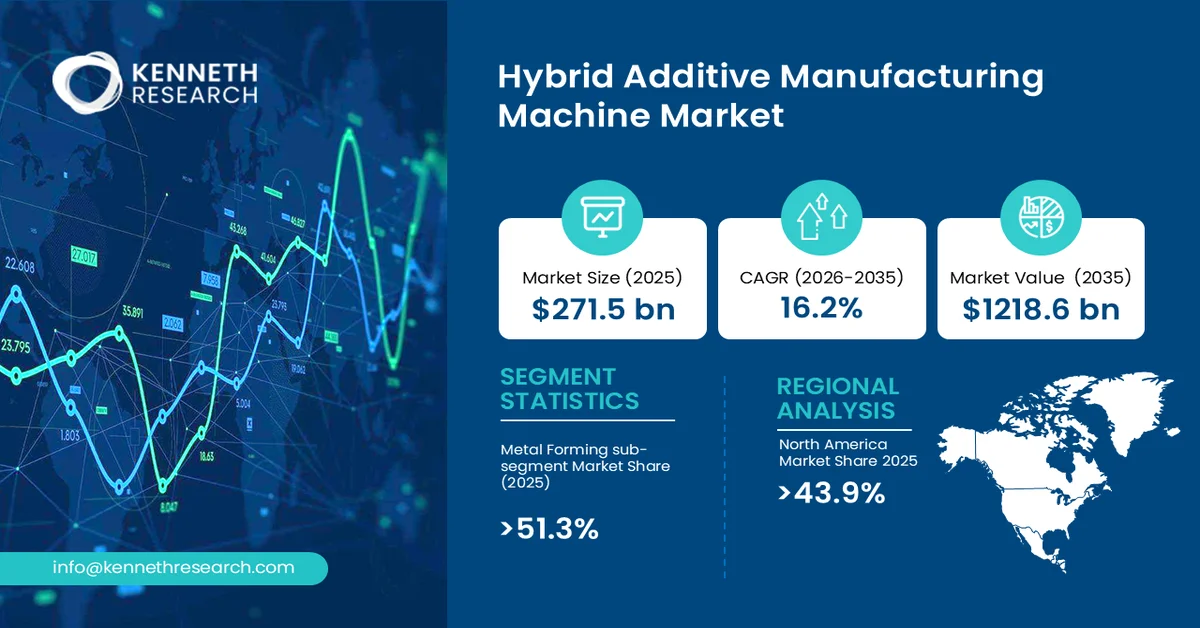
Hybrid Additive Manufacturing Machine Market size was valued at USD 271.5 billion in 2025 and is projected to reach USD 1,218.6 billion by the end of 2035, expanding at a CAGR of 16.2% during the forecast period, i.e., 2026–2035. In 2026, the industry size of the hybrid additive manufacturing machine is estimated at USD 315.5 billion.
The primary growth driver of the hybrid additive manufacturing machine market is the increasing adoption of integrated manufacturing systems that combine additive deposition with conventional machining in a single platform.
The hybrid additive manufacturing machine market comprises industrial manufacturing systems that integrate additive manufacturing processes with conventional subtractive or forming technologies within a unified machine or production platform. These systems can deposit material layer by layer and subsequently use machining, cutting, milling, or other conventional processes to achieve required dimensions, surface finishes, and geometric tolerances.
Key characteristics include multi-process manufacturing, digital process control, reduced part handling, improved design flexibility, and the ability to manufacture, repair, or modify complex components. Hybrid systems can work with metals and other engineering materials depending on the machine architecture and application requirements.
Key Hybrid Additive Manufacturing Machine Market Insights Summary:
Key Takeaways: Market Trends & Insights
- Hybrid Additive Manufacturing Machine Market is projected to grow from USD 271.5 billion in 2025 to USD 1,218.6 billion by 2035, registering a 16.2% CAGR during the forecast period.
- North America accounted for the largest regional share at 43.9% in 2025, supported by advanced manufacturing capabilities, strong aerospace and defense activity, and continued adoption of integrated production technologies.
- Metal Forming remained the leading By Type segment, accounting for 51.3% in 2025, driven by demand for high-precision metal component manufacturing, repair, and finishing.
- Production is expected to remain a key Application segment as manufacturers increasingly use hybrid systems for integrated additive and subtractive manufacturing of complex industrial components.
Market Drivers
- Increasing demand for integrated multi-process manufacturing.
- Growing adoption of advanced metal manufacturing.
- Rising use of hybrid systems for component repair and remanufacturing.
- Increasing integration of automation, process monitoring, and digital manufacturing software.
Challenges
- Process qualification and quality consistency.
- Complex toolpath and software integration.
Hybrid Additive Manufacturing Machine Market Overview & Supply Chain
Adoption of hybrid additive manufacturing is increasing as manufacturers seek greater flexibility, shorter production workflows, reduced material waste, and improved capability to produce or repair complex components. The technology is particularly relevant to aerospace, automotive, defense, tooling, energy, and other advanced manufacturing environments where additive deposition can be combined with conventional finishing operations. NIST reports that U.S. shipments of goods produced using additive manufacturing were approximately USD 2.8 billion, demonstrating the established industrial relevance of additive production within the manufacturing economy.
The hybrid additive manufacturing machine market value chain begins with suppliers of metals, powders, wires, cutting tools, machine components, lasers, motion systems, sensors, control electronics, and software. Machine manufacturers integrate these inputs into platforms capable of combining additive deposition with machining, forming, or other conventional manufacturing processes. Production involves machine assembly, software integration, calibration, process validation, and testing. Finished systems are distributed through direct sales, specialized industrial equipment channels, technology partners, and machine-tool distributors.
Hybrid Additive Manufacturing Machine Market: Growth Drivers & Challenges
Growth Drivers:
- Increasing demand for integrated multi-process manufacturing: Manufacturers are increasingly adopting hybrid manufacturing systems to combine material deposition with conventional material removal within a single production environment. This approach can reduce part transfers, simplify process chains, and enable manufacturers to produce complex geometries while achieving required dimensional accuracy and surface finish. Research from Oak Ridge National Laboratory highlights hybrid additive/subtractive machine tools as a flexible manufacturing approach capable of creating features that are difficult to produce using either process independently.
- Growing adoption of advanced metal manufacturing: The increasing use of advanced metal additive manufacturing for complex and high-value components is creating opportunities for hybrid machine platforms. Aerospace, defense, energy, automotive, and industrial equipment manufacturers increasingly require production approaches capable of handling complex geometries, customized components, repairs, and difficult-to-machine materials. Hybrid systems provide an opportunity to combine additive material deposition with subsequent machining or forming within a coordinated manufacturing workflow. Government-backed development is reinforcing this transition. India's Ministry of Defence reported the successful demonstration of a large-area metal additive manufacturing system for rocket-component fabrication, illustrating growing institutional investment in advanced metal manufacturing capabilities.
Challenges
- Process qualification and quality consistency: Hybrid additive manufacturing combines deposition and machining in a coordinated production sequence, making process qualification more complex than for conventional machining alone. Variations in deposition conditions can influence material properties, geometry, residual stresses, surface characteristics, and the subsequent machining process. NIST identifies process variability, inconsistent material properties, part accuracy, surface quality, and qualification methods as important barriers to broader additive manufacturing adoption. For hybrid systems, these issues are amplified because additive and subtractive operations must remain synchronized throughout production.
- Complex toolpath and software integration: Coordinating additive deposition and subtractive machining within one manufacturing workflow remains a significant technical challenge. Hybrid systems require software to generate compatible toolpaths for both processes while accounting for changing part geometry, machining accessibility, deposition conditions, and dimensional requirements. Oak Ridge National Laboratory research highlights the need for specialized CAM strategies because each hybrid manufacturing application can require different toolpath considerations and process sequencing.
Hybrid Additive Manufacturing Machine Market Size and Forecast:
| Report Attribute | Details |
|---|---|
| Base Year |
2025 |
| Forecast Year |
2026-2035 |
| CAGR |
16.2% |
| Base Year Market Size (2025) |
USD 271.5 billion |
| Forecast Year Market Size (2035) |
USD 1218.6 billion |
| Regional Scope |
|
Hybrid Additive Manufacturing Machine Market Segmentation Analysis:
By Type Segment Analysis
In the By Type segment, the Metal Forming sub-segment is anticipated to capture the largest market share of 51.3% in 2025. Its leading position is supported by the ability of hybrid manufacturing systems to integrate material deposition with forming and machining operations, enabling manufacturers to address complex geometries while maintaining dimensional and surface requirements. Hybrid approaches are particularly relevant where additive manufacturing alone cannot provide the required final characteristics. NIST notes that hybrid processes can combine additive manufacturing with secondary processes such as milling, grinding, or forming to improve part quality, functionality, and process performance.
Demand is supported by aerospace, automotive, energy, tooling, and other industries producing high-value metal components. On the supply side, machine manufacturers are developing increasingly integrated platforms combining deposition, forming, machining, sensing, and digital process control. The ability to perform multiple operations within a coordinated manufacturing environment can reduce handling and improve production flexibility.
Application Type Segment Analysis
In the Application segment, the Production sub-segment is projected to grow as manufacturers increasingly move additive and hybrid manufacturing beyond prototyping toward repeatable industrial component production. Hybrid machines are particularly valuable where manufacturers need to combine material deposition with precision machining, enabling complex parts to be produced and finished within a coordinated manufacturing workflow. Government initiatives are reinforcing this transition. India’s Ministry of Electronics and Information Technology states that additive manufacturing is being advanced for mass customization and distributed production, while the National Strategy for Additive Manufacturing is intended to strengthen domestic development and deployment of AM technologies.
Production applications are gaining relevance across aerospace, automotive, defense, energy, tooling, and industrial equipment because hybrid platforms can support complex geometries, repair, remanufacturing, and customized components.
Our in-depth analysis of the global hybrid additive manufacturing machine market includes the following segments:
|
Segment |
Sub-segment |
|
By Type |
|
|
By Application |
|
|
End User |
|
Hybrid Additive Manufacturing Machine Market Regional Insights:
North America Market Trends & Insights:
North America accounted for 43.9% of the hybrid additive manufacturing machine market in 2025, maintaining its position as the dominant regional market. The region benefits from established aerospace, defense, automotive, energy, and precision-manufacturing industries that require increasingly sophisticated production technologies. Strong government and research infrastructure is also supporting the adoption of additive and hybrid manufacturing. In 2024, NIST’s Manufacturing USA strategic plan identified additive manufacturing among the advanced technologies being developed through U.S. public-private manufacturing institutes, reinforcing the region’s focus on domestic advanced-manufacturing capabilities.
The U.S. remains the principal regional market because of its mature machine-tool ecosystem, aerospace and defense manufacturing base, research institutions, and extensive advanced-manufacturing infrastructure. Government-supported initiatives are encouraging integration of additive manufacturing with broader digital and automated production systems.
Canada is also developing a strong advanced-manufacturing ecosystem. The National Research Council of Canada’s current Advanced Manufacturing Initiative supports additive manufacturing, advanced materials, digital technologies, robotics, and hybrid processes, with applications spanning transportation, aerospace, and general manufacturing.
Europe Market Trends & Insights:
Asia-Pacific represents an important growth market for hybrid additive manufacturing machines, supported by strong manufacturing capabilities, expanding industrial automation, advanced machine-tool production, and government-backed investment in additive manufacturing. Japan is actively promoting the commercial adoption of metal additive manufacturing, while China has identified additive manufacturing equipment as a strategic area within its broader advanced-manufacturing development agenda.
Japan has a mature machine-tool and precision-manufacturing ecosystem and is strengthening its position in metal additive manufacturing through government-supported technology development. METI is actively examining measures to expand the commercial use of metal additive manufacturing and has identified aerospace, medical equipment, prototyping, and energy as areas where adoption is already progressing.
China provides substantial opportunities through its large industrial base and continued development of intelligent manufacturing, with government policy emphasizing breakthroughs in additive manufacturing equipment, intelligent production systems, and process integration.
Leading Companies Operating in the Global Hybrid Additive Manufacturing Machine:
Here is a list of upstream, downstream, and key players operating in the global hybrid additive manufacturing machine market competitive ecosystem:
- DMG MORI(Japan)
- Company Overview
- Business Strategy
- Key Product Offerings
- Financial Performance
- Key Performance Indicators
- Risk Analysis
- Recent Development
- Regional Presence
- SWOT Analysis
- Matsuura Machinery(Japan)
- Yamazaki Mazak(Japan)
- Okuma(Japan)
Recent Developments
- January 2026 —DMG MORI unveiled the LASERTEC 65 DED hybrid 2nd Generation, integrating directed energy deposition with five-axis milling in a single machine.
- June 2025 —Matsuura highlighted new developments around its LUMEX hybrid metal 3D printer, including a touch-probe capability designed to enable precise additional material building and continued integration of metal 3D printing with milling.
Frequently Asked Question
In 2025, the hybrid additive manufacturing machine market exceeded USD 271.5 billion.
The hybrid additive manufacturing machine market is projected to reach USD 1,218.6 billion by the end of 2035, expanding at a CAGR of 16.2% over the forecast period (2026–2035).
The major players in the market are DMG MORI, Matsuura Machinery, Yamazaki Mazak, Okuma, Optomec, Hybrid Manufacturing Technologies, and others.
In the By Type segment, the Metal Forming sub-segment is anticipated to capture the largest market share of 51.3% in the future and exhibit lucrative growth opportunities during 2026–2035.
North America is projected to hold the largest market share of 43.9% by the end of 2025 and provide more business opportunities in the future.
Why Choose Kenneth Research ?
-
Insight with Impact : We don’t just gather data — we uncover stories, trends, and opportunities that fuel business growth.
-
Experts Who Get It : Our team speaks your industry’s language and knows what really matters to your customers and market.
-
Custom-Built for You : Forget one-size-fits-all. We craft research and consulting solutions as unique as your business vision.
-
Partners, Not Just Providers : We work with you, not for you — collaborating closely to turn insights into smart, strategic moves.
-
Results That Speak : Our work powers brands, startups, and industry leaders alike — with a track record of ideas that work in the real world.
Report ID: 1214 |
Published Date: 14 Sep 2026 |
Report Format: |
Delivery Timeline: 48-72 Business Hours

Copyright © 2025 Kenneth Research. All rights reserved. Terms of Use | Privacy Policy
