Report ID: 1201 |
Published Date: 27 Aug 2026 |
Report Format: |
Delivery Timeline: 48-72 Business Hours
Graphene Coating Market Outlook:
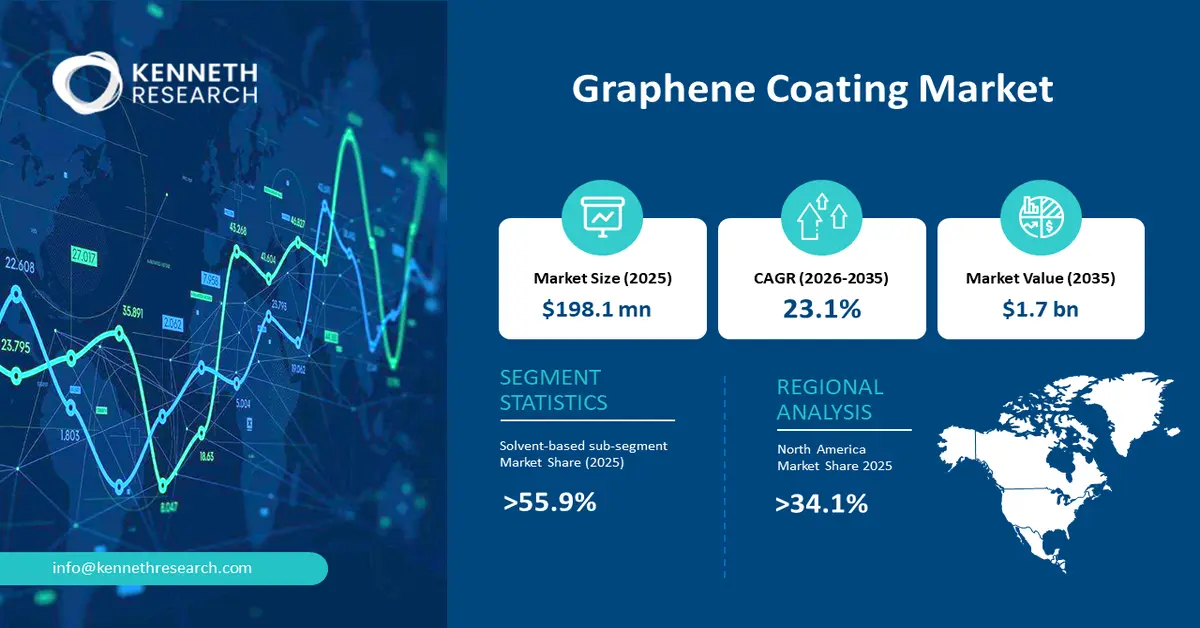
Graphene Coating Market size was valued at USD 198.1 million in 2025 and is projected to reach USD 1.7 billion by the end of 2035, rising at a CAGR of 23.1% during the forecast period, i.e., 2026-2035. In 2026, the industry size of the graphene coating is estimated at USD 243.2 million.
Growing adoption of advanced materials across electronics, automotive, aerospace, marine, and industrial infrastructure is the primary growth driver for the graphene coating market. Graphene’s exceptional corrosion resistance, electrical conductivity, thermal management, and mechanical strength enable high-performance coatings that improve durability, operational efficiency, and lifecycle performance across demanding industrial applications.
The graphene coating market comprises protective and functional coating solutions formulated with graphene or graphene-derived materials to enhance the physical, chemical, thermal, and electrical performance of coated surfaces. These coatings are applied to metals, composites, polymers, concrete, and electronic components to improve corrosion resistance, abrasion resistance, conductivity, barrier protection, and heat dissipation. Depending on end-use requirements, graphene coatings are available in solvent-based, water-based, and powder formulations for industrial, commercial, and specialty applications.
Graphene coatings are distinguished by their lightweight structure, excellent mechanical strength, superior impermeability, and multifunctional performance compared with conventional coating technologies. They support longer asset lifecycles, lower maintenance requirements, improved energy efficiency, and enhanced operational reliability in harsh environments. As industries increasingly prioritize high-performance materials, graphene coatings are gaining relevance across sectors including electronics, automotive, aerospace, marine, energy, and construction. According to the OECD, graphene is being deployed across coatings, electronics, semiconductors, composites, and energy-related applications, highlighting its expanding industrial significance and commercialization potential across multiple advanced manufacturing industries.
Key Graphene Coating Market Insights Summary:
Key Takeaways: Market Trends & Insights
- The graphene coating market is projected to expand from USD 198.1 Million in 2025 to USD 1.7 Billion by 2035, driven by a CAGR of 23.1%
- Growing adoption across electronics, automotive, aerospace, marine, and industrial infrastructure is accelerating demand for high-performance graphene coating solutions
- Solvent-based coatings remain the leading type segment owing to their superior durability, corrosion resistance, and compatibility with existing industrial coating systems
- North America leads the global market, supported by strong advanced manufacturing capabilities, continuous innovation, and investments across the United States and Canada
- Advancements in graphene production technologies and increasing commercialization of advanced materials are expected to create significant long-term growth opportunities across multiple end-use industries
Market Drivers
- Increasing adoption of graphene-enhanced coatings in aerospace and defense applications
- Advancements in scalable graphene production and coating formulation technologies
- Growing demand for sustainable and low-maintenance coating solutions across industries
- Expanding use of graphene coatings in renewable energy and energy storage infrastructure
Challenges
- High production costs and limited economies of scale
- Lack of standardized performance validation and industry qualification
Graphene Coating Market Overview & Supply Chain
lobal adoption of graphene coatings is accelerating as industries seek advanced materials that deliver enhanced corrosion resistance, conductivity, thermal management, and mechanical durability while supporting product performance and sustainability objectives. Their expanding use across electronics, transportation, marine, aerospace, and industrial manufacturing is reinforced by continuous innovation in graphene production and application technologies. Regulatory focus on material safety and commercialization is also strengthening industry confidence. The OECD notes that graphene is now being applied across coatings, composites, energy storage, electronics, and semiconductors, while graphene nanoplatelet powder production has scaled to multiple tonnes and industry participants have achieved REACH registration for graphene materials in the European Union, demonstrating growing industrial maturity and regulatory progress.
The graphene coating industry value chain begins with the sourcing of graphite, specialty chemicals, solvents, polymer binders, additives, and nanomaterials required for graphene synthesis and coating formulation. Raw material suppliers provide high-purity inputs that are processed into graphene oxide, reduced graphene oxide, graphene nanoplatelets, or other graphene derivatives using specialized production methods. Coating manufacturers then formulate these materials into application-specific products designed for protective, conductive, or multifunctional performance. Quality assurance, performance testing, and regulatory compliance play critical roles before commercialization. Distribution occurs through specialty chemical distributors, industrial coating suppliers, direct sales channels, and strategic partnerships with original equipment manufacturers. End users include electronics manufacturers, automotive companies, aerospace firms, marine operators, energy infrastructure developers, and construction material producers. Major stakeholders across the value chain include graphite producers, graphene material developers, coating formulators, equipment manufacturers, research institutions, certification bodies, distributors, industrial integrators, and end-use enterprises that incorporate graphene coatings into advanced manufacturing processes.
Graphene Coating Market: Growth Drivers & Challenges
Growth Drivers:
- Expanding commercialization of advanced electronics and semiconductor technologies: The increasing commercialization of advanced electronics and semiconductor technologies is a major driver for the graphene coating market. Manufacturers are adopting graphene coatings to improve electrical conductivity, thermal dissipation, electromagnetic shielding, and long-term reliability of electronic components while enabling miniaturization and higher device performance. As demand grows for electric vehicles, high-performance computing, 5G infrastructure, consumer electronics, and smart industrial equipment, coating developers are investing in formulations that deliver multifunctional properties without significantly increasing component weight. The industry's long-term outlook is further strengthened by continuous investments in semiconductor manufacturing capacity. According to the Semiconductor Industry Association, supported by official industry announcements, more than 140 new semiconductor manufacturing ecosystem projects have been announced across the United States following the CHIPS and Science Act, reflecting expanding opportunities for advanced materials used throughout semiconductor production and packaging.
- Rising demand for high-performance protective coatings across industrial infrastructure: Growing investment in industrial infrastructure is increasing demand for high-performance protective coatings capable of extending equipment life and reducing maintenance costs. Graphene coatings provide superior corrosion resistance, chemical stability, abrasion protection, and barrier performance compared with many conventional coating technologies, making them attractive for marine assets, energy infrastructure, transportation equipment, and heavy industrial facilities. As operators focus on lowering lifecycle costs and improving operational reliability, graphene-enhanced coatings are becoming part of long-term asset management strategies. Continuous advances in graphene dispersion technologies and scalable manufacturing processes are also improving commercial viability and application flexibility. Looking ahead, broader adoption across renewable energy installations, industrial machinery, pipelines, storage facilities, and smart infrastructure projects is expected to strengthen demand for multifunctional coating solutions that combine durability with enhanced environmental performance.
Challenges:
- High production costs and limited economies of scale: The widespread adoption of graphene coatings is constrained by the high cost of graphene production and the complexity of integrating graphene into commercial coating formulations. Producing high-quality graphene with consistent structural properties requires specialized manufacturing processes, stringent quality control, and advanced processing equipment, all of which increase production expenses. Variations in graphene quality and dispersion performance also create formulation challenges that require additional research and testing before large-scale commercialization. These factors increase product pricing, making graphene coatings less competitive than conventional protective coatings in cost-sensitive industries. Commercially, many end users continue to evaluate graphene coatings primarily for high-value applications where performance gains justify the additional investment. As production technologies mature and manufacturing capacity expands, improved process efficiency and standardization are expected to gradually reduce costs and improve commercial accessibility.
- Lack of standardized performance validation and industry qualification: The absence of universally accepted testing standards and qualification procedures remains a significant restraint for the graphene coating market. Performance characteristics often vary depending on graphene type, concentration, dispersion method, substrate compatibility, and coating formulation, making direct comparisons between products difficult. Industrial buyers frequently require extensive validation, long-term field testing, and certification before adopting advanced coating technologies in critical applications such as aerospace, marine, energy, and transportation. These lengthy qualification processes delay commercialization and increase development costs for manufacturers. Commercially, inconsistent performance benchmarks can reduce customer confidence and complicate procurement decisions, particularly for industries operating under strict regulatory and operational requirements. Looking ahead, broader collaboration among standards organizations, research institutions, manufacturers, and end users is expected to improve testing consistency, accelerate product qualification, and support wider commercial adoption.
Graphene Coating Market Size and Forecast:
| Report Attribute | Details |
|---|---|
| Base Year |
2025 |
| Forecast Period |
2026-2035 |
| CAGR |
23.1% |
| Base Year Market Size (2025) |
USD 198.1 million |
| Forecast Year Market Size (2035) |
USD 1.7 billion |
| Regional Scope |
|
Graphene Coating Market Segmentation Analysis:
Product Type Segment Analysis
In the product type segment, the solvent-based sub-segment is anticipated to capture the largest market share of 55.9% by the end of 2025.
These coatings are extensively used across marine, automotive, aerospace, industrial equipment, and energy infrastructure, where long-term corrosion protection and chemical resistance are critical. Their compatibility with existing industrial coating systems allows manufacturers to integrate graphene without significant changes to production processes, supporting broader commercial adoption. On the supply side, established solvent-based coating technologies, mature raw material supply chains, and scalable manufacturing capabilities continue to reinforce the segment's leadership. Looking ahead, ongoing innovation in graphene dispersion techniques and formulation chemistry is expected to further improve coating performance and regulatory compliance. Supporting this industrial demand, the OECD states that graphene nanoplatelets are applied in ship hull coatings, demonstrating the material's established commercial use in protective coating applications. This highlights the growing acceptance of graphene-enhanced solvent-based coatings in high-performance industrial sectors.
End Use Industry Segment Analysis
The electronics applications is projected to grow as the second-largest segment in the graphene coating market due to four converging demand drivers.
The electronics applications segment is projected to witness strong growth as manufacturers increasingly require advanced coating materials that improve electrical conductivity, thermal management, electromagnetic interference (EMI) shielding, and component reliability. Graphene coatings are gaining traction in semiconductors, printed electronics, sensors, displays, batteries, and wearable devices because they combine excellent conductive properties with lightweight and mechanically robust performance. Rising investments in semiconductor fabrication, device miniaturization, and next-generation electronic systems are further supporting adoption. On the supply side, improvements in graphene synthesis, dispersion technologies, and scalable manufacturing are enabling more consistent product quality and facilitating commercial integration into electronic components. Future growth is expected to be reinforced by expanding demand for high-performance electronics, flexible devices, and energy-efficient technologies. Supporting this trend, the OECD states that graphene is already being used in electronics and semiconductors, including the use of graphene oxide in smartphones, demonstrating its transition from research to commercial electronic applications.
Our in-depth analysis of the global graphene coating market includes the following segments:
|
Segment |
Sub-segment |
|
Product Type |
|
|
Application |
|
|
End-Use Industry |
|
Graphene Coating Market Regional Insights:
North America Market Trends & Insights:
North America graphene coating market is projected to hold the largest revenue share of 34.1% by the end of 2025.
The region's dominance is supported by strong investments in advanced materials, established industrial manufacturing capabilities, and rapid commercialization of nanotechnology across high-value sectors including electronics, aerospace, automotive, energy, and defense. The presence of leading graphene developers, coating manufacturers, and research institutions has accelerated product innovation and industrial deployment. In addition, supportive government initiatives promoting domestic advanced manufacturing, battery materials, and critical mineral supply chains are strengthening the ecosystem for graphene-enabled technologies. Reflecting this momentum, the U.S. Department of Energy reported that cumulative battery and EV supply chain investment in North America exceeded USD 250 billion by the end of 2023, creating significant opportunities for advanced functional materials such as graphene coatings in batteries, electronics, and related manufacturing applications.
The United States leads regional demand through its extensive advanced manufacturing base, robust research ecosystem, and growing commercialization of graphene across electronics, transportation, aerospace, and industrial coatings. Federal investments supporting domestic manufacturing and critical material innovation continue to encourage the adoption of high-performance coating technologies.
Canada complements regional growth with its abundant graphite resources, expanding graphene production capabilities, and active collaboration between industry, research organizations, and technology developers. The country's emphasis on critical minerals, clean technology, and advanced materials supports continued investment in graphene commercialization. Together, the United States and Canada provide North America with a resilient innovation ecosystem, integrated supply chains, and favorable conditions for the continued expansion of graphene coating applications across multiple industrial sectors.
Europe Market Trends & Insights:
Europe represents a strategically important market for graphene coatings, supported by robust industrial activity, strong research capabilities, and a policy environment that encourages the adoption of advanced and sustainable materials. Demand is increasing across automotive manufacturing, aerospace, renewable energy, electronics, marine, and industrial infrastructure, where high-performance coatings are valued for improving durability, corrosion resistance, and operational efficiency. The region's emphasis on decarbonization, circular economy practices, and advanced manufacturing is encouraging manufacturers to develop innovative coating technologies that deliver longer service life and reduced maintenance requirements. Public-private collaborations, nanomaterials research programs, and investments in next-generation manufacturing are further accelerating the commercialization of graphene-enabled coating solutions. As production technologies mature and industrial qualification expands, Europe is expected to create significant opportunities for graphene coatings in energy storage, electric mobility, smart infrastructure, and advanced electronic systems.
Germany serves as the leading growth engine within the region due to its strong automotive, industrial machinery, chemicals, and advanced manufacturing sectors. The country's continuous investment in industrial innovation and high-performance engineering supports the integration of graphene coatings into applications requiring enhanced durability, conductivity, and corrosion protection.
The United Kingdom contributes through its well-established graphene research ecosystem, commercialization initiatives, and collaboration between universities, technology developers, and industrial manufacturers. Ongoing investments in advanced materials, aerospace technologies, electronics, and clean energy solutions are supporting broader adoption of graphene-enhanced coatings, positioning the country as an important innovation hub within the European graphene value chain.
Leading Companies Operating in the Global Graphene Coating Market:
Here is a list of upstream, downstream, and key players operating in the global graphene coating market competitive ecosystem:
- Graphenea (Spain)
- Company Overview
- Business Strategy
- Key Product Offerings
- Financial Performance
- Key Performance Indicators
- Risk Analysis
- Recent Development
- Regional Presence
- SWOT Analysis
- Directa Plus (Italy)
- Universal Matter Inc. (Canada)
- Black Swan Graphene Inc. (Canada)
- Applied Graphene Materials Ltd. (United Kingdom)
- First Graphene Ltd. (Australia)
Recent Developments
- In March 2026, Black Swan Graphene announced completion of a production-capacity expansion at its facility in Consett, United Kingdom, more than tripling its production capacity. This upstream expansion is significant because graphene-enhanced coatings cannot scale commercially without a reliable, high-volume material supply.
Frequently Asked Question
In 2025, the graphene coating market exceeded USD 198.1 million.
The graphene coating market is projected to reach USD 1.7 billion by the end of 2035, expanding at a CAGR of 23.1% over the forecast period (2026-2035).
The major players in the market are Graphenea, Directa Plus, Universal Matter Inc., Black Swan Graphene Inc., Thomas Swan & Co. Ltd., Applied Graphene Materials Ltd., NanoXplore Inc., First Graphene Ltd., Versarien plc, Haydale Graphene Industries plc, Gerdau Graphene, Levidian, HydroGraph Clean Power Inc., The Sixth Element (Changzhou) Materials Technology Co., Ltd., CVD Equipment Corporation, ACS Material LLC, NeoGraf Solutions, Nano Graphene Inc., Huntsman Corporation, The Sherwin-Williams Company, and others.
In the type segment, the Solvent-based sub-segment is anticipated to capture the largest market share of 55.9% in the future and exhibit lucrative growth opportunities during 2026–2035. This growth trajectory is largely attributed to its superior corrosion resistance, strong adhesion, compatibility with existing industrial coating systems, and increasing adoption across automotive, marine, aerospace, and industrial infrastructure applications.
North America is projected to hold the largest market share of 34.1% by the end of 2025 and provide more business opportunities in the future. Continuous investments in advanced materials, semiconductor manufacturing, aerospace technologies, and industrial innovation across the United States and Canada are fostering the region's dominance.
Why Choose Kenneth Research ?
-
Insight with Impact : We don’t just gather data — we uncover stories, trends, and opportunities that fuel business growth.
-
Experts Who Get It : Our team speaks your industry’s language and knows what really matters to your customers and market.
-
Custom-Built for You : Forget one-size-fits-all. We craft research and consulting solutions as unique as your business vision.
-
Partners, Not Just Providers : We work with you, not for you — collaborating closely to turn insights into smart, strategic moves.
-
Results That Speak : Our work powers brands, startups, and industry leaders alike — with a track record of ideas that work in the real world.
Report ID: 1201 |
Published Date: 27 Aug 2026 |
Report Format: |
Delivery Timeline: 48-72 Business Hours

Copyright © 2025 Kenneth Research. All rights reserved. Terms of Use | Privacy Policy
