Report ID: 1272 |
Published Date: 01 Sep 2026 |
Report Format: |
Delivery Timeline: 48-72 Business Hours
Fuel Cell Electric Vehicle Market Outlook:
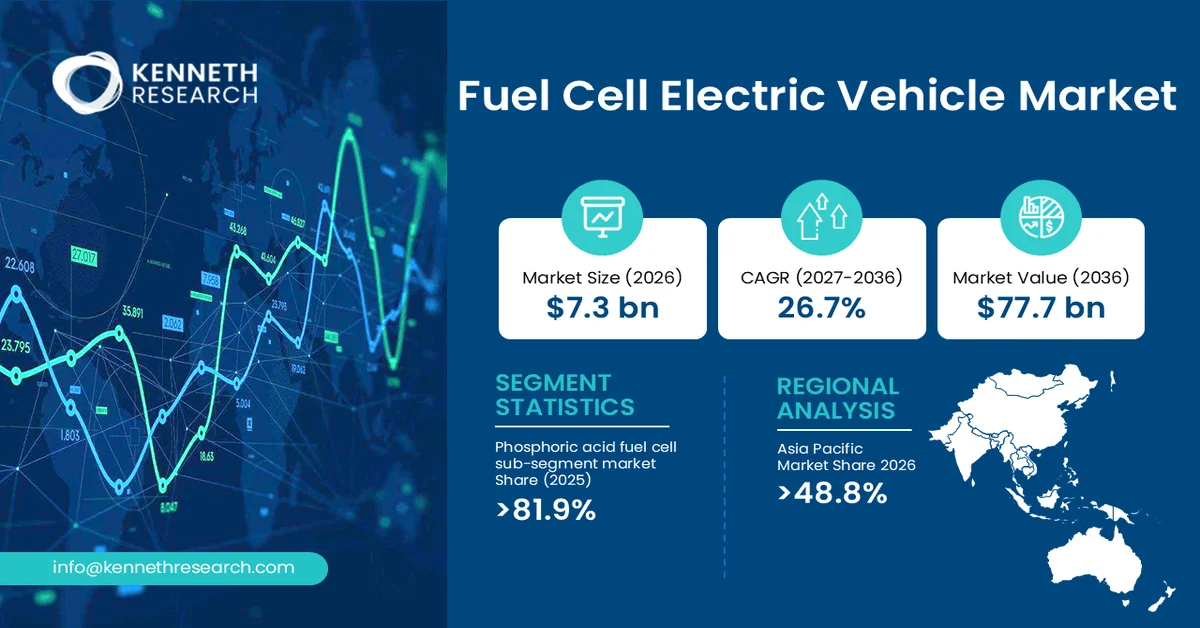
Fuel Cell Electric Vehicle Market size was valued at USD 7.3 billion in 2026 and is projected to reach USD 77.7 billion by the end of 2036, rising at a CAGR of 26.7% during the forecast period, i.e., 2027-2036. In 2027, the industry size of the fuel cell electric vehicle is estimated at USD 9.2 billion.
The primary growth driver is the need to decarbonize heavy-duty transportation, where hydrogen fuel cells can provide zero-tailpipe-emission propulsion without relying solely on large batteries. The U.S. Department of Energy identifies heavy-duty vehicles as disproportionately important to transportation emissions, strengthening the commercial rationale for hydrogen-powered trucks and other demanding applications.
The Fuel Cell Electric Vehicle (FCEV) market encompasses vehicles that use hydrogen as an onboard energy carrier and convert it into electricity through a fuel cell to drive an electric propulsion system. Unlike conventional internal-combustion vehicles, FCEVs generate electricity electrochemically rather than through combustion. Their powertrain generally integrates a hydrogen storage system, fuel-cell stack, electric motor, power electronics, and battery or other energy-storage components for managing regenerative braking and transient power requirements.
A defining characteristic of FCEVs is their dependence on hydrogen production, distribution, storage, and refueling infrastructure. Vehicle performance therefore depends not only on fuel-cell technology but also on the availability and reliability of the wider hydrogen ecosystem. The technology can serve passenger vehicles as well as commercial and heavy-duty transportation applications.
Key Fuel Cell Electric Vehicle Market Insights Summary:
Key Takeaways: Market Trends & Insights
- Fuel Cell Electric Vehicle Market is valued at USD 7.3 billion in 2026 and is projected to reach USD 77.7 billion by 2036
- The market is expected to expand at a CAGR of 26.7% during 2027-2036
- Phosphoric Acid Fuel Cell leads the Fuel Cell segment with an 81.9% market share in 2026
- Asia Pacific dominates the regional landscape with a 48.8% market share in 2026
- Passenger Cars represent the second and fastest analysis segment, supported by continued hydrogen mobility deployment and vehicle technology development
Market Drivers
- Heavy-duty transportation decarbonization
- Expansion of hydrogen production and refueling infrastructure
- Advances in fuel-cell durability, efficiency, and powertrain integration
- Government policies and zero-emission vehicle deployment programs
Challenges
- Hydrogen refueling infrastructure constraints
- High technology and system-level cost burden
Fuel Cell Electric Vehicle Market Overview & Supply Chain
Global adoption of fuel cell electric vehicles is increasing as governments and industry seek zero-emission transportation pathways that can address applications where vehicle range, payload requirements, and rapid refueling are operational priorities. Fuel-cell propulsion is particularly relevant to commercial and heavy-duty mobility because hydrogen can be stored onboard and converted into electricity without combustion. Technological progress in fuel-cell durability, onboard hydrogen storage, powertrain integration, and high-flow refueling is improving the feasibility of these applications, while national hydrogen strategies and transport policies are encouraging demonstrations and infrastructure deployment. The International Energy Agency reported that the global FCEV stock grew 20% in 2025, reaching almost 130,000 vehicles, with trucks and buses accounting for a substantial portion of hydrogen use.
The Fuel Cell Electric Vehicle value chain begins with raw materials and specialized inputs, including catalysts, membranes, carbon-based materials, metals, hydrogen-storage materials, semiconductors, and other components required for fuel-cell stacks and vehicle powertrains. Hydrogen production represents a parallel upstream activity, with supply originating from conventional or low-emissions production pathways and subsequently moving through compression, storage, transportation, and dispensing systems. Manufacturing encompasses fuel-cell stack assembly, balance-of-plant components, hydrogen tanks, electric motors, batteries, power electronics, thermal-management systems, and final vehicle integration. Distribution extends through hydrogen-fueling infrastructure, automotive logistics, fleet channels, and vehicle dealerships.
Fuel Cell Electric Vehicle Market: Growth Drivers & Challenges
Growth Drivers
- Heavy-duty decarbonization and long-haul operating requirements: Fuel cell electric vehicles are gaining traction in heavy-duty transportation because hydrogen propulsion can address operating requirements that are difficult for some battery-electric configurations, particularly long-distance duty cycles, payload-sensitive operations, and rapid refueling. This creates a differentiated growth pathway beyond passenger mobility, with truck manufacturers, fleet operators, logistics companies, and public-sector fleets becoming important demand centers. Government-backed technology programs are also accelerating commercialization by combining vehicle development with efficiency and emissions objectives. The U.S. Department of Energy’s SuperTruck 3 initiative specifically targets medium- and heavy-duty electric and fuel-cell applications and seeks a 75% reduction in greenhouse-gas and air-pollution emissions alongside lower total cost of ownership.
- Expansion of hydrogen ecosystems and vehicle-refueling integration: Development of hydrogen production, storage, transportation, and refueling infrastructure is creating the ecosystem required for broader FCEV deployment. As infrastructure becomes more coordinated with fleet routes and vehicle procurement, the principal adoption constraint shifts from technology availability toward system-level economics, utilization, and operational integration. This is particularly important for commercial fleets, where predictable routes can support dedicated hydrogen supply and fueling arrangements. Automotive manufacturers can therefore develop vehicles around defined fleet requirements, while energy companies and infrastructure providers gain opportunities to establish integrated hydrogen mobility services.
Challenges
- Hydrogen refueling infrastructure constraints: The root constraint is the fragmented development of hydrogen production, delivery, storage, and dispensing infrastructure relative to vehicle deployment. Hydrogen requires specialized compression, storage, transportation, and fueling equipment, creating a more complex infrastructure ecosystem than conventional road-fuel distribution. This directly affects commercial deployment because vehicle operators need dependable access to appropriately located refueling facilities before committing fleets to fuel-cell platforms. Infrastructure developers, meanwhile, face utilization and investment risks when vehicle volumes remain limited, creating a coordination challenge between supply and demand.
- High technology and system-level cost burden: Fuel-cell vehicles face a system-level cost challenge because commercial competitiveness depends on more than the vehicle itself. Fuel-cell stacks, hydrogen storage, power electronics, thermal-management systems, and supporting infrastructure must achieve sufficient durability, reliability, and manufacturing efficiency while hydrogen supply and dispensing costs also become economically viable. This creates pressure across the entire value chain rather than at a single manufacturing stage. For automakers, the challenge can constrain platform economics and production scale; for fleet operators, it can complicate total-cost-of-ownership comparisons and investment decisions.
Fuel Cell Electric Vehicle Market Size and Forecast:
| Report Attribute | Details |
|---|---|
| Base Year |
2026 |
| Forecast Period |
2027-2036 |
| CAGR |
26.7% |
| Base Year Market Size (2026) |
USD 7.3 billion |
| Forecast Year Market Size (2036) |
USD 77.7 billion |
| Regional Scope |
|
Fuel Cell Electric Vehicle Market Segmentation Analysis:
Fuel Cell Segment Analysis
In the fuel cell segment, phosphoric acid fuel cell sub-segment is anticipated to capture the largest market share of 81.9% by the end of 2026.
Phosphoric Acid Fuel Cell (PAFC) technology maintains a strong position because of its technological maturity, established operating experience, and suitability for applications requiring dependable, continuous power. Its high-temperature operation enables combined heat-and-power configurations, while tolerance to fuel impurities can support flexible fuel-processing arrangements. These characteristics have supported adoption where reliability and steady energy output are more important than rapid load response. The U.S. Department of Energy identifies PAFC as the most mature fuel-cell technology and notes its established use in stationary power generation, while also recognizing applications in large vehicles.
Vehicle Segment Analysis
The Passenger Cars is projected to grow as the second-largest segment in the fuel cell electric vehicle market due to four converging demand drivers.
Passenger cars are positioned for continued growth within the fuel cell electric vehicle market because hydrogen propulsion offers a combination of zero tailpipe emissions, rapid refueling, and extended driving capability that can appeal to consumers and commercial users where hydrogen access is established. The International Energy Agency reported that over 80% of FCEVs on the road at the end of 2021 were light-duty vehicles, with the majority being passenger cars, demonstrating the segment’s established role in early fuel-cell deployment. Demand is supported by automakers developing dedicated fuel-cell passenger platforms and by governments supporting hydrogen mobility and refueling infrastructure. Supply-side progress in fuel-cell stacks, hydrogen storage, power electronics, and vehicle integration is improving platform maturity, while expanding hydrogen ecosystems can make passenger-car deployment more practical.
Our in-depth analysis of the fuel cell electric vehicle market includes the following segments:
|
Segment |
Sub-segment |
|
Vehicle |
|
|
Fuel Cell |
|
|
Range |
|
|
Drive |
|
|
Application |
|
Fuel Cell Electric Vehicle Market Regional Insights:
Asia Pacific Market Trends & Insights:
Asia Pacific fuel cell electric vehicle market is projected to hold the largest revenue share of 48.8% by the end of 2026.
It is supported by strong hydrogen-mobility policy activity, vehicle manufacturing capabilities, infrastructure development, and growing commercial deployment. The region benefits from established automotive supply chains and substantial government involvement in hydrogen strategies, demonstration programs, and mobility infrastructure.
China is the principal regional growth engine, combining large-scale vehicle manufacturing with government-backed hydrogen and fuel-cell demonstration programs. Its emphasis on commercial vehicles strengthens domestic demand while supporting local component and system suppliers.
Japan represents a complementary technology and innovation hub, with government policy supporting hydrogen mobility and fuel-cell deployment. Japan’s Ministry of Economy, Trade and Industry has also established priority regions to stimulate fuel-cell commercial-vehicle demand and surrounding hydrogen mobility activity. Together, these markets strengthen Asia Pacific’s production base, technology ecosystem, investment attractiveness, and long-term commercialization potential.
North America Market Trends & Insights:
North America represents an important secondary market for fuel cell electric vehicles, supported by commercial-vehicle decarbonization, hydrogen infrastructure development, technology demonstration, and established automotive and energy industries. Demand is particularly relevant in freight, transit, fleet, and other applications where long operating ranges and rapid refueling can provide operational advantages.
The United States remains the principal North American technology and deployment center, supported by federal research, vehicle demonstrations, hydrogen infrastructure programs, and an established automotive manufacturing base. The Department of Energy is specifically pursuing fuel-cell truck durability, high-flow fueling, and total-cost-of-ownership improvements.
Canada offers complementary opportunities through its hydrogen-resource base, provincial infrastructure initiatives, and focus on medium- and heavy-duty transportation. Natural Resources Canada identifies trucking, freight, ports, mining, and other energy-intensive applications as promising hydrogen-use cases, while Transport Canada continues real-world zero-emission trucking deployments.
Leading Companies Operating in the Global Fuel Cell Electric Vehicle Market:
Here is a list of upstream, downstream, and key players operating in the fuel cell electric vehicle market competitive ecosystem:
- Hyundai Motor Company (South Korea)
- Company Overview
- Business Strategy
- Key Product Offerings
- Financial Performance
- Key Performance Indicators
- Risk Analysis
- Recent Development
- Regional Presence
- SWOT Analysis
- Toyota Motor Corporation (Japan)
- Honda Motor Co., Ltd. (Japan)
- BMW Group (Germany)
- Daimler Truck AG (Germany)
Recent Developments
- In January 2026, Daimler Truck presented the Mercedes-Benz NextGenH2 Truck, with small-series production planned from the end of 2026. The truck stores up to 85 kg of liquid hydrogen at -253°C, achieving over 1,000 km range with 10–15 minute refueling. It shares the same electric drive axle as the eActros 600, creating a common platform across battery and hydrogen technologies. Logistics firm Dachser will be the first customer, operating the truck from its Karlsruhe centre from December 2026.
- In March 2026, Toyota reaffirmed its hydrogen strategy at the European Hydrogen Energy Conference, with the Mirai FCEV offering 650 km range and 3–5 minute refueling. The company announced its third-generation fuel cell technology will offer 20% greater range and cost reductions of 37–50% once volume production scales. Toyota continues to position FCEVs as complementary to BEVs, particularly for use cases requiring fast refueling and longer range.
Frequently Asked Question
In 2026, the fuel cell electric vehicle market exceeded USD 7.3 billion.
The fuel cell electric vehicle market is projected to reach USD 77.7 billion by the end of 2036, expanding at a CAGR of 26.7% over the forecast period (2027-2036).
The major players in the market are Hyundai Motor Company, Toyota Motor Corporation, Honda Motor Co., Ltd., BMW Group, Daimler Truck AG, and others.
In the fuel cell segment, the phosphoric acid fuel cell sub-segment is anticipated to capture the largest market share of 81.9% in the future and exhibit lucrative growth opportunities during 2027-2036. This growth trajectory is largely attributed to its technological maturity and established suitability for reliable, continuous power applications.
Asia Pacific is projected to hold the largest market share of 48.8% by the end of 2026 and provide more business opportunities in the future. Continuous investments and hydrogen-mobility initiatives in China and Japan are fostering the region's dominance.
Why Choose Kenneth Research ?
-
Insight with Impact : We don’t just gather data — we uncover stories, trends, and opportunities that fuel business growth.
-
Experts Who Get It : Our team speaks your industry’s language and knows what really matters to your customers and market.
-
Custom-Built for You : Forget one-size-fits-all. We craft research and consulting solutions as unique as your business vision.
-
Partners, Not Just Providers : We work with you, not for you — collaborating closely to turn insights into smart, strategic moves.
-
Results That Speak : Our work powers brands, startups, and industry leaders alike — with a track record of ideas that work in the real world.
Report ID: 1272 |
Published Date: 01 Sep 2026 |
Report Format: |
Delivery Timeline: 48-72 Business Hours

Copyright © 2025 Kenneth Research. All rights reserved. Terms of Use | Privacy Policy
