Report ID: 1250 |
Published Date: 28 Sep 2026 |
Report Format: |
Delivery Timeline: 48-72 Business Hours
Force Sensor Market Outlook:
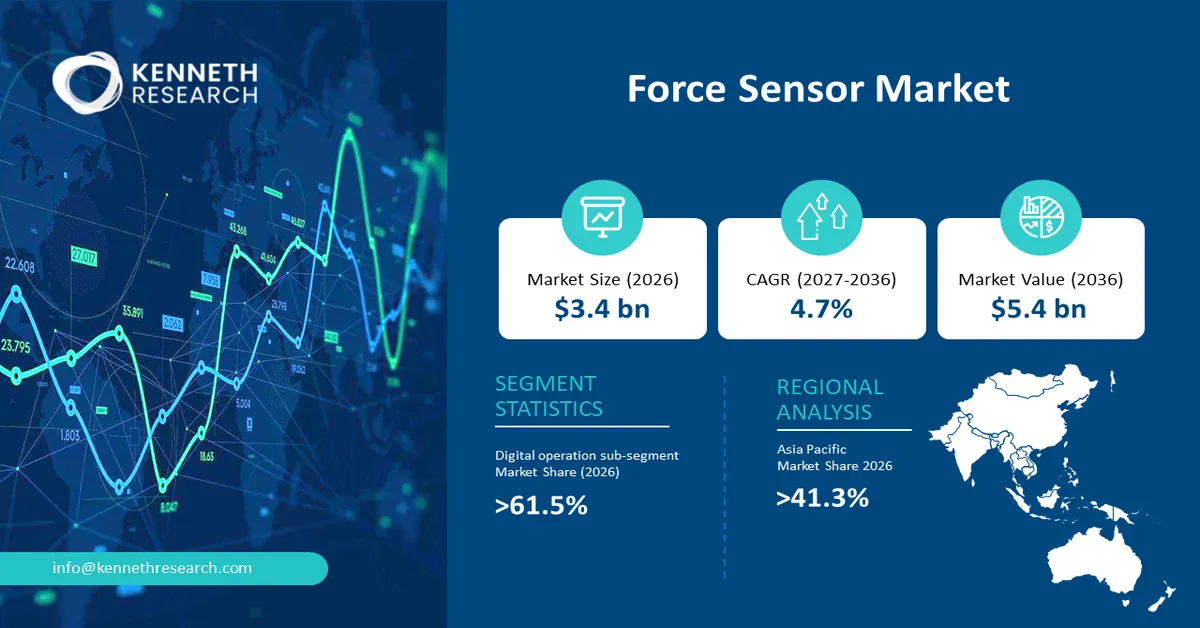
Force Sensor Market size was valued at USD 3.4 billion in 2026 and is projected to reach USD 5.4 billion by the end of 2036, rising at a CAGR of 4.7% during the forecast period, i.e., 2027-2036. In 2027, the industry size of the force sensor is estimated at USD 3.8 billion.
The primary growth driver for the force sensor market is the expanding adoption of robotics and smart manufacturing, where force sensing enables precise, adaptive, and safer machine operation.
The force sensor market comprises technologies that detect and quantify mechanical force applied to an object, component, structure, or robotic system and convert that physical input into a measurable electrical signal. These sensors are used to determine parameters such as applied force, load, tension, compression, and torque, depending on the sensor architecture and application.
Key characteristics include measurement accuracy, sensitivity, repeatability, response time, durability, and compatibility with control and data-acquisition systems. Force-sensing technologies can be integrated into industrial equipment, robotic end effectors, automated machinery, testing systems, and other applications where controlled interaction with physical objects is required. NIST identifies force sensing and compliance as important capabilities for collaborative robots, particularly in manufacturing assembly, where they support safer human-robot interaction and controlled manipulation.
Key Force Sensor Market Insights Summary:
Key Takeaways: Market Trends & Insights
- Force sensor market is valued at USD 3.4 billion in 2026 and is projected to reach USD 5.4 billion by 2036, reflecting a 4.7% CAGR during 2027-2036
- Digital operation is the leading segment, accounting for 61.5% market share in 2026, supported by increasing integration of force measurement with automated and digitally connected manufacturing systems
- Both tension and compression measurement is positioned as the second key segment, benefiting from demand for bidirectional force measurement across robotics, assembly, testing, and automated machinery
- Asia Pacific leads the force sensor market with a 41.3% share in 2026, supported by strong manufacturing, industrial automation, robotics, and precision-engineering activity in China and Japan
- North America represents a major secondary market, with the United States and Canada offering opportunities through advanced manufacturing, robotics, aerospace, automotive, medical-device, and digitally enabled industrial applications
Market Drivers
- Expansion of Industrial Robotics and Collaborative Automation
- Increasing Demand for Precision and Adaptive Manufacturing
- Integration of Force Sensing with Artificial Intelligence, Machine Vision, and Intelligent Control Systems
- Growing Adoption of Automated Inspection, Testing, and Quality-Control Systems in Precision Manufacturing
Challenges
- High Calibration and Measurement-Accuracy Requirements
- Integration Complexity Across Diverse Industrial Systems
Force Sensor Market Overview & Supply Chain
Adoption of force sensors is increasing as manufacturers transition toward automated, connected, and precision-controlled production environments. Force sensing provides machines and robotic systems with feedback on physical interaction, enabling controlled assembly, material handling, inspection, gripping, pressing, and process monitoring. This capability is increasingly relevant as manufacturing becomes more automated and digitally integrated. The OECD reports that over 33% of employment in the manufacturing sector is at high risk of automation, highlighting the sector’s particularly strong exposure to automation technologies and the associated need for machine-based sensing and control capabilities.
The force sensor value chain begins with raw materials and specialized inputs, including metals, semiconductor materials, ceramics, polymers, conductive elements, bonding materials, and electronic components used to construct sensing elements and signal-conditioning circuitry. Component manufacturers supply strain-sensitive, piezoelectric, capacitive, or other sensing technologies to sensor producers. Manufacturing involves fabrication of sensing elements, mechanical structures, electronic circuits, calibration systems, protective housings, and integrated assemblies, followed by testing and quality verification. Distribution occurs through direct sales, industrial automation suppliers, electronics distributors, system integrators, and specialized channel partners. End users include manufacturers, robotics companies, automotive producers, medical-equipment manufacturers, aerospace organizations, energy operators, and research institutions.
Force Sensor Market: Growth Drivers & Challenges
Growth Drivers:
- Expansion of industrial robotics and collaborative automation: The expansion of industrial robotics is strengthening demand for force sensors because automated equipment increasingly requires feedback to regulate contact, gripping, assembly pressure, and interaction with workpieces. Force sensing enables robots to detect physical resistance and adjust movement, supporting precision while reducing the risk of component damage or unsafe contact. The industry impact extends across automotive, electronics, machinery, logistics, and other automated production environments. As manufacturers move toward flexible automation, force sensors can become increasingly important for tasks where conventional position-based control is insufficient.
- Increasing demand for precision and adaptive manufacturing: Manufacturers are increasingly prioritizing precision, repeatability, and process control as product designs become more complex and production systems become more flexible. Force sensors support this transition by providing real-time measurements that allow machinery and robotic equipment to regulate applied loads rather than relying solely on predefined motion parameters. This capability is particularly valuable in assembly, pressing, fastening, polishing, testing, gripping, and material-handling operations where excessive or insufficient force can affect product quality. The resulting industry impact is a shift toward closed-loop manufacturing, in which equipment can respond dynamically to variations in components, tooling, and operating conditions.
Challenges:
- High calibration and measurement-accuracy requirements: Force sensors operate in applications where measurement errors can directly affect product quality, equipment performance, and process safety. The root challenge is the need to maintain reliable measurement performance across different loads, environmental conditions, installation configurations, and operating cycles. Calibration therefore becomes a technically demanding requirement, particularly when sensors are integrated with readout electronics or automated control systems. NIST notes that force-transducer calibration establishes the relationship between applied force and measured deformation, while calibration validity can depend on using the transducer and readout device together.
- Integration complexity across diverse industrial systems: A major restraint is the difficulty of integrating force sensors into heterogeneous industrial systems with different mechanical architectures, control platforms, communication interfaces, and measurement requirements. A sensor that performs effectively in one application may require different mechanical mounting, signal conditioning, calibration procedures, or software integration in another. This increases engineering effort for OEMs and system integrators and can complicate procurement decisions when customers require customized configurations. The commercial impact is particularly relevant for applications involving robotics, automated machinery, and precision equipment, where sensor output must interact reliably with motion-control and data-processing systems.
Force Sensor Market Size and Forecast:
| Report Attribute | Details |
|---|---|
| Base Year |
2026 |
| Forecast Period |
2027-2036 |
| CAGR |
4.7% |
| Base Year Market Size (2026) |
USD 3.4 billion |
| Forecast Year Market Size (2036) |
USD 5.4 billion |
| Regional Scope |
|
Force Sensor Market Segmentation Analysis:
Operation Segment Analysis
In the operation segment, Digital sub-segment is anticipated to capture the largest market share of 61.5% by the end of 2026.
The digital operation segment dominates the force sensor market because digitally processed force measurements integrate more effectively with automated machinery, robotics, industrial controllers, and connected production systems. Digital outputs can facilitate signal processing, data transmission, diagnostics, and closed-loop control, making them well suited to smart manufacturing environments where force information must be incorporated into broader operational workflows. The OECD reports that IoT technologies are used by an average of 27% of firms across OECD economies, demonstrating the established adoption of sensor-enabled connected technologies that create an increasingly compatible environment for digitally operated force measurement. Demand is supported by manufacturers seeking greater process consistency, real-time monitoring, and machine responsiveness. Supply-side developments are also favoring compact electronics, integrated signal conditioning, and connectivity that simplify deployment within automated equipment.
Measurement Type Segment Analysis
The Both (Tension and Compression) is projected to grow as the second-largest segment in the force sensor market due to four converging demand drivers.
The Both (Tension and Compression) measurement type is positioned for growth because industrial systems increasingly require force measurement across opposing loading conditions within a single application. This capability is valuable in robotic gripping, assembly, material testing, pressing, weighing, structural testing, and automated machinery, where equipment may experience pulling and pushing forces during the same operating cycle. Bidirectional measurement can reduce the need for separate sensing arrangements and support more comprehensive process monitoring. Demand is reinforced by expanding automation and increasingly sophisticated production equipment. From the supply side, sensor manufacturers are developing compact transducers, improved signal conditioning, and integrated measurement solutions capable of handling multiple loading directions.
Our in-depth analysis of the force sensor market includes the following segments:
|
Segment |
Sub-segment |
|
Measurement Type |
|
|
Sensing Technology |
|
|
Operation |
|
|
End Use Industry |
|
Force Sensor Market Regional Insights:
Asia Pacific Market Trends & Insights:
Asia Pacific force sensor market is projected to hold the largest revenue share of 41.3% by the end of 2026.
Asia Pacific is the dominant region in the force sensor market, supported by its extensive manufacturing base, rapid industrial automation, and strong concentration of electronics, automotive, machinery, and semiconductor production. The region’s leadership is reinforced by large-scale investments in smart factories and industrial robotics, which increase demand for precise force measurement across assembly, inspection, material handling, and machine control.
China remains the principal regional manufacturing engine, benefiting from deep industrial supply chains and extensive deployment of automated production equipment.
Japan complements this position through its sophisticated machinery, automotive, electronics, and robotics industries. Its established precision-engineering ecosystem supports demand for high-accuracy sensing technologies used in automated equipment and production systems. Together, China and Japan provide a strong combination of manufacturing scale, technology capability, industrial automation, and engineering expertise, supporting Asia Pacific’s continued strategic importance for force-sensing applications.
North America Market Trends & Insights:
North America represents an important market for force sensors because of its advanced manufacturing base, high concentration of automation-intensive industries, and emphasis on digitally enabled production. Demand is supported by robotics, automotive manufacturing, aerospace, electronics, medical devices, and industrial equipment, where precise force measurement contributes to process control, inspection, assembly, and machine safety.
The United States remains the region’s principal technology and industrial hub, supported by advanced manufacturing programs, robotics research, and efforts to strengthen domestic supply-chain resilience. Future opportunities are particularly relevant in aerospace, defense, automotive, medical-device, semiconductor, and energy applications, where intelligent sensing can support precision and automation.
Canada offers complementary opportunities through its advanced-manufacturing ecosystem, with federal initiatives encouraging collaboration among industry, academia, and government. Its focus on robotics, embedded sensing, AI, and sustainable manufacturing creates an expanding environment for force-sensing technologies.
Leading Companies Operating in the Global Force Sensor Market:
Here is a list of upstream, downstream, and key players operating in the force sensor market competitive ecosystem:
- TE Connectivity plc (Switzerland)
- Company Overview
- Business Strategy
- Key Product Offerings
- Financial Performance
- Key Performance Indicators
- Risk Analysis
- Recent Development
- Regional Presence
- SWOT Analysis
- Sensata Technologies, Inc. (United States)
- ATI Industrial Automation (United States)
- Flintec Group AB (Sweden)
Recent Developments
- In June 2026, TE Connectivity released the Measurement Specialties 85UHP Pressure Sensor, a compact, high-precision MEMS piezoresistive sensing solution designed for ultra-high purity semiconductor manufacturing environments. Housed in a stainless steel or alloy C276 package, it delivers exceptional media isolation, long-term stability, and reliable pressure measurement in demanding vacuum and high-purity gas systems.
- In June 2026, ATI Industrial Automation filed a patent (US20260133085A1) for a Force/Torque sensor employing multiple sensing technologies, designed to overcome the negative intrinsic properties of single-technology transducers. The multi-technology approach allows one set of transducers to validate the outputs of another, making it suitable for critical safety applications. The company's Axia90 Force/Torque Sensor has been deployed in automotive bin picking systems to reduce scrap and prevent collision damage.
Frequently Asked Question
In 2026, the force sensor market reached USD 3.4 billion.
The force sensor market is projected to reach USD 5.4 billion by the end of 2036, expanding at a CAGR of 4.7% over the forecast period (2027-2036).
The major players in the market are TE Connectivity plc, Sensata Technologies, Inc., ATI Industrial Automation, Flintec Group AB, and others.
In the Operation segment, the Digital sub-segment is anticipated to capture the largest market share of 61.5% in the future and exhibit lucrative growth opportunities during 2027-2036. This growth trajectory is largely attributed to increasing adoption of automated and digitally connected manufacturing systems.
Asia Pacific is projected to hold the largest market share of 41.3% by the end of 2026 and provide more business opportunities in the future. Continuous investments in industrial automation, robotics, precision manufacturing, and advanced production capabilities in China and Japan are fostering the region's dominance.
Why Choose Kenneth Research ?
-
Insight with Impact : We don’t just gather data — we uncover stories, trends, and opportunities that fuel business growth.
-
Experts Who Get It : Our team speaks your industry’s language and knows what really matters to your customers and market.
-
Custom-Built for You : Forget one-size-fits-all. We craft research and consulting solutions as unique as your business vision.
-
Partners, Not Just Providers : We work with you, not for you — collaborating closely to turn insights into smart, strategic moves.
-
Results That Speak : Our work powers brands, startups, and industry leaders alike — with a track record of ideas that work in the real world.
Report ID: 1250 |
Published Date: 28 Sep 2026 |
Report Format: |
Delivery Timeline: 48-72 Business Hours

Copyright © 2025 Kenneth Research. All rights reserved. Terms of Use | Privacy Policy
